Simple Sentences: Definition, Examples, Patterns, Exercises
Learn what a simple sentence is with clear examples, the 7 sentence patterns, punctuation rules, comparisons, and practice exercises with answers.
A simple sentence is the foundation of clear writing. Once you can build one well, every other sentence type (compound, complex, and compound-complex) becomes easier to build too. Yet "simple" is one of the most misunderstood words in grammar. A simple sentence is not necessarily a short sentence, and it can even have two subjects and two verbs while staying perfectly simple.
This guide brings together the clearest definition, the seven core sentence patterns, 60+ examples sorted by tense and structure, the punctuation rules that trip people up, common mistakes, a comparison of all four sentence types, and practice exercises with answers. Whether you are a student, an ESL learner, a teacher, or a writer polishing your style, you will find what you need here.
What Is a Simple Sentence?
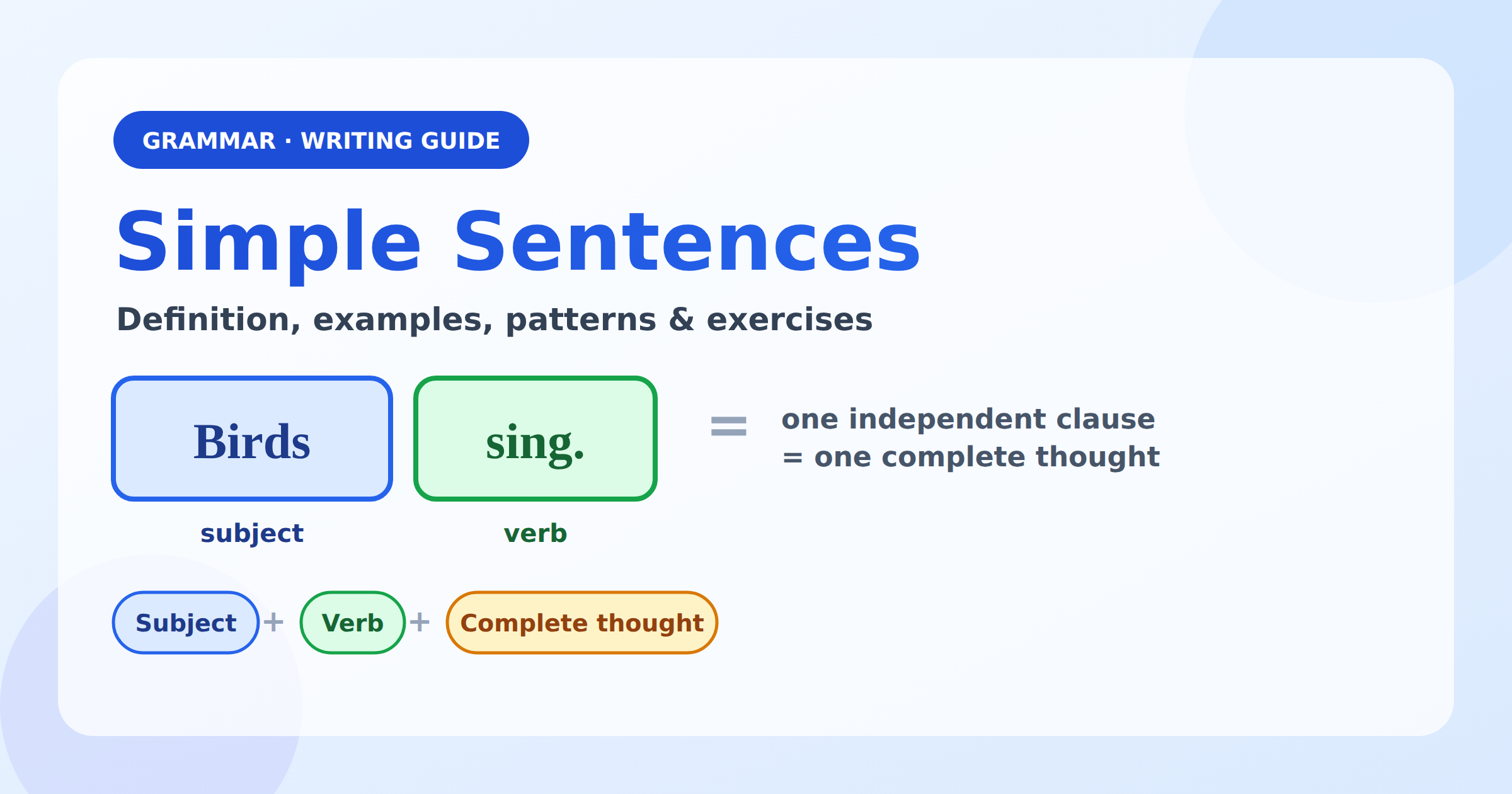
A simple sentence is a sentence made of one independent clause, a single subject and a single predicate that together express one complete thought, with no other independent or dependent clauses attached. Example: The dog barked. A simple sentence can have a compound subject (Sam and Mia laughed) or a compound verb (She cooked and cleaned) and still be simple, and it can be long. What makes it "simple" is that it contains exactly one independent clause and no subordinate clause.
Feature | Simple Sentence |
|---|---|
Independent clauses | Exactly 1 |
Dependent (subordinate) clauses | 0 |
Minimum parts | 1 subject + 1 verb + complete thought |
Can it have 2 subjects? | Yes (compound subject) |
Can it have 2 verbs? | Yes (compound verb) |
Can it be long? | Yes, length does not matter |
Example | Birds sing. / The tired hikers rested and drank water. |
Key Takeaways
A simple sentence is one independent clause with a subject, a verb, and a complete thought.
It contains no dependent clauses and no second independent clause.
"Simple" refers to structure, not length. A simple sentence can be long and detailed.
A simple sentence can have a compound subject (two or more subjects) and/or a compound verb (two or more verbs) and remain simple.
English simple sentences follow a handful of core patterns such as S + V, S + V + O, and S + V + C.
Commands (Sit down.) are simple sentences with an understood subject, "you."
Do not place a comma before and when it joins a compound verb sharing one subject. A comma there usually signals a different sentence type.
Overusing short simple sentences sounds choppy. Mixing sentence types makes writing flow.
What Is a Simple Sentence? (Full Definition)
A simple sentence consists of exactly one independent clause. An independent clause is a group of words that has at least one subject and at least one verb (predicate) and can stand alone as a complete sentence.
Put plainly, a simple sentence needs three things:
A subject: who or what the sentence is about.
A verb (predicate): what the subject does or is.
A complete thought: it makes sense on its own.
Examples:
She runs. (subject she + verb runs + complete thought)
The old clock stopped.
My brother is a nurse.
If any of those three ingredients is missing, you do not have a sentence at all. You have a fragment. And if you add a second independent clause or a dependent clause, you no longer have a simple sentence. You have a compound or complex one.
Subject and Predicate: The Two Halves of Every Simple Sentence
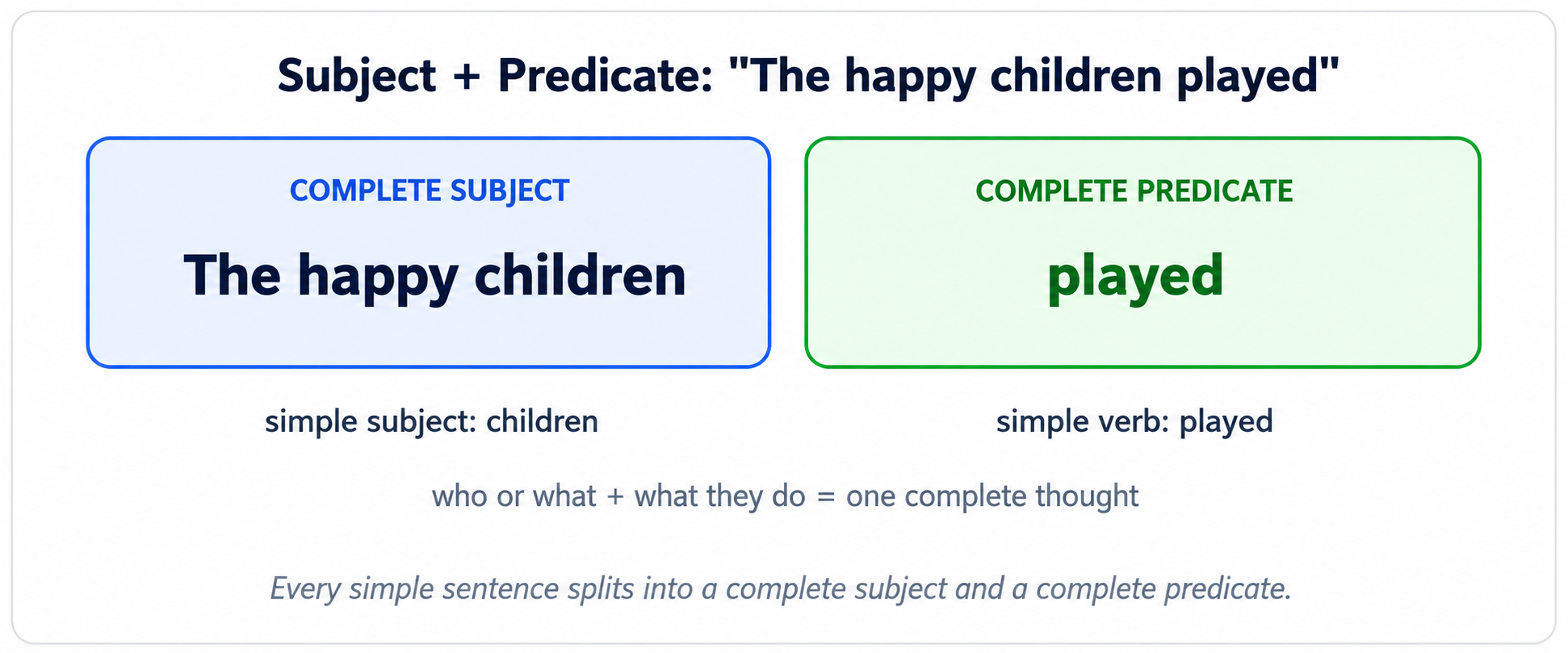
Every simple sentence divides into two parts:
Part | What it is | Example (in The tall player scored easily) |
|---|---|---|
Complete subject | The main noun/pronoun plus its modifiers | The tall player |
Complete predicate | The verb plus everything that completes it | scored easily |
The simple subject is the core noun or pronoun (player). The simple predicate is the main verb (scored). Being able to spot the true subject and verb is the single most useful skill for identifying, and for writing, simple sentences.
Pro tip for finding the real verb: test the word for tense. A true verb changes with time (scores, scored, will score). Words that look like verbs but cannot change tense on their own, such as infinitives (to score) and gerunds (scoring), are not the main verb of the clause. This trick, which comes from ESL grammar teaching, quickly separates the verb from look-alikes.
The Biggest Myth: "Simple" Does Not Mean "Short"
The most common mistake learners make is assuming a simple sentence must be brief. It doesn't. A simple sentence can be loaded with adjectives, adverbs, prepositional phrases, and objects and still be simple, as long as it keeps just one independent clause.
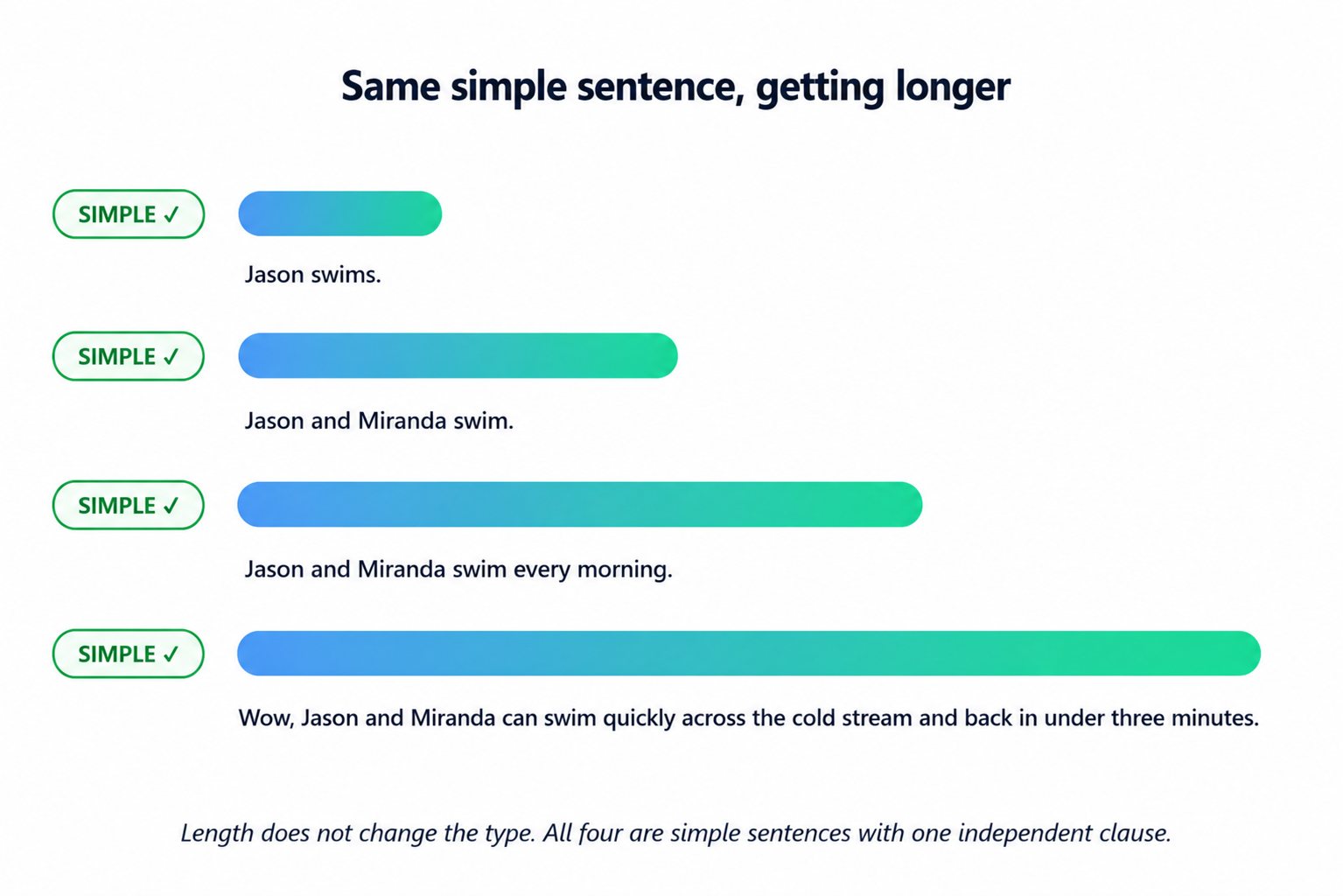
Watch a single simple sentence grow while staying simple:
Jason swims.
Jason and Miranda swim.
Jason and Miranda swim every morning.
Wow, Jason and Miranda can swim quickly across the cold stream and back in under three minutes.
That last sentence is long, has a compound subject and a compound verb, an interjection, adverbs, and prepositional phrases, yet it is still a simple sentence, because it contains exactly one independent clause and no subordinate clause.
Compound Subjects and Compound Verbs (Still Simple!)
A simple sentence is allowed to double up on subjects or verbs. This surprises people, so it deserves its own section.
Compound subject means two or more subjects sharing one verb:
Dogs and cats make good pets.
My mom, my dad, and my aunt arrived early.
Compound verb (compound predicate) means one subject performing two or more verbs:
She stood up and walked away.
The engine sputtered, coughed, and died.
Both at once means a compound subject and a compound verb, still one clause:
Ravi and Elena packed their bags and left for the airport.
The reason all of these stay simple is that there is still only one independent clause. No new subject-plus-verb unit is introduced that could stand as a separate sentence.
Core Structures of a Simple Sentence (Sentence Patterns)
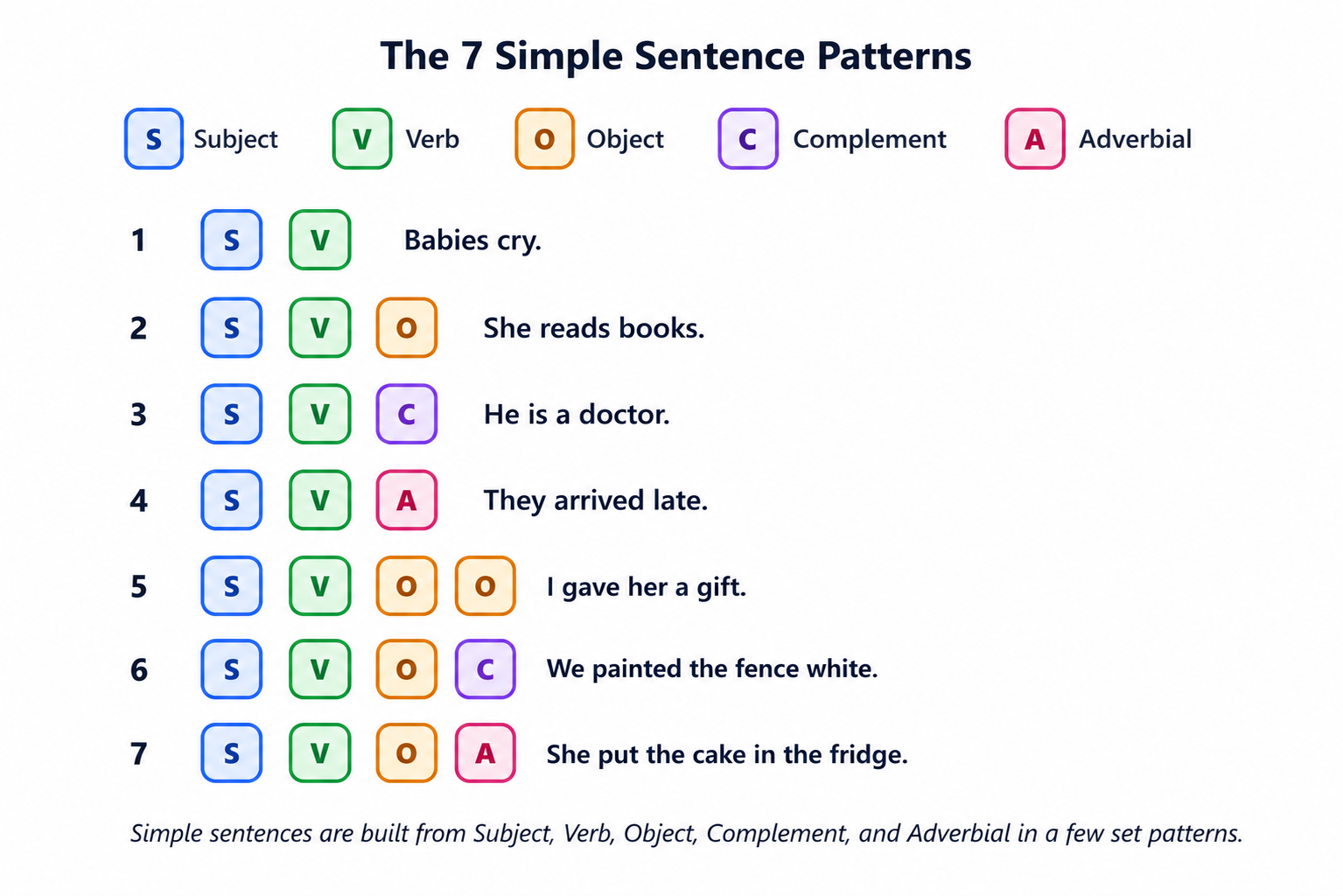
English simple sentences follow a small set of predictable patterns built from five building blocks: Subject (S), Verb (V), Object (O), Complement (C), and Adverbial (A). Learning the patterns helps you write with variety and understand how far a "simple" sentence can stretch. The British Council's reference on clause structure and verb patterns breaks these down further.
Pattern | Structure | Example |
|---|---|---|
1 | S + V | Babies cry. |
2 | S + V + Object | She reads books. |
3 | S + V + Subject Complement | He is a doctor. |
4 | S + V + Adverbial | They arrived late. |
5 | S + V + Indirect Object + Direct Object | I gave her a gift. |
6 | S + V + Object + Object Complement | We painted the fence white. |
7 | S + V + Object + Adverbial | She put the cake in the fridge. |
Quick glossary of the building blocks:
Subject: the doer or topic (She).
Verb: action or state (reads, is).
Object: receives the action; direct (books) or indirect (her).
Complement: completes the meaning of the subject (a doctor) or object (white).
Adverbial: adds time, place, manner, or reason (late, in the fridge).
Simple Sentence Examples (60+)
Below are ready-to-use examples grouped by verb tense and by pattern. Reading examples in context is the fastest way to get comfortable with the structure.
Present Simple
Water boils at 100 degrees Celsius.
She walks to school every day.
Dogs bark at strangers.
He doesn't like coffee.
The store opens at nine.
Birds build nests in spring.
Past Simple
The team won the match.
I lost my keys yesterday.
They painted the house last summer.
She forgot her umbrella.
The lights suddenly went out.
We visited our grandparents.
Future Simple
The train will arrive soon.
I will call you tonight.
It will rain tomorrow.
She won't attend the meeting.
They will announce the winner at noon.
Present Continuous
The baby is sleeping.
We are watching a movie.
He is fixing the car.
The kids are playing outside.
Past Continuous
She was reading in the garden.
They were arguing about money.
The phone was ringing all morning.
Present Perfect
I have finished my homework.
She has traveled to ten countries.
The company has hired new staff.
Examples With Compound Subjects
Tom and Jerry chased each other.
Rain and wind battered the coast.
The teacher and the students celebrated.
Examples With Compound Verbs
The cat stretched and yawned.
He opened the box and smiled.
She sang, danced, and laughed all night.
Longer (But Still Simple) Sentences
Before dawn, the exhausted marathon runner stretched her legs and jogged slowly toward the empty starting line.
The old fisherman and his young apprentice repaired their nets quietly on the misty wooden dock.
Downloadable resource suggestion: A free PDF of "100 Simple Sentence Examples by Tense" for teachers and ESL learners. Alt text: "Preview of a printable PDF listing 100 simple sentence examples organized by tense."
Commands, Questions, and Exclamations Can Be Simple Too
Simple sentences are not only statements. As long as there is one independent clause, the sentence type can vary:
Sentence purpose | Example | Notes |
|---|---|---|
Declarative (statement) | The sun set. | Standard subject + verb |
Imperative (command) | Close the door. | Subject "you" is understood |
Interrogative (question) | Did she leave? | Still one clause |
Exclamatory | What a beautiful view! | One clause, strong feeling |
Commands often look like they have no subject, but the subject is an implied "you" ([You] close the door.), which is why they still count as complete simple sentences.
Simple vs Compound vs Complex vs Compound-Complex
Simple sentences are one of four sentence structures. Knowing how they differ prevents the most common punctuation errors, comma splices and run-ons.
Sentence Type | Independent Clauses | Dependent Clauses | Example |
|---|---|---|---|
Simple | 1 | 0 | I finished the report. |
Compound | 2 or more | 0 | I finished the report, and I emailed it. |
Complex | 1 | 1 or more | After I finished the report, I emailed it. |
Compound-Complex | 2 or more | 1 or more | After I finished the report, I emailed it, and I logged off. |
The dividing line is clauses, not length. A compound sentence joins independent clauses with a coordinating conjunction (the FANBOYS: For, And, Nor, But, Or, Yet, So) and a comma. A complex sentence adds a dependent clause introduced by a subordinating conjunction (because, although, when, if, since, after, while). For a full walkthrough of all four types, see our guide to sentence structure, and Cambridge Dictionary's reference on clauses and sentences covers the underlying grammar.
Punctuation Rules for Simple Sentences
Simple sentences are usually easy to punctuate, but two rules cause most of the errors.
Rule 1: No comma before and in a compound verb. When one subject does two actions, do not separate them with a comma.
Correct: She grabbed her coat and ran out the door.
Incorrect: She grabbed her coat, and ran out the door.
The reason: ran out the door has no subject of its own, so this is one simple sentence, not two clauses. A comma before and here is a mistake.
Rule 2: A comma before and usually means you left "simple" behind. If both sides of and have their own subject and verb, you have a compound sentence and the comma is required.
Compound (comma needed): She grabbed her coat, and she ran out the door.
Watch for run-ons and comma splices. Joining two independent clauses with just a comma (She grabbed her coat, she ran out the door) is a comma splice. Fix it by making two simple sentences, adding a FANBOYS conjunction, or using a semicolon. Our paragraph correction guide shows how to fix run-ons, comma splices, and fragments in longer writing.
When (and When Not) to Use Simple Sentences
Simple sentences are useful well beyond beginner grammar.
Use simple sentences to:
Make a point land with impact. We lost.
Give clear instructions or steps.
Improve readability for younger or ESL audiences, who often start with simpler forms like CVCC words before building full sentences.
Slow the pace after several long sentences.
Avoid overusing them. A paragraph of nothing but short simple sentences reads choppy and childish:
I woke up. I ate breakfast. I went to work. I was tired.
Better, mix simple with other structures for rhythm:
I woke up and ate a quick breakfast. Because I had slept badly, I was already tired by the time I reached work.
Good writing varies sentence length and type. Simple sentences are one useful option among several, not the only tool you should reach for. A readability checker can flag writing that leans too hard on short sentences, and a list of paragraph starters helps you connect ideas smoothly.
Common Mistakes With Simple Sentences
Mistake | Wrong | Right | Why |
|---|---|---|---|
Thinking simple = short | (assuming The exhausted travelers finally reached the quiet mountain village at dusk is complex) | It is simple | One independent clause, no matter the length |
Comma before compound verb | He laughed, and clapped. | He laughed and clapped. | One subject, one clause |
Sentence fragment | Running down the street. | The boy was running down the street. | Needs a subject and finite verb |
Comma splice | It rained, we stayed inside. | It rained, so we stayed inside. | Two clauses need a conjunction |
Confusing compound subject with compound sentence | (calling Anna and Ben cooked dinner compound) | It is simple | Two subjects, but still one clause |
How to Write a Strong Simple Sentence (Step by Step)
Choose one clear subject. Decide who or what the sentence is about.
Add one finite verb. Make sure it shows tense.
Complete the thought. Add the object, complement, or adverbial the verb needs.
Check for one clause only. If you can split it into two stand-alone sentences, it is no longer simple.
Read it aloud. It should make full sense on its own.
Example walkthrough: subject The scientist, verb recorded, completion the results carefully, check that it is one clause, and you get The scientist recorded the results carefully. For more variety in how you open a sentence, browse these sentence starters.
Practice Exercises (With Answers)
Test your understanding. Answers follow each set. Tip: paste your own writing into the sentence counter or word counter to see how many sentences you are using and how long they run.
Exercise 1: Simple or Not?
Label each as Simple or Not simple.
The children laughed.
When the bell rang, the students left.
Priya and Sam built a sandcastle.
I was hungry, so I made a sandwich.
The dog barked and chased the ball.
Answers: 1. Simple 2. Not simple (complex, because it has a dependent clause) 3. Simple (compound subject) 4. Not simple (compound) 5. Simple (compound verb)
Exercise 2: Find the Subject and Verb
Identify the simple subject and simple verb.
The bright moon rose over the hills.
My two younger cousins visit every summer.
That old wooden bridge collapsed.
Answers: 1. subject moon, verb rose 2. subject cousins, verb visit 3. subject bridge, verb collapsed
Exercise 3: Fix the Punctuation
Correct any comma errors.
She picked up the phone, and answered it.
The runners stretched, and they warmed up.
Max cooked dinner, and washed the dishes.
Answers: 1. Remove the comma: She picked up the phone and answered it. (compound verb) 2. Correct as is (two independent clauses = compound) 3. Remove the comma: Max cooked dinner and washed the dishes.
Exercise 4: Build a Simple Sentence
Turn each set of words into one simple sentence.
teacher / explain / lesson
birds / fly / south / winter
Leo and Zoe / win / race
Sample answers: 1. The teacher explained the lesson. 2. Birds fly south in winter. 3. Leo and Zoe won the race.
Interactive element suggestion: Embed a 10-question auto-graded quiz ("Is it a simple sentence?") with instant feedback. Alt text: "Interactive quiz widget for identifying simple sentences."
Simple Sentences Checklist
Use this quick checklist before calling a sentence "simple":
Does it have at least one subject?
Does it have at least one finite verb (with tense)?
Does it express one complete thought?
Does it contain exactly one independent clause?
Is it free of dependent clauses (no because, when, although, if…)?
If it has and/but/or, do both sides NOT have their own subject-verb pair? (If they do, it is compound, not simple.)
If every box is checked, you have a simple sentence.
A simple sentence does a lot with a little. It is one independent clause, one subject, one verb, one complete thought, and nothing more, yet it can carry compound subjects, compound verbs, plenty of modifiers, and real length while staying simple. Once you can reliably spot the single independent clause, you can punctuate correctly, avoid run-ons and comma splices, and choose the right sentence type for the effect you want.
Start by writing clean simple sentences, then mix in compound and complex ones so your writing does not feel flat. Clear simple sentences plus variety from the other types is what good writing usually comes down to.
Frequently Asked Questions
What is a simple sentence in simple terms?
A simple sentence is one complete idea built from a single subject and a single verb that can stand on its own, such as The bell rang. It has one independent clause and no other clauses.
Can a simple sentence have two verbs?
Yes. A simple sentence can have a compound verb, one subject doing two or more actions, and still be simple, as in She laughed and cried. There is still only one independent clause.
Can a simple sentence have two subjects?
Yes. Two or more subjects sharing one verb form a compound subject, and the sentence stays simple: Tom and Jerry ran.
Can a simple sentence be long?
Absolutely. Length has nothing to do with it. The determined young athlete trained hard every single morning before sunrise is long but simple, because it is one independent clause.
Is a command a simple sentence?
Usually, yes. A command like Close the window. is a simple sentence with an understood subject, "you."
What is the difference between a simple and a compound sentence?
A simple sentence has one independent clause. A compound sentence has two or more independent clauses joined by a coordinating conjunction (FANBOYS) and a comma, or by a semicolon. I ran. is simple; I ran, and I won. is compound.
How many clauses does a simple sentence have?
Exactly one, a single independent clause, and zero dependent clauses.
What are the 7 sentence patterns of a simple sentence?
The common patterns are S + V, S + V + Object, S + V + Subject Complement, S + V + Adverbial, S + V + Indirect Object + Direct Object, S + V + Object + Object Complement, and S + V + Object + Adverbial.
Do you use a comma in a simple sentence?
Sometimes, for items in a list, after an introductory word, or around extra information. But you should not put a comma before and when it simply joins two verbs that share one subject.
Why are simple sentences important?
They deliver ideas clearly and with force, help beginners and ESL learners build confidence, and give experienced writers a way to control pace and emphasis. They are also the building block for every more complicated sentence type.