How to Write Hello in Korean: 안녕하세요 Letter by Letter
Learn how to write hello in Korean as 안녕하세요. See each Hangul letter, correct stroke order, keyboard keys, pronunciation, and formality levels.
Most guides tell you how to say hello in Korean. Almost none show you how to actually write it: which letters go where, in what order, and why the word looks like five syllable blocks instead of a row of letters. This guide fixes that.
Quick Answer
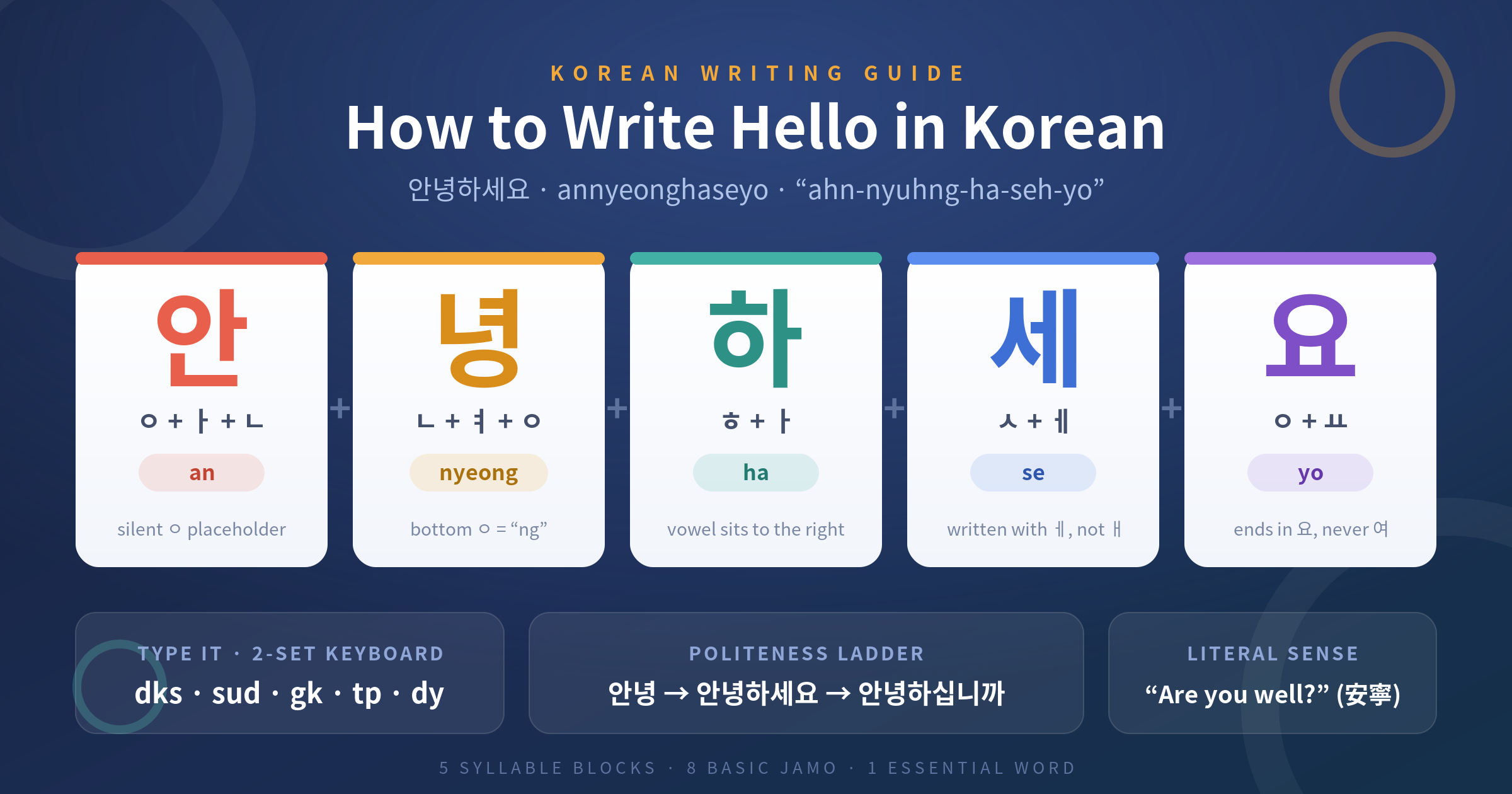
Hello in Korean is written 안녕하세요 (romanized: annyeonghaseyo, pronounced approximately ahn-nyuhng-ha-seh-yo). It is built from five syllable blocks: 안 + 녕 + 하 + 세 + 요. The casual form is 안녕 (annyeong), and the most formal version is 안녕하십니까 (annyeonghasimnikka). When in doubt, use 안녕하세요; it is the safe default in most everyday face-to-face situations.
Copy-paste versions:
Formality | Korean | Romanization | Use with |
|---|---|---|---|
Standard polite ✅ | 안녕하세요 | annyeonghaseyo | Most people: your safe default |
Casual | 안녕 | annyeong | Close peers, children, and people with whom you have an established casual relationship |
Formal | 안녕하십니까 | annyeonghasimnikka | Job interviews, announcements, military settings |
Common phone opener | 여보세요 | yeoboseyo | Answering or opening a phone call |
The English word “hello” can also be transliterated as 헬로, but the natural Korean greeting is 안녕하세요.
Now let’s learn to write it yourself, by hand and on a keyboard, in about 15 minutes.
What 안녕하세요 Actually Means?
안녕하세요 is not a direct translation of “hello.” It is commonly understood literally as “Are you well?” or “Are you at peace?”
안녕하다 means to be well, peaceful, healthy, or free from trouble. It comes from the Sino-Korean word 安寧 (安 = peace or safety, 寧 = tranquility).
Grammatically, 안녕하세요 can be analyzed as:
안녕하- + -시- + -어요 → 안녕하세요
The honorific -시- shows respect toward the person being addressed, while -어요 contributes the polite conversational ending. In modern Korean, however, 안녕하세요 functions as a conventional greeting. Speakers are not necessarily making a literal inquiry about someone’s well-being every time they use it.
A common reply is simply 안녕하세요 back, or 네, 안녕하세요 (“Yes, hello”).
How Korean Writing Works?
Korean is written in Hangul (한글), an alphabet with 14 basic consonants and 10 basic vowels, for 24 basic letters in modern use. King Sejong completed the original writing system in 1443, and it was promulgated in 1446 under the name Hunminjeongeum. The original system had 28 letters, four of which are no longer used in modern Korean.
Unlike English, Hangul letters do not simply sit in one long row. They combine into syllable blocks, with one block for each syllable:
Romanized: a-n-n-y-e-o-n-g-h-a-s-e-y-o: 14 Latin characters
Hangul: 안 · 녕 · 하 · 세 · 요: 12 jamo arranged in 5 syllable blocks
Each block follows one of two patterns:
C + V (consonant + vowel): 하 = ㅎ + ㅏ
C + V + C (with a final consonant, called batchim 받침): 안 = ㅇ + ㅏ + ㄴ
Spoken Korean syllables can begin with a vowel sound, but every written Hangul block requires a letter in the initial consonant position. When a syllable begins with a vowel sound, the silent placeholder ㅇ fills that position. That is why 안 starts with a circle even though you do not hear it.
💡 The ㅇ rule in one line: ㅇ at the start of a block is usually silent. ㅇ in the final position makes the “ng” sound. The word 안녕 demonstrates both uses.
How to Write 안녕하세요 Step by Step
Here is every block broken down into its individual letters (jamo):
Block | Letters | Sounds | How it assembles |
|---|---|---|---|
안 (an) | ㅇ + ㅏ + ㄴ | silent + “a” + “n” | ㅇ top-left, ㅏ to its right, ㄴ underneath |
녕 (nyeong) | ㄴ + ㅕ + ㅇ | “n” + “yeo” + “ng” | ㄴ top-left, ㅕ to its right, ㅇ underneath |
하 (ha) | ㅎ + ㅏ | “h” + “a” | ㅎ left, ㅏ right |
세 (se) | ㅅ + ㅔ | “s” + “e” | ㅅ left, ㅔ right |
요 (yo) | ㅇ + ㅛ | silent + “yo” | ㅇ on top, ㅛ underneath |
Notice the layout logic: vertical vowels (ㅏ, ㅕ, ㅔ) go to the right of the consonant; horizontal vowels (ㅛ) go below it. This is why 하 is side-by-side but 요 is stacked.
Step-by-Step Writing Practice
Write 안: Draw the circle ㅇ in one counterclockwise stroke, starting at the top. Add ㅏ to the right: draw the vertical line first, then the short horizontal stroke. Finish with ㄴ underneath: down, then across.
Write 녕: Draw ㄴ: down, then right. Add ㅕ beside it: draw the two short horizontal strokes first, then the long vertical line. Place ㅇ at the bottom.
Write 하: Draw ㅎ: the short top stroke, the second horizontal stroke, then the circle. Add ㅏ to the right.
Write 세: Draw ㅅ: the left-falling stroke, then the right-falling stroke. Add ㅔ: the first vertical line, the short horizontal stroke, then the second vertical line.
Write 요: Draw ㅇ on top. Below it, write ㅛ: the two short vertical strokes first, then the long horizontal base line.
Hangul Stroke Order Rules (All You Need for This Word)
Stroke order in Korean is not as rigid as it is in Chinese, but following it makes your handwriting more legible and natural:
Top to bottom: upper strokes before lower strokes
Left to right: left strokes before right strokes
Outside before inside for enclosing shapes
ㅇ is one counterclockwise stroke starting from the top
Handwriting Checklist
Each syllable block fits in an imaginary square, and the blocks are roughly equal in size.
안 and 녕 have their final consonants underneath, not beside the other letters.
The ㅇ in 요 sits on top of ㅛ, not next to it.
You wrote ㅔ in 세, not ㅐ. Both letters contain two vertical lines, but in ㅔ the short stroke attaches to the right-hand vertical line and points left; in ㅐ it attaches to the left-hand vertical line and points right.
The word ends in 요, not 여.
How to Type 안녕하세요 (Phone and Computer)
Handwriting is great practice, but most real Korean writing today happens on a keyboard. Korean commonly uses the 2-set (두벌식) layout: consonants are mainly on the left half of the keyboard, and vowels are mainly on the right. You type the letters in sequence, and the software assembles the blocks.
QWERTY key sequence for 안녕하세요:
Syllable | Korean letters | QWERTY keys |
|---|---|---|
안 | ㅇ ㅏ ㄴ | d k s |
녕 | ㄴ ㅕ ㅇ | s u d |
하 | ㅎ ㅏ | g k |
세 | ㅅ ㅔ | t p |
요 | ㅇ ㅛ | d y |
So the full word is typed: dkssudgktpdy
To set up a Korean keyboard:
iPhone: Settings → General → Keyboard → Keyboards → Add New Keyboard → Korean
Android with Gboard: Open Gboard settings → Languages → Add keyboard → Korean
Windows: Settings → Time & language → Language & region → Add a language → Korean
Mac: System Settings → Keyboard → Text Input → Edit → Add → Korean
Typing the word repeatedly is a useful way to strengthen your memory of its spelling.
The 5 Most Common Mistakes When Writing Hello in Korean
These mistakes appear frequently among Korean learners:
Writing 안녕하세여 instead of 안녕하세요. You may see 하세여 in casual online writing because it imitates a cute or informal pronunciation, but it is nonstandard. The correct spelling ends in 요.
Writing 않녕 instead of 안녕. The block 않 contains the complex final consonant ㄶ and belongs in words such as 않다 (“to not do”). Hello uses the simple final ㄴ: 안녕.
Confusing ㅐ and ㅔ in 세. Many contemporary speakers pronounce these vowels similarly, but their spellings remain different. Hello is written with ㅔ: 세, never 새.
Putting the final consonant beside the block instead of under it. 안 must have ㄴ underneath. Writing the letters separately as ㅇㅏㄴ does not form a standard syllable block.
Worrying about romanization variants. You may see annyeonghaseyo, annyeong haseyo, and anyoung haseyo online. The official Revised Romanization is annyeonghaseyo, but the Korean spelling is always 안녕하세요.
Which “Hello” Should You Write? (Politeness Decision Framework)
Korean has several speech levels, and using the wrong one can sound overly casual or unnecessarily stiff. Use this three-question framework:
Is the person older, senior, or a stranger? → Write 안녕하세요. This is the polite standard (haeyo-che) used in shop interactions, first meetings, messages to acquaintances, and conversations with people you do not know well.
Is the context official or highly formal, such as an announcement, formal presentation, military setting, or especially formal interview? → Write 안녕하십니까. This belongs to the deferential hasipsio-che level and can feel stiff in ordinary conversation.
Do you already have an established casual relationship? → 안녕 may be appropriate. Being the same age or younger does not automatically make casual speech acceptable; the relationship and agreed speech level matter.
In texting between close friends, Koreans may use even more casual forms:
Text slang | Meaning |
|---|---|
하이 (hai) | “Hi,” borrowed from English |
ㅎㅇ | Initials of 하이, extremely casual texting |
안뇽 (annyong) | A cute, nonstandard spelling of 안녕 |
⚠️ Do not use these slang forms with teachers, elders, strangers, or in professional communication.
Phone context: 여보세요 is the conventional opener when answering or beginning a phone call. It is not an absolute replacement for every greeting during the call; after the caller is identified, 안녕하세요 may also be used naturally.
Goodbye: 안녕 can mean either casual “hi” or casual “bye.” Context makes the meaning clear.
Why This Word Is Worth Mastering?
안녕하세요 uses eight of Hangul’s 24 basic letters: ㅇ, ㅏ, ㄴ, ㅕ, ㅎ, ㅅ, ㅔ, and ㅛ. It also demonstrates vertical and horizontal block layouts, both the silent and final uses of ㅇ, and two examples of batchim in 안 and 녕.
Learning to write this one greeting therefore gives you useful practice with several of Hangul’s core mechanics without relying on unsupported claims about how much of the alphabet one word can teach.
Practice Plan: Learn to Write It in 15 Minutes
Minutes 1–3: Copy the five blocks 안 · 녕 · 하 · 세 · 요 three times each on grid paper, saying each syllable aloud.
Minutes 4–6: Write the whole word five times without looking at the model.
Minutes 7–10: Add a Korean keyboard to your phone and type 안녕하세요 ten times using dkssudgktpdy.
Minutes 11–13: Write 안녕 and 안녕하십니까 twice each so you can produce all three politeness levels.
Minutes 14–15: Check your writing against the handwriting checklist above: especially 요 versus 여 and ㅔ versus ㅐ.
Repeating this practice once a day for three days can strengthen your recall of the spelling.
Hello in Korean is 안녕하세요: five syllable blocks commonly understood literally as “Are you well?” or “Are you at peace?” Write it by combining letters into square blocks, placing final consonants underneath, and using the silent ㅇ in the initial position of a vowel-starting syllable. Always end the standard spelling with 요, not 여.
Use 안녕하세요 as your everyday polite default, 안녕 only where an established casual relationship makes it appropriate, and 안녕하십니까 in highly formal settings. Short handwriting and keyboard practice can strengthen your spelling while introducing several important Hangul mechanics.
Frequently Asked Questions
How do you write hello in Korean?
Hello in Korean is written 안녕하세요 (annyeonghaseyo). It consists of five syllable blocks, 안, 녕, 하, 세, 요, built from 12 individual jamo.
What does 안녕하세요 literally mean?
It is commonly understood literally as “Are you well?” or “Are you at peace?” It comes from 안녕하다, meaning to be well, peaceful, healthy, or free from trouble, plus honorific and polite grammatical elements. In modern usage, it functions as a conventional greeting.
Is it annyeong or annyeonghaseyo?
Both are correct, but they differ in politeness. 안녕 (annyeong) is casual and should be used only when an established casual relationship makes it appropriate. 안녕하세요 (annyeonghaseyo) is the polite standard for most other everyday situations.
How do you spell annyeonghaseyo in English letters?
The official Revised Romanization is annyeonghaseyo. You may also see informal variants online, but they represent the same Korean greeting, 안녕하세요.
Is 안녕하세여 correct?
No. 안녕하세여 is a casual, nonstandard online spelling. The standard spelling ends in 요: 안녕하세요.
How do you respond to 안녕하세요?
You can simply say 안녕하세요 back. 네, 안녕하세요 (“Yes, hello”) is also natural.
How do you say hello on the phone in Korean?
여보세요 (yeoboseyo) is the conventional expression used when answering or opening a phone call. 안녕하세요 can still be used later in the conversation.
Does 안녕 also mean goodbye?
Yes. Among people who use casual speech with one another, 안녕 can mean both “hi” and “bye.” Context determines which meaning is intended.
Is stroke order important when writing Korean?
It is less rigid than Chinese stroke order, but using the conventional order generally makes Hangul handwriting more consistent and legible.
How do I type 안녕하세요 on an English keyboard?
Add a Korean 2-set keyboard in your device settings, then press d-k-s-s-u-d-g-k-t-p-d-y. The software assembles the letters into syllable blocks.
References
National Institute of Korean Language. Korean-Foreign Language Learners’ Dictionary: 안녕하다.
National Institute of Korean Language. 안녕하세요 형태소 분석.
National Institute of Korean Language. Romanization of Korean.
National Hangeul Museum. Permanent Exhibition: The Creation and Principles of Hangeul.
Korea Heritage Service. Hunminjeongeum Manuscript: Memory of the World.
University of British Columbia, Korean Language and Culture. How to Write Korean.
University of British Columbia, Korean Language and Culture. The Vowels.
Apple Support. Add or Change Keyboards on iPhone.
Google Gboard Help. Type in a Different Language.
Microsoft Support. Manage the Language and Keyboard/Input Layout Settings in Windows.
Apple Support. Write in Another Language on Mac.