100+ Literary Devices With Examples: (The Complete Guide)
100+ literary devices with clear examples, neatly categorized. Learn to spot, analyze & use each one, plus a free cheat sheet, quiz, and AP/GCSE exam guide.
You have almost certainly used a literary device today, probably several, without naming a single one. When you called a long meeting "a marathon," told a friend you'd "died laughing," or noticed a headline built on three drumbeat repetitions, you were reading and using the exact tools this guide catalogs.
The problem is that most online lists treat literary devices like flashcards to be memorized and forgotten. They give you a definition, a recycled example, and move on. That is why you can label a metaphor on a quiz but freeze when a teacher asks "So what? What does it actually do?", and why writers can name a hundred devices yet still can't decide which one a scene needs.
This guide is built to fix that. It gives you more than 100 literary devices with clear examples, organized into families instead of a flat A-to-Z wall of terms. But it also does what the top-ranking pages leave out: it untangles the words people constantly confuse (device vs. technique vs. figurative language), it hands you repeatable frameworks for spotting and analyzing devices, and it answers the questions students actually argue about, including the famous "the curtains are just blue" objection to literary analysis.
What Are Literary Devices?
Literary devices are techniques and tools writers use to convey meaning, evoke emotion, and add depth beyond the literal words on the page. Common examples include metaphor, simile, personification, imagery, symbolism, foreshadowing, alliteration, and irony.
If you only have two minutes, here are the twelve most common literary devices with examples:
Literary Device | One-Line Definition | Example |
|---|---|---|
Metaphor | A direct comparison stating one thing is another | "All the world's a stage" (Shakespeare, As You Like It) |
Simile | A comparison using like or as | "As brave as a lion" |
Personification | Giving human traits to non-human things | "The wind whispered through the trees" |
Imagery | Vivid language that appeals to the five senses | "The crimson sky bled into the dusk" |
Symbolism | An object or image that stands for a larger idea | The green light in The Great Gatsby |
Foreshadowing | Hints that prepare the reader for what's to come | The witches' prophecy in Macbeth |
Alliteration | Repetition of initial consonant sounds | "Peter Piper picked a peck of pickled peppers" |
Hyperbole | Deliberate, obvious exaggeration | "I've told you a million times" |
Irony | A gap between expectation and reality | A fire station burning down |
Allusion | A brief reference to another work, person, or event | "He was a real Romeo with the ladies" |
Onomatopoeia | A word that imitates a sound | buzz, hiss, clang, splash |
Oxymoron | Two contradictory words placed together | "deafening silence," "bittersweet" |
Keep reading for the full, categorized catalog, plus the parts almost every other guide skips.
The Big Confusion, Cleared Up
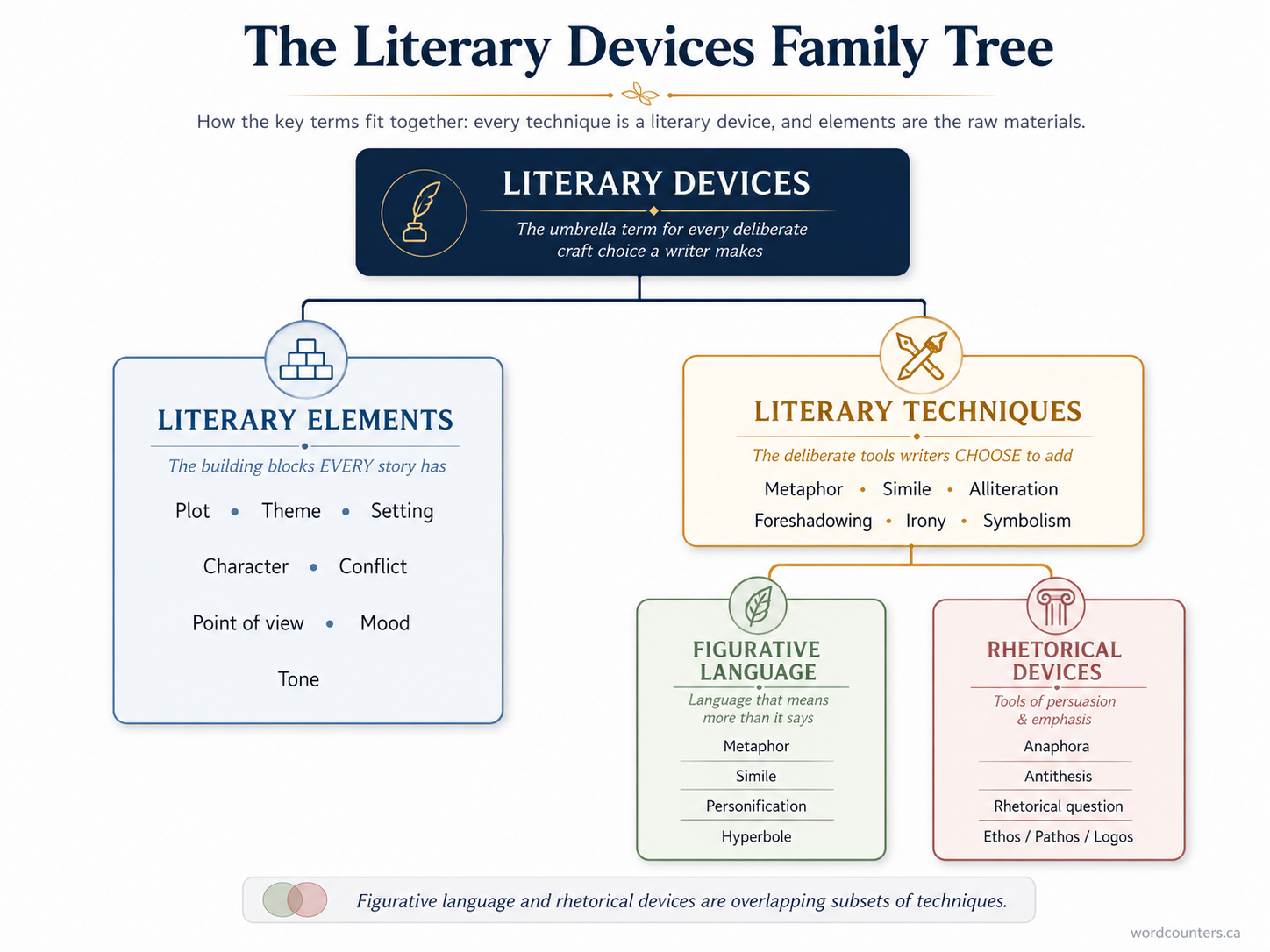
Before the catalog, let's fix the single most common source of confusion, the one nearly every competing article glosses over. People constantly mix up five terms: literary device, literary technique, literary element, figurative language, and rhetorical device. They overlap, which is exactly why they're confusing. Here's the clean version.
The one-sentence hierarchy
"Literary device" is the umbrella term. Everything else is either a type of literary device or a category within it.
Think of it as a family tree:
Definitions that actually distinguish them
Literary devices (the umbrella). Any technique a writer uses to produce a specific effect, from a single-word pun to the structure of an entire novel. Every other term on this list is a kind of literary device.
Literary elements are the components every narrative contains whether the author thinks about them or not, plot, character, setting, theme, conflict, point of view, mood, and tone. You don't "add" a plot the way you add a metaphor; the story has one by definition. Elements answer "What is this story made of?"
Literary techniques are the deliberate, optional choices a writer makes to shape those elements, metaphor, foreshadowing, irony, flashback, symbolism. Techniques answer "What did the writer choose to do?" A story must have a setting (element); the writer chooses to describe it with personification (technique).
Figurative language is a subset of techniques: language that means something different from, or beyond, its literal definition. Metaphor, simile, personification, hyperbole, metonymy, and idiom are all figurative language. If the words aren't literally true but communicate something real ("time flies"), that's figurative language.
Rhetorical devices are techniques aimed primarily at persuading, emphasizing, or moving an audience rather than telling a story, anaphora, antithesis, the rhetorical question, and the classical appeals ethos, pathos, and logos. They dominate speeches, essays, and advertising. Many overlap with literary devices (a metaphor can be both), but rhetoric's job is influence, not narrative.
The 10-second test
Ask yourself one question about the term you're looking at:
Is it something every story automatically has (plot, theme, tone)? → Literary element.
Is it a choice the writer made for effect (foreshadowing, irony)? → Literary technique / device.
Does the language mean more than it literally says (a metaphor, an idiom)? → Figurative language.
Is its main job to persuade or emphasize for an audience (anaphora, a rhetorical question)? → Rhetorical device.
Not sure which sub-type? → It's still a literary device. You're safe.
Bottom line: All figurative language and all rhetorical devices are literary devices. All literary techniques are literary devices. Literary elements are the raw materials; techniques are what you do with them. When in doubt, "literary device" is never wrong.
How Many Literary Devices Are There?
There is no official, fixed number of literary devices, and any article that gives you a hard count is choosing where to draw the line. Rhetoricians in ancient Greece and Rome had already named hundreds of figures of speech two thousand years ago; modern glossaries typically catalog somewhere between 30 and 200+, depending on how finely they slice the categories and whether they count narrative structures, sound patterns, and rhetorical figures separately.
Here's the honest, practical answer to the question you're really asking: "How many do I actually need to know?"
If you are… | Devices worth mastering | Why |
|---|---|---|
A middle/early high school student | ~15-20 core devices | The recurring set: metaphor, simile, personification, imagery, symbolism, foreshadowing, alliteration, hyperbole, irony, onomatopoeia, allusion, oxymoron, repetition, mood, theme |
A GCSE / SAT / AP Lit student | ~30-40 devices | The core set plus rhetorical and structural devices examiners reward (anaphora, juxtaposition, dramatic irony, motif, tone, extended metaphor, the three ironies) |
A serious writer or English major | 50+ devices | You want range, including wordplay, poetic sound devices, and narrative structures you can deploy deliberately |
A completist / this guide | 100+ devices | Full reference coverage, so nothing you encounter in a text is a mystery |
The trap to avoid: collecting terms like trading cards. Teachers and researchers consistently find that memorizing long lists in isolation produces poor retention and "surface-level" analysis: students can name the device but not explain its effect. It is far better to deeply know 20 devices (what they do, how to spot them, how to use them) than to vaguely recognize 150. This guide is organized so you can go deep on the essentials and use the rest as a lookup reference.
Why Writers Use Literary Devices?
Literary devices are not decoration. They are the difference between telling you something and making you feel it. "She was sad" is information; "She moved through the house like a ghost of herself" is an experience. Every device in this guide exists to do one or more of these six jobs:
To show, not tell, creating vivid sensory experience. Imagery, metaphor, and simile let readers see, hear, and feel a scene instead of being told about it.
To compress meaning. A single symbol (the green light in Gatsby) can carry an idea it would take a paragraph to explain.
To evoke emotion. Hyperbole amplifies, understatement lets the reader supply the feeling, and pathos aims straight at the heart.
To create rhythm, music, and memorability. Alliteration, assonance, and parallelism make language pleasurable to read aloud and hard to forget, which is why slogans and speeches lean on them.
To build structure and suspense. Foreshadowing, flashback, and dramatic irony control what the reader knows and when, turning information into tension.
To persuade and emphasize. Anaphora, antithesis, the rhetorical question, and the appeals of ethos, pathos, and logos bend an audience toward a point of view.
Why this still matters in 2025-2026?
It would be easy to assume that in the age of AI writing tools, understanding craft is obsolete. The data points the other way.
Reading is getting harder to hold onto. In the U.S., 2024 NAEP results showed roughly 40% of fourth-graders scored below the Basic reading level, the largest share since 2002, and eighth-grade reading also declined. Meanwhile, the 2023 international adult-skills assessment (PIAAC) found the share of U.S. adults at the lowest literacy tier rose from 19% to 28%. Reading for pleasure is falling too: a 2024 National Literacy Trust survey of over 76,000 UK children found only 34.6% enjoyed reading in their free time, the lowest level since 2005. In that environment, the ability to read closely and analytically is a genuine advantage, not a school formality.
Literary analysis is still high-stakes and growing. In 2025, 416,531 students sat the AP English Literature & Composition exam (up from 389,272 in 2024), and over 623,000 took GCSE English Literature in England in 2024. Facility with literary devices is directly tested on both.
What high performers actually do. A 2025 study in The Australian Educational Researcher analyzing top-scoring student narratives found that the strongest young writers packed their writing with figurative language, Year 5 high-achievers used devices at roughly 34 per 100 words, building imagery and tension "beyond what the rubrics explicitly rewarded." Command of devices correlates with stronger writing, not weaker.
AI raises the value of judgment, not lowers it. A 2025 Pew survey found 26% of U.S. teens now use ChatGPT for schoolwork (double the prior year), yet most drew a line at having it write their essays. As generation becomes cheap, the human skill that stays scarce is knowing why a passage works and whether a choice actually lands. That is exactly what literary devices train you to see.
The takeaway: whether you're decoding a poem for an exam, drafting a novel, or just trying to read the world more sharply, knowing these tools is a durable skill. Here's the full toolkit.
The Full Catalog: 100+ Literary Devices by Category
Instead of an overwhelming alphabetical wall, the devices below are grouped into seven families so you can build a mental map. The most important devices in each family get full treatment, definition, a real example from literature, why it works, how to use it, how to spot it, and what it's commonly confused with. The rest are cataloged with a crisp definition and example so you have a complete reference.
The seven families:
Figurative Language & Comparison, language that means more than it literally says
Sound & Poetic Devices, how language works on the ear
Imagery & Description, appealing to the senses
Narrative & Structural Devices, how a story is built and paced
Rhetorical & Persuasive Devices, tools of emphasis and persuasion
Wordplay, Wit & Irony, devices that turn on double meaning and contradiction
Character, Theme & Meaning Devices, the big-picture architecture of significance
1. Figurative Language & Comparison Devices
Figurative language means more than it literally says. This is the largest and most-tested family, if you master one group, make it this one.
Metaphor
What it is: A direct comparison that says one thing is another, transferring the qualities of one onto the other. No "like" or "as."
Example: "But soft, what light through yonder window breaks? It is the east, and Juliet is the sun." (Shakespeare, Romeo and Juliet). Juliet doesn't shine or resemble the sun; Romeo declares she is it.
Why it works: A metaphor forces two unlike ideas to fuse, so the reader understands the first thing through the second. Calling Juliet "the sun" makes her the source of light, warmth, and life in Romeo's world in four words.
How to use it (writers): Reach for a metaphor when a plain description feels flat. Pick a comparison whose associations match the feeling you want, comparing grief to "a stone in the chest" evokes weight and permanence; "a wound" evokes rawness. Avoid clichés ("a heart of gold") and mixed metaphors ("we'll burn that bridge when we cross it").
How to spot it (students): Look for an unexpected equation of two unlike things where the writer isn't being literal. Test: could you insert "is literally"? If "Juliet is literally the sun" is false but meaningful, it's a metaphor.
Often confused with: Simile (uses like/as), symbol (an image standing for an idea across a whole work), and analogy. See the comparison section.
Memory hook: Metaphor = a "transfer" (Greek metapherein, "to carry across"). It carries meaning across from one thing to another with no bridge word.
Simile
What it is: A comparison of two unlike things using an explicit connective, usually like, as, than, or resembles.
Example: "O my Luve is like a red, red rose / That's newly sprung in June." (Robert Burns). The love resembles the rose; it is not claimed to be one.
Why it works: Because the comparison is signposted, a simile can be more elaborate and precise than a metaphor without confusing the reader. It invites them to hold both images side by side.
How to use it (writers): Similes are ideal when you want the reader to consciously picture the comparison. Make the second half do work, "quiet as a library" is dull; "quiet as a held breath" adds tension. Fresh similes are a fast way to establish voice.
How to spot it (students): Find the connective word (like, as…as, than) linking two different things. "As tall as a giraffe", simile. But beware: not every "like" is a simile ("I feel like leaving" is not a comparison).
Often confused with: Metaphor (no connective word). The line between them is exactly that word.
Memory hook: Simile → think "similar," and both contain an "l" like the word "like."
Personification
What it is: Giving human qualities, emotions, or actions to non-human things, animals, objects, ideas, or nature.
Example: "Because I could not stop for Death – / He kindly stopped for me." (Emily Dickinson). Death becomes a courteous gentleman caller who drives a carriage.
Why it works: It makes the abstract or inanimate relatable and emotionally charged. A "kind" Death is far less frightening than a skeleton, which is exactly Dickinson's unsettling point.
How to use it (writers): Use it to inject life into settings and to smuggle emotion into description, "the house sulked behind its overgrown hedge" tells us the mood without naming it. A little goes a long way; constant personification turns purple fast.
How to spot it (students): Find a non-human subject performing a human action or holding a human feeling. "The storm raged," "opportunity knocked," "the flowers danced."
Often confused with: Anthropomorphism (a non-human character actually behaves as human throughout, like the pigs in Animal Farm) and pathetic fallacy (nature reflecting human mood).
Memory hook: Person-ification literally makes something into a person.
Hyperbole
What it is: Deliberate, obvious exaggeration for emphasis or effect, never meant to be taken literally.
Example: "I had to wait in the station for ten days, an eternity." (Joseph Conrad, Heart of Darkness). Ten days is not eternity; the exaggeration conveys unbearable tedium.
Why it works: By overshooting the truth, hyperbole communicates the intensity of a feeling more accurately than a literal statement could. "I'm starving" tells you more about impatience than "I'm somewhat hungry."
How to use it (writers): Great for comedy, voice, and conveying strong emotion. In dialogue it characterizes a speaker as dramatic or passionate. Keep it clearly non-literal so it reads as emphasis, not error.
How to spot it (students): Find a claim that is obviously, knowingly untrue and exaggerated. "This bag weighs a ton," "I've told you a million times."
Often confused with: Its opposite, understatement/litotes, and with a simple lie (hyperbole is understood by both sides as exaggeration).
Memory hook: Hyper- = "over/beyond" (as in hyperactive). Hyperbole goes over the top.
Symbolism
What it is: Using an object, image, color, or action to represent a larger abstract idea or theme throughout a work.
Example: The green light at the end of Daisy's dock in F. Scott Fitzgerald's The Great Gatsby symbolizes Gatsby's unreachable dream and the broader illusion of the American Dream. The conch shell in Golding's Lord of the Flies symbolizes civilization and order, and its shattering marks their collapse.
Why it works: A symbol lets a writer make an abstract theme physical and repeatable. Every time the object reappears, the theme is reinforced without a word of explanation.
How to use it (writers): Plant an object early, associate it with an idea through context, then let it recur at meaningful moments. The best symbols also work perfectly well on the literal level, a green light is just a green light until the story teaches you to read it.
How to spot it (students): Look for a concrete thing that gets disproportionate attention or recurs at emotionally charged moments. Ask: does the text keep returning to this object? Does it appear at turning points? (See the Blue Curtains Test for how to be sure you're not over-reading.)
Often confused with: Motif (a recurring image/idea that builds toward a theme), allegory (an entire narrative that's symbolic), and metaphor (a single, local comparison).
Memory hook: A symbol is a stand-in, a small thing standing in for a big idea.
Metonymy
What it is: Referring to something by the name of a closely associated thing rather than its own name.
Example: "The pen is mightier than the sword", "pen" stands in for writing/ideas, "sword" for military force. "The White House issued a statement", the building stands in for the presidential administration.
Why it works: It's efficient and evocative, letting one concrete, associated image carry a whole institution or concept. "The crown" conjures monarchy more vividly than "the monarchy" does.
How to use it (writers): Use metonymy to add texture and avoid repetition, and to lend abstract powers a concrete face ("Wall Street panicked," "the podium fell silent").
How to spot it (students): Find a word used to mean something it's associated with but isn't literally. "Hollywood" for the film industry; "the bottle" for alcohol.
Often confused with: Synecdoche (a part stands for the whole, a stricter relationship).
Memory hook: Met-onym-y = a "change of name", you swap in the name of something nearby.
Synecdoche
What it is: A type of metonymy where a part represents the whole (or, less often, the whole represents a part).
Example: "All hands on deck", "hands" (a part of each sailor) means the whole sailors. "Nice wheels" means the whole car; "hired hands" means workers.
Why it works: By naming the relevant part, it focuses attention exactly where the writer wants it, sailors are needed for their working hands, so "hands" is precisely apt.
How to use it (writers): Choose the part that carries the meaning you want to stress. "We need boots on the ground" emphasizes physical, on-site presence in a way "soldiers" doesn't.
How to spot it (students): Ask whether the word names a piece of the thing it represents. If yes → synecdoche. If it names something merely associated (not a part) → metonymy.
Often confused with: Metonymy (association, not part-for-whole). Synecdoche is technically a subset of metonymy.
Memory hook: Synecdoche (sih-NEK-duh-kee), a slice speaks for the whole cake.
Allusion
What it is: A brief, indirect reference to a well-known person, place, event, work of art, or text, the writer expects you to recognize it.
Example: Calling a rival "a real Einstein" (sarcastic reference to the physicist), or T.S. Eliot's The Waste Land, which is woven almost entirely from allusions to Shakespeare, the Bible, and Dante. "He met his Waterloo" alludes to Napoleon's final defeat.
Why it works: An allusion imports a whole story's worth of meaning in a couple of words. Calling someone a "Good Samaritan" instantly conveys selfless kindness by borrowing the biblical parable.
How to use it (writers): Allude to shared cultural touchstones to add depth economically, but know your audience. An allusion only works if the reader gets it; an obscure one just excludes.
How to spot it (students): Find a name or phrase pointing outside the text, to mythology, the Bible, history, or another book, that carries extra meaning.
Often confused with: Illusion (a false perception, a spelling trap, not a literary one) and allegory. Note: an allusion is a passing reference; an allegory is a sustained symbolic narrative.
Memory hook: Allude → the "u" is like a nod to something you both know.
Idiom
What it is: A fixed expression whose meaning can't be worked out from the literal words, it's understood by convention within a language or culture.
Example: "It's raining cats and dogs" (raining heavily), "break the ice" (ease social tension), "cost an arm and a leg" (very expensive), "barking up the wrong tree" (pursuing a mistaken course).
Why it works: Idioms pack cultural shorthand into vivid, memorable phrases and instantly signal a natural, native voice.
How to use it (writers): Idioms make dialogue sound authentic and characterize speakers by region and background. Used in narration, they add color, but overuse reads as cliché.
How to spot it (students): Find a phrase that is clearly not literally true but has an agreed-upon meaning everyone in the culture knows.
Often confused with: Metaphor (an idiom is often a "dead" metaphor whose original image has faded) and cliché. For ESL learners this is the hardest device of all, see the dedicated ESL section.
Memory hook: An idiom belongs to a language the way an "idio-syncrasy" belongs to a person, it's a quirk of that specific tongue.
Allegory
What it is: An entire narrative that works on two levels at once, a literal surface story and a sustained symbolic meaning underneath, usually political, moral, or spiritual.
Example: George Orwell's Animal Farm is a barnyard fable on the surface and an allegory of the Russian Revolution underneath, the pigs are the Bolshevik leadership, the farm is the USSR. Plato's Allegory of the Cave dramatizes a theory of knowledge as prisoners watching shadows.
Why it works: Allegory lets a writer explore dangerous or abstract ideas at a safe remove, and rewards readers who decode the second layer. Orwell could critique Stalinism through talking pigs.
How to use it (writers): Build a consistent one-to-one correspondence between your surface story and the target idea, but keep the surface story engaging in its own right so it never feels like a lecture.
How to spot it (students): Ask whether the whole narrative maps onto an outside system of meaning (a historical event, a moral scheme). One symbol isn't allegory; a fully doubled story is.
Often confused with: Symbolism (local, within a story) vs. allegory (the whole story is the symbol), and fable/parable (short allegories with an explicit moral).
Memory hook: Allegory = "other-speak" (Greek allos, "other" + agoreuein, "to speak"): the story says one thing and means another.
More figurative & comparison devices (complete reference)
Device | Definition | Example |
|---|---|---|
Analogy | An extended comparison that explains or argues by likeness, often to clarify a complex idea | "Just as a sword is the weapon of a warrior, a pen is the weapon of a writer." |
Extended metaphor | A metaphor sustained across several lines, a stanza, or a whole work | "Hope is the thing with feathers / That perches in the soul" (Emily Dickinson (hope = bird, developed throughout)) |
Conceit | An elaborate, surprising, extended metaphor between two very unlike things | John Donne compares two lovers to the legs of a drafting compass in "A Valediction: Forbidding Mourning" |
Epic (Homeric) simile | An extended, detailed simile, often several lines long, common in epic poetry | The elaborate battle-to-nature comparisons in Homer's Iliad |
Anthropomorphism | Non-human characters that fully act, speak, and behave as humans throughout | The talking, scheming pigs in Animal Farm; Mickey Mouse |
Zoomorphism | Attributing animal traits to humans, gods, or objects | "He wolfed down his dinner"; a god depicted with a hawk's head |
Pathetic fallacy | Nature or weather reflecting a character's or scene's emotional mood | A raging storm during King Lear's descent into madness |
Personified abstraction / Apostrophe | Directly addressing an absent person, dead person, or abstract idea as if present | "O Death, where is thy sting?"; "Twinkle, twinkle, little star" |
Litotes | Understatement made by negating the opposite | "She's not unkind" (= she's kind); "not bad" (= good) |
Understatement | Deliberately presenting something as smaller/less important than it is | "'Tis but a scratch," said of a severed limb |
Meiosis | Belittling understatement that minimizes something significant | Calling the decades-long Northern Ireland conflict "the Troubles" |
Euphemism | A mild or indirect term substituted for a harsh or blunt one | "Passed away" for died; "let go" for fired |
Dysphemism | A harsh or blunt term substituted for a neutral one (opposite of euphemism) | "Worm food" for a dead person; "bin" for a hospital |
Metaphor (dead) | A metaphor so common its figurative force has faded | "The foot of the bed," "running late" |
Metaphor (mixed) | Two incompatible metaphors jammed together (usually a fault, sometimes comic) | "We'll burn that bridge when we come to it" |
Personification of time/fate | Treating fate, time, or fortune as an acting agent | "Time will tell"; "Fortune favors the bold" |
2. Sound & Poetic Devices
These devices work on the ear. They create music, rhythm, and mood, and they're everywhere in poetry, song lyrics, speeches, and advertising slogans. Read the examples aloud, that's how you catch them.
Alliteration
What it is: The repetition of the same initial consonant sound in nearby words.
Example: "The fair breeze blew, the white foam flew, / The furrow followed free." (Coleridge, The Rime of the Ancient Mariner). Also every tongue-twister: "Peter Piper picked a peck of pickled peppers."
Why it works: Repeated sounds knit words together, create rhythm, and make phrases stick, which is why brand names ("Coca-Cola," "PayPal") and slogans lean on it so heavily.
How to use it (writers): Use alliteration to emphasize a linked pair or to set a mood, hard sounds (c, k, t) feel sharp and aggressive; soft sounds (f, l, m) feel gentle. Don't overdo it or it turns into a tongue-twister.
How to spot it (students): Read aloud and listen for repeated sounds at the start of words, not letters. "Phone" and "fun" alliterate (same sound); "cat" and "ceiling" do not (hard c vs. soft c).
Often confused with: Assonance (vowel sounds) and consonance (consonant sounds anywhere, not just the start).
Memory hook: A-LITER-ation repeats the same letter's sound at the start.
Assonance
What it is: The repetition of similar vowel sounds in nearby words, regardless of the surrounding consonants.
Example: "Hear the mellow wedding bells", Edgar Allan Poe (short e sound). "The rain in Spain stays mainly in the plain."
Why it works: Repeated vowel sounds create internal music and a sense of connection between words without full rhyme, subtly slowing or coloring a line.
How to use it (writers): Use assonance for a softer, more musical effect than rhyme. Long vowels (oh, oo, ay) slow a line and feel mournful; short vowels feel quick and light.
How to spot it (students): Read aloud and listen for repeated vowel sounds inside words: "fleet feet," "a host of golden daffodils."
Often confused with: Alliteration (initial consonants) and rhyme (which repeats both the vowel and the final consonant).
Memory hook: Ass-O-nance, the big round "O" is a vowel.
Consonance
What it is: The repetition of the same consonant sound within or at the end of nearby words (not limited to the start, which would be alliteration).
Example: "He struck a streak of bad luck" (repeated k). "Pitter patter." Poe's "silken, sad, uncertain rustling" threads s and t sounds throughout.
Why it works: It binds words with a subtle echo and can reinforce mood, clustered hard consonants feel harsh; soft ones feel smooth.
How to use it (writers): Use consonance for a less obvious cohesion than alliteration, especially with end-of-word sounds, to give prose or verse an undertow of music.
How to spot it (students): Listen for a repeated consonant sound appearing inside or at the end of words, not just the beginning.
Often confused with: Alliteration (a special case of consonance limited to initial sounds). All alliteration is consonance-adjacent, but consonance can happen anywhere.
Memory hook: Consonance repeats consonants.
Onomatopoeia
What it is: A word that phonetically imitates or resembles the sound it describes.
Example: buzz, hiss, clang, splash, murmur, boom, sizzle. In verse: Tennyson's "the murmuring of innumerable bees."
Why it works: It collapses the gap between word and thing, the reader hears the sound as they read it, making description immediate and sensory.
How to use it (writers): Drop onomatopoeia into action and sensory scenes to make them vivid and alive. It's a staple of comics ("POW!"), children's books, and any writing that wants energy.
How to spot it (students): Ask whether the word sounds like what it means. "The bacon sizzled"; "the door creaked."
Often confused with: Nothing closely, it's one of the more distinctive devices. (Just watch the spelling: on-o-mato-poeia.)
Memory hook: Say "buzz," "hiss," "boom" out loud, the word is the sound.
More sound & poetic devices (complete reference)
Device | Definition | Example |
|---|---|---|
Sibilance | Repetition of soft s, sh, and z sounds (a type of consonance) | "The silken, sad, uncertain rustling..." (Poe) |
Rhyme | Correspondence of ending sounds between words | "cat / hat"; "June / moon" |
End rhyme | Rhyme at the ends of lines | "Twinkle, twinkle, little star / How I wonder what you are" |
Internal rhyme | Rhyme within a single line | "Once upon a midnight dreary, while I pondered, weak and weary" (Poe) |
Slant (half/near) rhyme | Imperfect rhyme where sounds are similar but not identical | "soul / all"; "eyes / light" (common in Dickinson) |
Rhyme scheme | The ordered pattern of rhymes in a poem | ABAB, AABB, the sonnet's ABABCDCDEFEFGG |
Rhythm | The beat created by stressed and unstressed syllables | The steady pulse under any line of verse |
Meter | A regular, measured rhythmic pattern | Iambic, trochaic, anapestic, dactylic |
Iambic pentameter | Five iambs (da-DUM) per line, the workhorse of English verse | "Shall I com-pare thee to a summer's day?" (Shakespeare) |
Foot (iamb, trochee, spondee…) | The basic unit of meter | Iamb (da-DUM), trochee (DUM-da), spondee (DUM-DUM), anapest (da-da-DUM) |
Euphony | Pleasing, harmonious, smooth-sounding language | "Season of mists and mellow fruitfulness" (Keats) |
Cacophony | Harsh, discordant, jarring sounds used for effect | "Beware the Jabberwock, my son! The jaws that bite, the claws that catch!" (Carroll) |
Refrain | A line or phrase repeated at intervals, like a chorus | "Nevermore" in Poe's "The Raven" |
Repetition | Deliberate reuse of a word or phrase for emphasis | "Words, words, words" (Hamlet) |
Enjambment | A sentence or phrase running over the line break with no pause | "I think that I shall never see / A poem lovely as a tree" (Kilmer) |
Caesura | A deliberate pause or break within a line | "To err is human; |
End-stopped line | A line that ends with a natural pause or punctuation | "The woods are lovely, dark and deep." (Frost) |
Cadence | The natural rise and fall / musical flow of language | The measured close of a Lincoln sentence |
3. Imagery & Description Devices
Imagery is how writers make you experience a scene instead of just reading about it. It's the engine behind the classic advice "show, don't tell."
Imagery
What it is: Vivid, descriptive language that appeals to the reader's senses to create a mental picture or sensation. Crucially, imagery isn't only visual, it can engage any of the senses.
Example: "The crimson sky bled into the dusk, and the salt air stung our chapped lips as gulls screamed overhead." Here sight, touch, and sound work at once.
Why it works: The human brain processes concrete sensory detail far more vividly than abstract statement. "It was a nice evening" evaporates; "the smell of woodsmoke and the crunch of frost underfoot" puts you there.
How to use it (writers): Anchor abstract feelings in specific sensory detail, and vary the senses, beginning writers default to sight and forget smell, taste, and touch, which are often more evocative. One precise detail beats five vague adjectives.
How to spot it (students): Underline words that trigger a sense, anything you could see, hear, smell, taste, or feel. Then name which sense each detail targets.
Often confused with: Figurative language generally (imagery can be literal or figurative, "red rose" is literal visual imagery; "the sky bled" is imagery and metaphor) and description (imagery is the sensory, evocative kind of description).
Memory hook: Imagery makes an image, but for all five senses, not just your eyes.
The seven types of imagery:
Type | Sense it engages | Example |
|---|---|---|
Visual | Sight | "A host of golden daffodils... fluttering and dancing in the breeze" |
Auditory | Sound | "The murmuring of innumerable bees" |
Olfactory | Smell | "The sharp tang of the sea and rotting kelp" |
Gustatory | Taste | "The lemonade was so sour it made her cheeks pucker" |
Tactile | Touch | "The rough, splintering wood scraped her palm" |
Kinesthetic | Movement / motion | "The train lurched and shuddered around the bend" |
Organic | Internal sensation (hunger, fatigue, nausea, emotion) | "A hollow, gnawing dread pooled in his stomach" |
More description devices (complete reference)
Device | Definition | Example |
|---|---|---|
Synesthesia | Describing one sense in terms of another | "A loud shirt"; "a sweet voice"; "the warm red glow" |
Sensory detail | Concrete specifics that ground a scene in the senses | "chipped enamel mug," "diesel and wet asphalt" |
Concrete vs. abstract diction | Choosing tangible, specific words over vague, general ones | "a rust-pocked Ford" vs. "a vehicle" |
Juxtaposition | Placing two contrasting images side by side to heighten both | Poverty described in the shadow of a gleaming palace |
Vignette | A short, vivid, impressionistic descriptive scene | The brief, self-contained chapters of The House on Mango Street |
Motif (imagistic) | A recurring image that accrues meaning across a work | Recurring eyes/vision imagery in The Great Gatsby |
4. Narrative & Structural Devices
These devices govern how a story is told, the order of events, what the reader knows and when, and how tension is built. They operate at the level of the whole text, so they're easy to miss line-by-line but powerful to write about.
Foreshadowing
What it is: Hints, clues, or suggestions planted early that prepare the reader for events later in the story.
Example: In Steinbeck's Of Mice and Men, the shooting of Candy's old dog, quiet, "for its own good", foreshadows the novel's devastating final scene with Lennie. In Macbeth, the witches' prophecies foreshadow Macbeth's rise and ruin.
Why it works: Foreshadowing builds suspense and makes a later payoff feel earned rather than random. On a second read, the clues reward you, the ending was there all along.
How to use it (writers): Plant clues subtly enough to miss on first read but clearly enough to satisfy on reflection. Foreshadowing is the antidote to a climax that feels like it came from nowhere. Pair it with a red herring to misdirect.
How to spot it (students): Look for details that seem oddly emphasized, ominous remarks, weather, dreams, or prophecies, then connect them to what happens later. Ask: "Why did the author draw my attention here?"
Often confused with: Chekhov's gun (a stricter rule that every planted detail must pay off) and flash-forward (which actually shows the future rather than hinting).
Memory hook: Fore-shadow, a shadow cast before (fore) the thing that makes it arrives.
Flashback
What it is: An interruption of the present-time narrative to depict an earlier event.
Example: Much of Emily Brontë's Wuthering Heights is a flashback, as the housekeeper Nelly narrates the past to Mr. Lockwood. Films use them constantly to reveal a character's origin.
Why it works: Flashbacks deliver backstory at the moment it matters most, letting a writer withhold and then reveal a character's history for maximum emotional impact.
How to use it (writers): Trigger a flashback with a concrete cue (an object, a smell, a line of dialogue) and keep it purposeful, a flashback should change how we read the present, not just pause it. Signal the time shift clearly so readers don't get lost.
How to spot it (students): Watch for a shift into the past tense-within-the-past, time markers ("ten years earlier"), or a memory triggered by something in the present scene.
Often confused with: Backstory (information about the past, not necessarily dramatized as a scene) and nonlinear narrative (an entire structure out of order, not a single insert).
Memory hook: The narrative flashes back to an earlier time.
More narrative & structural devices (complete reference)
Device | Definition | Example |
|---|---|---|
In medias res | Beginning a story in the middle of the action | Homer's Odyssey opens with Odysseus already stranded years into his journey |
Frame narrative | A story told within another story ("story within a story") | Frankenstein, Walton's letters frame Victor's tale, which frames the creature's |
Nonlinear narrative | Events told out of chronological order | Slaughterhouse-Five; the reverse chronology of the film Memento |
Flash-forward (prolepsis) | Jumping ahead to show a future event | The future-glimpse openings common in crime dramas |
Cliffhanger | An abrupt, suspenseful, unresolved break at a moment of tension | The serialized chapter endings of Dickens's novels |
Chekhov's gun | The principle that every introduced element must be necessary and pay off | "If you show a loaded rifle in Act 1, it must fire by Act 3" |
Red herring | A false clue that misleads the reader away from the truth | The many wrong suspects in an Agatha Christie mystery |
Deus ex machina | An improbable, sudden device that resolves the plot | A god lowered onstage to fix everything in Greek tragedy |
Unreliable narrator | A narrator whose credibility is compromised | Nick vs. the truth in Gone Girl; the narrator of Poe's "The Tell-Tale Heart" |
Stream of consciousness | Prose that mimics the continuous, unfiltered flow of a character's thoughts | Molly Bloom's closing monologue in Joyce's Ulysses |
Epistolary form | A narrative told through letters, diaries, or documents | Dracula; The Color Purple |
Plot twist (peripeteia) | A sudden, surprising reversal of the situation | The revelation at the end of The Sixth Sense |
Anagnorisis | A moment of critical recognition or discovery by a character | Oedipus realizing the truth of his birth |
Bildungsroman | A coming-of-age narrative tracing a character's growth | Great Expectations; To Kill a Mockingbird |
Exposition | Background information that sets up the story | The opening crawl of Star Wars |
Subplot | A secondary storyline that supports or contrasts the main plot | The Gloucester storyline in King Lear |
Juxtaposition (structural) | Placing scenes, characters, or ideas side by side for contrast | Cutting between a wedding and a funeral |
Bookending / circular structure | Opening and closing with the same image or scene | A story that ends where it began, transformed |
Anachronism | Something placed outside its correct time period | A striking clock in Julius Caesar (Rome had none) |
Poetic justice | Virtue rewarded and vice punished, often ironically | The trickster undone by his own trap |
Suspense | Anxious uncertainty the writer sustains about what happens next | The slow reveal in any thriller |
Dramatic irony | The reader knows something a character does not (see Irony) | The audience knows Juliet is alive; Romeo does not |
5. Rhetorical & Persuasive Devices
These devices exist to emphasize, structure, and persuade. They dominate speeches, essays, debate, and advertising, and examiners love them because their effect on an audience is easy to analyze. Many are also literary devices; the difference is intent (persuasion vs. story).
Anaphora
What it is: The repetition of the same word or phrase at the beginning of successive clauses or sentences.
Example: "We shall fight on the beaches, we shall fight on the landing grounds, we shall fight in the fields and in the streets…" (Winston Churchill). Martin Luther King Jr.'s "I have a dream…" repeated across a passage.
Why it works: The drumbeat repetition builds rhythm and emotional momentum, hammering a single idea until it feels inevitable. It's one of the most powerful tools in oratory.
How to use it (writers): Use anaphora to build to a climax or to unify a list under one insistent idea. It's especially strong in speeches and persuasive essays, but three or four repetitions is usually the ceiling before it tips into parody.
How to spot it (students): Look for the same opening words repeated across consecutive sentences or lines. Then ask what idea the repetition is drilling in.
Often confused with: Epistrophe (repetition at the end) and epizeuxis (immediate back-to-back repetition of a single word). [See below.]
Memory hook: Ana-phora → "phora" as in before the clause; the repeated bit comes first.
Antithesis
What it is: Placing two contrasting ideas together in balanced, parallel grammatical structure.
Example: "It was the best of times, it was the worst of times." (Charles Dickens, A Tale of Two Cities). "That's one small step for man, one giant leap for mankind." (Neil Armstrong).
Why it works: The parallel structure makes the contrast land harder, opposites defined against each other are sharper than either would be alone, and the balance makes the line memorable.
How to use it (writers): Use antithesis to crystallize a choice, a paradox, or a turning point. The matched grammar is what sells it: keep both halves structurally parallel.
How to spot it (students): Find two opposing ideas set in matching grammatical frames. The contrast plus the balance is the giveaway.
Often confused with: Juxtaposition (contrast without the strict parallel grammar), oxymoron (contradiction within a phrase), and paradox (a self-contradiction that's true).
Memory hook: Anti-thesis = an "anti" (opposite) idea, balanced against another.
Rhetorical Question
What it is: A question posed for effect or to make a point, where no literal answer is expected (the answer is implied or obvious).
Example: "If you prick us, do we not bleed? If you tickle us, do we not laugh?", Shylock in Shakespeare's The Merchant of Venice. The answer is self-evidently "yes."
Why it works: It draws the audience into supplying the answer themselves, which makes them feel they reached the conclusion independently, more persuasive than being told.
How to use it (writers): Use a rhetorical question to open a topic, provoke reflection, or imply a point too obvious to state. In persuasion, it nudges readers toward agreement; in narration, it reveals a character's inner doubt.
How to spot it (students): Find a question that isn't really seeking information, the writer already knows (and expects you to know) the answer.
Often confused with: Hypophora (where the writer does immediately answer their own question) and aporia (genuine or feigned doubt).
Memory hook: It's a question with a rhetorical (persuasive), not literal, purpose.
Ethos, Pathos & Logos (the three appeals)
What they are: Aristotle's three modes of persuasion. Ethos appeals to credibility and character ("As a doctor of 20 years…"). Pathos appeals to emotion ("Think of the children who go to bed hungry…"). Logos appeals to logic and evidence ("Studies show a 40% reduction…").
Example: A charity ad that cites its awards (ethos), shows a suffering child (pathos), and quotes donation-impact statistics (logos) is using all three at once.
Why they work: Audiences are moved by who's speaking, how they feel, and what makes sense, the strongest persuasion braids all three together.
How to use it (writers): In persuasive writing, deliberately balance the three: establish your credibility, connect emotionally, and back it with logic. Leaning on only one (all pathos, no logos) reads as manipulation or dryness.
How to spot it (students): Label each persuasive move: is the author building trust (ethos), stirring feeling (pathos), or reasoning with facts (logos)? This is the backbone of rhetorical analysis on the SAT, AP Lang, and beyond. (The Purdue OWL offers a clear primer on the rhetorical appeals.)
Often confused with: Each other, and with "tone." Tip: ethos = ethics/authority, pathos = passion/emotion, logos = logic.
Memory hook: Ethos = Expertise, Pathos = Passion, Logos = Logic.
More rhetorical & persuasive devices (complete reference)
Device | Definition | Example |
|---|---|---|
Epistrophe | Repetition at the end of successive clauses | "...of the people, by the people, for the people" (Lincoln) |
Parallelism | Using matching grammatical structures for balance | "Like father, like son"; "easy come, easy go" |
Tricolon / Rule of Three | Three parallel words, phrases, or clauses | "Life, liberty, and the pursuit of happiness"; "Veni, vidi, vici" |
Antimetabole | Repeating words in reverse grammatical order | "Ask not what your country can do for you, ask what you can do for your country" (JFK) |
Chiasmus | Reversing the structure of parallel phrases (ABBA) | "Fair is foul, and foul is fair", Macbeth |
Asyndeton | Omitting conjunctions between items | "I came, I saw, I conquered" |
Polysyndeton | Using extra conjunctions for rhythm or excess | "And the rain fell and the wind blew and the sea rose" |
Anadiplosis | Repeating the last word of a clause to start the next | "Fear leads to anger. Anger leads to hate. Hate leads to suffering." (Yoda) |
Epizeuxis | Immediate repetition of a word for emphasis | "O horror, horror, horror!", Macbeth |
Epanalepsis | Beginning and ending a clause with the same word | "The king is dead, long live the king" |
Hypophora | Posing a question and immediately answering it | "What should we do? We should act now." |
Antanaclasis | Repeating a word in a different sense | "We must all hang together, or... we shall all hang separately" (Franklin) |
Apophasis (paralipsis) | Emphasizing something by claiming to pass over it | "I won't even mention his bankruptcy…" |
Procatalepsis | Raising and answering an objection before it's made | "You may say this is expensive, but consider the cost of inaction." |
Anastrophe (hyperbaton) | Inverting normal word order | "Powerful you have become." (Yoda) |
Climax (rhetorical) | Arranging items in ascending order of importance | "…first the word, then the deed, then the revolution" |
Aporia | Expressing (real or feigned) doubt or deliberation | "I do not know where to begin…" |
Enumeratio | Listing parts or details to build a fuller picture | Detailing every item to convey abundance |
6. Wordplay, Wit & Irony
This family turns on double meanings, contradictions, and the gap between what's said and what's meant. Irony in particular is one of the most misunderstood devices in English, so it gets the fullest treatment here.
Irony
What it is: A contrast between expectation and reality, or between what is said and what is meant. There are three distinct types, and confusing them is one of the most common mistakes students make.
The three types:
Verbal irony, saying the opposite of what you mean. Standing in a downpour: "What lovely weather!" (Sarcasm is a pointed, mocking form of verbal irony.)
Situational irony, an outcome that is the opposite of what's expected. A fire station burning down. In O. Henry's "The Gift of the Magi," a wife sells her hair to buy her husband a watch chain, while he sells his watch to buy her hair combs.
Dramatic irony, the audience knows something a character doesn't. In Romeo and Juliet, we know Juliet is only sleeping; Romeo, believing her dead, kills himself.
Why it works: Irony creates humor, tension, tragedy, or bite by exploiting a gap in knowledge or expectation. Dramatic irony in particular makes an audience lean forward, dreading what a character can't see coming.
How to use it (writers): Use dramatic irony to build suspense (let readers know the killer is behind the door), situational irony for a thematic gut-punch, and verbal irony for voice and humor.
How to spot it (students): Ask which gap you're seeing. Words vs. meaning → verbal. Expectation vs. outcome → situational. Audience vs. character knowledge → dramatic. Naming the type is what earns marks.
Often confused with: Coincidence (situational irony needs a pointed reversal of expectation, not just an accident), sarcasm (a subset of verbal irony), and satire. See the three-ironies breakdown.
Memory hook: Verbal = what you say (Voice). Situational = the Situation's outcome. Dramatic = the Drama's audience knows.
Pun
What it is: A play on words that exploits multiple meanings of a word, or words that sound alike, usually for humor or wit.
Example: In Romeo and Juliet, the dying Mercutio quips, "Ask for me tomorrow, and you shall find me a grave man", "grave" meaning both serious and a burial site.
Why it works: A pun makes the reader hold two meanings at once, producing a small jolt of surprise, comic, clever, or (as with Mercutio) darkly poignant.
How to use it (writers): Puns sharpen dialogue, headlines, and comedy. Shakespeare used them for tragedy as well as jokes. Used well they show wit; overused they groan.
How to spot it (students): Find a word doing double duty, carrying two meanings, or sounding like another word, at the same time.
Often confused with: Double entendre (a pun where one meaning is typically risqué) and malapropism (an accidental wrong word, not a deliberate play).
Memory hook: A pun is a word pulling a double shift.
Oxymoron
What it is: A figure of speech pairing two contradictory words right next to each other.
Example: "Parting is such sweet sorrow" (Shakespeare, Romeo and Juliet). Also everyday oxymorons: "deafening silence," "bittersweet," "jumbo shrimp," "living dead."
Why it works: The built-in contradiction captures complexity in two words, parting is both sweet (love felt) and sorrowful (love missed) at once.
How to use it (writers): Use an oxymoron to express mixed emotions or paradoxical truths compactly, and to make a phrase memorable through its tension.
How to spot it (students): Find two adjacent words that contradict each other. If the contradiction is a short phrase, it's an oxymoron; if it's a whole self-contradictory statement, it's a paradox.
Often confused with: Paradox (a statement that contradicts itself but reveals truth) and antithesis (balanced contrasting, not contradictory, ideas).
Memory hook: Oxymoron is itself one: from Greek oxys ("sharp") + moros ("dull"), "sharp-dull."
Paradox
What it is: A statement that appears self-contradictory or absurd but, on reflection, reveals a deeper truth.
Example: "I must be cruel only to be kind" (Hamlet). Orwell's 1984 slogans: "War is peace. Freedom is slavery. Ignorance is strength." From Animal Farm: "All animals are equal, but some animals are more equal than others."
Why it works: A paradox stops the reader, the surface contradiction forces you to dig for the sense underneath, making the eventual truth feel earned and profound.
How to use it (writers): Use paradox to express complex or counterintuitive truths and to give a line philosophical weight. It's a favorite for theme statements and memorable closings.
How to spot it (students): Find a statement that seems logically impossible or self-contradictory, then ask what truth it's pointing to once you think it through.
Often confused with: Oxymoron (just two words, not a whole idea) and irony. Rule of thumb: oxymoron = a phrase; paradox = a statement/situation.
Memory hook: A para-dox runs contrary (Greek para) to accepted opinion (doxa), yet turns out true.
More wordplay & wit devices (complete reference)
Device | Definition | Example |
|---|---|---|
Satire | Using humor, irony, or exaggeration to criticize or expose folly | Jonathan Swift's "A Modest Proposal"; Orwell's Animal Farm |
Sarcasm | Sharp, mocking verbal irony meant to wound or ridicule | "Oh, great, another Monday." |
Malapropism | Comically mistaking a word for a similar-sounding one | "a pineapple of politeness" (for pinnacle), Mrs. Malaprop |
Portmanteau | Blending two words into a new one | brunch (breakfast + lunch); smog; Carroll's slithy |
Neologism | A newly coined word or expression | "muggle" (Rowling); "cyberspace" (Gibson) |
Double entendre | A phrase with two meanings, one often risqué | Countless Shakespearean jokes; sitcom innuendo |
Innuendo | An indirect hint, often suggestive or insinuating | "I'm sure he earned that promotion… somehow." |
Zeugma (syllepsis) | One word governing two others in different senses | "She broke his car and his heart." |
Spoonerism | Swapping the initial sounds of two words | "a blushing crow" (for "a crushing blow") |
Antiphrasis | Using a word to mean its opposite, ironically | Nicknaming a 7-foot man "Tiny" |
Parody | A comic imitation of a specific work or style | Pride and Prejudice and Zombies |
Pastiche | An imitation that celebrates (rather than mocks) a style | Neo-noir films echoing 1940s crime cinema |
Palindrome | A word or phrase reading the same backward | "A man, a plan, a canal: Panama" |
Wit | Inventive verbal cleverness that delights or surprises | Oscar Wilde's epigrams |
7. Character, Theme & Meaning Devices
These operate at the largest scale, how a writer builds significance, shapes character, and threads meaning through a whole work. They overlap with "literary elements," but each involves deliberate craft.
Motif
What it is: A recurring image, idea, object, or phrase that runs through a work and builds toward its theme.
Example: Blood recurs throughout Macbeth, from the "bloody" battle reports to Lady Macbeth's "Out, damned spot!", building the theme of guilt. Light and dark imagery recurs across Romeo and Juliet.
Why it works: A motif reinforces theme through repetition, each recurrence deepens the association until the object carries the idea on its own.
How to use it (writers): Choose an image tied to your theme and let it reappear at meaningful moments, evolving as the story does. The repetition is the point, a symbol used once isn't a motif.
How to spot it (students): Notice what keeps coming back, an image, color, weather, or phrase. Track it, then ask what larger idea (theme) the pattern serves.
Often confused with: Symbol (a motif is a repeated symbol/image), theme (the abstract idea the motif points to), and leitmotif.
Memory hook: A motif is a motive that keeps moving through the text, it recurs.
Foil
What it is: A character who contrasts with another (usually the protagonist) to highlight particular qualities in them.
Example: In the Harry Potter series, Draco Malfoy is a foil to Harry, same age and school, opposite values, throwing Harry's decency into relief. In Hamlet, the decisive Laertes and Fortinbras foil the hesitant Hamlet.
Why it works: We understand traits best by contrast. Placing an impulsive character beside a cautious one sharpens both.
How to use it (writers): Build a foil who shares enough context with your protagonist (age, role, situation) that the differences stand out, that's what makes the contrast meaningful rather than random.
How to spot it (students): Look for two characters whose contrast seems designed to illuminate one of them. Ask: "What does character A reveal about character B by comparison?"
Often confused with: Antagonist (an opponent, a foil need not be an enemy; Laertes isn't Hamlet's villain) and juxtaposition (the general technique of contrast).
Memory hook: Like tin foil behind a gem, a foil makes another character shine by contrast.
Tone
What it is: The writer's or narrator's attitude toward the subject or audience, conveyed through word choice, style, and detail (e.g., ironic, reverent, bitter, playful).
Example: Jane Austen's tone toward her characters is often gently ironic; Edgar Allan Poe's tone is foreboding. The opening of Pride and Prejudice, "It is a truth universally acknowledged…", signals a wry, satirical tone.
Why it works: Tone shapes how we're meant to feel about what we read, the same event told in a mournful vs. a mocking tone becomes two different experiences.
How to use it (writers): Control tone through diction and detail. Word choice is the lever: "thrifty" vs. "stingy" describe the same trait with opposite tones.
How to spot it (students): Ask, "How does the author seem to feel about this?" Look at loaded word choices and what details they emphasize or mock.
Often confused with: Mood (the feeling created in the reader). This is one of the most common mix-ups in English class.
Memory hook: Tone = the author's tone of voice (how they feel).
Mood
What it is: The emotional atmosphere a piece of writing creates in the reader, the feeling you get while reading (e.g., eerie, joyful, tense, melancholy).
Example: The gloomy, decaying House of Usher in Poe creates a mood of dread. The opening of 1984, "the clocks were striking thirteen", creates an uneasy, wrong-footed mood.
Why it works: Mood immerses readers emotionally, priming them to respond to events the way the writer intends.
How to use it (writers): Build mood through setting, imagery, weather, pacing, and sound. A scene's mood should support its purpose, don't stage a reunion in relentless gloom unless the irony is the point.
How to spot it (students): Ask, "How does this passage make me feel?" Then trace which details (setting, word choice, weather) produce that feeling.
Often confused with: Tone (the author's attitude) and atmosphere (often used interchangeably with mood, but atmosphere leans on setting specifically).
Memory hook: Mood = how the reader's mood is set (how you feel).
More character, theme & meaning devices (complete reference)
Device | Definition | Example |
|---|---|---|
Theme | The central idea, insight, or message of a work | The corrupting power of ambition in Macbeth |
Atmosphere | The mood evoked by a setting or environment | The oppressive fog of Dickens's London in Bleak House |
Archetype | A universal, recurring character, symbol, or pattern | The Mentor (Gandalf, Dumbledore); the Hero's Journey |
Epithet | A descriptive nickname or phrase attached to a name | "Rosy-fingered dawn" (Homer); "Alexander the Great" |
Characterization | How a writer reveals a character (direct or indirect) | Showing greed through actions (indirect) vs. stating it (direct) |
Foreshadow via character (Cassandra) | A character whose warnings go unheeded | Cassandra in Greek myth; prophetic figures in tragedy |
Anti-hero | A protagonist lacking conventional heroic qualities | Walter White (Breaking Bad); Holden Caulfield |
Byronic hero | A brooding, charismatic, flawed romantic outsider | Heathcliff in Wuthering Heights; Mr. Rochester |
Stock character | A recognizable, stereotyped character type | The wise old mentor; the damsel in distress |
Tragic flaw (hamartia) | The error or weakness that leads to a hero's downfall | Othello's jealousy; Macbeth's ambition |
Hubris | Excessive pride or arrogance, often fatal | Victor Frankenstein playing God; Icarus flying too high |
Catharsis | The emotional release or purging an audience feels | The pity and fear at the end of a Greek tragedy |
Leitmotif | A recurring theme associated with a person or idea | A recurring musical or verbal cue tied to a character |
Aphorism | A concise statement of a general truth | "Actions speak louder than words" |
Epigram | A witty, terse, often paradoxical saying | "I can resist everything except temptation" (Wilde) |
Epigraph | A quotation placed at the start of a work to set the theme | The Dante epigraph opening Eliot's "Prufrock" |
Juxtaposition (thematic) | Contrasting characters or ideas to develop meaning | Wealth beside poverty; innocence beside corruption |
Symbolism / Allegory | Objects or whole narratives standing for larger ideas | (See Figurative Language) |
Commonly Confused Devices, Side by Side
If there's one thing the search data makes clear, it's that people don't struggle to define devices in isolation, they struggle to tell similar ones apart. "What's the difference between X and Y?" is by far the most-asked question in this topic. Here are the clusters that cause the most trouble, each with a one-line discriminator you can actually remember.
Simile vs. Metaphor vs. Analogy vs. Conceit
All four draw comparisons, which is exactly why they blur together.
Device | What it does | Tell-tale sign | Example |
|---|---|---|---|
Simile | Compares two things explicitly | Uses like, as, than | "Her smile was like sunshine" |
Metaphor | States one thing is another | No connective word | "Her smile was sunshine" |
Analogy | Explains/argues via a comparison | Used to clarify or reason | "A cell is like a factory, because…" |
Conceit | An elaborate, extended, surprising metaphor | Long, ingenious, unexpected | Donne comparing two souls to compass legs |
The 5-second discriminator: Like/as → simile. Is → metaphor. Explaining a concept → analogy. A metaphor stretched to an ingenious extreme → conceit.
Symbol vs. Motif vs. Theme vs. Allegory
These stack from smallest to largest scale.
Device | Scale | What it is | Example |
|---|---|---|---|
Symbol | An object | One thing standing for an idea | The green light (Gatsby) |
Motif | A recurring element | A symbol/image that repeats to build theme | Blood in Macbeth |
Theme | The whole work | The abstract idea itself | "Guilt is inescapable" |
Allegory | The whole narrative | An entire story that's symbolic | Animal Farm = Russian Revolution |
The 5-second discriminator: A symbol appears; a motif reappears; a theme is the idea they build; an allegory is a whole story that doubles as symbol.
Oxymoron vs. Paradox vs. Antithesis vs. Juxtaposition
All four involve contrast or contradiction, at different sizes.
Device | Size | Relationship | Example |
|---|---|---|---|
Oxymoron | Two words | Contradictory terms joined | "deafening silence" |
Paradox | A statement/idea | Self-contradictory but true | "Less is more" |
Antithesis | Two clauses | Opposite ideas in parallel grammar | "Speech is silver, silence is gold" |
Juxtaposition | Any two elements | Contrasting things placed side by side | A wedding scene cut against a funeral |
The 5-second discriminator: Two contradictory words → oxymoron. A contradictory statement that's true → paradox. Opposites in balanced grammar → antithesis. Any two contrasting things side by side → juxtaposition.
Tone vs. Mood vs. Atmosphere
The classic mix-up. The key is whose feeling it describes.
Device | Belongs to | Question it answers | Example |
|---|---|---|---|
Tone | The writer | How does the author feel about the subject? | Austen's ironic tone |
Mood | The reader | How does the reader feel while reading? | An eerie, dreadful mood |
Atmosphere | The setting | What feeling does the environment create? | The oppressive fog of a moor |
The 5-second discriminator: Tone = the author's attitude. Mood = the reader's feeling. Atmosphere = the feeling that rises from the setting (and largely produces the mood).
Personification vs. Anthropomorphism vs. Pathetic Fallacy
All give human qualities to non-human things, but not in the same way.
Device | What happens | Key difference | Example |
|---|---|---|---|
Personification | Human traits described figuratively | It's a figure of speech, not literal | "The wind whispered" |
Anthropomorphism | Non-human literally acts human | The character actually talks/behaves as human | The pigs in Animal Farm |
Pathetic fallacy | Nature reflects human emotion/mood | Specifically weather/nature mirroring feeling | A storm raging during a character's grief |
The 5-second discriminator: A figurative description → personification. A creature/object that really behaves as human → anthropomorphism. Weather or nature echoing mood → pathetic fallacy.
Alliteration vs. Assonance vs. Consonance
The sound-device trio.
Device | Repeats | Where | Example |
|---|---|---|---|
Alliteration | Consonant sounds | At the start of words | "big bad bear" |
Assonance | Vowel sounds | Anywhere inside words | "the rain in Spain" |
Consonance | Consonant sounds | Anywhere (often the end) | "blank and think" |
The 5-second discriminator: Repeated first-letter consonant sound → alliteration. Repeated vowel sound → assonance. Repeated consonant sound not at the start → consonance.
Metonymy vs. Synecdoche
A subtle but examinable distinction.
Device | Relationship | Example |
|---|---|---|
Metonymy | Something associated stands in | "The crown" = the monarchy; "the White House" = the administration |
Synecdoche | A part stands for the whole (or vice versa) | "All hands on deck"; "nice wheels" |
The 5-second discriminator: If the substitute is a physical part of the thing → synecdoche. If it's merely associated with it → metonymy. (Technically, synecdoche is a type of metonymy.)
The Three Types of Irony
The distinction examiners most want you to name correctly.
Type | The gap is between… | Example |
|---|---|---|
Verbal irony | What's said vs. what's meant | "Lovely weather!" in a storm |
Situational irony | What's expected vs. what happens | A fire station burns down |
Dramatic irony | What the audience knows vs. what the character knows | We know Juliet's alive; Romeo doesn't |
The 5-second discriminator: Words → verbal. Events → situational. Audience-vs-character knowledge → dramatic. (And remember: sarcasm is just cutting verbal irony.)
Literary Device vs. Rhetorical Device vs. Figure of Speech
The umbrella-terms confusion, resolved.
Term | Primary purpose | Relationship |
|---|---|---|
Literary device | Any technique for literary effect | The umbrella, includes the other two |
Figure of speech | Language used non-literally | A subset of literary/figurative devices (metaphor, simile) |
Rhetorical device | Persuasion and emphasis | Overlaps with literary devices; aimed at audiences |
The 5-second discriminator: All figures of speech and rhetorical devices are literary devices. "Figure of speech" stresses non-literal meaning; "rhetorical device" stresses persuasive purpose.
How to Spot Literary Devices: The 3-S Scan
Recognizing a device in a glossary is easy. Finding one in an unfamiliar poem or passage, under time pressure, in an exam, is the skill people actually struggle with. The reason is that most students read a text once, looking for "devices" in general, which is like searching a room for "something interesting." You need to know what channels to scan.
Here's a repeatable method. On any passage, run three passes, Sound, Sense, Structure, because almost every literary device lives on one of these three channels.
Pass 1, Sound (read it aloud in your head)
Listen for how the language sounds:
Repeated opening consonants → alliteration
Repeated vowel sounds → assonance
Repeated consonants inside/at ends → consonance / sibilance
Words that imitate noises → onomatopoeia
A strong beat, rhyme, or repeated line → rhythm, rhyme, refrain, repetition
Pass 2, Sense (what pictures and comparisons form?)
Look for language that means more than it says or paints a sensory picture:
A comparison with like/as → simile; without → metaphor
Human traits on non-human things → personification
Sensory detail you can see/hear/smell/taste/touch → imagery
An object that seems to stand for something bigger → symbol / motif
Obvious exaggeration → hyperbole; deliberate downplaying → understatement
A non-literal fixed phrase → idiom
Pass 3, Structure (how is it arranged, and what's the twist?)
Step back and look at shape and meaning:
Contrasting things placed together → juxtaposition / antithesis
The same opening words repeated → anaphora
A hint about what's coming → foreshadowing
A gap between expectation and reality, or audience and character → irony
A sudden shift in tone, tense, or sentence length → a deliberate structural choice
A question with no expected answer → rhetorical question
The 3-S Scan in action
Take this short passage (constructed here to be device-rich, so you can see the method work):
"The city is a bruise, purpling under a sky that will not stop weeping. Wet streets. Wet windows. Wet, wet world."
Sound: "wet… windows… wet… wet world" → alliteration on w; the repeated "wet" → repetition building relentlessness.
Sense: "The city is a bruise" → metaphor (city = bruise, suggesting damage and pain); "a sky that will not stop weeping" → personification (the sky weeps) shading into pathetic fallacy (weather mirroring sorrow); "purpling" → visual imagery.
Structure: "Wet streets. Wet windows. Wet, wet world." → fragmentary asyndeton and shrinking sentences that mimic a closing-in mood; the escalation street → window → world widens the despair.
In under a minute, the 3-S Scan pulls six devices out of two sentences, and, more importantly, tells you where to look next time.
Pro tip: If you only remember one thing, remember to read aloud. Half of all devices (every sound device, most rhythm and repetition) are literally inaudible on a silent skim.
How to Analyze a Device: The "So What?" Ladder
Here's the pain point teachers describe most: students learn to identify devices but then write things like "The author uses a metaphor here, which makes it more interesting." That's naming, not analysis, and it earns almost no marks.
Real analysis answers the question "So what?" Naming the device is step one of four. Each rung of the ladder is you asking "so what?" again until you reach meaning.
The "So What?" Ladder
Name it + quote it. "The author describes the city as 'a bruise.'" → So what?
Effect, what does it literally do? "A bruise is an injury just under the skin, so the metaphor frames the city as damaged and tender." → So what?
Reader response, what does that make us feel or think? "This makes the reader see the city as a body in pain, something wounded rather than threatening." → So what?
Meaning, how does it connect to character, theme, or the writer's purpose? "It reinforces the poem's theme that urban life is quietly, chronically harmful, not dramatic violence, but a slow, aching bruise."
Reach rung 4 and you've done genuine analysis. Most students stop at rung 1 or 2. The difference between a passing and a top answer is almost always how many rungs you climb.
Turn the ladder into a paragraph: the DEEP method
Whatever scaffold your school uses (PEE, PEEL, PETAL, TEEL), the common failure is stopping at "Explain." DEEP forces the two rungs that get skipped, Effect and Purpose:
D, Device: name the technique.
E, Evidence: quote the exact words (keep it short and embedded).
E, Effect: zoom in on specific word choices and what they do to the reader.
P, Purpose: connect it to the bigger picture, theme, character, or the writer's intent.
Worked example (a full DEEP paragraph):
Steinbeck uses foreshadowing (Device) when Carlson insists on shooting Candy's old dog, painlessly, "right in the back of the head", presenting it as an act of mercy (Evidence). The clinical, matter-of-fact language that frames the killing as humane and reasonable makes the death feel both merciful and quietly chilling (Effect). This prepares the reader for the novel's final scene, where George shoots Lennie in the same way and for the same reason, so that Lennie's death lands as tragically inevitable rather than shocking, reinforcing Steinbeck's bleak theme that mercy and destruction can be the same act (Purpose).
Notice there's no "this makes it interesting." Every sentence does a job.
Analysis sentence-starters (steal these)
For effect: "The word '___' connotes… which creates a sense of…"
For reader response: "This positions the reader to feel… / invites the reader to see ___ as…"
For purpose: "This reinforces the theme of… / reflects the writer's wider concern with…"
To sound analytical, not descriptive: replace "shows" with "suggests," "implies," "reveals," "emphasizes," "undercuts," "foreshadows."
The golden rule of analysis: never let a quotation sit without explaining its effect and its purpose. If your sentence could end with "…and that's a metaphor," you've stopped one rung too early. Ask "so what?" one more time.
How to Use Literary Devices in Your Own Writing?
If you're a writer rather than a student, you have the opposite problem: not spotting devices but deploying them without sounding forced, purple, or try-hard. This is the fear that comes up again and again in writing communities, "I don't want it to be cringe." Here's how to use devices well.
Start with the effect, not the device
Amateur writing reaches for a device and then hunts for a place to jam it in. Skilled writing starts with the effect you want and then chooses the tool. Work backward:
You want to… | Reach for… |
|---|---|
Make a description vivid and sensory | Imagery, metaphor, simile |
Convey strong emotion or intensity | Hyperbole, or (for restraint) understatement |
Build suspense or dread | Foreshadowing, dramatic irony, ominous mood |
Make a line memorable / quotable | Antithesis, parallelism, alliteration, chiasmus |
Add humor or wit | Pun, irony, hyperbole, comic juxtaposition |
Suggest a theme without stating it | Symbolism, motif, allegory |
Create rhythm and momentum | Anaphora, tricolon, polysyndeton |
Show mixed or complex feeling | Oxymoron, paradox |
The dosage principle (how to avoid "purple prose")
Devices are seasoning, not the meal. The most common failure of ambitious writing is too many devices at once: three metaphors, an alliteration, and a personification in one sentence, until the reader can't find the point. Guidelines:
One strong image beats three weak ones. If a sentence has two metaphors, cut the weaker.
Vary the intensity. Follow a lush, figurative sentence with a plain one. Contrast is what makes the figurative moments land.
Cut clichés and dead metaphors ("heart of gold," "cold as ice"); they signal you reached for the first thing, not the right thing.
Never mix metaphors. "We'll burn that bridge when we come to it" collapses two images into nonsense.
Read it aloud. Purple prose almost always sounds overwrought. Your ear catches what your eye forgives.
Watch the length. Figurative writing expands fast. When you revise, a quick word count check helps you catch a passage that has ballooned past what the moment needs.
Plant deliberately, but let some grow naturally
Writers often ask whether devices should be conscious or spontaneous. The honest answer is both:
Let sound and rhythm happen in the draft, then sharpen them in revision. You'll find you alliterated by instinct; polish it or cut it on the second pass.
Plant structural devices deliberately. Foreshadowing, symbolism, and motifs usually have to be engineered: you seed the clue in chapter 2 because you know what happens in chapter 20. This is normal craft, not cheating.
For symbolism and foreshadowing, aim for the "invisible until re-read" zone: subtle enough to miss the first time, clear enough to satisfy on reflection. Too obvious feels heavy-handed; too obscure and no one notices.
The test that never fails: for every device, ask "What is this doing that a plain sentence wouldn't?" If you can't answer, cut it. A device that isn't earning its place is just decoration, and readers feel the difference.
"But the Curtains Are Just Blue"
No discussion of literary devices is complete without addressing the most famous objection to the whole enterprise, the "blue curtains" meme:
What the author wrote: "The curtains were blue." What your English teacher says it means: "The blue curtains represent his crushing depression and emotional isolation." What the author actually meant: "The curtains were blue."
This skepticism is real, widespread, and worth taking seriously rather than dismissing. Students who feel that literary analysis is invented, that teachers impose meaning that isn't there, often check out of the subject entirely. So let's be honest about it.
The honest concession: sometimes the curtains are just blue
Not every detail is symbolic. Writers describe rooms, name colors, and mention weather for all sorts of ordinary reasons, realism, rhythm, or simply because a scene needs furniture. Over-reading a throwaway detail as a profound symbol is a real error, and good analysis doesn't treat every noun as a code to be cracked.
But here's what the meme gets wrong
Two things:
Analysis isn't a claim about the author's private intention. You're not mind-reading the author or insisting they consciously planned every meaning. Writers work by instinct as much as design, and a symbol can function in a text whether or not the author "meant" it, meaning also lives in patterns and effects the writer may not have fully mapped. Literary analysis asks "What does this choice do in the text, and can I support that reading with evidence?", not "What was in the author's head?"
The strongest readings aren't arbitrary, they're evidenced. The difference between insight and invention is whether the text backs you up.
The Blue Curtains Test: is it real symbolism, or are you reaching?
Before you claim a detail is symbolic, run it through three checks, the three P's. The more it passes, the safer your reading.
Pattern, does it recur? A single blue curtain is décor. But if blue keeps appearing, at every death, in every sad scene, you've found a motif, and patterns are deliberate by nature. One instance is thin; a pattern is evidence.
Placement, does it appear at a charged moment? A detail spotlighted at a climax, a turning point, or a character's emotional peak is doing more work than one buried in a list. Where a detail sits signals how much weight it carries.
Payoff, does the symbolic reading make the rest of the text cohere? A strong reading connects, it links to the themes, other images, and the arc of the story. If reading the curtains as isolation illuminates the character's arc and echoes other imagery, it earns its place. If it explains nothing else, you're probably reaching.
Worked example. In The Great Gatsby, is the green light "just a light"? Run the test: it recurs across the novel (pattern ✓), it appears at the charged ends of chapters and Gatsby's most yearning moments (placement ✓), and reading it as unreachable desire illuminates Gatsby's whole character and the book's theme of the American Dream (payoff ✓). Three for three, that's not reaching; that's reading.
Bottom line: The curtains are just blue until pattern, placement, and payoff say otherwise. Analysis isn't making things up, it's noticing what the text keeps doing and being able to prove it. That standard protects you from both errors: dismissing real meaning and inventing fake meaning.
Exam Guide: AP Lit, SAT, GCSE & A-Level
Literary devices are directly tested across every major English exam, and the stakes are high. In 2025, 416,531 students sat AP English Literature (up from 389,272 the year before), and over 623,000 took GCSE English Literature in England in 2024. Yet most online guides pick one system and ignore the rest. Here's what actually matters for each, in one place.
The devices examiners reward most
Across every board, the same higher-order devices separate top answers from average ones, because they invite analysis of effect, not just spotting:
The exam power-list: metaphor, extended metaphor, symbolism, imagery, personification, juxtaposition, irony (all three types), foreshadowing, tone, motif, semantic field, pathetic fallacy, anaphora, and structural choices (sentence length, shifts, form). Knowing these deeply, with the DEEP method above, beats memorizing a hundred you can only name.
What each exam wants
Exam | Region | What it tests | Devices to prioritize | Key move |
|---|---|---|---|---|
AP English Literature | US | Close reading of prose & poetry; a literary argument essay | Diction, imagery, tone, figurative language, structure, irony, symbolism | Build a defensible thesis about meaning; use devices as evidence for it, never as a checklist |
AP English Language | US | Rhetorical analysis of non-fiction | Ethos/pathos/logos, rhetorical question, anaphora, antithesis, tone, diction | Analyze how the writer persuades and why it works on the audience |
SAT (Reading & Writing) | US | Recognizing purpose, tone, and technique in passages | Tone, main idea, textual evidence, rhetorical purpose | Focus on author's purpose and word-in-context; less about naming devices |
GCSE English Language | UK | Analysis of unseen fiction & non-fiction extracts | Language techniques + effect, structure, semantic field, imagery | "Language + effect on reader" every time; embed short quotes |
GCSE English Literature | UK | Set texts (Macbeth, An Inspector Calls, poetry anthology) | Dramatic irony, symbolism, motif, pathetic fallacy, dramatic/structural devices | Link device → theme → writer's intentions and context (AO3) |
A-Level / IB | UK / Intl | Sophisticated close analysis & comparison | All of the above + form, meter, narrative voice, ambiguity | Argue interpretation; weigh multiple readings |
Exam-day tips that actually move marks
Always pair device + effect + purpose. "This is a metaphor" scores nothing. "This metaphor of X positions the reader to Y, reinforcing Z" scores. (Use the DEEP method.)
Quote short and embed. Weave two or three words into your own sentence rather than quoting a whole line.
Don't "device-spot." A list of ten named techniques with no analysis scores worse than two techniques analyzed in depth. Examiners' reports say this every single year.
For unseen texts, run the 3-S Scan to find your evidence fast, then pick the two or three richest examples to develop.
Structure counts as a device. Sentence length, paragraphing, shifts in tense or tone, and where information is placed are all analyzable choices, and noticing them impresses examiners because most students don't.
Know your context (UK Lit AO3). Linking a device to the writer's world (e.g., Priestley's socialism in An Inspector Calls) hits the context objective.
Mind the word count. Timed essays reward tight, purposeful writing over padding. Practise writing to the length your exam expects, and check drafts with a free word counter so you learn what a strong-length answer feels like.
Sentence-starters for exam essays
"The writer's use of ___ creates a sense of ___, which…"
"By juxtaposing ___ with ___, the writer highlights…"
"The semantic field of ___ ('', '') builds an atmosphere of…"
"On a deeper level, this reflects the writer's concern with…"
"An alternative reading is that ___, suggesting the text's ambiguity about…" (A-Level/IB gold)
Literary Devices for ESL & EAL Learners
If English isn't your first language, literary devices carry an extra layer of difficulty, and it's rarely the technical terms that trip learners up. It's figurative meaning, especially idioms, which by definition can't be translated word-for-word. "Break the ice," "barking up the wrong tree," and "cost an arm and a leg" have no literal logic and often no direct equivalent in other languages. Research on figurative-language comprehension confirms it depends on the interplay of familiarity and transparency and "extends beyond memorization, requiring integrated linguistic, pragmatic, and cognitive skills." In other words: you can't just memorize a list.
The core skill: literal vs. figurative meaning
Before device names matter, train the instinct to notice when language isn't literal. When a phrase makes no literal sense ("it's raining cats and dogs"), that's your signal it's figurative, an idiom, metaphor, or hyperbole, and you should ask what it means, not what it says.
Strategies that work
Learn idioms in context, not as flashcards. Meet "break the ice" inside a story or conversation; the situation teaches the meaning far better than a definition.
Group idioms by theme (time, money, emotions, body parts) so related expressions reinforce each other.
Map to your first language. Find the equivalent idiom in your language ("it's raining cats and dogs" ≈ many languages' own heavy-rain expressions). Equivalents stick better than translations.
Notice devices in songs and film. Pop culture is where native speakers actually use figurative language casually, a low-pressure, high-exposure way to absorb it.
Read and write regularly. Figurative language clicks through exposure and practice; working through English writing guides such as those on the Word Counters blog helps build the habit.
Start with the "big five" universal devices (metaphor, simile, personification, hyperbole, imagery). They exist in every literary tradition, so you likely already understand the concept, you're just learning the English label.
High-frequency English idioms (with real meanings)
Idiom | It does not mean… | It actually means… |
|---|---|---|
Break the ice | Smashing ice | Ease initial social tension |
Cost an arm and a leg | Losing limbs | Be very expensive |
Barking up the wrong tree | Anything about dogs | Pursuing a mistaken idea |
Piece of cake | Dessert | Very easy |
Under the weather | Standing in rain | Feeling ill |
Hit the books | Striking books | Study hard |
Once in a blue moon | Lunar color | Very rarely |
Spill the beans | Dropping food | Reveal a secret |
Reassurance: every fluent English speaker was once baffled by these too. Figurative language is learned through exposure and use, not memorization, and noticing it at all already puts you ahead.
Free Cheat Sheet, Checklist & Templates
Everything below is designed to be copied, printed, or saved. Use the checklist to self-assess, the quiz to test yourself, and the template to structure any analysis paragraph.
The 40 essential literary devices (printable quick-reference)
Tick the ones you can define and give an example for without looking. Aim to master these before the long tail.
Figurative language
Metaphor, one thing is another
Simile, comparison with like/as
Personification, human traits on non-human things
Hyperbole, obvious exaggeration
Symbolism, object stands for an idea
Metonymy, associated thing stands in
Synecdoche, part stands for whole
Idiom, non-literal fixed phrase
Allusion, reference to another work/event
Allegory, whole story is symbolic
Sound & poetic
Alliteration, repeated initial consonant sounds
Assonance, repeated vowel sounds
Consonance, repeated consonant sounds
Onomatopoeia, word imitates a sound
Rhyme, matching end sounds
Rhythm/meter, pattern of stresses
Repetition/refrain, deliberate reuse
Imagery & description
Imagery, sensory language (all 5 senses)
Synesthesia, one sense described as another
Pathetic fallacy, weather mirrors mood
Narrative & structural
Foreshadowing, hints of what's to come
Flashback, scene from the past
In medias res, starting mid-action
Frame narrative, story within a story
Unreliable narrator, untrustworthy teller
Juxtaposition, contrasting things side by side
Rhetorical & persuasive
Anaphora, repeated opening words
Antithesis, balanced opposites
Rhetorical question, question for effect
Ethos / Pathos / Logos, the three appeals
Parallelism, matching grammatical structure
Wordplay, wit & irony
Verbal irony, say the opposite
Situational irony, opposite outcome
Dramatic irony, audience knows more
Pun, play on double meaning
Oxymoron, two contradictory words
Paradox, self-contradiction that's true
Satire, humor that criticizes
Character, theme & meaning
Motif, recurring image building theme
Foil, contrasting character
Tone vs. Mood, author's attitude vs. reader's feeling
Test yourself: Identify the Device (quiz)
Name the device in each. Answers are below, no peeking.
"The thunder grumbled and the lightning danced across the sky."
"I've asked you a thousand times to clean your room!"
"The ship plowed through the waves as the wind screamed in the rigging." (name two)
"All the world's a stage, / And all the men and women merely players."
"Ask not what your country can do for you, ask what you can do for your country."
"It was the best of times, it was the worst of times."
The reader knows the poisoned cup is meant for the hero, but he doesn't.
"The soft sigh of the sea soothed her."
"Water, water, everywhere, / Nor any drop to drink." (the situation)
"Life is a box of chocolates, you never know what you're gonna get."
Answer key:
Personification (thunder grumbles, lightning dances), plus you could note pathetic fallacy.
Hyperbole.
Personification ("wind screamed") and imagery (sensory: the ship plowing, wind in rigging).
Metaphor (extended metaphor / conceit, the world is a stage, sustained).
Antimetabole (also chiasmus), words reversed.
Antithesis, balanced opposites.
Dramatic irony.
Sibilance / alliteration (repeated s sounds).
Situational irony (surrounded by water, none drinkable).
Simile (uses "is" but functions as a comparison, accept metaphor/analogy too; "is like" would make it a textbook simile).
Score yourself: 9-10 = exam-ready · 6-8 = solid, review the misses · below 6 = revisit the catalog and re-test.
The DEEP analysis template (fill in the blanks)
Copy this for any analysis paragraph:
The writer uses ________________ (DEVICE) when they write "________________" (EVIDENCE, short quote). The word/phrase "________" suggests ________________, which creates a sense of ________________ for the reader. (EFFECT) On a deeper level, this reinforces ________________ (theme/character/purpose), reflecting the writer's wider concern with ________________. (PURPOSE)
The "spot it" bookmark (3-S Scan, condensed)
Print this and keep it in your book:
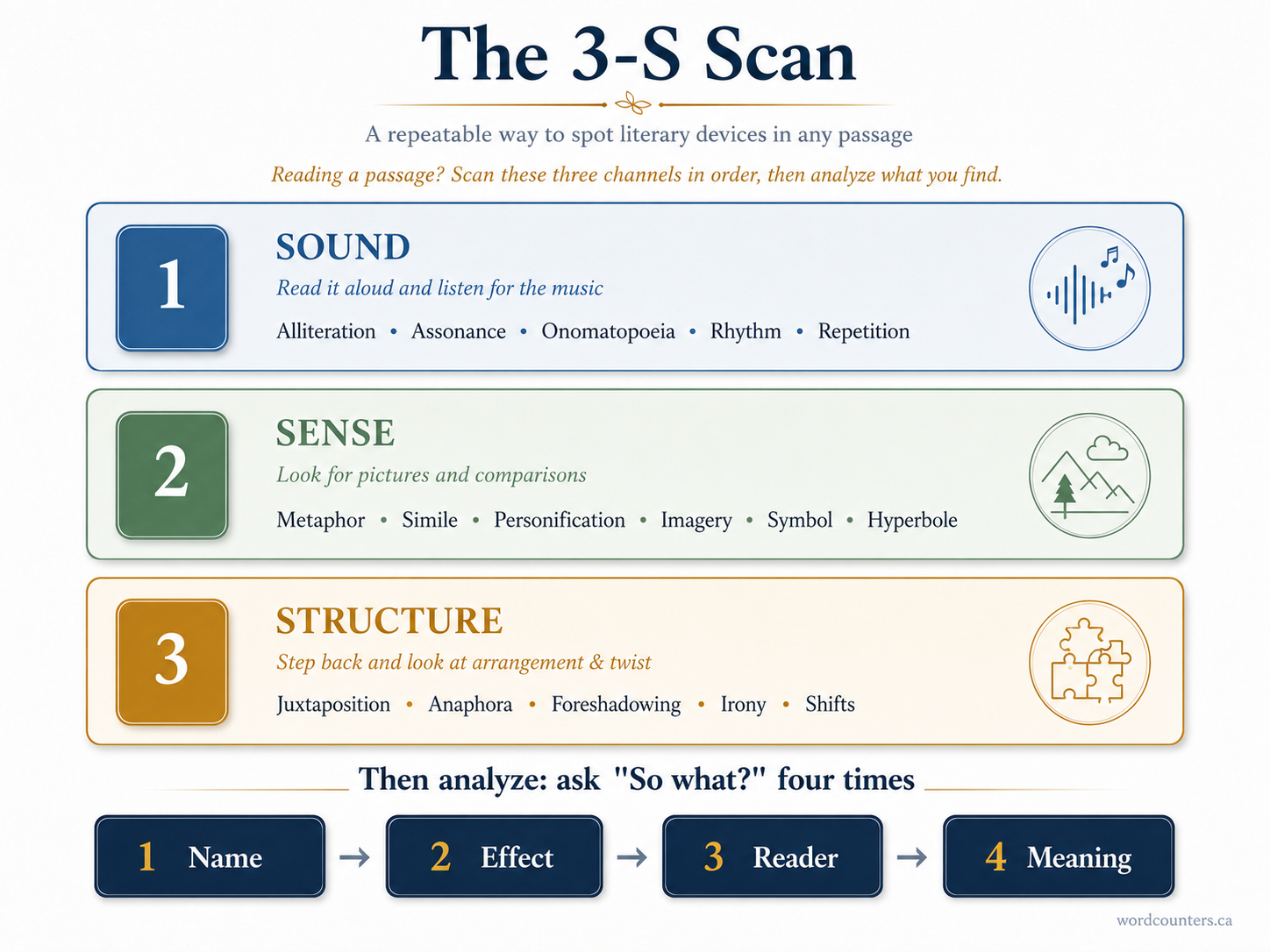
Verdict
Literary devices aren't a vocabulary test to be survived and forgotten. They're a way of seeing, the difference between reading words and reading meaning. Here's what to carry away:
"Literary device" is the umbrella. Techniques, figurative language, and rhetorical devices all live under it; literary elements are the raw materials they shape. When in doubt, "literary device" is never wrong.
Go deep, not wide. Knowing 20 devices thoroughly, how they work, how to spot them, how to use them, beats vaguely recognizing 150. Master the essentials first.
Spotting is a skill you can systematize. The 3-S Scan, Sound, Sense, Structure, turns "find the devices" from guesswork into a method. Always read aloud.
Naming isn't analyzing. Climb the "So What?" Ladder: Name → Effect → Reader → Meaning. The DEEP method turns that into a paragraph that earns marks.
For writers, less is more. Start with the effect, choose the device to match, and cut anything that isn't earning its place.
Analysis isn't invented. The Blue Curtains Test, Pattern, Placement, Payoff, is how you tell real meaning from reaching.
Bookmark this guide, print the cheat sheet, and come back to the catalog whenever a device stumps you. For more writing, grammar, and analysis guides, explore the Word Counters blog. The more you practice noticing these tools, the more the writing around you, books, songs, speeches, ads, even a well-turned text message, opens up.
Now go find a metaphor in the wild. They're everywhere.
Frequently Asked Questions
What are literary devices?
Literary devices are techniques and tools writers use to convey meaning, evoke emotion, and add depth beyond the literal words on the page. They include figurative language (metaphor, simile), sound devices (alliteration), structural techniques (foreshadowing), and rhetorical tools (anaphora). In short, they're the deliberate craft choices that turn plain information into an experience.
What are the most common literary devices?
The most common are metaphor, simile, personification, imagery, symbolism, foreshadowing, alliteration, hyperbole, irony, allusion, onomatopoeia, and oxymoron. If you learn these twelve well, including how to spot and analyze each, you'll recognize the majority of devices you meet in school texts, poetry, and everyday writing.
What is the difference between literary devices and figurative language?
Figurative language is a subset of literary devices. "Literary device" is the umbrella term for any technique a writer uses for effect; "figurative language" refers specifically to language that means something beyond its literal definition, metaphor, simile, personification, hyperbole, and idiom. So all figurative language consists of literary devices, but many literary devices (like foreshadowing, alliteration, or flashback) are not figurative language.
What is the difference between a literary device and a literary technique?
The terms are often used interchangeably, and that's usually fine. When a distinction is drawn: "literary elements" are the components every story inherently has (plot, character, theme, setting), while "literary techniques" (or devices) are the optional, deliberate tools a writer chooses to add, metaphor, irony, foreshadowing. Elements are what a story is made of; techniques are what the writer does with them.
How many literary devices are there?
There is no fixed number, glossaries typically list anywhere from 30 to 200+, depending on how the categories are divided. There's no official master list. Practically, students need about 15-40 core devices depending on their level, while writers and English majors benefit from knowing 50+. This guide catalogs over 100 so nothing you encounter is a mystery.
What is the difference between a literary device and a rhetorical device?
They overlap heavily; the difference is purpose. Rhetorical devices (anaphora, antithesis, rhetorical question, and the appeals ethos/pathos/logos) are aimed primarily at persuading or moving an audience, they dominate speeches and essays. Literary devices serve broader artistic effects in storytelling and poetry. A metaphor can be both. If its main job is persuasion or emphasis for an audience, it's functioning rhetorically.
What are the three types of irony?
Verbal irony is saying the opposite of what you mean ("lovely weather" in a storm). Situational irony is when the outcome is the opposite of what's expected (a fire station burning down). Dramatic irony is when the audience knows something a character doesn't (we know Juliet is alive; Romeo doesn't). Naming the correct type is what earns marks in exams.
What is the difference between a metaphor and a simile?
Both compare two unlike things. A simile makes the comparison explicit using like, as, or than ("brave as a lion"). A metaphor states that one thing is another, with no connective word ("he is a lion in battle"). The single-word test: if you can spot a like or as doing the comparing, it's a simile; if not, it's a metaphor.
Why do authors use literary devices?
To do six main jobs: show rather than tell (vivid, sensory writing), compress meaning (a symbol carries a whole idea), evoke emotion, create rhythm and memorability, build structure and suspense, and persuade. In every case, the goal is to make writing more powerful, memorable, and meaningful than a plain statement of facts.
How do you identify literary devices in a text?
Run the 3-S Scan: read the passage for Sound (read aloud for alliteration, assonance, onomatopoeia, rhythm), for Sense (metaphor, simile, personification, imagery, symbolism), and for Structure (juxtaposition, anaphora, foreshadowing, irony, shifts). Reading aloud is essential, every sound device is invisible on a silent skim.
How do you use literary devices in your own writing?
Start with the effect you want, then choose the device that produces it, not the other way around. Use devices sparingly (one strong image beats three weak ones), avoid clichés and mixed metaphors, vary figurative sentences with plain ones, and read your work aloud to catch anything overwrought. Ask of every device: "What is this doing that a plain sentence wouldn't?" If there's no answer, cut it.
What literary devices are used in Romeo and Juliet?
Shakespeare packs the play with them: metaphor ("Juliet is the sun"), oxymoron ("O brawling love, O loving hate," "parting is such sweet sorrow"), dramatic irony (we know Juliet lives; Romeo doesn't), foreshadowing (references to "star-crossed lovers" and premonitions of death), pun (Mercutio's "a grave man"), personification, and the light/dark motif running throughout. It's one of the richest texts for practicing device analysis.
What are the most common poetic devices?
The devices most associated with poetry are alliteration, assonance, consonance, onomatopoeia, rhyme, rhythm/meter, imagery, metaphor, simile, personification, enjambment, caesura, and repetition/refrain. Poetry concentrates sound devices especially, which is why poems reward reading aloud. (For an authoritative glossary of poetic terms, see the Poetry Foundation.)
Is imagery a literary device or figurative language?
Imagery is a literary device, and it can be figurative or literal. "The red rose" is literal visual imagery; "the sky bled crimson" is imagery that's also figurative (a metaphor). So imagery is the broader category, sensory, evocative language, and figurative language is one of the tools it often uses.
What literary devices do I need to know for AP Lit or GCSE?
For AP Literature, prioritize diction, imagery, tone, figurative language, irony, symbolism, and structure, and build a defensible argument about meaning. For GCSE English Literature, prioritize metaphor, symbolism, motif, dramatic irony, pathetic fallacy, and structural devices, always linking device → effect → theme → the writer's intentions. In both, analyzing a few devices deeply beats naming many.
What is the hardest part of learning literary devices?
For most students, it's not defining devices but two things: telling similar ones apart (metaphor vs. symbol, oxymoron vs. paradox, the three ironies) and moving from identifying a device to explaining its effect. For ESL learners, idioms and figurative meaning are hardest. This guide targets all three with the commonly-confused comparisons, the "So What?" Ladder, and a dedicated ESL section.