How Many Words Are in the English Language? (Real Answer)
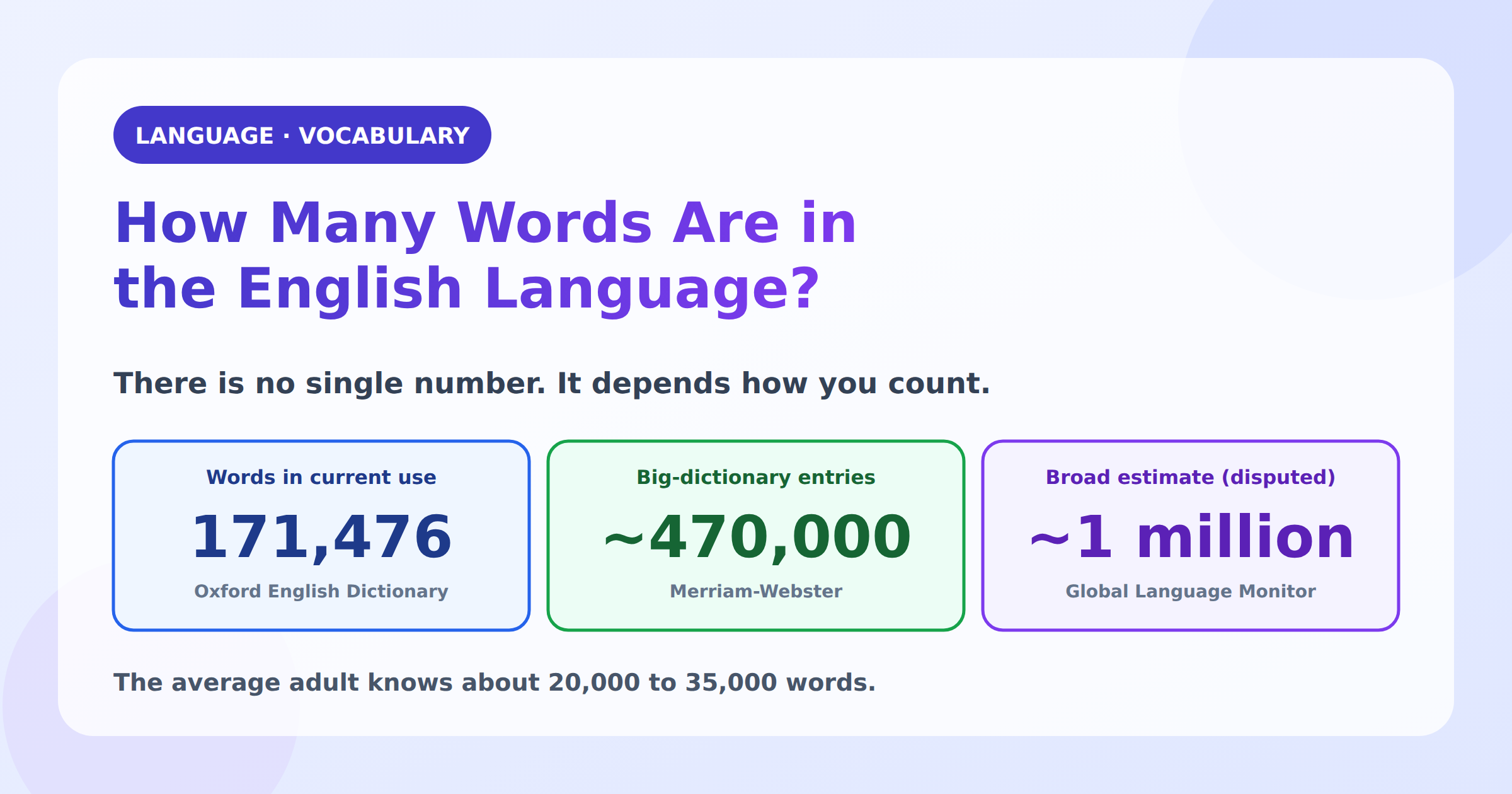
How many words are in the English language? About 171,476 are in use, ~470,000 in major dictionaries, and up to 1 million by broad estimates.
It sounds like a question with a tidy answer, but it is one of the trickiest questions in linguistics. Depending on how you count, English has anywhere from about 170,000 words to more than a million. There is no official number, and even the world's biggest dictionaries and the lexicographers who write them will not give you a single figure.
This guide gives you the honest, sourced answer. You will see the numbers from the Oxford English Dictionary and Merriam-Webster, why counting is so hard, whether the famous "one million words" claim is real, how many words the average person actually knows, how English compares to other languages, and how fast new words are being added. The numbers come from the dictionaries and studies themselves, with the disputed ones clearly flagged.
How many words are in the English language?
There is no exact number, because it depends on what you count as a word. The most useful figures are: major unabridged dictionaries list around 470,000 entries (Merriam-Webster's Webster's Third New International), the Oxford English Dictionary defines about 171,476 words in current use plus 47,156 obsolete ones, and broad estimates that include technical terms, slang, and every word form put the total near 1 million (though that figure is disputed). Meanwhile, the average adult English speaker recognizes roughly 20,000 to 40,000 words.
Way of counting | Approximate number | Source |
|---|---|---|
Entries in a large unabridged dictionary | ~470,000 | Merriam-Webster (Webster's Third) |
Words in current use | ~171,476 | Oxford English Dictionary |
Obsolete words still recorded | ~47,156 | Oxford English Dictionary |
Broad total including all forms and terms | ~1,000,000 (disputed) | Global Language Monitor |
Words the average adult recognizes | ~20,000 to 40,000 | Brysbaert et al., 2016 |
Key Takeaways
There is no single correct number. The answer changes completely depending on how you define a "word."
The biggest dictionaries hold around 470,000 entries, and the OED records about 171,476 words in current use.
The popular "one million words" figure comes from the Global Language Monitor and is not accepted by most linguists.
The average adult recognizes roughly 20,000 to 40,000 words but actively uses only about half of what they know.
You only need about 3,000 common words to understand roughly 95% of everyday English.
English keeps growing, with dictionaries adding hundreds of new words every year.
Cross-language word counts are not directly comparable, because every language counts differently.
Why there is no exact number?
The reason nobody can give you a precise count is not laziness. It is that "word" does not have one fixed meaning. Before you can count words, you have to decide what counts, and every reasonable choice gives a different total.
Here are the decisions that change the number:
Word forms vs base words (lemmas). Do run, runs, running, and ran count as one word or four? Counting base words (lemmas) gives a small number; counting every inflected form gives a much larger one.
Homographs. The word post has around a dozen different dictionary meanings (a wooden post, to post a letter, a job post, and more). Is that one word or twelve?
Phrases and compounds. Do multi-word terms like port of call, emotional support animal, or ice cream count as words?
Technical and scientific terms. English contains millions of chemical compound names and scientific terms. Include them and the total explodes; exclude them and it shrinks.
Slang, jargon, and new coinages. Words like rizz and doomscroll exist and are used everywhere, but dictionaries add them slowly, if at all.
Loanwords. English constantly absorbs words from other languages. When does schadenfreude or emoji become an English word?
Proper nouns and dialects. Names, brand names, and regional or World English varieties add even more if you include them.
Because there is no single right way to make these calls, there is no single right number. Every count is really an answer to a slightly different question.
Dictionary word counts compared
The most concrete way to answer the question is to look at how many entries the major dictionaries actually contain. Keep in mind that each one counts an "entry" differently, so these are not apples-to-apples.
Dictionary | Approximate entries | Notes |
|---|---|---|
Webster's Third New International (Merriam-Webster) | ~470,000 | One of the largest single-volume English dictionaries |
Oxford English Dictionary (2nd ed.) | ~171,476 in current use (plus ~47,156 obsolete) | The most detailed historical record of English |
Collins English Dictionary | ~700,000+ (broadest claim) | Counts word forms and phrases generously |
Cambridge Advanced Learner's Dictionary | ~140,000 | Aimed at learners, so it is more selective |
Oxford Advanced Learner's Dictionary | ~60,000+ | A learner's dictionary, deliberately smaller |
Note: dictionaries count differently. Collins and Cambridge include phrases and meanings in their totals, while the OED figure counts words with full entries. That is another reason these numbers are not apples-to-apples.
Two takeaways. First, the comprehensive dictionaries range from roughly 170,000 words in current use to 470,000 entries or more, with Collins claiming higher still because it counts word forms and phrases generously. Second, a bigger number does not mean a better dictionary; learner dictionaries are smaller on purpose because they focus on the words people actually need.
What the Oxford English Dictionary actually says?
The Oxford English Dictionary is the most authoritative historical record of English, so its numbers carry real weight. Its Second Edition contains full entries for about 171,476 words in current use and about 47,156 obsolete words that are no longer used but are kept for the record. Counting all the different forms and derivatives it documents, the OED covers well over 600,000 word forms in total.
Even the OED's editors are careful here. They point out that there is no reasonable way to count the number of words in English, partly because it is impossible to decide what to include and exclude, especially when it comes to scientific vocabulary and words on the fringes of the language.
Is English really over a million words?
You have probably seen the claim that English passed one million words. That figure comes from the Global Language Monitor, which announced on June 10, 2009 that "Web 2.0" was the millionth English word, and claims a new word is created roughly every 98 minutes.
Here is the honest part most articles leave out: linguists and major dictionaries do not accept this figure. The Global Language Monitor is not a dictionary or a research institution, and its methods (which count many phrases, brand names, and rarely used terms) are widely criticized by lexicographers. Merriam-Webster estimates the vocabulary of English at roughly one million words but adds that this could easily be off by a quarter million in either direction, which tells you how loose the number really is.
A separate study by researchers at Harvard and Google, using millions of digitized books, estimated the English lexicon at about 1,022,000 words. That study is interesting, but it also counted a lot of things most people would not call words, including typos, numbers, and stray strings of letters.
The fair conclusion: if you count generously (every technical term, every proper noun, every rare form), English can plausibly reach a million or more. If you count the way a careful dictionary does, the real working vocabulary is a few hundred thousand words. The million-word headline is memorable, but treat it as a ballpark, not a fact.
How fast is English growing?
English is one of the most rapidly expanding languages in the world, mostly because it borrows freely and coins new words constantly. Dictionaries add new words in regular updates: Merriam-Webster and the OED each add anywhere from a few hundred to over a thousand new words and senses in a typical year, covering everything from technology (doomscroll, deepfake, enshittification) to culture (rizz, cromulent). Many of those coinages are blends of existing words, or portmanteaus, the way doomscroll fuses doom and scroll.
The growth is real, but the exact rate is impossible to pin down precisely, because a "new word" might be a fresh coinage, a slang term finally recorded, or an old word with a new meaning. What is clear is that the language never stops adding to itself.
How many words does the average person know?
This is where the numbers get personal and, honestly, more useful than the grand total. Your vocabulary comes in two sizes.
Passive vocabulary is every word you recognize and understand when you read or hear it. Active vocabulary is the smaller set of words you actually use when you speak and write.
Research suggests the average adult native English speaker recognizes somewhere between 20,000 and 40,000 words. A widely cited 2016 study by Marc Brysbaert and colleagues, published in Frontiers in Psychology, found the average 20-year-old American knows about 42,000 lemmas (base words). Active vocabulary is much smaller: the lexicographer Susie Dent has put the split memorably at around 40,000 words known but only about 20,000 actively used.
The encouraging news for language learners: you do not need anywhere near that many to function. The figures below draw on vocabulary-coverage research of the kind pioneered by Paul Nation.
Vocabulary size | What it gets you |
|---|---|
~800 to 1,000 words | Understand roughly 85% of everyday speech |
~3,000 words | Understand about 95% of general, everyday text |
~5,000 to 10,000 words | Comfortable, fluent proficiency |
~20,000+ words | Educated native-speaker level |
In other words, a small core of common words does most of the heavy lifting. The other hundreds of thousands are specialized, rare, technical, or archaic. You can see the same effect in your own writing: paste a page into a word counter and then a word frequency counter, and a small handful of words will dominate the list.
Shakespeare and the size of a great vocabulary
People often say William Shakespeare had the largest vocabulary of any English writer and invented thousands of words. The reality is more nuanced and worth getting right.
Across all his plays and poems, Shakespeare used roughly 20,000 distinct words (some counts run higher when every form is included). He is frequently credited with introducing more than 1,700 words to English, such as lonely, bedroom, and eyeball. Modern scholarship adds an important caveat: in many cases his work is simply the earliest surviving written record of a word, not proof that he personally invented it. Either way, his vocabulary was remarkable, and it shows how much one writer can stretch a language.
Counting distinct words in a text is the one part of this question you can settle precisely. Paste any passage into a unique word counter and you get the exact number of different words it uses, the same analysis scholars run on Shakespeare's complete works.
English vs other languages
English is often called one of the largest languages by vocabulary, but comparisons should be treated with care. Every language counts words differently, and some (like German) build long compound words that inflate or deflate totals depending on the method. These figures are rough estimates, not a fair race.
Language | Rough vocabulary estimate |
|---|---|
English | ~470,000 dictionary entries; ~1,000,000 by broad estimates |
German | ~330,000 to 400,000 (counts include word forms) |
Spanish | ~300,000+ (counts include word forms) |
Italian | ~260,000 |
Russian | ~150,000 |
French | ~60,000 to 100,000 (in standard dictionaries) |
English tends to score high partly because it borrowed heavily from Latin, French, Norse, and dozens of other languages over its history, and partly because it welcomes technical and scientific vocabulary. But no linguist would call these numbers a precise ranking, so read the table as a general sense of scale rather than a leaderboard.
A short history of how English got so many words
English is large because it is a mongrel language that has absorbed vocabulary from everywhere.
Old English (roughly 450 to 1150). A Germanic language with a core vocabulary that still gives us common words like water, house, and love.
Middle English (roughly 1150 to 1500). After the Norman Conquest of 1066, French and Latin flooded in, adding tens of thousands of words for law, food, art, and government.
Modern English (1500 to today). The Renaissance added Latin and Greek scientific terms, the British Empire imported words from around the globe, and technology and the internet keep adding more.
This habit of borrowing, rather than translating, is the main reason English has so many near-synonyms (ask from Old English, question from French, interrogate from Latin) and such a huge total vocabulary.
The most accurate answer to "how many words are in the English language" is that there is no single answer, and anyone who gives you one exact number is oversimplifying. The dependable figures: about 171,476 words in current use per the OED, roughly 470,000 entries in the biggest dictionaries, and a disputed ballpark near one million if you count everything.
What matters more for most people is the personal number: the average speaker thrives on a passive vocabulary of 20,000 to 40,000 words and communicates well with far fewer. English is enormous, it is still growing, and no dictionary will ever quite catch up, which is part of what makes it such a rich language to use.
Frequently Asked Questions
How many words are in the English language exactly?
No exact count exists, and none is possible, because the total depends on whether you count word forms, technical terms, slang, and proper nouns. The defensible range runs from about 170,000 words in current use (OED) to around 470,000 dictionary entries, with looser estimates reaching a million.
How many words are in the English dictionary?
It depends on the dictionary. Merriam-Webster's Webster's Third New International has about 470,000 entries, the Oxford English Dictionary defines about 171,476 words in current use, and learner dictionaries like Cambridge's contain around 140,000. There is no single official dictionary count.
Are there really one million words in English?
That figure comes from the Global Language Monitor, which declared "Web 2.0" the millionth English word in 2009, and it is not accepted by most linguists or major dictionaries. English can reach a million or more only if you count every technical term, proper noun, and word form. By a careful dictionary's standard, the number is a few hundred thousand.
How many words does the average person know?
Studies put the average adult native speaker's passive vocabulary between 20,000 and 40,000 words, with one large 2016 study finding about 42,000 lemmas for a typical 20-year-old American. Active vocabulary, the words people actually use in speech and writing, is roughly half of what they recognize.
How many words do you need to be fluent in English?
You can understand about 95% of everyday English with roughly 3,000 common words, and comfortable fluency usually takes 5,000 to 10,000 words. You do not need the full dictionary to communicate well.
Which English dictionary has the most words?
Among widely known dictionaries, Merriam-Webster's Webster's Third New International (about 470,000 entries) is one of the largest. The Oxford English Dictionary documents more historical detail and word forms (over 600,000) but defines fewer words as currently in use.
How many new words are added to English each year?
Major dictionaries add anywhere from a few hundred to over a thousand new words and meanings in a typical year. The exact number varies because a "new word" can be a fresh coinage, a slang term finally recorded, or an old word with a new sense.
Does English have more words than other languages?
By most estimates English has one of the largest vocabularies, ahead of German, Spanish, and French in raw dictionary counts. But these comparisons are not precise, because every language defines and counts words differently.
Why can't we count the exact number of words in English?
Because "word" has no fixed definition. You have to decide whether to count inflected forms, homographs, phrases, technical terms, slang, loanwords, and proper nouns, and each choice produces a different total. Language also changes daily, so any count is out of date the moment it is made.