Paragraph Starters: Useful Words and Phrases With Examples
Starting a paragraph can feel harder than writing the paragraph itself. You may know the point you want to make, but the first few words feel weak. You write…
Starting a paragraph can feel harder than writing the paragraph itself.
You may know the point you want to make, but the first few words feel weak. You write “also,” then delete it. You try “another thing,” but it sounds too casual. You start with “in conclusion,” but the paragraph is not actually ending.
That is where paragraph starters help.
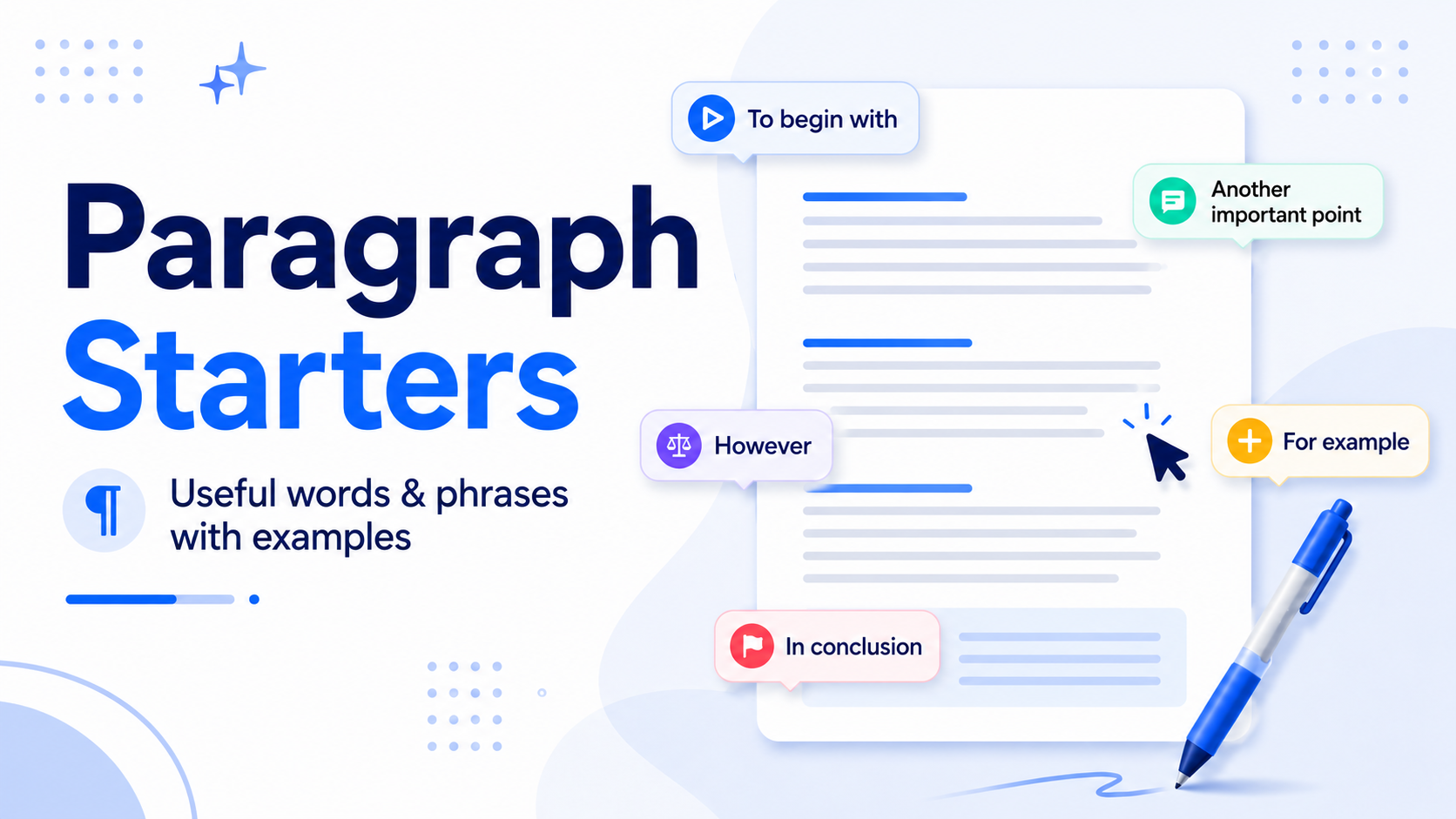
A paragraph starter is a word or phrase that begins a new paragraph and shows the reader where the idea is going. It can introduce a topic, add a new point, show contrast, give evidence, explain an example, or move toward a conclusion.
For example:
To begin with, strong paragraphs need one clear main idea.
Another important point is that each paragraph should connect to the one before it.
However, not every paragraph needs a long transition.
As a result, good paragraph starters make writing easier to follow.
Paragraph starters are useful for essays, reports, blog posts, stories, emails, speeches, and academic writing. They do not write the paragraph for you, but they make the beginning smoother.
What are paragraph starters?
Paragraph starters are words or phrases used at the beginning of a paragraph to introduce the next idea.
They help the reader understand the purpose of the paragraph before reading the full explanation.
A paragraph starter can show that you are:
Beginning a new idea
Adding another reason
Giving an example
Showing contrast
Explaining evidence
Starting a conclusion
Moving from one section to another
For example:
The first reason is that daily reading improves vocabulary.
This starter tells the reader that the paragraph will explain a reason.
Another example:
On the other hand, too much screen time can reduce focus.
This starter tells the reader that the paragraph will show a contrast.
A good paragraph starter works like a signpost. It tells the reader what kind of idea is coming next.
Key takeaways
Paragraph starters help begin paragraphs clearly.
They improve flow between ideas.
Different starters work for introductions, body paragraphs, evidence, contrast, examples, and conclusions.
The best paragraph starter depends on the purpose of the paragraph.
Overusing the same starter can make writing sound repetitive.
Strong paragraph starters should guide the reader, not decorate the writing.
Why paragraph starters matter?
A paragraph is not just a block of text. It is a step in your writing.
If the first sentence of a paragraph is unclear, the reader may not understand why the paragraph is there.
Look at this example:
Reading helps students. It improves vocabulary. It also supports writing. Students should read more often.
This is understandable, but the flow is basic.
Now compare it with this:
One major benefit of reading is vocabulary growth. Students meet new words in context, which helps them understand meaning naturally. Over time, this makes both reading and writing easier.
The second version feels stronger because the paragraph starts with a clear purpose.
That is the job of a paragraph starter. It helps the reader enter the paragraph with direction.
If you are checking a longer essay or article, you can also use a paragraph counter to see how your writing is divided and whether some paragraphs are too long, too short, or uneven.
Paragraph starters for introductions
Introductory paragraph starters help you open a topic, introduce a problem, or prepare the reader for your main idea.
Useful starters include:
To begin with
At the start
In many cases
One important issue is
A common question is
Many people believe that
The main idea behind this topic is
This topic matters because
Before looking at the details
The first thing to understand is
Examples:
To begin with, paragraph starters help writers organize their ideas more clearly.
A common question is how to begin a paragraph without sounding repetitive.
The first thing to understand is that a paragraph should focus on one main idea.
These starters are useful for essays, blog posts, and school assignments.
If you are writing an essay, your introduction should usually lead toward a clear thesis. Do not make the opening too broad. A strong introduction gives the reader enough context, then moves into the main point.
Paragraph starters for body paragraphs
Body paragraphs explain the main points of an essay, article, or report. Each body paragraph should focus on one idea.
Useful starters include:
The first reason is
Another important point is
A second factor is
One example of this is
This can be seen in
The next point to consider is
A related issue is
This idea is important because
In the same way
This section focuses on
Examples:
The first reason is that paragraph starters make writing easier to follow.
Another important point is that each paragraph should connect to the main topic.
The next point to consider is how paragraph length affects readability.
Body paragraph starters should not feel random. They should show how the paragraph supports the main idea.
For a deeper guide on essay paragraph structure, see How to Count Paragraphs in an Essay.
Paragraph starters for adding another point
Sometimes you need to add more support to an idea. These starters help you continue without sounding repetitive.
Useful starters include:
In addition
Also
Another reason is
Along with this
Besides that
It is also important to note
A further point is
Not only that
This also shows that
More importantly
Examples:
In addition, paragraph starters can help connect one section to the next.
Another reason is that they make essay writing less stressful for beginners.
It is also important to note that not every paragraph needs a formal transition.
Use these when your new paragraph supports the same overall argument.
Paragraph starters for contrast
Contrast starters help you show a different side of the topic. They are useful when comparing ideas, responding to objections, or changing direction.
Useful starters include:
However
On the other hand
In contrast
Still
Even so
Despite this
At the same time
While this may be true
Although this seems reasonable
A different view is
Examples:
However, paragraph starters can sound unnatural when they are overused.
On the other hand, a short paragraph may not need a transition at all.
While this may be true, longer essays usually need clearer paragraph openings.
A common mistake is using however when you are not showing contrast.
Weak:
However, paragraph starters also help with essays.
Better:
In addition, paragraph starters also help with essays.
Use however only when the new paragraph pushes against the previous idea.
Paragraph starters for examples
Example starters tell the reader that you are about to make an idea clearer.
Useful starters include:
For example
For instance
One example is
A clear example is
This can be seen when
To illustrate this point
In practice
Consider this example
A simple case is
One way this happens is
Examples:
For example, a student might start a body paragraph with “The first reason is.”
To illustrate this point, compare a paragraph with no transition to one with a clear starter.
In practice, paragraph starters help writers move from one idea to the next.
Example starters are especially useful in essays because they help connect claims to proof.
Paragraph starters for evidence
Evidence starters are useful in academic writing, research essays, reports, and analysis.
Useful starters include:
The evidence shows that
According to the text
Research suggests that
The data shows that
This is supported by
The author explains that
The passage states that
One study found that
This example supports the idea that
We can see this when
Examples:
The evidence shows that clear paragraph structure improves readability.
According to the text, the character changes after facing the main conflict.
This example supports the idea that paragraph starters guide the reader through an argument.
Do not drop evidence into a paragraph without preparing the reader. A good starter explains why the evidence matters.
Paragraph starters for explaining ideas
Explanation starters help you define, clarify, or restate a point in simpler words.
Useful starters include:
In other words
This means that
Put simply
To explain further
More specifically
The idea is that
Another way to understand this is
This matters because
The reason is simple
What this means is
Examples:
In other words, paragraph starters help the reader understand how ideas are connected.
Put simply, a paragraph starter gives the paragraph a clear beginning.
This matters because readers need structure to follow longer writing.
These starters are useful when you are explaining a difficult idea or moving from a general point to a clearer one.
Paragraph starters for analysis
Analysis paragraphs explain why something matters. They do more than summarize.
Useful starters include:
This shows that
This suggests that
This reveals that
This matters because
The deeper point is
This is important because
This connects to
This helps explain why
The result is
The main lesson is
Examples:
This shows that paragraph starters do more than make writing sound formal.
This suggests that the paragraph needs a clearer connection to the main argument.
The deeper point is that structure affects how readers understand meaning.
Analysis starters are especially helpful in literature essays, opinion essays, and research writing.
Paragraph starters for conclusions
Conclusion starters help you wrap up an idea, paragraph, section, or entire essay.
Useful starters include:
In conclusion
To sum up
Overall
In the end
Ultimately
For these reasons
As a final point
The main takeaway is
The lesson is
All things considered
Examples:
Overall, paragraph starters are useful when they make the writing easier to follow.
The main takeaway is that each paragraph should begin with a clear purpose.
In conclusion, strong paragraph starters can improve flow, structure, and readability.
Do not use in conclusion too early. Save it for the final paragraph or final section.
Paragraph starters for persuasive writing
Persuasive writing needs strong paragraph openings because each paragraph should move the reader closer to your argument.
Useful starters include:
One reason is
The strongest reason is
This matters because
A better solution is
The problem with this view is
A more effective approach is
This proves that
This argument is important because
The best way to solve this is
For this reason
Examples:
One reason is that paragraph starters make arguments easier to follow.
The problem with this view is that it ignores how readers process information.
A better solution is to choose paragraph starters based on purpose, not habit.
Persuasive paragraph starters should sound confident, but not aggressive.
Paragraph starters for stories
Story paragraph starters help move time, action, and setting forward.
Useful starters include:
At first
A few minutes later
Before long
Suddenly
Meanwhile
After that
By the time
For a moment
Without warning
In the distance
Examples:
At first, nobody noticed the sound coming from the basement.
Meanwhile, the rest of the group waited near the front door.
Without warning, the lights went out.
Story starters work best when they create movement. They help readers feel time passing and scenes changing.
Paragraph starters for comparing ideas
Comparison starters help show similarities and differences.
Useful starters include:
Similarly
In the same way
Compared with
In comparison
Unlike the first example
Both examples show
The same idea appears in
This is similar to
By contrast
The difference is
Examples:
Similarly, sentence starters help individual sentences flow more smoothly.
By contrast, paragraph starters guide the reader from one larger idea to another.
Compared with the first draft, the revised paragraph has a clearer beginning.
For more sentence-level transitions, you may also find Sentence Starters helpful.
Paragraph starters vs sentence starters
Paragraph starters and sentence starters are related, but they are not exactly the same.
A sentence starter begins any sentence.
A paragraph starter begins the first sentence of a new paragraph.
For example:
However, the second draft was much clearer.
This could be a sentence starter inside a paragraph or a paragraph starter at the beginning of a new paragraph.
The difference is the job it performs. A sentence starter connects one sentence to another. A paragraph starter usually connects one larger idea to the next.
If your sentence structure feels weak even after adding starters, the problem may be deeper than transitions. This guide on Sentence Structure explains how subjects, verbs, clauses, and sentence types work together.
How to choose the right paragraph starter?
Before choosing a paragraph starter, ask one question:
What is this paragraph doing?
If the paragraph adds information, use in addition or another reason is.
If it gives an example, use for example or one example is.
If it shows contrast, use however or on the other hand.
If it explains evidence, use the evidence shows that or this supports the idea that.
If it ends the essay, use overall, to sum up, or in conclusion.
Do not choose a starter because it sounds fancy. Choose it because it fits the purpose.
Common mistakes when using paragraph starters
The first mistake is repeating the same starter too often.
Weak:
First, reading improves vocabulary.
First, it helps writing.
First, it builds focus.
Better:
First, reading improves vocabulary.
In addition, it helps writing.
Over time, it also builds focus.
The second mistake is using formal starters in casual writing.
For example, furthermore may work in an academic essay, but it can sound stiff in a friendly blog post.
The third mistake is using a paragraph starter without a clear paragraph idea.
A starter cannot save a paragraph that has no focus.
Weak:
In addition, students, books, homework, and sometimes the school system.
This is not a complete idea.
Better:
In addition, students benefit from reading because it exposes them to new words in context.
The fourth mistake is starting every paragraph with a transition. Sometimes the best starter is a direct topic sentence.
Example:
Paragraph length affects readability.
That is clear. It does not need a fancy opening.
How to improve paragraph flow?
Paragraph flow means each paragraph connects naturally to the next.
A good paragraph usually does three things:
Introduces one main idea.
Explains or supports that idea.
Connects to the larger topic.
If a paragraph feels sudden, add a starter that shows the relationship.
Example without flow:
Students should read every day.
Writing is important.
Better:
Students should read every day.
In addition to improving reading skills, daily reading can also strengthen writing.
The second version shows the connection.
If you want to check whether your paragraphs are too long or uneven, use the paragraph counter. If your paragraphs look fine but the sentences feel repetitive, the sentence counter can help you review sentence variety.
Best paragraph starters for beginners
Start with these simple starters:
To begin with
The first reason is
Another important point is
For example
In addition
However
On the other hand
This means that
As a result
Overall
These are easy to use and work in many types of writing.
Once you feel comfortable, add more specific starters like:
The evidence shows that
This suggests that
A more effective approach is
The deeper point is
Compared with the first example
The main takeaway is
The goal is not to memorize every phrase. The goal is to know which starter fits which situation.
Paragraph starter examples in a short essay
Here is a simple example topic:
Why students should read every day
Introduction:
To begin with, daily reading is one of the simplest habits students can build to improve their learning.
First body paragraph:
The first reason is that reading improves vocabulary. Students meet new words in context, which makes those words easier to understand and remember.
Second body paragraph:
In addition, reading helps students become better writers. By seeing how sentences and paragraphs are built, students learn structure naturally.
Third body paragraph:
However, reading only helps when students do it consistently. A few pages every day are more useful than one long reading session once a month.
Conclusion:
Overall, daily reading supports vocabulary, writing, focus, and long-term learning.
Notice how each starter tells the reader what the paragraph is doing.
Paragraph starters and readability
Paragraph starters can improve readability, but only when they are used naturally.
Too many transitions can make writing sound mechanical.
Weak:
Furthermore, students should read daily. Moreover, reading helps vocabulary. In addition, it supports writing. Therefore, students should read more.
Better:
Students should read daily because the habit builds vocabulary and improves writing. Over time, it also helps them understand sentence flow and paragraph structure more naturally.
Readability depends on more than starters. Sentence length, paragraph length, word choice, and structure all matter. You can test a draft with the readability checker after revising your paragraphs.
For broader writing improvement, see 20 Writing Tips to Instantly Improve Your Writing Quality.
Paragraph starters make writing easier to follow.
They help you introduce new ideas, add support, show contrast, explain evidence, give examples, and close your argument clearly. But they should not be used just to make writing sound formal.
The best paragraph starter is the one that matches the purpose of the paragraph.
If the paragraph adds a point, use an adding starter.
If it gives proof, use an evidence starter.
If it shows contrast, use a contrast starter.
If it ends the essay, use a conclusion starter.
Start simple. Use starters like to begin with, for example, however, in addition, and overall. Then add more specific phrases as your writing improves.
Strong paragraph starters do not make writing complicated. They make it easier to read.
Frequently Asked Questions
What are paragraph starters?
Paragraph starters are words or phrases used at the beginning of a paragraph to introduce the next idea. Examples include to begin with, another important point is, for example, however, as a result, and in conclusion.
What are good paragraph starters?
Good paragraph starters include the first reason is, in addition, for example, on the other hand, this shows that, the evidence suggests, overall, and to sum up. The best choice depends on the purpose of the paragraph.
What are paragraph starters for essays?
Essay paragraph starters include to begin with, the first reason is, another important point is, according to the text, this evidence shows, however, as a result, and in conclusion.
How do you start a body paragraph?
Start a body paragraph with a clear topic sentence or transition. For example: The first reason is that daily reading improves vocabulary. This tells the reader what the paragraph will explain.
Can I start a paragraph with however?
Yes, you can start a paragraph with however when the new paragraph shows contrast with the previous idea. Use a comma after it: However, this method does not work for every writer.
Can I start a paragraph with because?
Yes, you can start a paragraph with because if the sentence is complete. For example: Because the paragraph lacked evidence, the argument felt weak.
Should every paragraph start with a transition?
No. Not every paragraph needs a transition phrase. Sometimes a direct topic sentence is stronger. Use a paragraph starter when it helps the reader understand the connection between ideas.
What is the difference between a paragraph starter and a sentence starter?
A sentence starter begins any sentence. A paragraph starter begins the first sentence of a new paragraph. Paragraph starters usually connect bigger ideas, while sentence starters may connect smaller sentence-level ideas.
What are conclusion paragraph starters?
Conclusion paragraph starters include in conclusion, to sum up, overall, ultimately, for these reasons, the main takeaway is, and as a final thought.