Sentence Structure: Meaning, Types, Rules, and Examples
Good writing does not start with fancy words. It starts with clear sentence structure. A sentence can have strong vocabulary and still sound confusing if the…
Good writing does not start with fancy words.
It starts with clear sentence structure.
A sentence can have strong vocabulary and still sound confusing if the parts are in the wrong order. On the other hand, a simple sentence can feel smooth, clear, and professional when the structure works.
Look at this sentence:
The student wrote the essay carefully.
Now compare it with this:
Carefully the essay student wrote the.
The words are almost the same, but the second sentence does not work because the structure is broken.
That is why sentence structure matters.
Sentence structure is the way words, phrases, and clauses are arranged to create a complete thought. It controls how your ideas move, how easy your writing is to read, and how naturally your sentences flow.
Below, you will learn what sentence structure means, the main types of sentence structures, common rules, examples, mistakes, and practical ways to improve your writing.
What is sentence structure?
Sentence structure means the arrangement of words in a sentence.
A basic English sentence usually follows this pattern:
Subject + verb + object
For example:
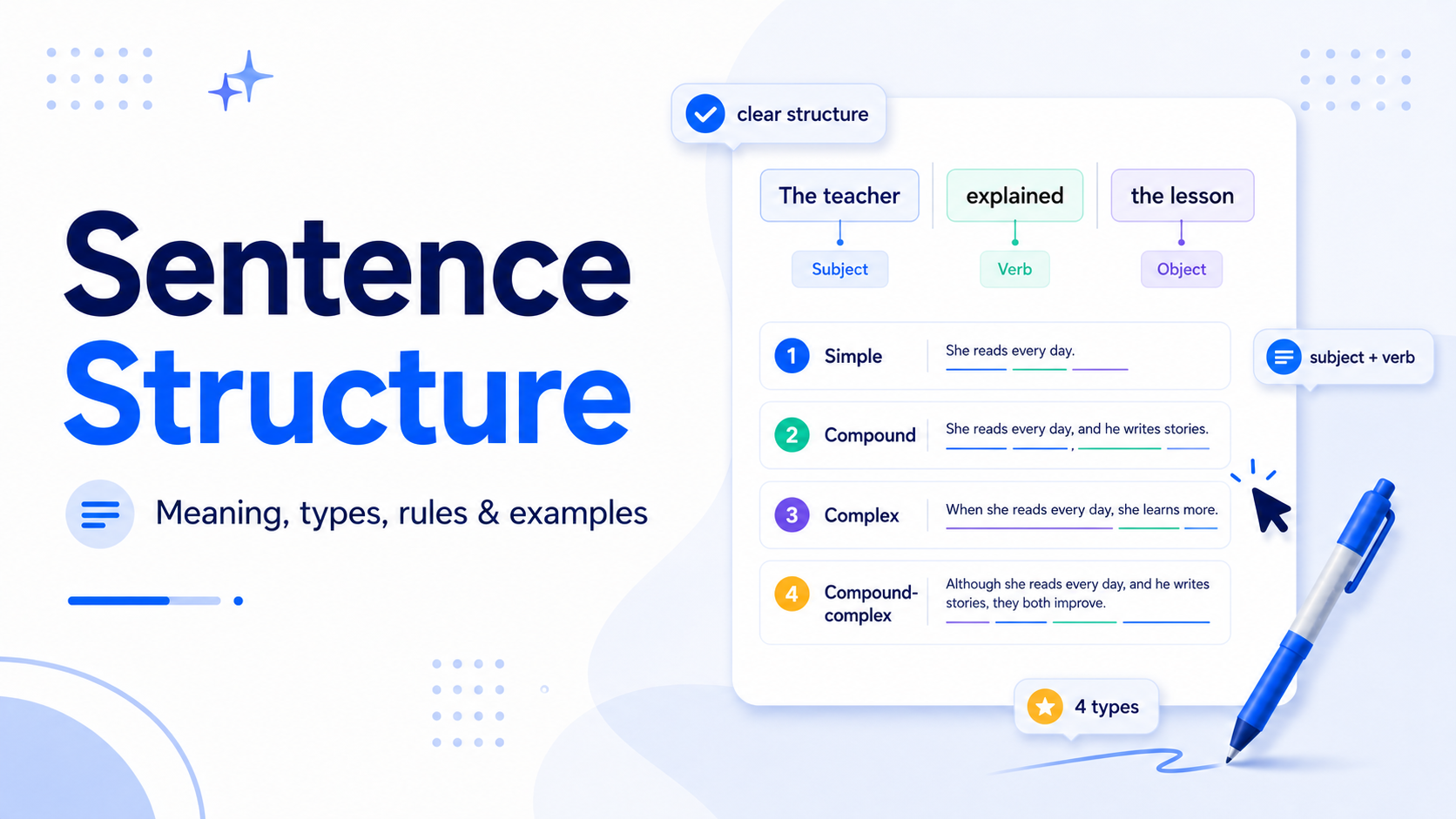
The teacher explained the lesson.
Here is how it breaks down:
Sentence part | Example | Purpose |
|---|---|---|
Subject | The teacher | Who or what the sentence is about |
Verb | explained | The action |
Object | the lesson | Who or what receives the action |
Not every sentence has an object, but every complete sentence needs a subject and a verb.
Example:
Birds fly.
This sentence is short, but it is complete.
Birds is the subject.
Fly is the verb.
That is enough to form a complete thought.
Key takeaways
Sentence structure is the way words and clauses are arranged in a sentence.
A complete sentence usually needs a subject and a verb.
The four main sentence structures are simple, compound, complex, and compound-complex.
Sentence variety makes writing smoother and less repetitive.
Poor sentence structure can cause fragments, run-on sentences, and confusing ideas.
The best sentences are clear first, stylish second.
Why sentence structure matters?
Sentence structure affects how your writing feels.
Short sentences can feel direct.
The door opened.
Longer sentences can add detail.
The door opened slowly as the wind pushed through the hallway.
Both sentences are useful. The problem starts when every sentence sounds the same.
Flat writing:
I woke up early. I made breakfast. I went to school. I finished my homework.
Better writing:
I woke up early, made breakfast, and went to school before the first bell. After class, I finished my homework in the library.
The second version has better flow because the sentence structure changes.
Sentence structure helps with:
Writing goal | How sentence structure helps |
|---|---|
Clarity | Shows who did what |
Flow | Connects ideas smoothly |
Emphasis | Puts important ideas in strong positions |
Variety | Prevents repetitive writing |
Readability | Makes writing easier to follow |
Tone | Helps writing sound simple, formal, dramatic, or conversational |
If you want to check whether your writing has too many long or short sentences, you can use a sentence counter to review the number of sentences in your draft and spot places where the structure may need more variety.
Basic parts of a sentence
Before learning sentence types, you need to understand the main parts.
Subject
The subject tells who or what the sentence is about.
Examples:
Sentence | Subject |
|---|---|
The dog barked. | The dog |
Maria opened the window. | Maria |
The old car stopped suddenly. | The old car |
The subject is usually a noun, pronoun, or noun phrase.
Verb
The verb shows action or state of being.
Examples:
Sentence | Verb |
|---|---|
The dog barked. | barked |
She is tired. | is |
They finished the project. | finished |
A sentence cannot be complete without a verb.
Object
The object receives the action.
Examples:
Sentence | Object |
|---|---|
She read the book. | the book |
He kicked the ball. | the ball |
They cleaned the room. | the room |
Not every sentence needs an object.
Example:
The baby slept.
This sentence has a subject and a verb, but no object. It is still complete.
Clause
A clause is a group of words with a subject and a verb.
There are two main types:
Clause type | Meaning | Example |
|---|---|---|
Independent clause | Can stand alone as a sentence | I finished my essay. |
Dependent clause | Cannot stand alone | Because I finished my essay |
The difference matters because sentence structure depends on how clauses are connected.
Phrase
A phrase is a group of words that does not have both a subject and a verb.
Examples:
Phrase | Why it is a phrase |
|---|---|
after school | No subject and verb |
in the morning | No subject and verb |
with great care | No subject and verb |
the old wooden chair | No verb |
Phrases add detail, but they do not form complete sentences by themselves.
The 4 main types of sentence structure
English has four main sentence structures:
Simple sentence
Compound sentence
Complex sentence
Compound-complex sentence
Each one creates a different rhythm.
Simple sentence structure
A simple sentence has one independent clause. That means it has one complete thought.
Examples:
The cat slept.
I finished my homework.
The students listened carefully.
A simple sentence can be short, but it does not have to be.
Example:
The tired students finished their long science project before lunch.
This is still a simple sentence because it has only one independent clause.
Sentence | Subject | Verb | Object or detail |
|---|---|---|---|
The cat slept. | The cat | slept | none |
I finished my homework. | I | finished | my homework |
The students listened carefully. | The students | listened | carefully |
When to use simple sentences?
Use simple sentences when you want to be clear, direct, or strong.
Example:
The answer was wrong.
That sentence works because it is short and clear.
Compound sentence structure
A compound sentence joins two or more independent clauses.
Usually, the clauses are joined with a coordinating conjunction:
for, and, nor, but, or, yet, so
These are often remembered as FANBOYS.
Examples:
I wanted to study, but I was too tired.
She opened the window, and the room filled with fresh air.
He missed the bus, so he walked to school.
Each side can stand alone.
I wanted to study.
I was too tired.
When joined, they become a compound sentence.
Sentence | First independent clause | Connector | Second independent clause |
|---|---|---|---|
I wanted to study, but I was too tired. | I wanted to study | but | I was too tired |
She opened the window, and the room filled with fresh air. | She opened the window | and | the room filled with fresh air |
He missed the bus, so he walked to school. | He missed the bus | so | he walked to school |
Common mistake
Do not join two complete sentences with only a comma.
Incorrect:
I wanted to study, I was too tired.
Correct:
I wanted to study, but I was too tired.
Correct:
I wanted to study. I was too tired.
This mistake is called a comma splice.
Complex sentence structure
A complex sentence has one independent clause and one or more dependent clauses.
A dependent clause starts with words like:
Dependent word | Example |
|---|---|
because | because I was tired |
although | although it was raining |
when | when the bell rang |
if | if you study |
while | while she waited |
after | after the meeting ended |
before | before we left |
Examples:
Because I was tired, I went to bed early.
I went to bed early because I was tired.
Although it was raining, we continued the game.
She smiled when she heard the news.
A complex sentence helps show relationships between ideas.
Relationship | Example |
|---|---|
Cause | I stayed home because I was sick. |
Time | Call me when you arrive. |
Contrast | Although the test was hard, she passed. |
Condition | If you practice, you will improve. |
Comma rule for complex sentences
When the dependent clause comes first, use a comma.
Because I was tired, I went to bed early.
When the dependent clause comes after the main clause, you usually do not need a comma.
I went to bed early because I was tired.
Compound-complex sentence structure
A compound-complex sentence has at least two independent clauses and at least one dependent clause.
Example:
Although it was raining, I walked to school, and my brother took the bus.
Breakdown:
Part | Type |
|---|---|
Although it was raining | Dependent clause |
I walked to school | Independent clause |
my brother took the bus | Independent clause |
More examples:
Because the deadline was close, Sarah worked late, and Tom reviewed the final draft.
Although the movie was long, the story was interesting, and the ending was satisfying.
Compound-complex sentences are useful for advanced writing, but they can become confusing if they are too long.
Quick tip
Use compound-complex sentences when ideas are truly connected. Do not force them just to make your writing sound advanced.
Sentence structure examples
Here is one idea written in four different sentence structures.
Type | Example |
|---|---|
Simple | The storm ended. |
Compound | The storm ended, and the sun appeared. |
Complex | When the storm ended, the sun appeared. |
Compound-complex | When the storm ended, the sun appeared, and the children went outside. |
All four are correct. The best one depends on what you want to emphasize.
Sentence structure and sentence length
Sentence structure and sentence length are connected, but they are not the same.
A short sentence can be complex.
When he arrived, we left.
A long sentence can be simple.
The extremely tired students from the advanced biology class finished their detailed research posters before the final school presentation.
That sentence is long, but it has only one independent clause.
To review your sentence count and sentence length, you can use the sentence counter. If a paragraph has too many long sentences in a row, it may need shorter sentences for balance.
Sentence structure and paragraph structure
Sentences do not work alone. They sit inside paragraphs.
A paragraph usually contains several sentences that develop one main idea. If the sentences are clear but the paragraph is too long, the reader may still get lost.
For paragraph-level editing, the paragraph counter can help you see how your writing is divided and whether some paragraphs are too long or too short.
You may also find this guide useful: How to Count Paragraphs in an Essay. It explains what counts as a paragraph and how essay structure works.
Sentence structure vs sentence starters
Sentence structure is the full arrangement of a sentence.
Sentence starters are the words or phrases that begin a sentence.
For example:
However, the second draft was clearer.
Here, however is the sentence starter. The full sentence structure includes the subject, verb, and complete idea.
Sentence starters can improve flow, but they do not fix weak structure by themselves.
Weak:
However, because the writing.
This starts with a transition, but it is not a complete sentence.
Better:
However, the writing improved after the student revised the sentence structure.
If you want more examples of opening phrases, see this related article on sentence starters.
Common sentence structure rules
Good sentence structure follows a few basic rules.
1. A complete sentence needs a subject and a verb
Incorrect:
After the class ended.
This is a fragment because it does not complete the thought.
Correct:
After the class ended, we went home.
2. Keep related words close together
Confusing:
She almost drove her kids to school every day.
This sounds like she almost drove them, but maybe did not.
Clearer:
She drove her kids to school almost every day.
Word placement changes meaning.
3. Do not mix sentence patterns carelessly
Awkward:
The essay was clear, organized, and it explained the topic well.
Better:
The essay was clear, organized, and detailed.
Or:
The essay explained the topic clearly and stayed well organized.
This is called parallel structure. Items in a list should follow the same pattern.
4. Avoid run-on sentences
A run-on sentence happens when two complete thoughts are joined incorrectly.
Incorrect:
The essay was long it was difficult to read.
Correct:
The essay was long, and it was difficult to read.
Correct:
The essay was long. It was difficult to read.
Correct:
Because the essay was long, it was difficult to read.
5. Vary your sentence openings
Repetitive:
I woke up early. I ate breakfast. I walked to school. I studied for the test.
Better:
I woke up early and ate breakfast before walking to school. Later, I studied for the test.
Different openings make writing smoother.
6. Put the most important idea in a strong position
The end of a sentence often gets extra attention.
Weak:
The student improved because of practice, feedback, and a clear revision plan in many ways.
Better:
The student improved in many ways because of practice, feedback, and a clear revision plan.
The second version ends with the strongest information.
Common sentence structure mistakes
Sentence fragments
A sentence fragment is an incomplete sentence.
Fragment:
Because the weather was bad.
This leaves the reader waiting.
Complete sentence:
Because the weather was bad, the game was cancelled.
Fragments can work in creative writing, but in essays and formal writing, they usually need to be fixed.
Run-on sentences
A run-on sentence joins complete ideas without proper punctuation.
Incorrect:
I opened my laptop I started writing my essay.
Correct:
I opened my laptop, and I started writing my essay.
Correct:
I opened my laptop. I started writing my essay.
Comma splices
A comma splice joins two complete sentences with only a comma.
Incorrect:
The paragraph was too long, the reader lost focus.
Correct:
The paragraph was too long, so the reader lost focus.
Correct:
The paragraph was too long. The reader lost focus.
Misplaced modifiers
A modifier is a word or phrase that describes something. If it is in the wrong place, the sentence can sound strange.
Confusing:
Running down the street, the backpack fell open.
This sounds like the backpack was running.
Clear:
Running down the street, the student noticed that his backpack had fallen open.
Weak parallel structure
Incorrect:
She likes reading, writing, and to paint.
Correct:
She likes reading, writing, and painting.
The items should follow the same pattern.
How to improve sentence structure?
Improving sentence structure is not about making every sentence longer. It is about making every sentence clearer.
1. Find the subject and verb
When a sentence feels confusing, ask:
Who or what is doing the action?
What is the action?
Example:
The report that the team prepared after the meeting and shared with the manager.
This is missing a clear main verb.
Better:
The team prepared the report after the meeting and shared it with the manager.
2. Break long sentences into shorter ones
Long sentence:
The student tried to finish the essay before midnight because the deadline was close and the topic was difficult and the research notes were not organized.
Better:
The student tried to finish the essay before midnight because the deadline was close. The topic was difficult, and the research notes were not organized.
Shorter sentences make the idea easier to follow.
3. Combine short, choppy sentences
Choppy:
The test was hard. I studied a lot. I passed.
Better:
Although the test was hard, I passed because I studied a lot.
Combining related ideas improves flow.
4. Use transitions carefully
Transitions help connect ideas.
Examples:
Purpose | Transition |
|---|---|
Add | in addition, also, furthermore |
Contrast | however, although, on the other hand |
Cause | because, since, due to |
Result | therefore, as a result, so |
Example | for example, for instance |
Transitions should support meaning. They should not be added randomly.
5. Read your writing aloud
Reading aloud helps you hear awkward structure.
If you run out of breath, the sentence may be too long.
If the sentence sounds unfinished, it may be a fragment.
If several sentences sound the same, you may need more variety.
6. Check readability
Sentence structure affects readability. Long sentences, repeated patterns, and unclear clauses can make writing harder to understand.
After revising, you can test the draft with the readability checker to see whether your writing is easy to read.
For more general improvement tips, see 20 Writing Tips to Instantly Improve Your Writing Quality.
Sentence structure examples: weak vs strong
Here are common sentence structure problems and better versions.
Weak sentence | Problem | Better sentence |
|---|---|---|
Because I was late. | Fragment | Because I was late, I missed the quiz. |
I studied hard I passed. | Run-on | I studied hard, so I passed. |
The essay was long, it was confusing. | Comma splice | The essay was long, and it was confusing. |
She likes to read, writing, and paints. | Weak parallel structure | She likes reading, writing, and painting. |
Walking to school, the rain started. | Misplaced modifier | While I was walking to school, the rain started. |
The teacher gave to the students the papers. | Awkward word order | The teacher gave the papers to the students. |
I wrote the essay quickly because tired. | Missing structure | I wrote the essay quickly because I was tired. |
He not only plays soccer but also basketball. | Incomplete parallel idea | He plays not only soccer but also basketball. |
How sentence structure improves writing style?
Clear sentence structure makes writing easier to trust.
Readers may not know grammar terms, but they can feel when a sentence is confusing.
Good structure helps you:
Writing skill | Example |
|---|---|
Explain ideas | Because the evidence is limited, the claim is weak. |
Compare ideas | The first method is faster, but the second is more accurate. |
Add detail | The student revised the essay after receiving feedback. |
Create emphasis | The answer was simple: practice. |
Build rhythm | Short sentences create impact. Longer sentences add explanation and flow. |
A good paragraph usually mixes sentence structures.
Example:
Sentence structure affects how readers understand your ideas. If every sentence follows the same pattern, the paragraph can feel flat. However, when you mix short, direct sentences with longer explanatory ones, the writing becomes smoother and easier to follow.
That paragraph uses simple, complex, and compound structures together.
Sentence structure for essays
In essays, sentence structure helps build a clear argument.
A strong essay usually uses:
Essay part | Useful sentence structure |
|---|---|
Introduction | Clear simple or complex sentences |
Thesis | Direct sentence with a focused claim |
Body paragraphs | Mix of simple, compound, and complex sentences |
Evidence | Clear sentence starters and accurate citation phrases |
Analysis | Complex sentences that explain relationships |
Conclusion | Direct sentences that summarize the main point |
Example thesis:
School uniforms can reduce daily clothing pressure because they make student dress more consistent and less distracting.
This sentence is clear because it gives a claim and a reason.
Sentence structure for blog writing
Blog writing usually works best with clear, readable sentences.
That does not mean every sentence must be short. It means the structure should feel easy to follow.
Good blog sentence:
Sentence structure matters because readers leave when writing feels confusing.
Weak blog sentence:
Due to the fact that the overall arrangement of written language can impact reader comprehension, sentence structure is an important consideration.
The second sentence is not wrong, but it is too heavy for most readers.
Sentence structure for academic writing
Academic writing often uses longer sentences because the ideas are more complex.
But longer does not mean better.
Weak academic sentence:
The research was done and the results were found and the conclusion was made that students need feedback.
Better:
The research found that students improve faster when they receive clear and regular feedback.
The better sentence is shorter, clearer, and stronger.
Sentence structure and vocabulary
Sentence structure works with vocabulary.
Strong vocabulary helps you choose exact words. Strong structure helps you place those words correctly.
For example:
The argument is compelling.
That sentence works because the structure is simple and the word compelling is precise.
If you want stronger word choices, this guide on advanced vocabulary words can help. You can also improve variety by using stronger alternatives from 150 Powerful Synonyms to Make Your Writing Sharper.
Common sentence structure patterns
Here are useful patterns you can copy.
Pattern | Example |
|---|---|
Subject + verb | Birds fly. |
Subject + verb + object | She wrote an essay. |
Subject + verb + adjective | The answer is correct. |
Dependent clause + independent clause | Because it rained, we stayed home. |
Independent clause + dependent clause | We stayed home because it rained. |
Independent clause + conjunction + independent clause | I studied hard, and I passed the test. |
Intro phrase + complete sentence | After the meeting, the team revised the plan. |
List structure | The essay was clear, focused, and persuasive. |
Contrast structure | The idea is simple, but the execution is difficult. |
Cause-effect structure | The paragraph was too long, so the reader lost focus. |
Best sentence structure tips for beginners
Start with these rules:
Tip | Example |
|---|---|
Keep the subject clear | The student revised the essay. |
Use strong verbs | The data shows a clear pattern. |
Avoid unnecessary words | The answer is unclear. |
Break long sentences | One idea per sentence is often enough. |
Combine choppy ideas | I studied hard, so I passed. |
Use transitions carefully | However, the second draft was stronger. |
Read aloud | Your ear catches awkward structure. |
Check paragraph flow | Each sentence should lead to the next. |
Sentence structure is the foundation of clear writing.
You do not need complicated grammar to write better sentences. Start with the basics: subject, verb, complete thought, and clear word order.
Then learn the four main structures: simple, compound, complex, and compound-complex.
Use short sentences when you need impact. Use longer sentences when you need explanation. Mix both so your writing does not sound flat.
Most importantly, make every sentence easy to follow.
Good sentence structure does not make writing fancy. It makes writing clear.
Frequently Asked Questions
What is sentence structure?
Sentence structure is the way words, phrases, and clauses are arranged in a sentence. It shows how the subject, verb, object, and details work together to create a complete thought.
What are the 4 types of sentence structure?
The four main types of sentence structure are simple, compound, complex, and compound-complex. A simple sentence has one complete thought. A compound sentence joins two complete thoughts. A complex sentence includes a dependent clause. A compound-complex sentence combines both.
What is a simple sentence structure?
A simple sentence structure has one independent clause. For example: The student wrote the essay. It has a subject, a verb, and a complete idea.
What is a compound sentence?
A compound sentence joins two independent clauses. For example: I studied hard, and I passed the test. Both parts can stand alone as complete sentences.
What is a complex sentence?
A complex sentence has one independent clause and one dependent clause. For example: Because I studied hard, I passed the test.
What is a compound-complex sentence?
A compound-complex sentence has at least two independent clauses and at least one dependent clause. For example: Because I studied hard, I passed the test, and my teacher praised my effort.
What is the basic sentence structure in English?
The basic English sentence structure is subject + verb + object. For example: She wrote an essay. The subject is she, the verb is wrote, and the object is an essay.
How can I improve my sentence structure?
You can improve sentence structure by checking for a clear subject and verb, fixing fragments and run-ons, varying sentence length, using transitions carefully, and reading your writing aloud.
Why is sentence structure important?
Sentence structure is important because it affects clarity, flow, readability, and meaning. Good structure helps readers understand your ideas without confusion.
What is a sentence fragment?
A sentence fragment is an incomplete sentence. For example: Because I was tired. It starts an idea but does not finish it. A complete version would be: Because I was tired, I went to bed early.