20 Writing Tips to Instantly Improve Your Writing Quality
The fastest way to improve your writing is to make small, repeatable edits: cut filler, shorten long sentences, swap weak verbs for strong ones, and read your…
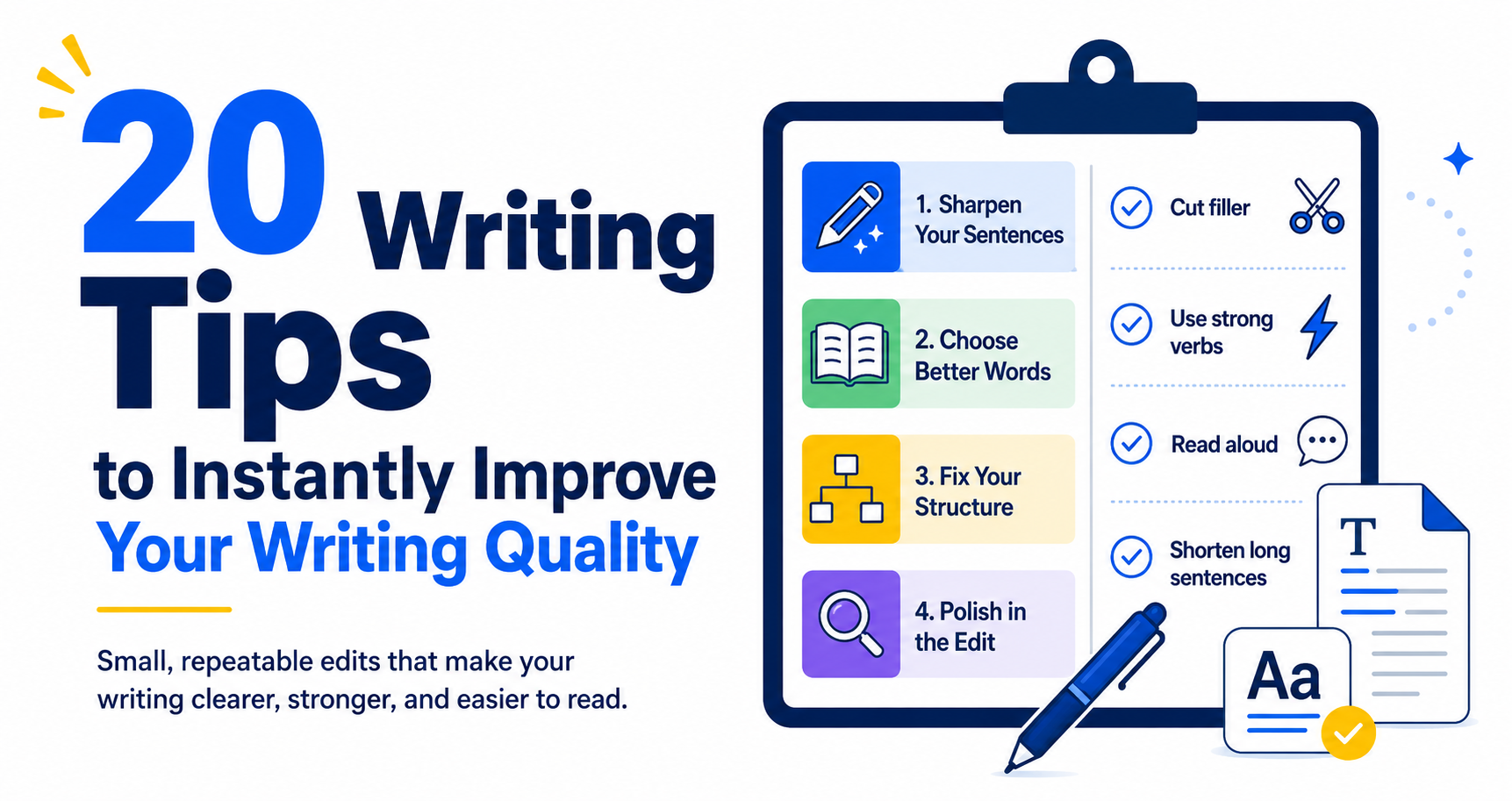
The fastest way to improve your writing is to make small, repeatable edits: cut filler, shorten long sentences, swap weak verbs for strong ones, and read your work aloud. None of these take talent or time, and each one lifts quality on its own. Below are 20 specific tips you can apply to your next draft today, grouped so you can work through them in order: sharpen your sentences, choose better words, fix your structure, and polish in the edit.
Sharpen your sentences (tips 1 to 6)
Sentences are where most clarity is won or lost. These six tips fix the structural habits that make writing feel heavy.
1. Put one idea in each sentence
When a sentence carries two or three ideas, readers lose the thread. If a sentence feels overwhelming, find the natural break and split it in two. One thought per sentence is the simplest clarity rule there is.
2. Keep your average sentence under 20 words
Aim for an average of 15 to 20 words across a document, and split anything past 25. Long sentences are not banned, but a page full of them tires the reader. Check your average by pasting a draft into the sentence counter and dividing the word counter total by the number of sentences.
3. Vary your sentence length
A run of same-length sentences sounds flat. Mix short, medium, and long to create rhythm. As the writer Gary Provost showed, a short sentence lands hard after a long one, and that contrast is what makes prose sing.
4. Use the active voice by default
Put the doer before the action. "The manager reviewed the report" beats "The report was reviewed by the manager." Active voice is shorter, clearer, and shows who is responsible.
5. Start sentences with the subject
Long wind-ups bury the point. Lead with who or what the sentence is about, then say what they did. It keeps the reader oriented from the first word.
6. Keep subject and verb close together
When too many words separate the subject from its verb, a reader has to hold the subject in mind while wading through the gap. Move the action closer to the actor.
Choose better words (tips 7 to 12)
Word choice is the next biggest lever. Strong, plain words do more work than long or vague ones.
Tip | Weak | Strong |
|---|---|---|
7. Pick a strong verb | ran quickly | sprinted |
8. Cut the adverb | walked nervously | paced |
9. Replace "to be" verbs | is a help to | helps |
10. Use plain words | utilize | use |
11. Delete filler | very unique | unique |
12. Be specific | a lot of people | two thirds of readers |
7. Pick a strong verb
The verb carries the sentence. A precise verb, like sprinted, dashed, or bolted instead of ran, conveys more in one word than a weak verb plus an adverb ever can.
8. Cut the adverb, strengthen the verb
Most adverbs prop up a weak verb. Rather than walked nervously, write paced. Rather than said loudly, write shouted. The verb does the work the adverb was patching.
9. Replace "to be" as your main verb
Is, are, was, and were are weak as main verbs. "She is the manager of the team" becomes "She manages the team." The sentence gets shorter and more active.
10. Choose the simplest word that fits
Plain words are not lazy; they are clear. Use, start, and about beat utilize, commence, and regarding. Plain words also have fewer syllables, which lifts your readability score.
11. Delete filler words
Very, really, just, actually, basically, and that usually add nothing. Read the sentence without them; if the meaning holds, leave them out.
12. Be specific instead of vague
Concrete detail is more convincing than generality. A lot of people becomes two thirds of readers. Soon becomes by Friday. Specifics build trust because they show you know the detail.
Fix your structure (tips 13 to 16)
13. Put one idea in each paragraph
A paragraph should make a single point, stated in its first sentence. When it drifts to a second idea, break it. Check your breaks with the paragraph counter.
14. Lead with your main point
Do not bury the message in the middle. Say the most important thing first, then explain it. Busy readers skim, and the top of a paragraph is where their eyes land.
15. Use headings, lists, and white space
Structure is visual clarity. Headings signal what is coming, lists break up dense runs of items, and white space gives the eye room. A wall of text feels hard before a word is read.
16. Keep paragraphs short for the screen
Online, two to four sentences per paragraph reads best. Long blocks make people skim or leave. Shorter paragraphs feel approachable and hold attention longer.
Polish in the edit (tips 17 to 20)
Quality is mostly made in the edit, not the first draft. These four habits catch what drafting misses.
17. Read it aloud
Reading aloud is the single best edit. Your ear catches what your eye skips: clumsy phrasing, missing words, sentences that run out of breath. If you stumble, the reader will too.
18. Cut 10 percent
After a draft, challenge yourself to remove a tenth of the words without losing meaning. Almost every first draft has that much slack, and cutting it makes the rest land harder.
19. Check your readability score
Turn clarity into a number. A Flesch Reading Ease score of 60 to 70 suits most general writing. Paste your draft into the readability checker and fix the sentences dragging the score down.
20. Sleep on it, then reread
Time creates distance. Coming back to a draft after a break, even a few hours, lets you read it closer to how a stranger would. Problems you could not see while writing become obvious.
The 20 tips at a glance
Group | Tips |
|---|---|
Sharpen sentences | One idea, under 20 words, vary length, active voice, lead with subject, subject near verb |
Choose better words | Strong verbs, cut adverbs, replace "to be", plain words, delete filler, be specific |
Fix structure | One idea per paragraph, lead with the point, use headings and lists, short paragraphs |
Polish in the edit | Read aloud, cut 10 percent, check readability, sleep on it |
How to use these tips together?
You do not need to apply all 20 at once. Write your first draft freely, without stopping to edit, then make one focused pass for each group: tighten the sentences, sharpen the words, fix the structure, and polish. Read the result aloud, run it through the readability checker, and you will feel the difference in a single sitting. The tips compound, so the more of them become habit, the less editing each new draft needs.
Frequently Asked Questions
What is the fastest way to improve my writing?
Read your draft aloud and cut filler. Reading aloud catches awkward phrasing your eye skips, and removing filler words like very, just, and actually instantly tightens the prose. Together they lift quality in a single editing pass.
How do strong verbs improve writing?
A precise verb carries meaning that would otherwise need a weak verb plus an adverb. Sprinted says more than ran quickly, and paced says more than walked nervously. Strong verbs make sentences shorter, clearer, and more vivid.
Why should I cut adverbs?
Most adverbs prop up a weak verb. Instead of walked nervously, use paced; instead of said loudly, use shouted. Replacing the adverb with a stronger verb tightens the sentence and sharpens the image.
How long should sentences be for good writing?
Aim for an average of 15 to 20 words and rarely go past 25. Vary the length for rhythm, using short sentences for emphasis and longer ones for detail, but keep the document average in that range.
Does reading my writing aloud really help?
Yes, it is one of the most effective edits there is. Your ear catches clumsy phrasing, missing words, and sentences that run too long, all of which the eye tends to skip. If you stumble while reading, a reader will stumble too.
Sources
The tips in this guide reflect widely taught writing and plain-language advice, including plain-language principles, Gary Provost's well-known guidance on varying sentence length for rhythm, and the standard recommendation of a 15-to-20-word average sentence and a Flesch Reading Ease score of 60 to 70 for general readers.