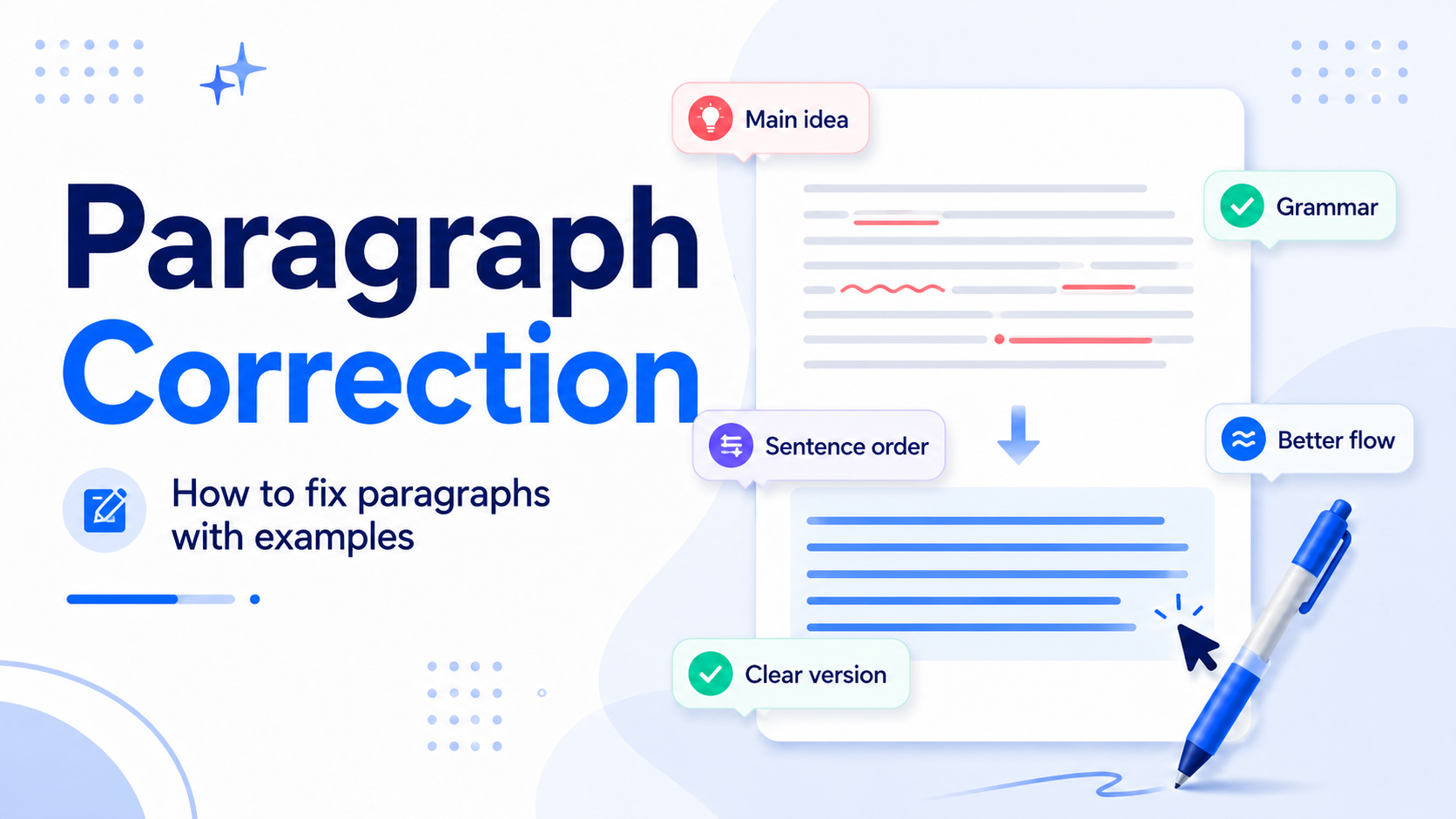
Paragraph Correction: How to Fix Paragraphs With Examples
A paragraph can have good ideas and still feel hard to read. Sometimes the grammar is fine, but the paragraph has no clear point. Sometimes the sentences are…
A paragraph can have good ideas and still feel hard to read.
Sometimes the grammar is fine, but the paragraph has no clear point. Sometimes the sentences are correct, but they are in the wrong order. Sometimes the paragraph is too long, too short, repetitive, or missing a smooth connection between ideas.
That is where paragraph correction helps.
Paragraph correction means improving a paragraph so it is clear, complete, organized, and easy to read. It is not only about fixing spelling and grammar. It is also about checking the main idea, sentence order, transitions, flow, punctuation, and word choice.
A corrected paragraph should help the reader understand one idea without confusion.
What is paragraph correction?
Paragraph correction is the process of reviewing and improving a paragraph for grammar, clarity, structure, flow, and meaning.
A paragraph usually needs correction when it has problems like:
Unclear main idea
Weak topic sentence
Grammar or punctuation errors
Sentences in the wrong order
Too many ideas in one paragraph
Repeated words or phrases
Missing transitions
Awkward sentence structure
Weak conclusion or ending sentence
For example, this paragraph needs correction:
Reading is good. Students should do it. It helps words and writing. Some students do not read. Books are useful.
The idea is there, but the paragraph feels choppy and underdeveloped.
Corrected version:
Reading is one of the easiest ways for students to improve their language skills. It helps them learn new words, understand sentence patterns, and develop stronger writing habits. Even a few pages a day can make a difference because students see vocabulary and grammar used in real context.
The corrected version has a clear topic, better sentence flow, and stronger explanation.
Key Takeaways
Paragraph correction is more than grammar correction.
A strong paragraph should focus on one main idea.
The topic sentence should tell the reader what the paragraph is about.
Sentences should follow a logical order.
Transitions help connect ideas smoothly.
Paragraphs should be long enough to explain the idea, but not so long that they become hard to read.
The best paragraph correction improves clarity first, style second.
Why paragraph correction matters?
A paragraph is one of the basic building blocks of writing.
If your paragraphs are weak, the full essay, article, email, or report becomes harder to understand. Readers may lose the point, skip sections, or misunderstand your message.
Good paragraph correction helps you:
Make your writing clearer
Remove unnecessary words
Fix grammar and punctuation mistakes
Improve sentence flow
Organize ideas in a better order
Make paragraphs easier to read
Strengthen essays, assignments, blog posts, and professional writing
It also helps you become a better writer because you start noticing patterns. You learn when a paragraph is too crowded, when a sentence is out of place, and when an idea needs more support.
The parts of a strong paragraph
Most strong paragraphs have four basic parts.
Part | Purpose | Example |
|---|---|---|
Topic sentence | Introduces the main idea | Daily reading improves student writing. |
Explanation | Explains the idea | It exposes students to better vocabulary and sentence patterns. |
Evidence or example | Supports the idea | For example, students who read often usually recognize more words in context. |
Closing sentence | Wraps up the paragraph | This is why reading is one of the simplest ways to build stronger writing habits. |
Not every paragraph needs to follow this exact pattern, but most clear paragraphs need a main idea, support, and logical flow.
If you are writing an essay and are unsure how many paragraphs you need, this guide on how to count paragraphs in an essay can help you understand essay structure better.
How to correct a paragraph step by step?
Paragraph correction becomes easier when you follow a process. Do not try to fix everything at once. Start with the big problems, then move to smaller edits.
1. Find the main idea
Before fixing grammar, ask:
What is this paragraph really about?
A paragraph should focus on one main idea. If it has two or three unrelated ideas, split it.
Weak paragraph:
Exercise is good for health. Many students also struggle with homework. Healthy food can be expensive. Walking every day is useful.
This paragraph jumps between exercise, homework, food, and walking.
Corrected paragraph:
Exercise is good for health because it strengthens the body and improves energy. Even simple activities like walking can help students feel more focused during the day. A short daily walk is often easier to maintain than an intense workout plan.
Now the paragraph focuses on one idea: exercise helps health and focus.
2. Improve the topic sentence
The topic sentence should tell the reader what the paragraph will explain.
Weak topic sentence:
There are many things about reading.
Better topic sentence:
Reading every day helps students improve vocabulary and writing skills.
The second version is clearer because it gives a specific point.
A good topic sentence should not be too broad. It should give the paragraph direction.
3. Check the sentence order
Even correct sentences can feel confusing if they are in the wrong order.
Weak order:
For example, many students learn new words from novels. Reading improves vocabulary. This helps them use better words in essays.
Better order:
Reading improves vocabulary. For example, many students learn new words from novels. This helps them use better words in essays.
The corrected version moves from main idea to example to result.
A simple order is:
Main idea → explanation → example → result
This structure works for many school paragraphs, blog paragraphs, and essay body paragraphs.
4. Fix grammar and punctuation
After the idea and order are clear, fix grammar.
Look for:
Subject-verb agreement
Missing verbs
Wrong tense
Comma mistakes
Run-on sentences
Sentence fragments
Incorrect word forms
Capitalization errors
Weak sentence:
The students was reading because they wants to improve.
Corrected sentence:
The students were reading because they wanted to improve.
For quick grammar checks, you can use a grammar checker after you revise the paragraph yourself. A tool can catch many mistakes, but you should still read the paragraph carefully to make sure the meaning is right.
5. Improve sentence structure
Paragraph correction often requires sentence structure correction.
Weak structure:
Because the paragraph was too long and the reader confused and the main idea was not clear.
This is not a complete sentence.
Corrected version:
Because the paragraph was too long, the reader became confused and the main idea was not clear.
Better version:
The paragraph was too long, so the reader became confused and missed the main idea.
The best correction is not always the longest one. Often, the clearer sentence is shorter.
For a deeper explanation of how sentences work, see this guide on sentence structure.
6. Add transitions where needed
Transitions help connect ideas.
Without transitions:
Reading improves vocabulary. It helps writing. It builds focus.
With transitions:
Reading improves vocabulary. In addition, it helps students understand sentence patterns. Over time, it can also build focus and patience.
Transitions should not be forced. Use them only when they help the reader follow your thinking.
Useful transition phrases include:
For example
In addition
However
As a result
In other words
Because of this
On the other hand
To sum up
If your paragraphs feel difficult to begin, this article on paragraph starters gives useful phrases for introductions, body paragraphs, examples, evidence, contrast, and conclusions.
7. Remove repeated words and weak phrases
Some paragraphs feel boring because they repeat the same words.
Weak version:
Writing is important because writing helps students write better essays. Good writing also helps students write better answers.
Corrected version:
Writing is important because it helps students create stronger essays and clearer answers.
You can often replace repeated words with:
A pronoun
A synonym
A shorter phrase
A clearer sentence structure
But do not replace every word with a fancy alternative. Clarity matters more than sounding impressive.
8. Check paragraph length
A paragraph can be correct but still hard to read if it is too long.
Long paragraphs often contain too many ideas. Short paragraphs may not explain enough.
A good paragraph should be long enough to develop one point clearly. In many essays, body paragraphs are often around 100 to 200 words, but this depends on the assignment and topic.
If you want to check how your writing is divided, use a paragraph counter to review the number of paragraphs in your draft.
9. Read the paragraph aloud
Reading aloud is one of the easiest ways to catch awkward writing.
You may notice:
A sentence is too long
A word sounds unnatural
Two sentences repeat the same idea
The paragraph ends suddenly
The flow feels choppy
If you stumble while reading, the reader may stumble too.
Paragraph correction example
Here is a weak paragraph:
Social media is good and bad. People use it every day. It helps communication. But it also waste time and people can get distracted. Students should be careful because many students use it too much and then they cannot focus on study.
Now let’s correct it.
Corrected paragraph:
Social media has both benefits and drawbacks for students. It helps people communicate quickly, share information, and stay connected with friends. However, it can also waste time when students scroll for hours without a purpose. Because of this, students should use social media carefully and set limits so it does not affect their focus or study habits.
What changed?
The topic sentence is clearer.
Grammar errors were fixed.
The sentences now follow a logical order.
The contrast is introduced with “however.”
The final sentence explains the main lesson.
Paragraph correction before and after
Weak paragraph:
Online learning is useful. It is flexible. Students can study home. Some students not understand because no teacher near them. Online learning has good things and bad things.
Better paragraph:
Online learning is useful because it gives students more flexibility. They can study from home, review lessons at their own pace, and save travel time. However, some students may struggle when they do not have a teacher nearby to answer questions. For this reason, online learning works best when students have clear instructions, support, and a regular study schedule.
This correction improves grammar, flow, detail, and balance.
Common paragraph correction mistakes
The first mistake is fixing only grammar.
Grammar matters, but a grammatically correct paragraph can still be weak if the idea is unclear.
The second mistake is adding too many transition words.
Weak:
Furthermore, reading is useful. Moreover, it helps students. In addition, it is good.
Better:
Reading is useful because it helps students build vocabulary, focus, and writing skills.
The third mistake is making every sentence longer.
Some people think correction means adding more words. It does not. Sometimes the best correction is cutting words.
Weak:
Due to the fact that students are in need of better writing skills, they should practice on a regular basis.
Better:
Students should practice regularly to improve their writing skills.
The fourth mistake is changing the meaning.
When correcting a paragraph, keep the writer’s original idea. Improve the expression, but do not replace the point with something else.
Paragraph correction checklist
Use this checklist when editing your own writing:
Does the paragraph have one clear main idea?
Is the topic sentence specific?
Are the sentences in a logical order?
Does each sentence support the main idea?
Are there grammar or punctuation errors?
Are any sentences too long or confusing?
Are any words repeated too often?
Does the paragraph need a transition?
Is the paragraph too long or too short?
Does the final sentence feel complete?
This checklist works for essays, blog posts, reports, emails, and school assignments.
Paragraph correction for essays
Essay paragraphs need clear structure because every paragraph should support the thesis.
A strong essay body paragraph usually follows this pattern:
Topic sentence → explanation → evidence → analysis → closing sentence
Example:
Daily reading improves student writing because it exposes learners to stronger sentence patterns. When students read often, they see how experienced writers organize ideas, use transitions, and vary sentence length. For example, a student who reads articles and short stories may start to use clearer paragraph structure in their own essays. This shows that reading does not only build vocabulary; it also teaches writing through repeated exposure.
This paragraph works because every sentence supports the same point.
Paragraph correction for blog posts
Blog paragraphs should usually be shorter and easier to scan than academic essay paragraphs.
Long blocks of text can make online readers leave, especially on mobile.
Weak blog paragraph:
Paragraph correction is important because when people write online they need to make sure their content is readable and if the paragraphs are too long then users may not continue reading and they may leave the page before understanding the point.
Better blog paragraph:
Paragraph correction is important for online writing because readers scan before they read. If a paragraph is too long, users may leave before they understand the point. Shorter, clearer paragraphs make blog posts easier to read, especially on mobile.
For blog writing, clarity and spacing matter. A paragraph that looks fine in a document may feel too heavy on a phone screen.
Paragraph correction for students
Students often make paragraph mistakes because they focus only on word count.
A paragraph should not exist just to make the essay longer. It should do a job.
Ask:
What point does this paragraph prove?
If the paragraph does not support the assignment question, it may need to be rewritten or removed.
Students should also check whether the paragraph has enough explanation. A quote or example is not enough by itself. You still need to explain why it matters.
Paragraph correction for professional writing
In professional writing, paragraphs should be clear, direct, and easy to act on.
Weak email paragraph:
I am writing to say that maybe we should possibly change the meeting time because some people might not be available and it could be better to move it if that works for everyone.
Better email paragraph:
We may need to change the meeting time because several people are unavailable. If everyone agrees, I suggest moving it to Thursday at 2 p.m.
Professional paragraph correction often means removing hesitation, cutting filler, and making the message direct.
Paragraph correction and readability
A corrected paragraph should be easy to read.
Readability depends on:
Sentence length
Word choice
Paragraph length
Clear structure
Smooth transitions
Logical order
After correcting a paragraph, you can use a readability checker to see whether the writing is easy to understand.
If your paragraph still feels heavy, try shortening long sentences, replacing difficult words, or splitting one paragraph into two.
For more editing advice, see 20 Writing Tips to Instantly Improve Your Writing Quality.
Paragraph correction vs sentence correction
Paragraph correction and sentence correction are related, but they are not the same.
Sentence correction focuses on one sentence.
Paragraph correction focuses on the whole block of writing.
A sentence correction checks grammar, punctuation, and word order.
A paragraph correction checks:
Main idea
Sentence order
Flow
Development
Transitions
Relevance
Ending
A paragraph can contain correct sentences but still need correction if the ideas do not connect.
How sentence starters help paragraph correction?
Sometimes a paragraph feels weak because the sentences do not connect well.
Sentence starters can help with that.
Example:
The paragraph explains the problem. For example, it shows how long sentences confuse readers. As a result, the corrected version feels easier to follow.
Sentence starters should not be added everywhere, but they can help guide the reader through the paragraph.
For more options, see this guide on sentence starters.
Best tools for paragraph correction
You can correct paragraphs manually, but tools can help you review faster.
Use tools for:
Counting paragraphs
Checking sentence count
Finding grammar mistakes
Reviewing readability
Spotting long sentences
Checking word count
If a paragraph feels too long, check the paragraph count. If the writing feels choppy, check the sentence count. If the text feels difficult, check readability.
For sentence-level review, a sentence counter can help you see how many sentences are in your paragraph and whether you may need more variety.
Paragraph correction is not only about fixing mistakes.
It is about making the paragraph work better.
A strong paragraph has one main idea, a clear topic sentence, logical sentence order, enough support, and a smooth ending. It should guide the reader from the first sentence to the last without confusion.
Start with the big question:
What is this paragraph trying to say?
Once that is clear, everything else becomes easier to fix.
Correct the structure. Improve the sentences. Remove what does not belong. Add what the reader needs.
That is how a rough paragraph becomes clear writing.
Frequently Asked Questions
What is paragraph correction?
Paragraph correction is the process of improving a paragraph for grammar, clarity, structure, flow, punctuation, and meaning. It helps make the paragraph easier to read and understand.
How do you correct a paragraph?
Start by finding the main idea. Then improve the topic sentence, arrange the sentences in a logical order, fix grammar and punctuation, add transitions where needed, remove repetition, and check whether the paragraph is too long or too short.
What makes a paragraph correct?
A correct paragraph has one clear main idea, complete sentences, proper grammar, logical order, and enough supporting detail. It should feel focused and easy to follow.
What are common paragraph mistakes?
Common paragraph mistakes include unclear topic sentences, too many ideas in one paragraph, weak sentence order, grammar errors, repeated words, missing transitions, and paragraphs that are too long or too short.
How long should a paragraph be?
In many essays, a paragraph is often around 100 to 200 words, but there is no fixed rule. A paragraph should be long enough to explain one idea clearly and short enough to stay readable.
Can a paragraph be one sentence?
Yes, a paragraph can be one sentence if it expresses a complete idea. However, in formal essays, most body paragraphs need more than one sentence to explain and support the point.
What is the difference between editing and paragraph correction?
Editing can include many levels of improvement, including grammar, punctuation, tone, style, and formatting. Paragraph correction focuses specifically on making a paragraph clearer, better organized, and easier to read.
How do I know if my paragraph needs correction?
Your paragraph may need correction if the main idea is unclear, the sentences feel out of order, the writing sounds choppy, the paragraph is too long, or the reader may not understand the point.
Should I correct grammar first or structure first?
Correct structure first. Make sure the paragraph has one clear idea and logical sentence order. Then fix grammar, punctuation, and word choice.