CVCC Words: Lists, Examples, Worksheets, Teaching Guide
CVCC words made simple: clear definition, complete word lists by blend and vowel, examples, worksheets, exercises, teaching tips, and FAQs for K–Grade 1.
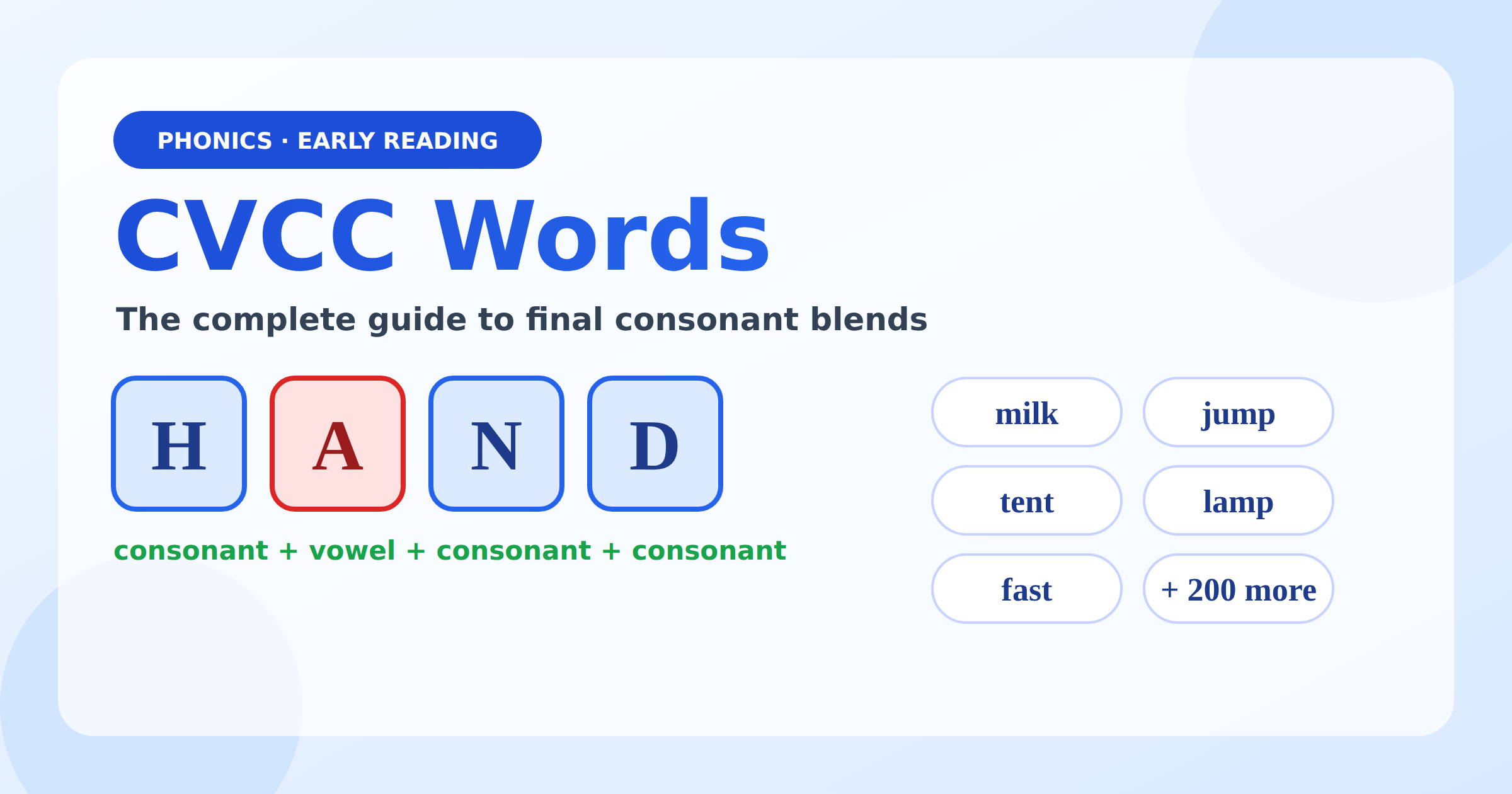
CVCC words are the bridge between simple three-letter reading and longer, more natural words. A child who can read cat, dog, and sun is ready for hand, milk, jump, tent, and lamp. That extra consonant at the end changes everything: suddenly the reader has to hear and blend two consonant sounds at the end of a word instead of one.
This guide brings together everything a teacher, tutor, or homeschooling parent needs. You will find a clear definition, the difference between CVCC and other phonics patterns, complete and deduplicated word lists sorted by ending blend and vowel sound, sentences, reading passages, step-by-step teaching methods, hands-on activities, a printable-style worksheet, exercises with answers, common mistakes with fixes.
What Are CVCC Words?
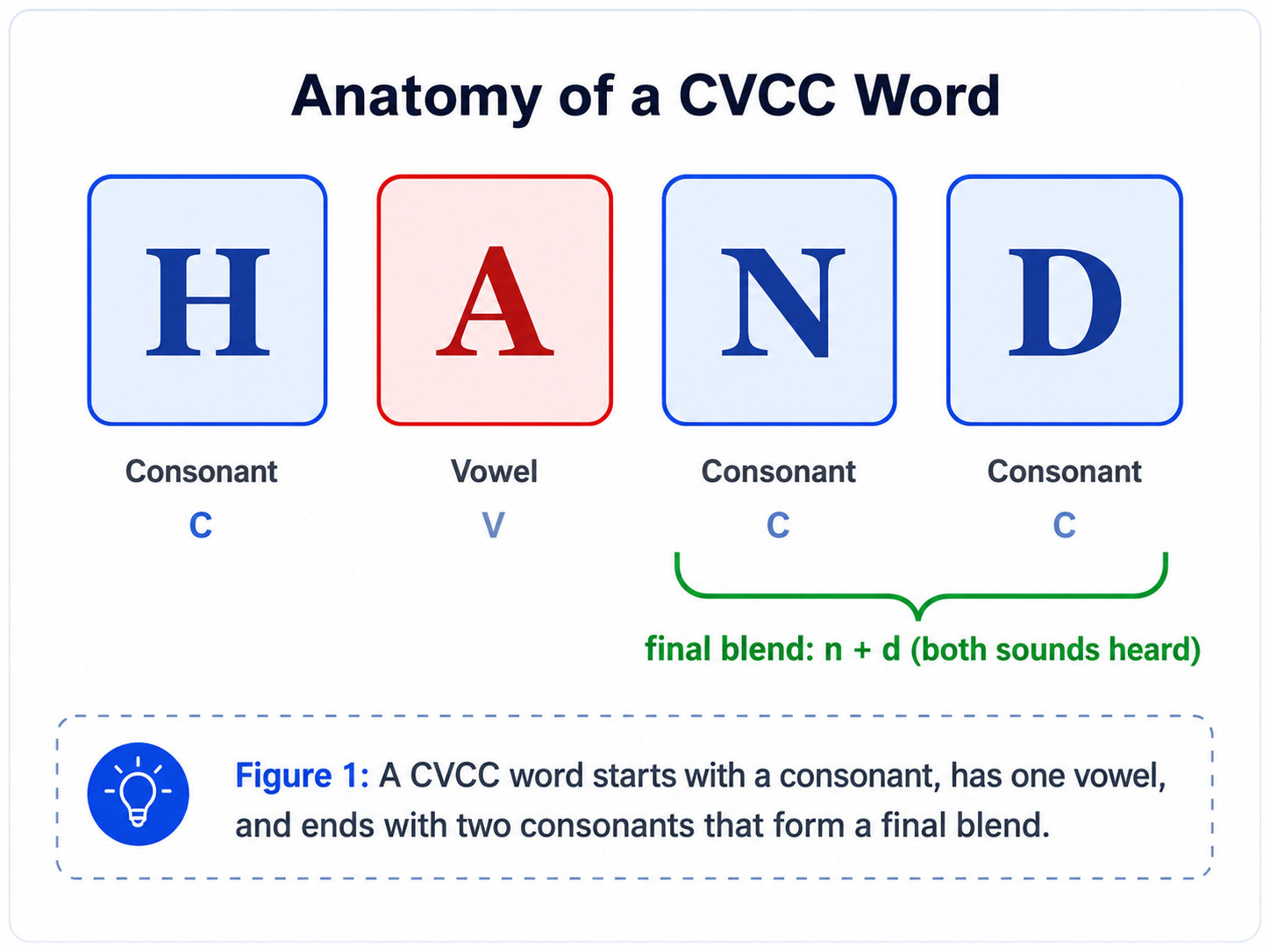
A CVCC word begins with one consonant, has one vowel, and ends with two consonants (Consonant + Vowel + Consonant + Consonant). Examples include hand, milk, jump, tent, lamp, and fast. The final two consonants usually form a blend such as nd, mp, nt, or st, where both consonant sounds can be heard. CVCC words are used to teach short vowels, final consonant blends, blending, segmenting, and early spelling.
CVCC Word | Consonant | Vowel | Consonant | Consonant |
|---|---|---|---|---|
hand | h | a | n | d |
milk | m | i | l | k |
jump | j | u | m | p |
tent | t | e | n | t |
lamp | l | a | m | p |
fast | f | a | s | t |
desk | d | e | s | k |
Key Takeaways
CVCC stands for consonant-vowel-consonant-consonant.
CVCC words usually have four written letters and end with two consonants.
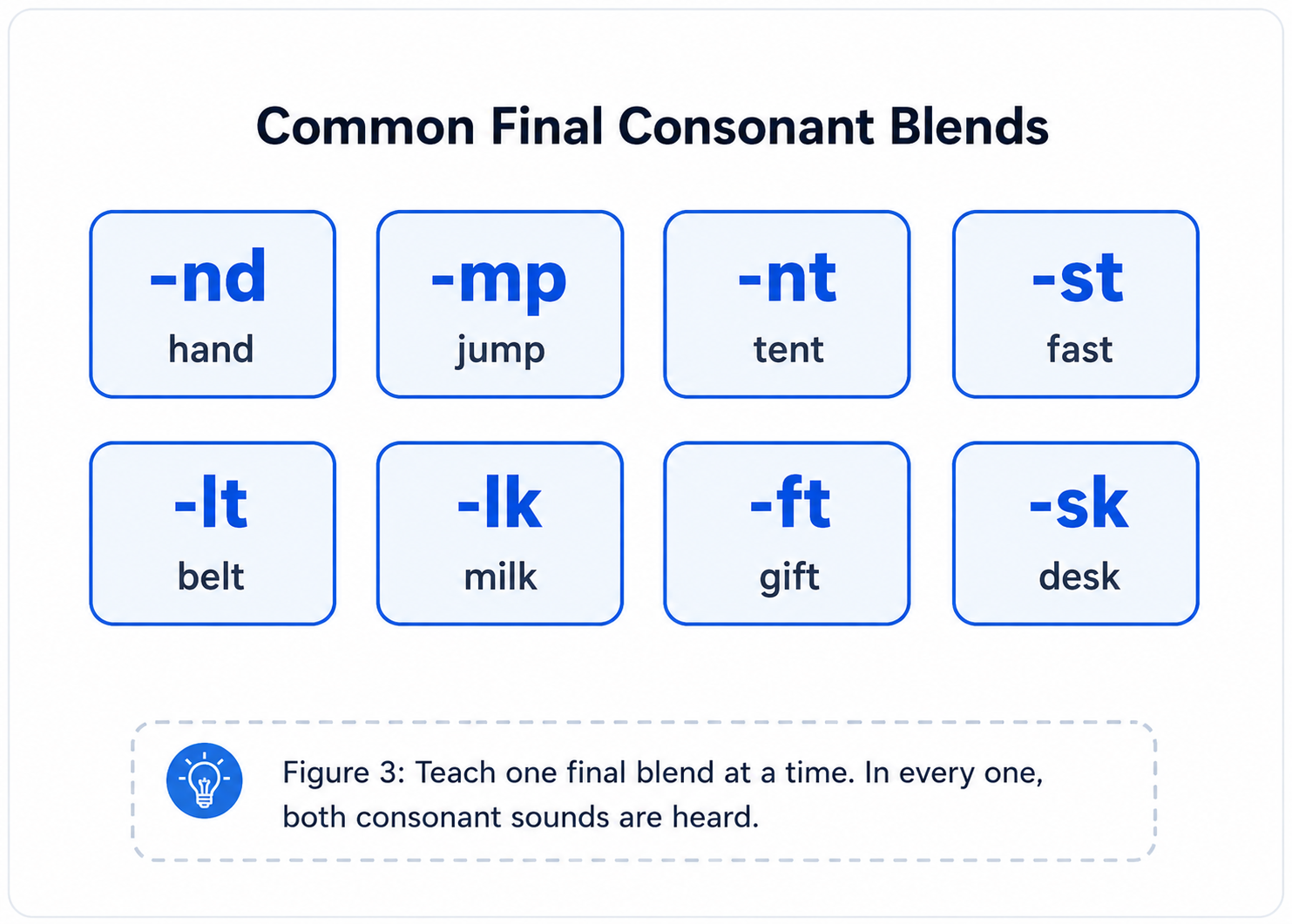
The final two consonants often form a final consonant blend (nd, mp, nt, st, lt, lk, ft, sk), where both sounds are heard.
Most beginner examples use a short vowel sound, though some written CVCC words (cold, find, wild) do not.
Children normally master CVC words before CVCC words.
CVCC is different from CCVC (blend at the beginning, like clap) and from digraph words (two letters, one sound, like dish).
Not every four-letter word is CVCC. Written letter patterns and spoken sound patterns do not always match.
The most effective teaching tools are sound boxes, blending and segmenting, word sorting, dictation, and short reading passages, one blend group at a time.
What Does CVCC Mean?
CVCC describes the order of letters in a word:
Consonant + Vowel + Consonant + Consonant
C = a consonant (b, c, d, f, g, h, j, k, l, m, n, p, q, r, s, t, v, w, x, y, z)
V = a vowel (a, e, i, o, u)
C = a consonant
C = a consonant
The word starts with a single consonant, the vowel sits in the second position, and two consonants close the word.
Word | Pattern |
|---|---|
hand | C V C C |
milk | C V C C |
jump | C V C C |
tent | C V C C |
lamp | C V C C |
pond | C V C C |
belt | C V C C |
dust | C V C C |
Most early CVCC words carry a short vowel: short a in lamp, short e in tent, short i in milk, short o in pond, and short u in jump.
CVCC Letters vs CVCC Sounds
Here is a nuance that trips up many word lists. The label "CVCC" can describe either the written letters or the spoken sounds, and the two do not always line up.
As a written pattern, a word is CVCC if its four letters are arranged consonant-vowel-consonant-consonant. By this definition, milk (m-i-l-k) is CVCC.
As a sound pattern, some phonics programs care about phonemes rather than letters. hand works cleanly because it has exactly four sounds: /h/ /a/ /n/ /d/.
The mismatch matters when a word contains a digraph, a silent letter, an irregular vowel, or an accent-dependent pronunciation. Throughout this guide, CVCC mainly means a four-letter word written in the C-V-C-C sequence, and beginner lists deliberately favor words in which all four sounds are easy to hear.
Why CVCC Words Matter?
CVCC words push readers past the safety of three-sound words. Once a child can read cat, dog, and sun, the next challenge is hearing that hidden extra consonant in words like hand, jump, milk, and tent.
Learning CVCC words helps children:
hear every sound in a word, including both final consonants
read words that end with consonant blends
spell longer short-vowel words with confidence
strengthen decoding and build reading fluency
write more natural sentences
prepare for longer words, digraphs, and multisyllable reading
In short, CVCC words are the bridge between basic CVC reading and more advanced phonics.
CVCC vs CVC vs CCVC (At a Glance)
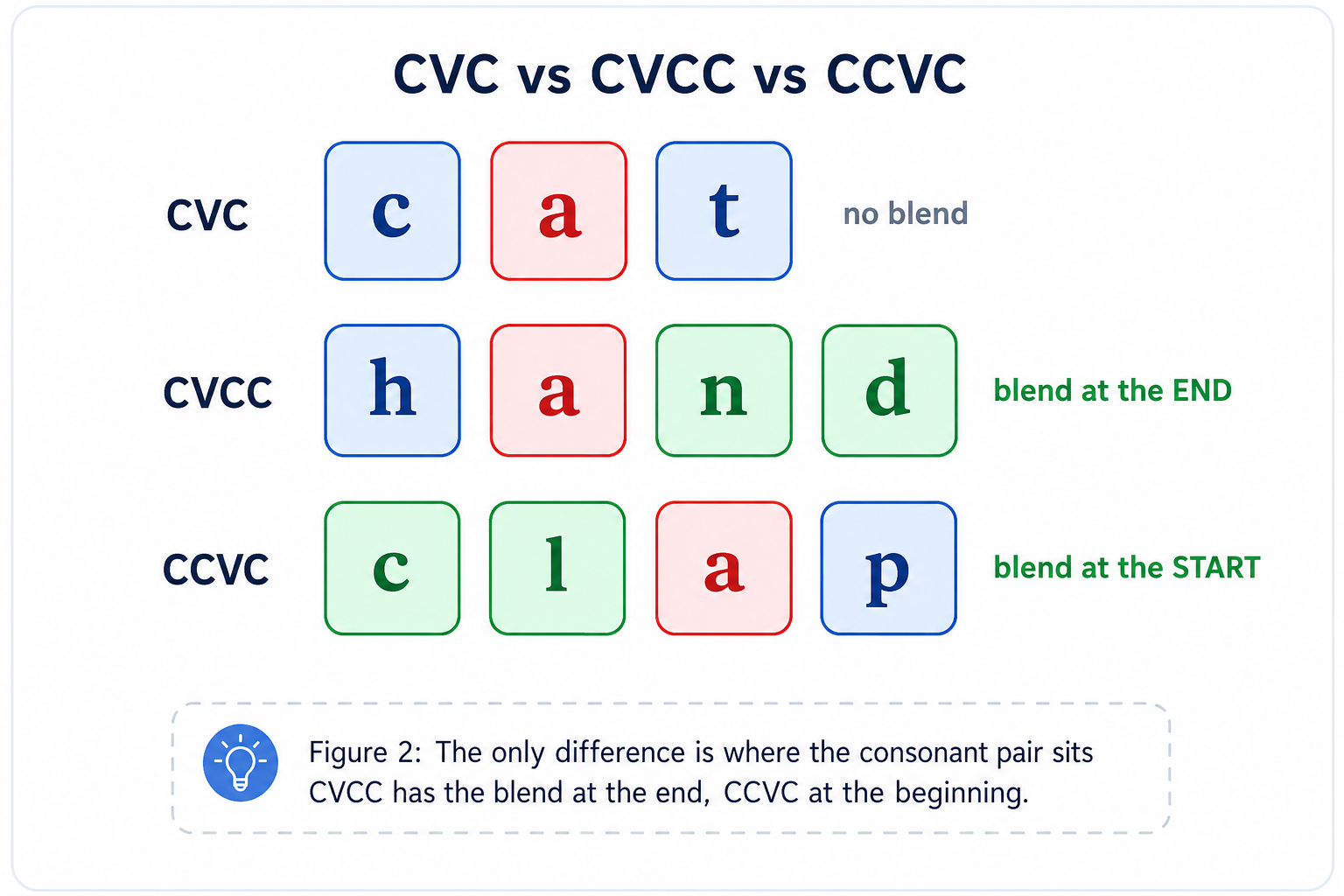
The fastest way to understand CVCC is to place it next to its neighbors. All three patterns are common in early phonics, and the only real difference is where the consonants sit.
Pattern | Structure | Where the blend is | Examples |
|---|---|---|---|
CVC | consonant + vowel + consonant | no blend | cat, dog, pen, sun |
CVCC | consonant + vowel + consonant + consonant | end of the word | hand, milk, jump, tent |
CCVC | consonant + consonant + vowel + consonant | start of the word | clap, frog, stop |
Worked examples:
CVC: cat = c + a + t
CVCC: hand = h + a + n + d (blend nd at the end)
CCVC: stop = s + t + o + p (blend st at the start)
CVC words are taught first because they are shorter and easier to sound out. CVCC and CCVC come next. Some teachers introduce CCVC before CVCC and some do the reverse; the right order depends on the child, and the only firm rule is that CVC reading should be solid first.
CVCC Blends vs Digraphs
This distinction is essential and often missed.
A final blend is two consonants at the end of a word where both sounds are still heard. A digraph is two letters that together make one sound.
Type | What happens | Examples |
|---|---|---|
Final blend | Both consonant sounds are heard | hand, jump, fast, desk |
Digraph | Two letters make one sound | dish, much, path, duck |
In milk, you hear both /l/ and /k/. In dish, the letters sh make a single sound. Some four-letter words with digraphs (ship, duck, path) look like CVCC by spelling but are taught separately because the sound pattern is different. When you begin, choose words where both final consonant sounds are unmistakable: hand, jump, lamp, belt, desk, fast.
Complete CVCC Word List by Ending Blend
Grouping words by their ending blend is the single most useful way to teach and sort them. Teach one group at a time so the ending sound stays in focus.
CVCC Words Ending in ND
Word | Example Sentence |
|---|---|
band | The band played music. |
bend | Bend your knees. |
bond | They formed a strong bond. |
fund | The class has a fund. |
hand | Raise your hand. |
land | The plane will land. |
lend | Lend me a pencil. |
mend | Mend the torn sock. |
pond | A duck swam in the pond. |
sand | The sand is warm. |
send | Send the letter today. |
wind | The wind blew hard. |
CVCC Words Ending in NT
Word | Example Sentence |
|---|---|
bent | The wire is bent. |
dent | The car has a dent. |
hint | Give me a hint. |
hunt | The cat likes to hunt. |
lint | There is lint on the coat. |
mint | The mint smells fresh. |
pant | The dog may pant. |
rent | They pay rent. |
sent | She sent a card. |
tent | We slept in a tent. |
vent | Air came through the vent. |
went | We went home. |
CVCC Words Ending in MP
Word | Example Sentence |
|---|---|
bump | Mind the bump. |
camp | We stayed at camp. |
damp | The towel is damp. |
dump | Dump the soil here. |
hump | The camel has a hump. |
jump | Jump over the line. |
lamp | Turn on the lamp. |
limp | The dog began to limp. |
lump | There is a lump in the bag. |
pump | Pump air into the ball. |
ramp | Walk up the ramp. |
CVCC Words Ending in ST
Word | Example Sentence |
|---|---|
best | Do your best. |
bust | The pipe could bust. |
cost | The toy has a cost. |
dust | Wipe away the dust. |
fast | The rabbit is fast. |
fist | Make a fist. |
gust | A gust moved the leaves. |
just | I just arrived. |
last | This is the last page. |
list | Make a list. |
lost | I lost my book. |
mist | Mist covered the hill. |
must | You must stop. |
nest | The bird built a nest. |
past | We walked past the gate. |
pest | The fly is a pest. |
rest | Take a short rest. |
rust | Rust covered the gate. |
test | We have a test. |
vest | He wore a red vest. |
west | The sun sets in the west. |
CVCC Words Ending in LT
Word | Example Sentence |
|---|---|
belt | Fasten your belt. |
felt | I felt the soft cloth. |
jolt | The jolt surprised me. |
melt | The ice will melt. |
pelt | Rain began to pelt the roof. |
salt | Add salt to the soup. |
tilt | Tilt the cup slowly. |
wilt | The plant may wilt. |
CVCC Words Ending in LD
Word | Example Sentence |
|---|---|
bald | The man is bald. |
bold | Be bold. |
cold | The drink is cold. |
fold | Fold the paper. |
gold | The ring is gold. |
held | She held the cup. |
mild | The soup is mild. |
mold | Mold grew on the bread. |
sold | He sold his bike. |
told | She told a story. |
wild | The horse is wild. |
Accent note: Words like cold, gold, mild, and wild follow the written C-V-C-C pattern but do not use a short vowel. Keep them out of short-vowel lists and introduce them after the pattern is secure.
CVCC Words Ending in LK
Word | Example Sentence |
|---|---|
bulk | The box has a lot of bulk. |
milk | Drink your milk. |
silk | The scarf is made of silk. |
sulk | Do not sit and sulk. |
Accent note: walk and talk also fit the written CVCC pattern, but the l is not clearly pronounced in many accents. For beginners practising four distinct sounds, start with milk and silk.
CVCC Words Ending in FT
Word | Example Sentence |
|---|---|
gift | I opened the gift. |
left | Turn left. |
lift | Lift the lid. |
loft | The boxes are in the loft. |
raft | The raft floated downstream. |
rift | A small rift formed. |
sift | Sift the flour. |
soft | The blanket is soft. |
CVCC Words Ending in SK
Word | Example Sentence |
|---|---|
bask | The cat will bask in the sun. |
desk | Put the book on the desk. |
disk | Save the file to the disk. |
dusk | We returned at dusk. |
mask | Put on the mask. |
risk | Do not take that risk. |
task | Finish the task. |
tusk | The elephant has a tusk. |
Watch out: ask ends in sk but is not CVCC, because it begins with a vowel. Its written pattern is VCC.
CVCC Words Ending in NK
Word | Example Sentence |
|---|---|
bank | We sat on the river bank. |
bunk | He slept on the top bunk. |
dunk | Dunk the ball through the hoop. |
honk | The horn made a loud honk. |
junk | Put the junk in the bin. |
pink | The flower is pink. |
rank | The runners stood in rank order. |
sink | The stone will sink. |
tank | The tank is full. |
wink | She gave me a wink. |
CVCC Words Ending in LP
Word | Example Sentence |
|---|---|
gulp | Take a small gulp. |
help | Please help me. |
pulp | The orange has pulp. |
yelp | The puppy gave a yelp. |
CVCC Words Ending in SP
Word | Example Sentence |
|---|---|
gasp | She gave a quiet gasp. |
lisp | The character spoke with a lisp. |
rasp | His voice had a rasp. |
wasp | A wasp flew past. |
wisp | A wisp of smoke rose. |
CVCC Words Ending in CT
Word | Example Sentence |
|---|---|
fact | That is a useful fact. |
pact | They made a pact. |
tact | Use tact when speaking. |
Watch out: act is not CVCC, it begins with a vowel, giving it a VCC pattern.
CVCC Words by Short Vowel Sound
Many early lessons target one short vowel at a time. Sorting words this way helps children lock in the middle sound.
Short A CVCC Words
band, bank, bask, camp, damp, fact, fast, hand, land, lamp, last, mask, pant, past, raft, ramp, sand, tank, task
Short E CVCC Words
belt, bend, bent, best, dent, desk, felt, help, held, kept, left, lend, melt, mend, nest, pest, rent, rest, self, send, sent, tent, test, vent, vest, went, west, yelp
Short I CVCC Words
disk, gift, hint, lift, limp, lint, list, milk, mint, mist, pink, risk, sift, silk, sink, wink, wind, wisp
Short O CVCC Words
bond, cost, honk, loft, lost, pond, soft
Accent note: the letter o varies most by accent. Model the pronunciation your learners actually use.
Short U CVCC Words
bulk, bump, bunk, bust, dump, dust, fund, gulp, gust, hump, hunt, jump, junk, lump, must, pump, rust, sulk, tusk
CVCC Words With Other (Non-Short) Vowel Sounds
A word can follow the written CVCC sequence without a short vowel. These are still CVCC by spelling, but keep them in their own group:
cold, find, fold, gold, kind, mild, mind, sold, told, wild
Start beginners with clear short-vowel words (hand, tent, milk, pond, jump). Introduce these longer or irregular vowels only once the pattern itself is secure.
CVCC Word Families (Rhyming Groups)
Word families change the first sound while the ending stays the same, which makes spelling and rhyming patterns click. In -amp, only the first letter changes: camp, damp, lamp, ramp.
Word Family | CVCC Examples |
|---|---|
-amp | camp, damp, lamp, ramp |
-and | band, hand, land, sand |
-ank | bank, rank, sank, tank |
-ant | pant, rant |
-ask | ask*, mask, task |
-ast | fast, last, mast, past |
-elt | belt, felt, melt |
-end | bend, lend, mend, send |
-ent | bent, dent, rent, sent, tent, went |
-est | best, nest, pest, rest, test, vest, west |
-ift | gift, lift, rift, sift |
-ilk | milk, silk |
-ilt | hilt, tilt, wilt |
-ind | find, kind, mind, wind |
-ink | pink, sink, wink |
-int | hint, lint, mint |
-ist | fist, list, mist |
-old | bold, cold, fold, gold, sold, told |
-ond | bond, pond |
-ost | cost, lost |
-ump | bump, dump, hump, jump, lump, pump |
-unk | bunk, dunk, junk |
-ust | bust, dust, gust, just, must, rust |
*ask fits the rhyme but is VCC, not CVCC.
How to Teach CVCC Words: A Step-by-Step Method
The main challenge in every CVCC word is the ending blend. Children who read too quickly tend to drop one of the final consonants, turning hand into "han" or milk into "mik." The steps below build the skill in order.
1. Make Sure CVC Reading Is Secure
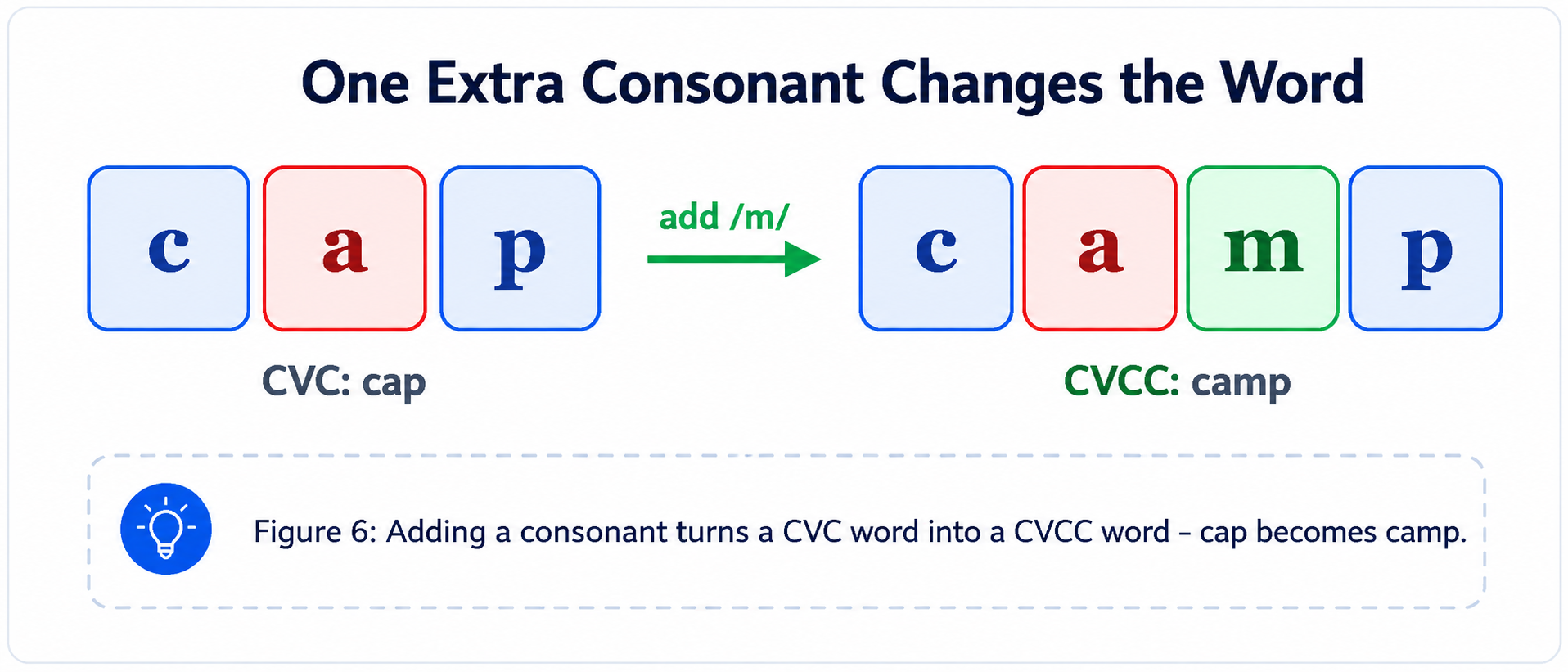
Before adding a fourth sound, confirm the child can confidently read words like cat, bed, pig, hot, sun. A reader still working to blend three sounds will find four-sound words frustrating. A quick check: show how one added consonant changes a familiar word.
CVC | CVCC | Sound Added |
|---|---|---|
cap | camp | /m/ |
lap | lamp | /m/ |
ten | tent | /t/ |
had | hand | /n/ |
set | sent | /n/ |
bed | bend | /n/ |
win | wind | /d/ |
pun | punt | /t/ |
2. Teach One Final Blend at a Time
Do not introduce every blend at once. Start with -nd (hand, land, sand, pond), then move to -mp (camp, damp, lamp, ramp), and so on. Small groups keep the target sound in focus.
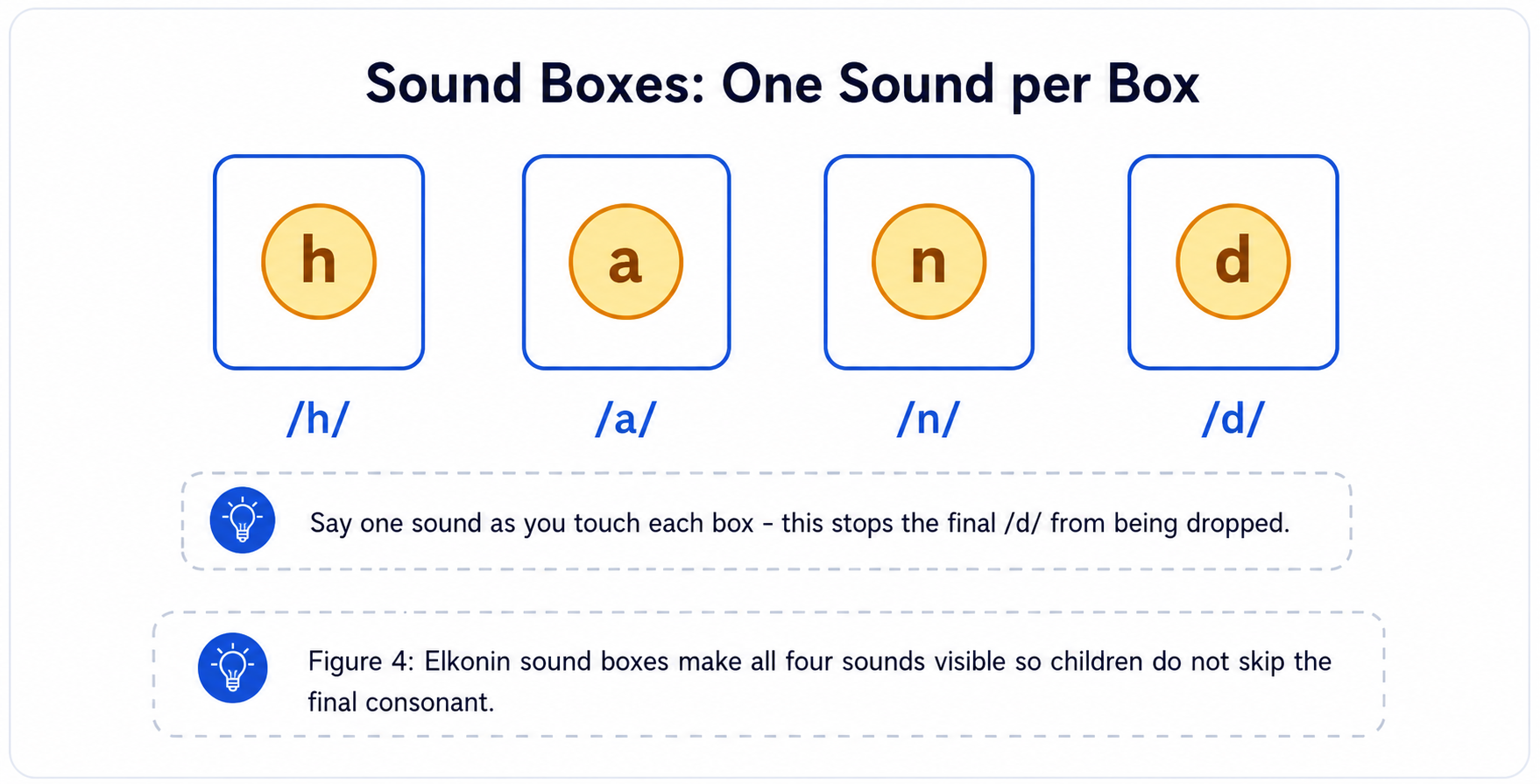
3. Use Four Sound Boxes
Draw four boxes and have the child place one counter in each while saying one sound:
h a n d
/h/ /a/ /n/ /d/
Sound boxes make the two final sounds visible and dramatically reduce dropped consonants.
4. Blend From Left to Right
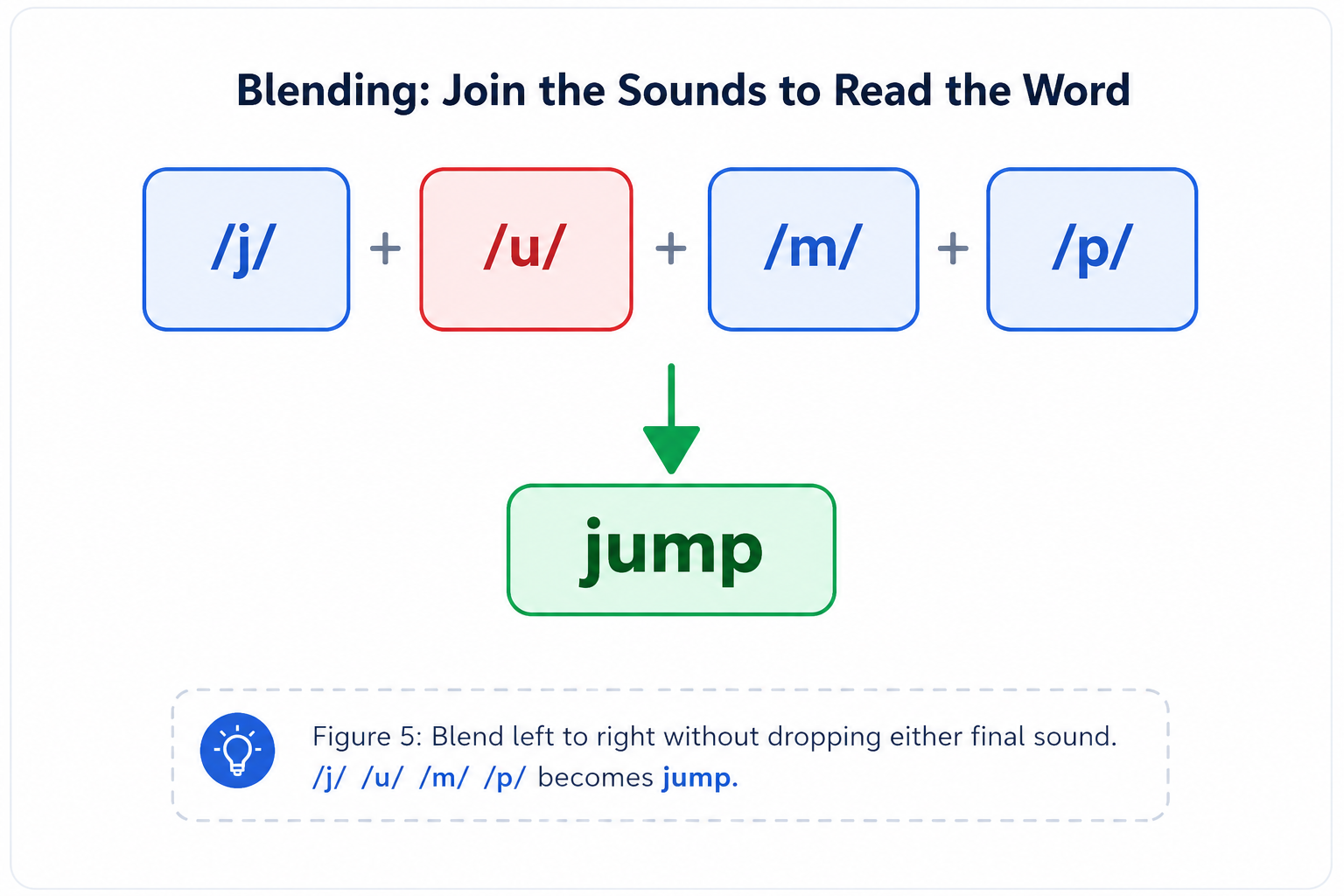
Point to each letter as the child says its sound, then blend the whole word. A simple routine:
Say the first consonant sound.
Say the vowel sound.
Say the first ending consonant.
Say the final consonant.
Blend it all together.
/j/ /u/ /m/ /p/ → jump
5. Stretch the Ending Blend
When a child drops a final sound, slow the word down and isolate the ending:
hannn-d → /n/ /d/
Ask: "What sound comes just before the last sound? What is the very last sound? Can you hear both?"
6. Compare Similar Words
Minimal pairs make the added sound obvious. Show ten → tent, had → hand, set → sent, lap → lamp, then ask the child to explain what changed.
7. Practise Reading and Spelling Together
Say jump and have the child (1) repeat it, (2) segment the sounds, (3) count the sounds, (4) write one letter per sound, and (5) read the finished word. Spelling forces the child to hear both ending consonants.
jump → /j/ /u/ /m/ /p/ → four sounds → j-u-m-p
8. Move From Words to Sentences
Once a word is solid on its own, drop it into a short sentence, then expand it:
I can jump. → I can jump over the log.
This keeps phonics connected to meaning instead of becoming a list to memorize.
CVCC Words in Sentences
Reading words inside sentences connects phonics to meaning.
The lamp is on.
Raise your hand.
I can jump.
The milk is cold.
The bird is in the nest.
We slept in a tent.
Put the book on the desk.
The sand is warm.
Turn left at the sign.
Take a short rest.
I opened the gift.
The duck swam in the pond.
Make a list.
The rabbit ran fast.
The towel is damp.
Short CVCC Reading Passages
Short passages let children practise fluency in context without feeling overwhelmed.
Passage 1: The Camp Tent
We went to camp. Dad put up the tent. A lamp sat beside my bunk. At dusk, we went inside to rest.
CVCC words: went, camp, tent, lamp, bunk, dusk, rest
Passage 2: The Pond
A frog sat beside the pond. It made a big jump and sank into the soft mud. Then it swam back to land.
CVCC words: pond, jump, sank, soft, land
Passage 3: The Gift
Mom sent me a gift. I held the box in my hand. The gift was soft, and I felt glad.
CVCC words: sent, gift, held, hand, soft, felt
Passage 4: The Desk
A pink lamp sits on my desk. I made a list and put it beside my book. Then I drank my milk.
CVCC words: pink, lamp, desk, list, milk
CVCC Word Activities
Good practice asks children to hear, blend, read, write, and understand final blends.
1. Final blend sort. Give a mixed set (hand, lamp, tent, sand, jump, nest, milk, desk) and sort by ending: nd → hand, sand; mp → lamp, jump; nt → tent; st → nest; lk → milk; sk → desk.
2. Short vowel sort. Sort hand, tent, milk, pond, jump into short a, e, i, o, u.
3. Build the word. Combine a beginning with a final blend: ha + nd = hand, la + mp = lamp, te + nt = tent, de + sk = desk, ne + st = nest, mi + lk = milk.
4. Picture match. Match words to pictures using picture-friendly words: hand, lamp, milk, tent, jump, desk, gift, nest, pond, belt, mask.
5. Word hunt. In "The lamp is on the desk. I put my milk beside it. Then I made a list and took a rest," find the CVCC words: lamp, desk, milk, list, rest.
6. Read and draw. Give a sentence ("The pink gift is on the desk") and ask the child to read it and draw the scene. This checks decoding and comprehension.
7. Rhyming families. Practise matching endings: -and (band, hand, land, sand), -amp (camp, damp, lamp, ramp), -est (best, nest, rest, test, vest), -ump (bump, dump, jump, lump, pump).
CVCC Words Worksheet
Use this for classroom practice, tutoring, or home learning.
Part 1: Circle the CVCC Words
cat, hand, clap, milk, dog, tent, stop, jump, sun, desk
Answers: hand, milk, tent, jump, desk
Part 2: Complete the Words
Add the missing final blend.
ha__
ju__
mi__
te__
de__
ne__
gi__
po__
Answers: hand, jump, milk, tent, desk, nest, gift, pond
Part 3: Sort the Words
Sort into CVC and CVCC.
cat, hand, dog, milk, sun, tent, bed, jump
CVC: cat, dog, sun, bed CVCC: hand, milk, tent, jump
Part 4: Match the Word to Its Meaning
Word | Meaning |
|---|---|
hand | a part of the body |
milk | a drink |
tent | a shelter used for camping |
desk | a table used for work |
jump | to push yourself off the ground |
Part 5: Complete the Sentences
Use: hand, jump, desk, tent, milk
Raise your ______.
I can ______.
The book is on the ______.
We slept in a ______.
Drink your ______.
Answers: hand, jump, desk, tent, milk
CVCC Words Exercises (With Answers)
Exercise 1: Identify the Pattern
Write CVC, CCVC, or CVCC.
cat 2. clap 3. hand 4. dog 5. stop 6. milk 7. sun 8. tent
Answers: CVC, CCVC, CVCC, CVC, CCVC, CVCC, CVC, CVCC
Exercise 2: Blend the Sounds
/h/ /a/ /n/ /d/
/j/ /u/ /m/ /p/
/m/ /i/ /l/ /k/
/t/ /e/ /n/ /t/
/d/ /e/ /s/ /k/
Answers: hand, jump, milk, tent, desk
Exercise 3: Segment the Words
lamp 2. pond 3. nest 4. belt 5. fast
Answers: /l/ /a/ /m/ /p/, /p/ /o/ /n/ /d/, /n/ /e/ /s/ /t/, /b/ /e/ /l/ /t/, /f/ /a/ /s/ /t/
Exercise 4: Find the Missing Sound
A child wrote han but the word was hand. Which sound is missing?
Answer: /d/
Exercise 5: Change CVC to CVCC
Add one consonant to create a CVCC word.
ten → ______
lap → ______
cap → ______
pan → ______
had → ______
Possible answers: tent, lamp, camp, pant, hand
Exercise 6: Sort by Final Blend
hand, lamp, tent, sand, jump, nest, pond, desk
nd: hand, sand, pond mp: lamp, jump nt: tent st: nest sk: desk
Exercise 7: Sort by Vowel Sound
hand, tent, milk, pond, jump, lamp, desk, gift, soft, dust
Short a: hand, lamp Short e: tent, desk Short i: milk, gift Short o: pond, soft Short u: jump, dust
Exercise 8: Write a Sentence
Write one sentence for each word: milk, hand, jump, tent, desk.
Possible answers: The milk is cold. Raise your hand. I can jump. The tent is green. The book is on the desk.
Common Mistakes With CVCC Words (and How to Fix Them)
Mistake 1: Dropping the Final Sound
A child reads hand as "han," skipping the /d/. Fix: use four sound boxes and have the child touch one box per sound.
Mistake 2: Missing the First Consonant in the Blend
A child reads milk as "mik," dropping the /l/. Fix: slow the word down — mil-k — then isolate /l/ /k/ and tap one finger per sound.
Mistake 3: Adding an Extra Vowel
A child says lamp as "lam-puh." Fix: model the final blend cleanly, with no vowel slipped between or after the consonants.
Mistake 4: Treating Every Four-Letter Word as CVCC
Letter count alone does not determine the pattern.
Word | Pattern |
|---|---|
hand | CVCC |
clap | CCVC |
ship | CVC + final digraph |
tree | CCVV |
bake | CVCe |
play | CCVV |
Mistake 5: Putting Long-Vowel Words in Short-Vowel Lists
cold, find, kind, mild, wild follow the written CVCC sequence but do not have short vowels in standard North American pronunciation. Keep them in a separate group.
Mistake 6: Teaching Too Many Blends at Once
Do not introduce nd, nt, mp, st, lt, lk, ft, sk, and nk in a single lesson. Pick one blend, master it, then move on.
Mistake 7: Starting CVCC Before CVC Is Solid
If a child struggles with CVC words, CVCC will feel too hard. A workable progression: letter sounds → CVC words → CVC word families → CCVC words → CVCC words → longer words with blends and digraphs. The exact CCVC/CVCC order can flex per child; solid CVC reading cannot.
Mistake 8: Ignoring Accent Differences
Words like wind, talk, walk, and wild can sound different across accents. For early phonics, choose words whose sounds are clear and consistent for your learners: hand, lamp, jump, tent, milk, desk, nest, pond.
CVCC Words for Kindergarten
Kindergarten learners can begin CVCC words once they blend simple CVC words confidently. Keep lessons short and focused on hearing all four sounds.
Good beginner words: hand, lamp, jump, tent, milk, sand, pond, nest, gift, desk, belt, fast
Simple sentences: Raise your hand. The lamp is on. I can jump. The tent is big. The milk is cold. The sand is hot. The bird is in the nest. Put it on the desk.
Useful activities: picture matching, sound boxes, magnetic letters, oral blending, word sorting, short sentence reading.
CVCC Words for Grade 1
Grade 1 learners can work with a wider range of final blends and longer word lists.
Good Grade 1 words: band, bank, belt, bend, best, camp, cold, damp, desk, dust, fast, felt, gift, hand, help, jump, lamp, left, lift, milk, mint, nest, pink, pond, rest, sand, sink, soft, tent, went, wind
Grade 1 practice can include: reading word lists, sorting by final blend, spelling from dictation, writing sentences, reading short passages, comparing CVC / CCVC / CVCC patterns, and finding CVCC words in books.
CVCC Teaching Progression Checklist
Use this checklist to confirm a child is genuinely secure before moving on. A reader who can do most of these is building strong CVCC skills.
Reads CVC words confidently before starting CVCC
Identifies that a CVCC word starts with one consonant, has one vowel, and ends with two consonants
Hears both final consonant sounds
Blends all four sounds smoothly
Segments a word into its four sounds
Reads the word without dropping the final sound
Spells the word from dictation
Sorts the word by final blend
Sorts the word by vowel sound
Uses the word correctly in a sentence
Reads the word inside a short passage
Teacher & Parent Tips for Preparing CVCC Lists
When you build a phonics list, check that each word starts with a consonant, has a vowel in the second position, ends with two consonants, matches the vowel category it appears in, and has a pronunciation that is clear in your local accent. Remember that word length alone does not prove a word is CVCC.
A few free tools speed this up: a Character Counter confirms a word has four letters, a Word Counter checks the length of a worksheet or passage, a Syllable Counter confirms a word is one syllable, a Sentence Counter tallies your practice sentences, and a Readability Checker checks reading level.
CVCC words are a milestone in early reading. They move children past basic three-sound words and into words with final consonant blends like hand, lamp, milk, jump, and tent. Start with clear examples, teach one ending at a time, and ask the child to hear, say, and write every sound using sound boxes, short lists, sentences, and simple passages.
The goal is never to race through the longest possible list. It is to recognize the pattern, hear both final consonants, and read each word accurately. Once children can read and spell CVCC words with confidence, they are ready for CCVC words, digraphs, longer blends, and more advanced phonics.
Frequently Asked Questions
What are CVCC words?
CVCC words follow the consonant-vowel-consonant-consonant pattern. They begin with one consonant, have one vowel, and end with two consonants. Examples include hand, milk, jump, tent, and lamp.
What does CVCC stand for?
CVCC stands for consonant-vowel-consonant-consonant. It describes the order of letters in words such as hand, milk, jump, and tent.
What are some common CVCC words?
Common examples include band, hand, lamp, milk, jump, tent, desk, nest, pond, belt, gift, and fast.
Are CVCC words always four letters long?
Under the written-letter definition, yes CVCC words contain four letters. Some phonics programs classify patterns by sounds instead, which can create differences when a word contains a digraph or silent letter.
Do all CVCC words have short vowels?
No. Many beginner examples use short vowels, but written CVCC words such as cold, find, kind, and wild have other vowel sounds. Keep those in a separate group.
What is the difference between CVC and CVCC words?
CVC words end with one consonant, as in cat. CVCC words end with two consonants, as in hand.
What is the difference between CVCC and CCVC words?
CVCC words have a consonant pair at the end (milk). CCVC words have a consonant pair at the beginning (clap).
Are final consonant blends the same as digraphs?
No. In a blend, both consonant sounds are heard, such as nd in hand. In a digraph, two letters represent one sound, such as sh in dish.
Is "ask" a CVCC word?
No. Ask begins with a vowel, so its written pattern is VCC, not CVCC.
Is "act" a CVCC word?
No. Act also begins with a vowel, giving it a VCC pattern.
Is "cold" a CVCC word?
Yes, by its written C-V-C-C letter sequence. However, it does not have a short-O sound in standard North American pronunciation, so it should not go in a short-vowel list.
When should children learn CVCC words?
After they can blend and segment basic CVC words without significant difficulty. CVCC is the natural next step because it introduces final consonant blends.
How do you teach CVCC words?
Start with one final blend, use four sound boxes, model each sound, compare CVC and CVCC pairs, practise spelling by segmenting, and move from isolated words to short sentences and passages.
Why are CVCC words important?
They teach children to read and spell words with two final consonant sounds, which strengthens blending, segmenting, decoding, spelling, and reading fluency, the bridge to more advanced phonics.
What are good CVCC words for beginners?
Words where all four sounds are easy to hear: hand, lamp, milk, jump, tent, desk, nest, pond, sand, belt, and gift.