The Sun Also Rises: Novel by Ernest Hemingway
Explore The Sun Also Rises by Ernest Hemingway with a clear plot summary, character guide, themes, ending analysis, context, symbols, and FAQs for readers.
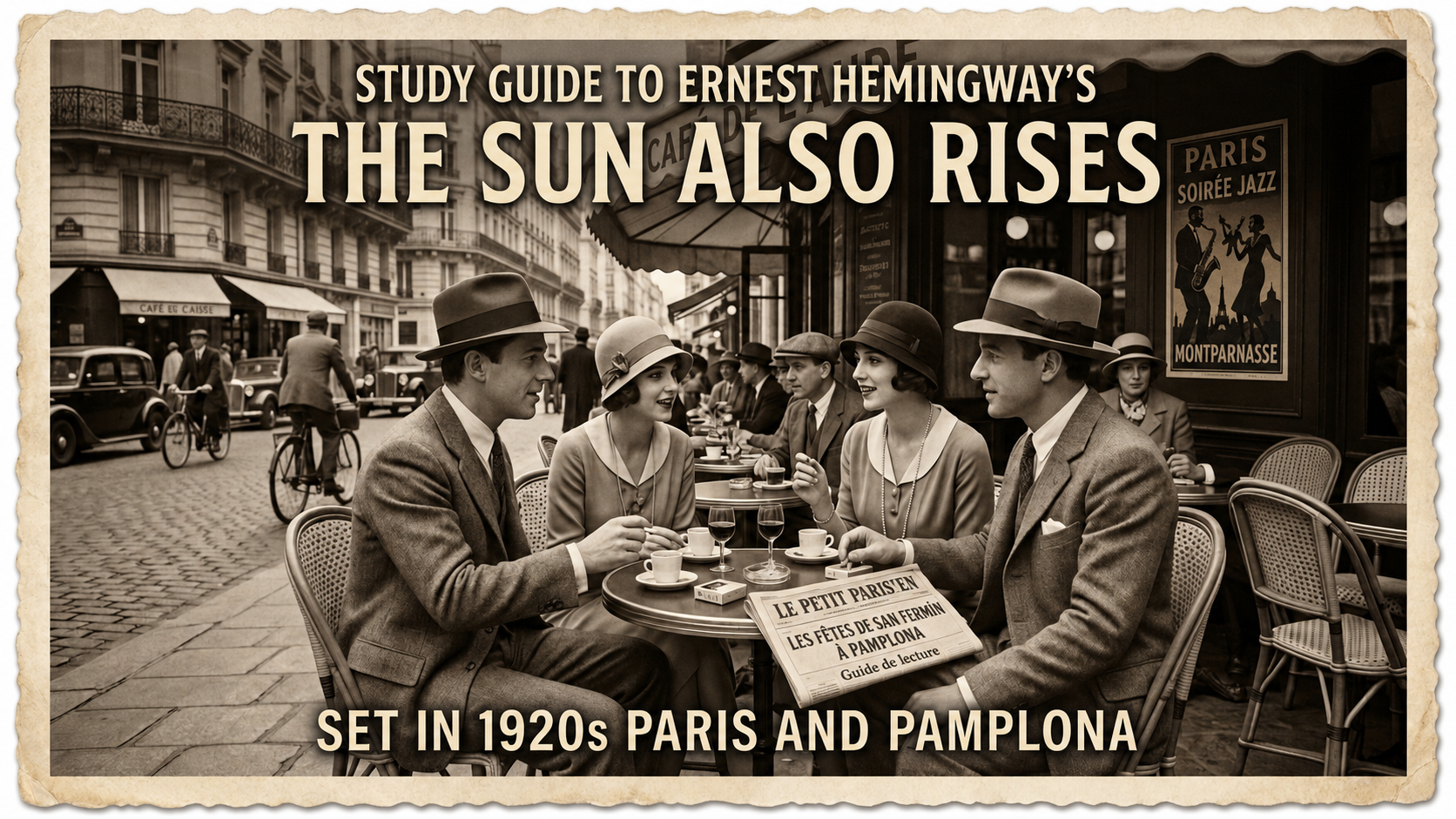
Ernest Hemingway's The Sun Also Rises follows a circle of American and British expatriates traveling from the cafes of 1920s Paris to the Festival of San Fermín in Pamplona, Spain. Beneath its parties, arguments, journeys, and bullfights lies a study of people trying, and repeatedly failing, to build meaningful lives after the First World War.
First published on October 22, 1926, the novel established Hemingway as a major modernist writer. It reaches its 100th anniversary in 2026, yet its questions remain recognizable. What happens when distraction replaces purpose? Can love survive a permanent limitation? And how do people continue after the future they expected becomes impossible? The JFK Library's Hemingway collection records that he wrote the book between July 1925 and April 1926, with Charles Scribner's Sons publishing it later that year. For a concise scholarly overview, see the Encyclopaedia Britannica entry.
Spoiler warning: the plot summary and ending analysis below reveal major events.
What Is The Sun Also Rises About?
The Sun Also Rises is about Jake Barnes, an American journalist living in Paris after sustaining a life-changing injury during the First World War. He loves the independent Lady Brett Ashley, but his injury prevents them from having the conventional relationship Brett wants.
Jake, Brett, and their companions travel to Pamplona for bullfighting and the Festival of San Fermín. Their holiday exposes jealousy, prejudice, insecurity, and emotional damage that Parisian nightlife had allowed them to conceal.
The novel's central message is that movement is not the same as progress. The characters cross countries, change partners, and seek increasingly intense experiences, but they carry their unresolved problems with them.
The Sun Also Rises at a Glance
Detail | Information |
|---|---|
Author | Ernest Hemingway |
Original US publisher | Charles Scribner's Sons |
First publication | October 22, 1926 |
UK title | Fiesta |
Genre | Modernist novel, expatriate fiction, roman à clef |
Narrator | Jake Barnes |
Main settings | Paris, Burguete, Pamplona, San Sebastián, and Madrid |
Historical period | Europe after the First World War |
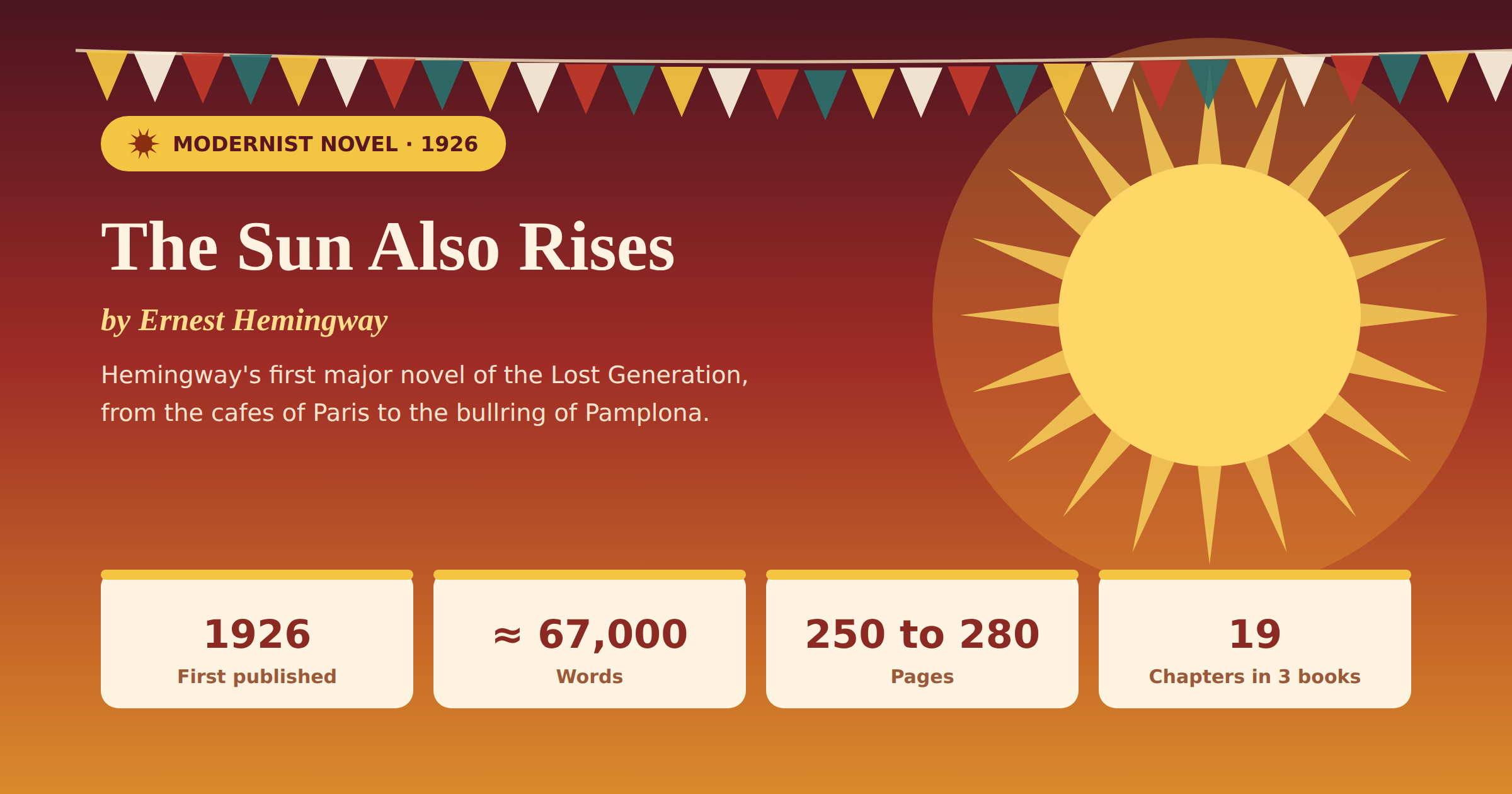
Structure | Three books containing 19 chapters |
Approximate length | About 67,000 words; roughly 250 to 280 pages in common paperback editions |
Central conflict | Jake and Brett love each other but cannot build the relationship they imagine |
Major themes | Disillusionment, love, masculinity, identity, prejudice, authenticity, escapism, and resilience |
Current copyright status | Public domain in the United States |
Free legal edition |
Page totals vary by edition. One Simon & Schuster paperback runs 272 pages, while annotated or academic editions can run considerably longer because they include introductions and historical material. At roughly 67,000 words, the book sits toward the shorter end of the typical word count for a novel.
Plot Summary of The Sun Also Rises
Book One: Paris and the Emotional Triangle
Jake Barnes works as a journalist in Paris. He appears controlled and observant, but his calm narration conceals loneliness, frustration, and uncertainty about his identity.
The novel initially focuses on Jake's acquaintance Robert Cohn. Cohn is a wealthy Jewish American writer, a former Princeton boxer, and a romantic idealist. He dislikes his repetitive life and wants Jake to travel with him to South America. Jake refuses, recognizing that a new destination will not solve Cohn's dissatisfaction.
Jake later encounters Lady Brett Ashley, an Englishwoman with whom he has a painful emotional bond. Brett loves Jake, but both understand that Jake's war injury prevents them from having the kind of physical relationship she considers necessary. Instead of separating completely, they remain emotionally dependent on one another.
Brett is engaged to Mike Campbell, yet she has also had an affair with Cohn. Cohn interprets their brief relationship as the beginning of something permanent. Brett does not. This misunderstanding quietly prepares the conflict that erupts in Spain.
Book Two: Fishing, Pamplona, and the Fiesta
Jake travels to Spain with his friend Bill Gorton. Their peaceful fishing trip near Burguete provides one of the novel's few periods of genuine companionship. The natural world is ordered and restorative, unlike the unstable social world waiting in Pamplona.
Jake and Bill eventually reunite with Brett, Mike, and Cohn for the Festival of San Fermín. The celebration initially appears to offer liberation from ordinary life. Music fills the streets, social boundaries weaken, and the group becomes absorbed in the fiesta. But celebration soon turns into emotional disorder.
Mike repeatedly insults Cohn for following Brett when she has clearly rejected him. His attacks are driven partly by jealousy and partly by antisemitism. Cohn, unable to accept Brett's rejection, remains with the group even as the hostility against him intensifies.
Meanwhile, Brett becomes interested in Pedro Romero, a gifted young matador. Jake understands bullfighting and has earned the respect of Montoya, the hotel owner and guardian of its traditions. Nevertheless, Jake helps Brett meet Romero, even though he knows the relationship may harm Romero and violate Montoya's trust.
Cohn reacts violently when he learns about Brett and Romero. His physical strength allows him to defeat several men, but it cannot make Brett love him. His victory in a fight becomes a moral and emotional defeat. Romero refuses to be intimidated. He performs successfully in the bullring, and Brett leaves Pamplona with him.
Show Image
Book Three: Consequences and Madrid
When the fiesta ends, the group separates. Without the crowds and noise, Jake begins to recognize what the trip has cost him. His relationships have deteriorated, and his standing with Montoya has been damaged.
Jake retreats to San Sebastián, where he briefly enjoys solitude. Brett soon sends him an urgent message from Madrid. When Jake reaches her, Brett explains that her relationship with Romero is over. She decided to let him go rather than interfere with his career and identity. She now intends to return to Mike, despite the obvious problems in that relationship.
Jake once again becomes the person who helps Brett manage the consequences of her choices. In the final taxi scene, Brett imagines how wonderful life might have been if she and Jake could have remained together. Jake replies:
"Isn't it pretty to think so?"
The sentence does not deny that their love is real. It challenges the fantasy that love alone would have solved everything.
Who Are the Main Characters?
Character | Role in the novel | What the character represents |
|---|---|---|
Jake Barnes | American journalist, veteran, and narrator | Emotional restraint, damaged identity, and the struggle to preserve dignity |
Lady Brett Ashley | Independent Englishwoman loved by several men | Changing gender roles, freedom, desire, and emotional restlessness |
Robert Cohn | Writer, former boxer, and social outsider | Romantic idealism, insecurity, exclusion, and possessiveness |
Mike Campbell | Brett's Scottish fiancé | Financial decline, jealousy, and destructive bitterness |
Bill Gorton | Jake's American friend and fishing companion | Friendship, humor, and temporary emotional balance |
Pedro Romero | Talented young Spanish matador | Discipline, skill, and the group's idealized idea of authenticity |
Montoya | Pamplona hotel owner and bullfighting authority | Tradition, cultural knowledge, and moral judgment |
Count Mippipopolous | Wealthy older admirer of Brett | Experience, survival, and an ability to enjoy life without demanding ownership |
Frances Clyne | Cohn's partner in Paris | Resentment, social pressure, and fear of abandonment |
Show Image
The diagram above captures the novel's engine: almost every relationship runs through Brett, and almost every conflict traces back to something Jake feels but will not say.
Is Jake Barnes a Reliable Narrator?
Jake is reliable about where people go and what they do, but less reliable when interpreting motives, especially Cohn's. His prejudice, jealousy, and resentment influence his descriptions. The opening chapter presents Cohn through Jake's dismissive judgment before readers have a chance to observe Cohn independently.
Jake's restraint also hides information. He rarely names his feelings directly, so readers must distinguish between what Jake reports, what Jake assumes, what Jake refuses to admit, and what his actions reveal despite his words. That distance between observation and confession makes Jake a limited, psychologically revealing narrator.
Is Brett Ashley Selfish or Sympathetic?
She is both sympathetic and capable of harming other people. Brett has independence, honesty, and social freedom unusual for many female characters in novels of the period. She does not pretend to be more conventional than she is. However, she repeatedly turns to Jake for emotional support while pursuing relationships that hurt him.
Reducing Brett to either a villain or a liberated heroine misses Hemingway's ambiguity. She wants freedom but fears loneliness. She loves Jake but does not believe love can overcome every practical limitation. She recognizes some of the damage she causes, yet often recognizes it too late.
Why Does Everyone Dislike Robert Cohn?
The group resents Cohn for several overlapping reasons:
He treats his brief affair with Brett as a lasting commitment.
He refuses to accept her rejection.
His romantic ideals clash with the group's practiced cynicism.
His presence exposes Mike's jealousy and Jake's resentment.
He tries to solve humiliation through physical strength.
He is the target of persistent antisemitism.
Cohn behaves badly, but the group's treatment of him cannot be explained solely by his behavior. Their prejudice makes him a convenient target for frustrations that existed before he arrived.
The Meaning of The Sun Also Rises: A Four-Layer Framework
The novel becomes easier to understand when read on four levels.
Level | Central question | What the novel reveals |
|---|---|---|
Personal | Can Jake and Brett make their love work? | Love does not automatically remove physical, emotional, or practical limitations |
Social | Why does the group keep traveling and celebrating? | They use activity, nightlife, and alcohol to avoid confronting pain and uncertainty |
Moral | What separates genuine conduct from performance? | Skill, discipline, and accountability matter more than money, status, or dramatic gestures |
Formal | Why does the writing omit explanations? | Hemingway makes readers experience emotional uncertainty instead of explaining it for them |
These levels work together. A casual conversation may advance little external action while revealing a change in jealousy, trust, loyalty, or power.
Major Themes in The Sun Also Rises
1. The Lost Generation, and the Limits of That Label
Gertrude Stein's statement, "You are all a lost generation," appears as the novel's first epigraph. It describes people who came of age during the First World War and struggled to trust the values that existed before it.
Yet the second epigraph, taken from Ecclesiastes, emphasizes continuity: generations pass, but the earth remains and the sun rises again. The title therefore complicates the first epigraph. These characters may be injured, disillusioned, and directionless, but life has not ended. Morning still comes. Work continues. Nature renews itself.
Critics have long read the book as both a love story and a moral portrait of a generation left without a clear sense of purpose after the war.
2. Love Versus Compatibility
Jake and Brett's tragedy is not that they feel nothing. It is that their feelings cannot create a sustainable relationship. Their bond exposes three different questions. Do two people love each other? Can they meet each other's needs? Can they build a stable life together?
The novel answers the first question affirmatively but remains doubtful about the other two. This is why the ending is more complicated than a simple story of unrequited love.
3. Masculinity as Performance
Nearly every major male character tries to prove something. Cohn uses boxing and physical strength. Mike uses insults and social status. Jake relies on knowledge, restraint, and professional competence. Romero demonstrates courage and discipline in the bullring.
Yet the novel repeatedly separates performance from character. Winning a fight does not produce respect. Acting indifferent does not eliminate jealousy. Public courage does not guarantee private wisdom. Jake's injury makes him especially sensitive to narrow definitions of masculinity. His resentment often appears when another person threatens the identity he has carefully constructed.
4. Authenticity and Afición
Afición means more than casual interest in bullfighting. In the novel, it describes informed passion, commitment, and respect for the art's traditions. Montoya recognizes Jake as someone who understands bullfighting rather than treating it as entertainment for tourists. This acceptance gives Jake a valued identity.
His decision to introduce Brett to Romero therefore matters beyond jealousy. Jake compromises something he respects in order to satisfy Brett. He becomes responsible for bringing the chaos of his social group into a world he considers disciplined and authentic.
5. Escapism and Avoidance
The characters repeatedly use travel, nightlife, alcohol, and romance to change how they feel. None provides lasting resolution. The pattern can be expressed simply: discomfort leads to distraction, distraction leads to temporary relief, relief gives way to conflict, and conflict renews the original discomfort.
This cycle explains the novel's repetition. The repeated cafes, meals, and journeys are not empty background. They show people maintaining avoidance through routine. The heavy drinking should be read as a sign of instability and emotional avoidance, not as harmless glamour.
6. Money, Payment, and Moral Responsibility
Money appears constantly in the novel. Jake pays bills, arranges transportation, tips workers, and calculates costs. These details establish that emotional relationships also contain debts. Jake repeatedly pays for Brett, not only financially, but socially and emotionally. He helps her reach Romero, loses Montoya's respect, and later travels to Madrid when she needs assistance. The recurring question beneath these transactions is who accepts the cost of their choices, and who leaves someone else to pay.
7. Nature as Temporary Restoration
The fishing trip gives Jake and Bill a calm that the cafes and fiesta cannot provide. Nature has rhythm, attention, and recognizable rules. Friendship becomes easier when the romantic rivalry is absent. The men can eat, fish, and talk without constantly defending their status. But nature does not permanently heal Jake. The trip is a restorative pause, not a magical cure. Once he returns to the group, the old tensions return.
8. Prejudice and Exclusion
The novel contains antisemitic, racist, and homophobic language and attitudes. These elements should not be ignored or dismissed merely as products of the 1920s. Cohn's outsider status is central to the social structure of the group. The characters use prejudice to isolate him and to justify hostility that also comes from jealousy and insecurity.
A responsible reading asks two questions at once. What do the characters' prejudices reveal about them and their historical environment? And does the novel adequately distance itself from those prejudices? Readers and scholars disagree about the second question. The Broadview Press centenary edition includes historical material addressing the novel's portrayals of Jewish people, Black Americans, women, and other marginalized groups. In his introduction to the 2026 Annotated Sun Also Rises, critic Adam Gopnik likewise argues that the novel's stylistic brilliance must be weighed alongside its antisemitism, misogyny, and homophobia.
Important Symbols and Motifs
The Sun
The sun represents recurrence rather than easy optimism. It rises again, but the new day does not erase the previous day's damage. This creates the novel's central tension: human lives are temporary, pain can feel permanent, and the world nevertheless continues. Continuation creates the possibility, though not the guarantee, of renewal.
Bullfighting
To Jake, bullfighting represents discipline, courage, and grace under pressure. Romero's movements appear controlled and meaningful, unlike the group's chaotic behavior. But the symbol is intentionally unstable. Skill inside the ring does not create moral clarity outside it. The bullfight may offer a code, but that code cannot solve Jake and Brett's relationship. Modern readers may also reject Hemingway's idealization because of animal-welfare concerns. The literary function of bullfighting can be analyzed without endorsing the activity itself.
Fishing and Water
Fishing represents attention, companionship, and temporary renewal. Its slower rhythm contrasts with the sensory overload of the fiesta. Water also marks moments of withdrawal and cleansing, especially when Jake swims in San Sebastián after the group separates.
Travel
Travel appears to promise transformation, yet the characters remain emotionally unchanged. Trains, taxis, and hotel rooms become symbols of motion without arrival.
Boxing
Cohn's boxing ability gives him physical power but not emotional maturity. He can defeat rivals in fights, but he cannot force acceptance or affection.
Food, Bills, and Tips
Meals appear mundane, but they create a quiet accounting system. Who pays, who serves, who works, and who consumes help Hemingway distinguish responsibility from entitlement.
Hemingway's Writing Style and the Iceberg Theory
Hemingway's prose appears simple because he removes explicit explanation. He builds meaning from short, simple sentences, concrete details, and spare dialogue, while the emotional force remains beneath the visible language. This technique is commonly called the iceberg theory, or the theory of omission. The visible portion contains dialogue, actions, and concrete details. The submerged portion contains memory, jealousy, fear, shame, and grief. Readers infer the submerged meaning from patterns and contradictions.
The Nobel Prize organization notes that Hemingway's concise, lucid prose strongly influenced twentieth-century fiction. He received the 1954 Nobel Prize in Literature partly for that wider influence on modern narrative style.
How the Iceberg Theory Works in the Novel
What Hemingway shows | What readers infer |
|---|---|
Jake and Brett repeatedly separate and reunite | Neither can fully release the relationship |
Jake carefully records bills and travel details | Practical control compensates for emotional powerlessness |
Characters joke during tense moments | Humor protects them from vulnerable conversation |
The war is rarely discussed directly | Its consequences remain present in their bodies and behavior |
Jake describes Cohn dismissively | Jake is jealous and invested in controlling the reader's judgment |
Brett imagines a better life with Jake | She still depends on an idealized alternative to reality |
Why Does the Dialogue Seem Random?
Many first-time readers feel that the characters ramble, ignore one another, and talk without advancing the plot. The conversations feel disconnected because the characters rarely say what they mean. Their dialogue performs four hidden functions. Deflection uses jokes to replace vulnerable admissions. Status testing uses insults to determine who belongs in the group. Emotional concealment uses repetition to keep painful subjects at a distance. And control changes the subject to prevent another person from defining the situation. Read the dialogue for shifts in power, not just information.
"Nothing Happens": What Readers May Be Missing?
The novel does have external events, including travel, affairs, fights, and bullfights, but its true plot is an emotional ledger. Each major scene changes one of five things.
Hidden plot element | Key change |
|---|---|
Trust | Jake compromises Montoya's trust by helping Brett reach Romero |
Loyalty | Jake chooses Brett's wishes over his friendship and values |
Status | Cohn moves from tolerated companion to rejected outsider |
Debt | Brett becomes increasingly dependent on Jake's help |
Self-knowledge | Jake begins recognizing the cost of sustaining their fantasy |
The climax is not simply Cohn's fight or Romero's performance. It is Jake's realization that his devotion to Brett has made him participate in his own unhappiness.
What Does the Ending Mean?
Brett imagines that she and Jake could have had an ideal life together. Jake's response, "Isn't it pretty to think so?", carries several meanings at once.
First, it questions whether the fantasy was ever realistic. Removing one obstacle would not have erased Brett's restlessness, their emotional dependency, or their different needs. Second, it marks a shift in Jake. Throughout the novel he supports Brett whenever she calls, but here he introduces skepticism instead of confirming her romantic fantasy without resistance. Third, it separates the love from the imagined future. The line is moving precisely because it does not mock their feelings; it distinguishes genuine affection from an idealized life that never had to survive ordinary reality. Finally, it mirrors the title. The imagined relationship belongs to an unrealized past, while the sun rises regardless, and Jake and Brett must go on living in the world that exists.
The ending therefore offers limited progress rather than full closure. Jake may be starting to see the relationship more clearly, but Hemingway does not promise that he will change.
Why Is the Novel Called The Sun Also Rises?
The title comes from the novel's biblical epigraph from Ecclesiastes, which describes the sun rising and setting while generations pass. It suggests that nature continues despite individual loss, that human suffering is real but not unique to one generation, that history moves in cycles, that being "lost" does not mean being permanently beyond recovery, and that renewal occurs without erasing consequences.
The title is more hopeful than the plot initially appears, although its hope is restrained. Another day arrives. What people do with it remains uncertain.
Key Quotes Explained
A few lines carry much of the novel's meaning. These are among the most useful to quote in an essay, each paired with what it reveals.
The two epigraphs. Gertrude Stein's "You are all a lost generation" names the wound, while the passage from Ecclesiastes answers it: "One generation passeth away, and another generation cometh: but the earth abideth for ever... The sun also ariseth, and the sun goeth down." Read together, they set the book's argument in motion: a generation may feel finished, but the world keeps turning.
"You can't get away from yourself by moving from one place to another." (Jake to Robert Cohn, Book One)
This is the thesis of the entire novel in one sentence. Jake says it early, then spends the rest of the book proving it true, as the group carries the same problems from Paris to Pamplona to Madrid.
"How did you go bankrupt?" "Two ways. Gradually and then suddenly." (Bill and Mike, Book Two)
Mike is describing money, but the line describes the whole group's emotional collapse. The fiesta is the "suddenly" that a long, slow avoidance had been building toward all along.
"I did not care what it was all about. All I wanted to know was how to live in it." (Jake, Book Two)
Here Jake states the novel's practical ethic. He has stopped searching for grand meaning and instead looks for a workable code, which is why he values Romero's disciplined skill so highly.
"You're an expatriate. You've lost touch with the soil. You get precious. Fake European standards have ruined you." (Bill Gorton, Book Two)
Bill delivers this as a joke, but it names the anxiety underneath the group's glamour: the fear that their rootless, café life is a slow form of decay rather than freedom.
"Oh, Jake, we could have had such a damned good time together." "Yes. Isn't it pretty to think so?" (Brett and Jake, Book Three)
The closing exchange refuses easy comfort. Jake does not deny the love; he declines to pretend that love alone would have solved everything, which turns a romantic sigh into the book's final act of clear sight.
Is The Sun Also Rises Autobiographical?
The novel is a roman à clef, meaning fiction based recognizably on real people and events. Hemingway drew heavily from a 1925 trip to Spain with members of his social circle. Commonly identified inspirations include:
Fictional character | Real-life inspiration |
|---|---|
Jake Barnes | Partly Hemingway himself, though Jake is not a direct self-portrait |
Lady Brett Ashley | Lady Duff Twysden |
Robert Cohn | Harold Loeb |
Mike Campbell | Pat Guthrie |
Bill Gorton | Donald Ogden Stewart |
Pedro Romero | Bullfighter Cayetano Ordóñez |
These are starting points, not exact copies. Hemingway altered personalities, relationships, and events to create a controlled fictional structure. The JFK Library documents how the 1925 Pamplona trip became the creative springboard for the novel.
Historical Context: The World Behind the Novel
The novel's mood is inseparable from its moment. Its characters came of age during the First World War, a conflict that killed millions and left survivors distrustful of the patriotic and moral certainties they had been raised on. Jake's unnamed wound is the personal version of that larger injury: a permanent loss that no amount of courage can undo. When Hemingway lets the war stay mostly unspoken, he is reproducing how many veterans actually lived with it, present in the body and behavior rather than in conversation.
The Paris of the book was a real magnet for American and British writers and artists in the 1920s. A strong dollar and a weak franc meant Americans could live well in France for very little, and Prohibition back home made Europe's open café and drinking culture more appealing still. Gertrude Stein's salon sat at the center of this expatriate world, and it is her remark that gives the "Lost Generation" its name. Hemingway was part of that scene, which is why the novel reads as reportage as much as invention.
Spain provides the book's counterweight. Bullfighting and the Festival of San Fermín in Pamplona represented, for Hemingway, a living tradition with its own discipline and code, something the drifting expatriates lacked. Understanding that contrast, between rootless modern leisure and an older, rule-bound craft, unlocks much of what the Spanish sections are doing.
Publication History and the 2026 Centenary
Hemingway began the novel shortly after attending the 1925 San Fermín festival. He initially used titles including Fiesta and The Lost Generation before selecting The Sun Also Rises. The novel retained the title Fiesta for its British publication.
The book entered the US public domain on January 1, 2022. This made free digital editions and new commercial versions possible, but it also created quality problems. As the Hemingway Society explains in "The Freeing of The Sun Also Rises," some quickly produced editions contain scanning, proofreading, and textual errors.
That warning matters in 2026. A centenary annotated edition edited by scholar Robert W. Trogdon uses a corrected text and restores punctuation changes, including details affecting the final lines. For casual reading, Project Gutenberg offers a legal free edition in the United States. Students doing detailed textual analysis should use a carefully edited academic or authorized edition.
What Readers and Critics Say?
Since 1926, few American novels have provoked such divided and passionate responses. Following that conversation is part of understanding the book.
The First Reaction, in 1926
The novel was an immediate event. Scribner's first printing of 5,090 copies sold quickly enough to require a second printing of about 7,000 within two months, and the book reached its eighth printing by 1928. Critics split sharply. The New York Times admired its "lean, hard, athletic narrative prose," and Conrad Aiken singled out the dialogue for praise. Others recoiled. The Cincinnati Enquirer complained that the story "begins nowhere and ends in nothing," and a Chicago Daily Tribune reviewer said it made him "almost plain angry." The most stinging response came from home: Hemingway's own mother, Grace, called it "one of the filthiest books of the year" and wrote that "every page fills me with a sick loathing."
The Cultural Aftershock
Disapproval did little to slow it. The novel turned the phrase "Lost Generation" into common currency and gave the postwar mood a face. Young readers imitated its characters directly. Women adopted Brett's cropped hair and sweaters, and Ivy League men set out to become "Hemingway heroes," self-possessed, understated, and hard-drinking. Few first novels have shaped how their own readers dressed and behaved.
How Critics Read It Now?
Later criticism gave the book its durable vocabulary. Scholars describe Jake as an early example of the Hemingway "code hero," a figure who holds to discipline and "grace under pressure" in a world that offers no larger meaning. Brett has remained the novel's most contested figure. Leslie Fiedler grouped her among Hemingway's "bitch women," while many later critics read her far more sympathetically, as a woman improvising freedom inside a society built to constrain her. Since the 1990s, scholars have also examined the novel's antisemitism, misogyny, and homophobia directly rather than treating them as period background, a reassessment that continues into the 2026 centenary through the Broadview edition and Adam Gopnik's introduction to the annotated text. For a book-length survey of this debate, see Peter L. Hays's The Critical Reception of Hemingway's The Sun Also Rises.
What Everyday Readers Say Today?
Modern readers tend to divide along familiar lines. Many first-time readers admit the opening feels slow and the dialogue aimless, the "nothing happens" reaction discussed earlier in this guide. Others come away moved by the Paris and fishing passages and consider the final line one of the most quietly devastating endings in American fiction. Two reactions recur across reader reviews: genuine discomfort with the book's prejudiced language, and real disagreement over whether Brett is admirable or exhausting. That split is not a flaw in the audience. It is the novel working as designed, refusing to resolve the tensions it raises.
Film and Screen Adaptations
The novel has reached the screen more than once. The 1957 feature film, directed by Henry King, starred Tyrone Power as Jake and Ava Gardner as Brett, with Errol Flynn as Mike Campbell and Mel Ferrer as Robert Cohn. A 1984 television miniseries adapted the story again for a new audience. Neither version fully captures the interior, understated quality that makes the novel distinctive, which is a common challenge when adapting Hemingway's omission-based style.
How to Read The Sun Also Rises Without Getting Lost?
Before Reading
Learn the basic meaning of the Lost Generation. Remember that the war's effects are usually implied rather than described. Keep a simple character list. Expect emotional development instead of a fast conventional plot. And know that the text includes prejudiced language and outdated attitudes.
While Reading: The PLACE Method
P is for Payment: who pays the financial or emotional cost?
L is for Language: what is a character avoiding saying?
A is for Allegiance: whom does Jake support in this scene?
C is for Control: who controls the conversation or social group?
E is for Escape: what distraction prevents honest reflection?
After Each Section
Ask what changed in Jake's relationship with Brett, who gained or lost social standing, what Jake observed but failed to explain, whether travel solved anything, and which character accepted responsibility. This method turns apparently casual scenes into a clear emotional narrative.
Strong Essay Angles and Thesis Templates
Lost Generation thesis: In The Sun Also Rises, Hemingway portrays the Lost Generation not as completely directionless but as trapped between inherited values they no longer trust and new freedoms that cannot provide lasting meaning.
Jake as unreliable narrator thesis: Jake Barnes's restrained narration creates an appearance of objectivity, but his descriptions of Cohn and Brett reveal how jealousy and prejudice shape the story readers receive.
Masculinity thesis: By contrasting Cohn's physical strength, Mike's aggression, Jake's restraint, and Romero's discipline, Hemingway presents masculinity as a contested performance rather than a stable identity.
Setting thesis: Hemingway uses Paris, Burguete, and Pamplona as emotional environments. Paris enables avoidance, nature offers temporary balance, and the fiesta exposes conflicts the characters can no longer conceal.
Ending thesis: Jake's final response rejects Brett's idealized alternative life, marking a subtle shift from emotional dependency toward recognition, though not necessarily complete freedom.
Critical-context thesis: The novel's treatment of Cohn shows how personal jealousy and social prejudice reinforce one another, making antisemitism part of the group's power structure rather than a detachable historical detail.
Once you have drafted an essay, paste it into a free word counter to confirm you are within the assignment's limit and to spot padded sentences you can tighten.
Discussion Questions
These ten questions are grouped by theme so a book club or class can focus on one strand at a time, and each includes a short prompt on how to approach it. They pair directly with the essay angles above: pick a question, then build a two-sided thesis from it.
Jake: Love, Need, and Self-Knowledge
1. Does Jake help Brett because he loves her, or because being needed gives him purpose? How to approach it: Track whether Jake ever refuses Brett, from the taxi scenes to the trip to Madrid. The pattern says more about his motives than anything he admits directly.
2. Is Jake more self-aware at the end than he is at the beginning? How to approach it: Compare his guarded narration in Book One with the final exchange. Decide whether "Isn't it pretty to think so?" marks real change or only clearer sight.
3. What does Jake sacrifice by introducing Brett to Romero? How to approach it: List what he loses: Montoya's trust, his standing as an aficionado, and his self-respect. Then weigh that against his inability to deny Brett anything.
Freedom and Belonging: Brett and the Outsider
4. Does Brett free herself from conventional gender roles, or become trapped by another pattern? How to approach it: Contrast her independence and cropped hair with her repeated returns to men who cannot help her. Ask whether freedom brings her stability or a new dependency.
5. Why does Hemingway open the novel with Cohn rather than Jake or Brett? How to approach it: Consider how framing Cohn first lets Jake shape the reader's judgment before we meet him, an early clue that the narration is not neutral.
6. Is Cohn rejected because of his behavior, the group's prejudice, or both? How to approach it: Separate what Cohn actually does from the antisemitic language aimed at him, then ask whether the group's hostility existed before he gave them a reason.
Authenticity and the Code
7. What does Romero possess that the expatriates lack? How to approach it: Focus on discipline, afición, and rootedness. Romero has a craft and a code, while the group has only motion and appetite.
8. Why does the fishing trip feel more peaceful than Paris or Pamplona? How to approach it: Note the absence of Brett and romantic rivalry. Nature has rules and rhythm, so the men can drop their constant performance of status.
Being "Lost" and the Ending
9. Are the characters truly lost, or simply unwilling to change? How to approach it: Test the two epigraphs against each other. Decide whether the characters are casualties of history or authors of their own avoidance.
10. Does the final line offer resignation, wisdom, bitterness, or all three? How to approach it: Read the tone of "Isn't it pretty to think so?" closely. Your answer depends on whether you hear defeat, clarity, or irony, and the text can support each.
Glossary of Key Terms
Lost Generation: The generation that came of age during the First World War and emerged disillusioned with pre-war values. The phrase comes from Gertrude Stein and serves as the novel's first epigraph.
Roman à clef: French for "novel with a key." A work of fiction that portrays real people and events under invented names. The Sun Also Rises is a classic example, drawn from Hemingway's 1925 trip to Spain.
Afición: In the novel, a deep, informed passion for bullfighting and respect for its traditions, as opposed to a tourist's casual curiosity. Someone who possesses it is an aficionado, and Montoya treats it as a mark of character.
Iceberg theory (theory of omission): Hemingway's technique of leaving the deeper meaning beneath the surface. The visible text shows action and dialogue, while emotion and motive stay submerged for the reader to infer.
Expatriate: A person living outside their native country. The novel's central group are American and British expatriates in Europe.
The Sun Also Rises is not simply a novel about expatriates drinking and traveling through Europe. It is a carefully structured account of emotional debt, failed communication, and the search for a code by which to live. Its characters mistake motion for change. Cohn treats possession as love. Mike turns insecurity into cruelty. Brett pursues freedom without consistently accepting its costs. Jake appears controlled but repeatedly sacrifices his judgment to remain necessary to Brett.
The final insight is modest rather than triumphant. Imagined lives can be beautiful, but people must live in the world that actually exists. The sun rises again. Whether the characters use the new day differently is the question Hemingway leaves unanswered.
Frequently Asked Questions
What is the main point of The Sun Also Rises?
The novel shows how people affected by war and disillusionment seek meaning through travel, romance, nightlife, and intense experiences. These distractions provide temporary relief but cannot replace responsibility, self-knowledge, or purpose.
What is the main conflict?
The personal conflict is Jake and Brett's impossible relationship. The broader conflict is between the characters' desire for meaningful lives and their habit of avoiding honest emotional decisions.
Why is The Sun Also Rises so famous?
It helped define the literary image of the Lost Generation and demonstrated Hemingway's influential style of short sentences, spare dialogue, and emotional omission. It also changed how novels could create tension without relying on a heavily event-driven plot.
Is The Sun Also Rises Hemingway's first novel?
It is generally described as Hemingway's first major novel. His satirical novella The Torrents of Spring appeared several months earlier in 1926, while In Our Time was a short-story collection.
What happened to Jake Barnes?
Jake received a serious injury during the First World War that affects his ability to have a conventional physical relationship. Hemingway deliberately avoids giving a detailed medical explanation because Jake's emotional response matters more than the anatomy of the injury.
Are Jake and Brett in love?
Yes, but their relationship is shaped by incompatibility, frustration, and emotional dependency. The novel distinguishes loving someone from being able to build a stable life with that person.
Why can't Jake and Brett be together?
Jake's injury is the immediate reason they give. The ending suggests their problems may extend beyond it, including Brett's restlessness and the unhealthy pattern through which she repeatedly seeks Jake's help.
Why does Jake help Brett find Romero?
Jake wants Brett to be happy and has difficulty refusing her. His decision also reveals how devotion can become self-betrayal: he sacrifices his values and Montoya's trust for a relationship that continues to hurt him.
Why does Brett leave Romero?
Brett believes remaining with Romero would change or damage him. Sending him away is one of her clearest attempts to accept responsibility, although it occurs after considerable harm has already been done.
What does the final line mean?
Jake recognizes that an imagined perfect life with Brett is attractive but unprovable. His response separates their real feelings from the fantasy that everything would have worked out under different circumstances.
Is The Sun Also Rises difficult to read?
Its vocabulary and sentences are generally accessible. The difficulty comes from omission, since characters rarely explain their motives and the most important emotional information must be inferred from dialogue, repetition, and behavior.
How long does it take to read The Sun Also Rises?
At roughly 67,000 words, most readers finish it in about four to five hours. You can estimate your own pace with a reading time calculator.
Why do the characters drink so much?
They drink partly because of the era's expatriate social culture, but within the novel it also functions as emotional avoidance. It lowers restraint, intensifies conflict, and postpones self-examination.
Is the novel antisemitic?
It contains significant antisemitic language and stereotypes, especially in its treatment of Robert Cohn. Critics debate how much distance exists between Jake's prejudice and the novel's perspective. A serious reading should analyze this directly rather than excusing or ignoring it.
Was The Sun Also Rises banned?
The novel faced restrictions and objections because of its language, sexuality, and portrayal of postwar social life. Claims about a specific ban should identify the institution and date, since local censorship, library challenges, and nationwide legal bans are not the same thing.
Is The Sun Also Rises in the public domain?
Yes. It entered the public domain in the United States in 2022. Copyright status can differ by country, so readers outside the US should check local rules.
Is the book still worth reading?
Yes, if read critically. Its prose, narration, and treatment of emotional avoidance remain influential. Its prejudices and gender politics also require direct examination. Appreciating the novel's craft does not require agreeing with all its values.
How this guide was prepared: the summary and analysis are based on a close reading of Hemingway's text, with historical and publication details checked against the John F. Kennedy Presidential Library's Hemingway collection, the Hemingway Society, Encyclopaedia Britannica, and the official Nobel Prize record. Quotations follow the standard Scribner text; where editions differ in punctuation, we note it.