For Whom the Bell Tolls: Novel by Ernest Hemingway Explained
For Whom the Bell Tolls explained: plot summary, ending, characters, themes, the title's meaning, and whether Hemingway's Spanish Civil War novel is worth reading.
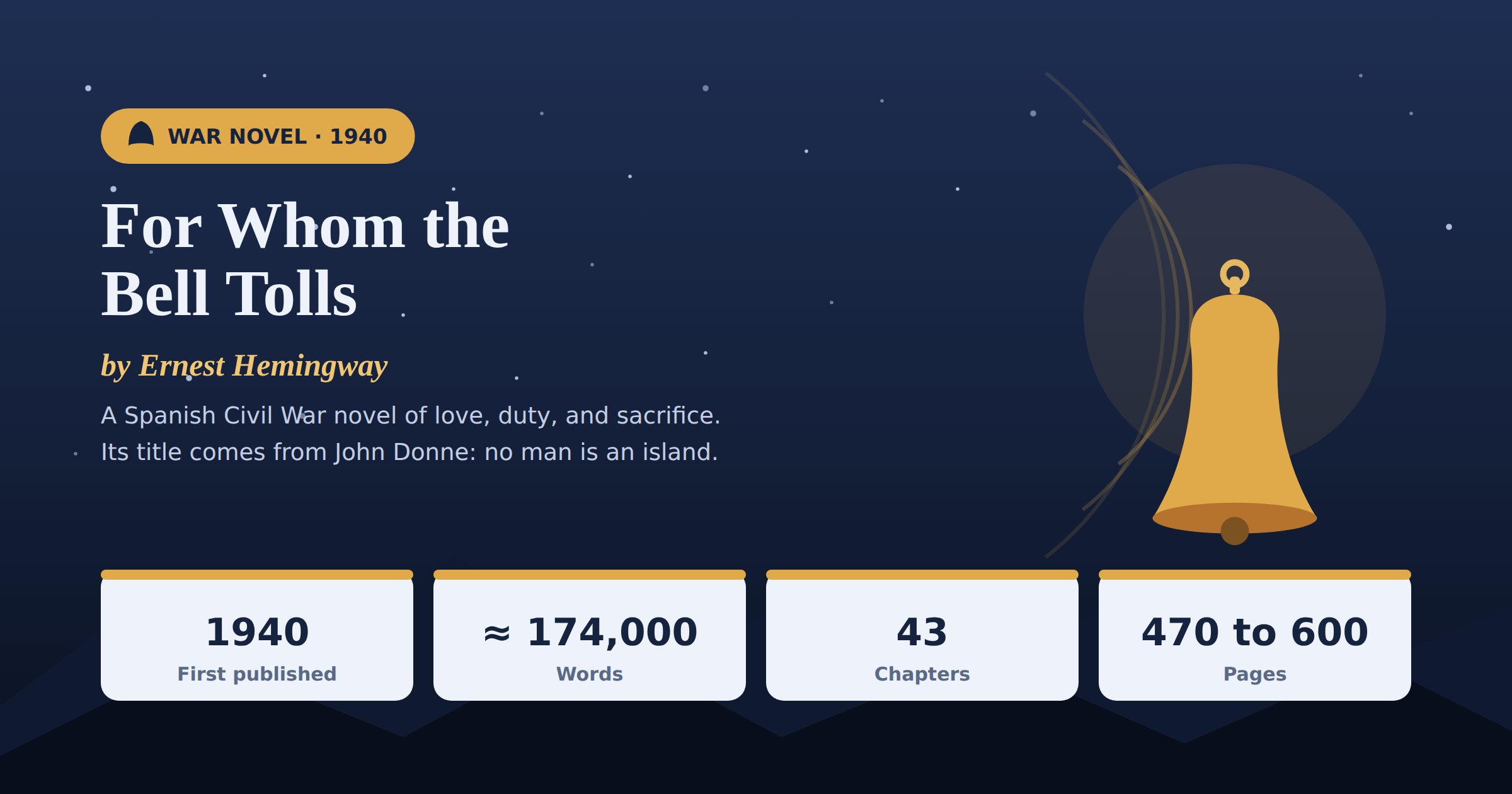
A definitive reader's companion to Hemingway's 1940 masterpiece: the plot, the ending explained, the title's meaning, the strange "thee and thou" dialogue, the real history, and honest answers to the questions readers actually ask before committing to roughly 470 pages.
Spoiler warning: The plot summary and ending sections reveal major events. A spoiler-free reading guide and "should I read it?" verdict come first.
What Is For Whom the Bell Tolls About?
For Whom the Bell Tolls is a 1940 war novel by Ernest Hemingway set over roughly 70 hours, four days and three nights, during the Spanish Civil War in late May 1937. It follows Robert Jordan, a young American demolitions expert and former Spanish instructor volunteering for the Republican side, who is ordered to blow up a strategically vital bridge behind fascist (Nationalist) lines at the exact moment a Republican offensive begins. To do it, he must rely on a small, fractious band of guerrillas in the Sierra de Guadarrama mountains, led on paper by the fearful Pablo and in practice by the formidable Pilar. During those four days he falls in love with María, a young survivor of wartime atrocity, and is forced to weigh duty, conscience, love, and sacrifice against one another.
The novel's central message is that no life exists in isolation. Political decisions made by distant commanders reshape ordinary lives, one person's choices ripple through an entire group, and the loss of any single human being diminishes humanity as a whole. That idea comes straight from the title's source, John Donne's meditation, "never send to know for whom the bell tolls; it tolls for thee."
The novel in one sentence: A military demolition mission becomes a moral pressure test in which Robert Jordan must balance duty, love, conscience, and responsibility during roughly 70 hours behind enemy lines.
Should you read it? If you want a war novel that is also a love story and a meditation on mortality, and you can tolerate a slow, immersive middle and deliberately unusual dialogue, then yes. It rewards patience, and most readers who push past the first fifty pages rate it among Hemingway's finest.
Key Facts at a Glance
Detail | Information |
|---|---|
Full title | For Whom the Bell Tolls |
Author | Ernest Hemingway (1899–1961) |
First published | October 21, 1940 |
Original publisher | Charles Scribner's Sons (first print run: about 75,000 copies at $2.75) |
Genre | War novel, historical fiction, political novel, tragic romance |
Setting | Sierra de Guadarrama mountains, between Madrid and Segovia, Spain |
Time span | Four days and three nights (about 68 to 70 hours), late May 1937 |
Historical backdrop | Spanish Civil War (1936–1939); the Segovia Offensive |
Protagonist | Robert Jordan, American dynamiter attached to the Republican forces |
Central mission | Destroy a bridge at the start of a Republican offensive |
Chapters | 43 |
Length | About 174,000 words; roughly 470 to 600 pages depending on edition |
Estimated reading time | 10 to 12 hours (about two weeks at a relaxed pace) |
Narrative style | Third-person, closely following Jordan's thoughts |
Major themes | Human solidarity, individual conscience versus collective cause, mortality, love, time, leadership, the cost and disillusionment of war |
Title source | John Donne's Meditation XVII (1624) |
Early sales | About 500,000 copies within months; Book-of-the-Month Club selection |
Major award status | 1941 Pulitzer Prize finalist (no fiction prize awarded that year) |
Best-known adaptation | 1943 Paramount film with Gary Cooper and Ingrid Bergman |
The Library of Congress includes the novel on its Books That Shaped America list, and it is widely read as portraying war as disillusioning rather than glorious. For a concise scholarly overview, the Encyclopaedia Britannica entry is a reliable starting point.
Content note for readers: The novel contains wartime violence, political executions, trauma, the aftermath of sexual assault, and discriminatory language common to its period. These elements matter to the story, but some passages can be difficult for modern readers.
The Spanish Civil War Context You Need First
You do not need to become an expert on Spanish history, but understanding the two sides makes the novel considerably clearer. The Spanish Civil War lasted from 1936 to 1939. It began after military officers launched a rebellion against Spain's elected Republican government.
Republican side | Nationalist side |
|---|---|
Defended the elected Second Spanish Republic | Sought to overthrow the Republican government |
Included liberals, socialists, communists, anarchists, and regional groups | Included conservative military forces, monarchists, Falangists, and other right-wing groups |
Backed by the Soviet Union, Mexico, and international volunteers | Backed militarily by Nazi Germany and Fascist Italy |
Also called Loyalists in English-language accounts | Led increasingly by General Francisco Franco |
Lost the war in 1939 | Established Franco's dictatorship after victory |
Important: "Republican" here has nothing to do with the modern US Republican Party. In this context it means a supporter of the Spanish Republic. The war is widely seen as a rehearsal for World War II, and its outcome cast a decades-long shadow over Europe.
Where does Robert Jordan fit?
Jordan is an American volunteer working with the Republican forces, attached to an anti-fascist guerrilla unit operating behind Nationalist lines. Crucially, he supports the Republican cause but is not blindly loyal to every Republican leader or policy. He sees poor planning, political suspicion, and internal factional conflict on his own side.
That distinction is the key to reading the book honestly. The novel is anti-fascist, but it is not simple propaganda in which every Republican is virtuous and every Nationalist is cruel. As Hemingway scholar Alex Vernon has noted, the book deliberately portrays wrongdoing and hypocrisy within the very side Hemingway personally supported.
Full Plot Summary: The Four-Day Countdown
Spoiler warning: this section reveals the ending.
The assignment
The Soviet General Golz orders Robert Jordan to cross behind enemy lines, make contact with a local guerrilla band, and destroy a strategically important bridge in the Guadarrama mountains at the precise moment a Republican offensive begins. Timing is everything: blow it too early and you warn the Nationalists; too late and enemy reinforcements pour across. Anselmo, an older guerrilla and trusted guide, leads Jordan to a hidden camp.
Day One: Jordan enters the camp
At the camp Jordan meets Pablo, the band's official leader. Pablo once had a reputation for courage, but years of war have made him cautious, cynical, and increasingly obsessed with survival. He immediately opposes the mission, convinced it will reveal the guerrillas' hideout and bring overwhelming retaliation.
Pilar, Pablo's partner, who is fierce, wise, superstitious, and respected by the fighters, backs Jordan. When Pablo refuses to cooperate, Pilar effectively seizes control of the band. Jordan also meets María, a young woman the guerrillas rescued after Nationalist forces executed her parents and raped her. She and Jordan become emotionally attached almost at once. The speed startles many readers, but Hemingway is deliberately compressing emotional time: Jordan senses the mission may leave them no ordinary future.
Day Two: reconnaissance and growing doubt
Jordan studies the bridge, the terrain, and the Nationalist positions. He knows the technical job cold; the human part is far less predictable. Pablo stays hostile; Pilar seems dependable; the rest of the band varies in discipline, fear, and conviction. Enemy activity in the mountains suggests the Nationalists may already know the offensive is coming. Jordan visits a neighboring guerrilla leader, El Sordo, to request more men and horses, but worsening weather and enemy movement make cooperation harder.
Day Three: the mission begins to unravel
El Sordo's band is discovered and, in a harrowing chapter, surrounded on a hilltop and annihilated by enemy aircraft, a grim preview of the cost to come. Now certain the Nationalists are prepared, Jordan writes a message begging Golz to call off the offensive and sends the young fighter Andrés through Republican lines to deliver it. Andrés's journey becomes its own argument: a military organization can fail even when individuals act bravely, as suspicion, bureaucracy, and rigid procedure delay the warning.
Meanwhile Pablo disappears after stealing and destroying some of Jordan's detonators, sabotage that endangers everyone. He later returns, ashamed, having recruited additional men and horses. His return does not erase the betrayal, but it confirms he is more complicated than a simple coward: he wants to survive, fears the mission, and still feels bound to the group.
Day Four: the bridge operation
Jordan never learns whether his warning reached Golz in time. When the offensive begins, he carries out his orders anyway. The guerrillas attack the positions around the bridge while Jordan sets the charges. The bridge is destroyed, but at a terrible price. Anselmo is killed by falling debris. During the retreat under fire, Jordan's horse is hit and falls on him, shattering his left leg.
Unable to travel and refusing to slow the others, Jordan orders María and the survivors to flee without him. He remains behind alone to ambush the pursuing Nationalist cavalry and buy the others time to escape. The novel ends before the final outcome is shown.
The Ending Explained
This is one of the most discussed endings in twentieth-century American fiction, and readers constantly search for what it "means."
Robert Jordan chooses to stay behind and almost certainly die so that María and the others can survive. It is the moral culmination of everything the book has built toward. Throughout the novel Jordan wrestles intellectually with the worth of a single life against a cause; in the final pages he stops theorizing and simply acts. His sacrifice is not for an abstract political victory, since by now he knows the larger offensive is probably doomed, but for the concrete lives of the people he has come to love.
Three details make the ending land:
He resists suicide. Jordan's own father killed himself, a fact that haunts him and mirrors Hemingway's family history. By choosing to fight rather than take his own life, Jordan reclaims agency and meaning in his final moments.
The book stops before he dies. Hemingway deliberately ends on the beat of Jordan's heart against the pine-needled forest floor. We never see the bullet. This is the "iceberg" ending, where the most important event happens beneath the surface, left to the reader, and it suspends Jordan forever in a moment of chosen purpose.
The structure comes full circle. The novel opens with Jordan lying on the pine-needle floor studying the bridge, and it closes with him on that same ground. His whole life has come full circle in four days, and Donne's epigraph gives it universal weight: his death diminishes all of us, because "no man is an island."
What changes in Jordan?
At the start, Jordan thinks like a specialist: the bridge is an assignment and the guerrillas are the personnel required to complete it. By the end, he understands the mission entirely through relationships, with María as a future worth protecting, Pilar and the fighters as people rather than resources, Anselmo's conscience as mattering as much as his usefulness, and the cause as meaningful only because of the people it is supposed to serve. His final decision is not obedience to orders; it is an attempt to give the others enough time to live.
Is the ending hopeful or tragic?
It is both. Tragic, because the future Jordan and María imagined can never unfold. Hopeful, because María and the surviving guerrillas carry that future forward. The bell does not say an individual vanishes without meaning; it says one life keeps affecting others.
What Does the Title Mean?
The title comes from a 1624 devotional meditation by the English poet and cleric John Donne, which Hemingway printed as the book's epigraph:
"No man is an island, entire of itself; every man is a piece of the continent, a part of the main. … Any man's death diminishes me, because I am involved in mankind; and therefore never send to know for whom the bell tolls; it tolls for thee."
In Donne's era, church bells tolled to announce a death. His point: never ask whose funeral bell is ringing, because in a real sense it rings for you too. Every human death is a loss to all of humanity, since we are all connected.
Hemingway chose it because it is the philosophical thesis of the entire novel. Robert Jordan, an American, chooses to fight and die for Spaniards he never knew, because he understands he is "involved in mankind." Against the isolationism of its era, the book argues that human beings owe one another across borders, and that the death of a stranger in a Spanish mountain war concerns everyone. The title connects to four parts of the story:
Every individual matters. The people affected by the bridge mission are not replaceable pieces in a military calculation.
War spreads responsibility. Decisions made by distant commanders fall on civilians, volunteers, and guerrillas.
The enemy remains human. Hemingway occasionally shifts perspective to a Nationalist soldier to stop readers from imagining the other side as identical and faceless.
Jordan's fate belongs to a larger struggle. His choices affect María, the band, the offensive, and the reader's sense of political responsibility.
The bell asks a moral question rather than naming one person: Can you remain indifferent to someone else's loss when you belong to the same humanity?
The Bridge-and-Bell Framework
The novel's deepest conflict lives in two central symbols that pull in opposite directions. Hold them side by side and the whole book snaps into focus.
The Bridge | The Bell |
|---|---|
A specific military target | A universal moral symbol |
Must be destroyed | Calls people into connection |
Represents strategy | Represents shared humanity |
Reduces people to roles in an operation | Restores their individual value |
Focuses on one moment | Connects that moment to all human experience |
Separates two military positions | Reminds us that no person is truly separate |
Jordan is ordered to destroy a physical connection in service of a cause. The title insists that human beings are morally connected. His challenge, and the novel's, is to carry out the mission without letting military logic erase the people it affects. The bridge divides; the bell connects. That tension is why the book endures.
Main Characters and Their Moral Roles
The characters do more than move the plot. Each embodies a different answer to one question: How should a person behave when survival, duty, and conscience collide?
Character | Role | Moral question represented |
|---|---|---|
Robert Jordan | American volunteer and demolition specialist | Can a person serve a cause without surrendering independent judgment? |
Pilar | Practical, de facto leader of the guerrillas | What does responsible leadership require when official authority fails? |
Pablo | Formerly respected guerrilla leader | When does caution become betrayal, and can a betrayer still change? |
María | Survivor rescued by the guerrillas | Can a person imagine a future after violence has damaged the past? |
Anselmo | Jordan's older guide | Can someone oppose killing while still doing his duty in a war? |
Agustín | Blunt but loyal fighter | Is rough behavior compatible with genuine loyalty? |
El Sordo | Leader of a neighboring band | What happens when courage cannot overcome bad circumstances? |
General Golz | Soviet commander who orders the mission | How much freedom does a leader have inside a flawed institution? |
Andrés | Messenger carrying Jordan's warning | Why can a system fail even when the individual does everything right? |
Karkov | Informed Soviet journalist and political insider | Does understanding corruption create a duty to resist it? |
Robert Jordan: hero, idealist, or compromised agent?
Jordan is the protagonist, but not the uncomplicated romantic hero he first appears to be. He is skilled yet uncertain of his assignment's strategic value; committed to the Republic yet critical of its leadership; compassionate toward individuals yet willing to risk them; suspicious of superstition yet swayed by fear and intuition; disciplined in his work yet emotionally transformed by María; opposed to needless violence yet fully inside a violent conflict.
Alex Vernon's 2024 Reading Hemingway's For Whom the Bell Tolls: Glossary and Commentary argues that readers often oversimplify Jordan by treating him as a straightforward hero, when the book actually foregrounds his political, personal, and ideological contradictions. Jordan's most important quality is therefore not certainty. It is his ability to keep acting while recognizing that his cause, orders, and judgment may all be imperfect.
Pilar: the novel's real center of authority
Pilar is arguably the strongest and most memorable character in the book, and a perennial fan favorite. She reads people more accurately than Jordan does, sensing Pablo's fear, María's trauma, and the emotional pressure surrounding the mission, and she is intimidating, compassionate, practical, and politically committed all at once. Her authority comes not from a title but from experience, emotional intelligence, decisiveness, deep knowledge of the group, and a willingness to accept responsibility. The command structure says Pablo leads; the group's behavior shows Pilar does. Her account of a village massacre and the "smell of death" passage are among the novel's most powerful set pieces.
Pablo: coward or realist?
"Coward" is the easy label and an incomplete one. Pablo grasps something Jordan initially minimizes: destroying the bridge may aid a larger offensive while destroying the guerrillas' ability to survive in the mountains. His fear is not irrational. The problem is how he responds to it. He lurches between resistance, betrayal, regret, and renewed cooperation, which makes him frustrating but also one of the novel's most psychologically realistic figures. He embodies what prolonged war does to political idealism: a person may begin fighting for a cause and end up fighting only to preserve what remains.
Anselmo: conscience without innocence
Anselmo supports the Republic and accepts that the bridge must fall, yet refuses to treat killing as emotionally meaningless. He believes people should be held accountable after the war but takes no pleasure in punishment or revenge, separating political commitment from hatred. He is the novel's moral conscience precisely because he holds two truths at once: fascism must be resisted, and necessary resistance can still damage the person who carries it out. His death is the book's quietest and most devastating loss.
María: and the problem of the romance
María represents survival and the possibility of a future beyond war; her bond with Jordan gives him a personal reason to want to live. But modern readers frequently find the relationship rushed or idealized, a concern that recurs across reader reviews and contemporary criticism. Both readings deserve a hearing.
Why the relationship works structurally. It gives Jordan something personal to lose, contrasts creation and connection with wartime destruction, makes the limited time feel emotionally larger, lets María imagine a life beyond her trauma, and tests whether Jordan can stay a detached professional.
Why some readers stay unconvinced. It develops in a few days; María's identity is often defined through Jordan; he imagines a shared future before they truly know each other; the narrative sometimes attends more to Jordan's transformation than to María's recovery; and their dialogue can sound formal or over-idealized.
The most useful interpretation is not that this is a realistic courtship. It is a compressed future, two people under extreme pressure imagining the years they may never receive.
Major Themes
1. Individual responsibility within a collective cause
Jordan fights for something larger than himself, but belonging to a cause never removes his duty to think. He must repeatedly decide whether his orders remain strategically useful, whether the mission justifies the risk, whether leaders deserve trust, whether loyalty requires obedience, and whether a person can stay moral inside an immoral situation. Hemingway rejects both extremes: isolated individualism and unquestioning collective obedience.
2. Political ideals versus political institutions
The Republican cause promises democracy and resistance to fascism; its institutions are riddled with suspicion, bureaucracy, and factional rivalry. Andrés's delayed message dramatizes the gap between a worthy goal and an effective organization. The failure is not one incompetent official. It is a chain in which every delay makes the next delay more damaging.
3. Death, mortality, and how to face it
Death saturates the novel: foreshadowed, feared, and finally embraced. Hemingway's question is not whether we die but how we face it. Jordan's dignified final choice answers his father's suicide and, implicitly, the suicides that ran through Hemingway's own family.
4. The morality and disillusionment of war
Does violence become moral simply because it serves a just cause? Anselmo says no; Pilar's memories show revolutionary violence curdling into revenge; Jordan sees that an operation can be militarily necessary yet morally costly. Hemingway refuses to romanticize the side he personally supported, depicting atrocities on both sides and insisting brutality is a feature of all war, not one team's flaw.
5. Time: seventy hours versus seventy years
Only a few days pass, but the characters live them at extraordinary intensity. Jordan starts measuring life by depth rather than length; the approaching mission concentrates relationships, memories, and decisions that might otherwise unfold over years. This is why the book feels both urgent and slow: little calendar time passes, but Hemingway expands each hour through memory and reflection.
6. Love as an imagined future
Jordan and María's relationship is more than romance. It conjures an alternative future of safety, ordinary routine, and life away from political violence. Whether that future is realistic matters less than what imagining it does: María begins seeing herself as more than what happened to her; Jordan becomes invested in surviving; the mission acquires a personal cost; and private happiness becomes fused with political freedom. Their love is not outside the war. It is shaped, accelerated, and threatened by it.
7. Leadership, fear, and uncertainty
The novel auditions several models of leadership and finds each one partial.
Leader | Strength | Weakness |
|---|---|---|
Jordan | Technical competence | Limited local knowledge |
Pilar | Human understanding | Emotional intensity |
Pablo | Survival instinct | Unreliability |
Golz | Strategic awareness | Trapped in a flawed command system |
El Sordo | Courage and cooperation | Limited resources |
No leader has everything the situation demands. Success depends on combining technical skill, local knowledge, trust, and timing, which is exactly what the mission never fully achieves.
8. Betrayal and return
Pablo's arc poses a hard question: does coming back after betrayal restore trust? The novel's answer is partial. His return helps the mission but does not erase the harm. Redemption is presented as useful action after failure, not automatic forgiveness.
9. Memory and storytelling
Much of the book's meaning arrives through stories characters tell about earlier events. These stories explain how the war changed the guerrillas, reveal political violence on both sides, puncture Jordan's simplified expectations, keep absent and dead people present, and turn private memory into historical testimony. The novel is not only about completing a mission. It is about preserving experiences that official military accounts would ignore.
Symbols That Unlock the Novel
The bridge is at once a military objective, a test of Jordan's professional identity, a connection that must be broken, and a symbol of the clash between strategic success and human cost. Jordan understands it mechanically; the novel forces him to understand what its destruction means to people.
The bell symbolizes shared mortality and moral interdependence, transforming an individual tragedy into a question for everyone.
The pine forest frames the story, which begins and ends on the pine-needle floor. This circular structure shows how little physical distance Jordan travels while emphasizing how much he changes inside. The earth beneath stands for Spain, reality, and the physical world underneath political theory.
Snow exposes tracks, restricts movement, and wrecks plans, standing for the uncontrollable conditions that resist human strategy.
Aircraft remind the guerrillas that modern war operates on a scale beyond their control: they rely on courage and local knowledge while machines transform the battlefield from far away, as El Sordo's band learns fatally.
Horses represent movement, escape, and survival. Pablo's fixation on them reveals both practical intelligence and his deepening self-preservation.
Key Quotes Explained
A handful of lines carry much of the novel's argument, and they are the most useful ones to cite in an essay.
The epigraph (John Donne): "…any man's death diminishes me, because I am involved in mankind; and therefore never send to know for whom the bell tolls; it tolls for thee."
The moral premise the whole book tests: no death is ever only someone else's.
"Today is only one day in all the days that will ever be. But what will happen in all the other days that ever come can depend on what you do today." (Robert Jordan)
Jordan's answer to the novel's compressed time. Because he may have no future, the present has to hold everything; a single day's choices carry the weight of years.
"The world is a fine place and worth the fighting for and I hate very much to leave it." (Robert Jordan, near the end)
He thinks this while lying wounded, waiting to make his final stand. It captures the book's refusal of easy heroism: he does not welcome death, and that reluctance is exactly what makes his choice meaningful.
"There's no one thing that's true. It's all true." (Robert Jordan)
A compact statement of the novel's moral complexity. Jordan can believe in the Republican cause and still see its cruelty and failures, and the book asks readers to hold both at once.
"But did thee feel the earth move?" (Robert Jordan and María)
The famous "earth moved" scene gave English a lasting phrase, and, for some modern readers, an unintentionally comic one. Beyond the romance, it marks the moment private feeling briefly cancels the war's clock, seventy years of ordinary life compressed into a single hour.
"I am thee and thou art me and all of one is the other." (Robert Jordan and María)
The love plot's clearest version of the title's idea, scaled down to two people: the boundary between self and other dissolving, mirroring the human interdependence the bell announces.
Why the Dialogue Sounds So Strange?
New readers are almost universally startled by the dialogue. Characters say things like "thou hast no manners" and "I obscenity in the milk of thy fatigue." It is the single most common complaint online, and it is deliberate, not a mistake. Understanding four things removes about 80 percent of new-reader friction.
1. The "thou/thee" is translated Spanish. The guerrillas are speaking Spanish. Spanish distinguishes the familiar tú from the formal usted; modern English no longer marks that difference, so Hemingway revives the archaic English thee, thou, thy to signal the intimate tú. Ironically, these words now sound formal or biblical to English readers, even though they historically expressed familiarity.
2. The "obscenities" are censored profanity. Words like "obscenity," "muck," "unprintable," and "milk" stand in for Spanish curses that 1940 publishing would not print. So "I obscenity in the milk of thy mother" is a near-literal rendering of a real, very crude Spanish oath. Modern readers can mentally restore the profanity.
3. It is an experiment in "translation English." Hemingway also reproduces Spanish word order and idiom, bending ordinary English syntax to keep another language's rhythm. The effect reminds you the characters are not really speaking English, gives their speech a distinctive cadence, and, yes, sometimes slows things down.
4. The "iceberg theory" is everywhere. Hemingway's famous principle, that a story's deeper meaning should glint beneath a spare surface like the seven-eighths of an iceberg underwater, governs the whole book, especially the ending. Emotion is implied through action and omission, not stated.
Was the profanity censored in later editions? Usually no. Readers occasionally assume an ebook publisher swapped the language, but as Alex Vernon explains, "obscenity" and "unprintable" were part of Hemingway's original strategy, written into the novel from the start.
Reader tip: If the dialogue frustrates you in chapter one, keep going about 40 to 50 pages. Nearly every reader who pushes past the adjustment reports that it "clicks" and becomes invisible. If a passage still trips you up, running it through a readability checker can show just how much the sentence structure, rather than the vocabulary, is doing the work. If the style remains a barrier, the audiobook, which lets you hear the Spanish cadence, is the most-recommended fix.
Why the Novel Feels Slow, and How to Read It?
The surface plot is a countdown thriller. The narrative form is a political and philosophical meditation. Hemingway repeatedly pauses the mission for memories, stories of earlier violence, political argument, reflection on Spain, technical observation, and questions about love, fear, and responsibility. In effect, two clocks run at once.
External clock (plot) | Internal clock (meaning) |
|---|---|
The offensive is approaching | Jordan reviews his life and beliefs |
The bridge must be studied | The group decides whether Jordan can be trusted |
Andrés carries the warning | The novel examines institutional failure |
The guerrillas prepare to leave | María and Jordan imagine a future |
Only a few days pass | Characters experience years of memory |
Readers who expect constant action often stall in the middle. Readers who track the internal clock, and who do not skim Pilar's stories or Jordan's interior monologues, which are the heart of the book rather than digressions, usually find the slowness is the point.
Is Hemingway's style still minimalist here?
Only partly. The prose keeps his familiar concrete detail and controlled sentences, but For Whom the Bell Tolls is far more expansive than The Sun Also Rises or his short stories, full of long interior monologues, embedded stories, political history, tactical discussion, shifting perspectives, and symbolic repetition. Vernon calls it a "maximalist" novel written by an author famous for minimalism. That contradiction is one reason it feels both recognizably Hemingway and unlike the rest of his work.
The Real History Behind the Novel
Hemingway covered the Spanish Civil War firsthand as a correspondent for the North American Newspaper Alliance, making several trips to Spain between 1937 and 1938. He witnessed combat, propaganda, atrocity, and the internal betrayals within the Republican coalition, especially Soviet manipulation of the anti-fascist forces. That disillusioned, clear-eyed experience is exactly why the novel refuses simple heroism and shows cruelty on both sides.
Historically grounded elements: the Republican and Nationalist conflict; international volunteers in the International Brigades; guerrilla activity behind enemy lines; tension among communist, anarchist, and other Republican factions; Soviet influence in parts of the Republican command; German and Italian support for Franco; communication failures and political suspicion; fighting in the Sierra de Guadarrama; and the atmosphere around Republican operations near Segovia.
Fictionalized or compressed elements: Robert Jordan is not a transcription of one real volunteer; the guerrilla band is invented; the bridge operation is not a documentary record; political figures are filtered through Hemingway's perspective; and several incidents fuse reporting, memory, and invention. Hemingway modeled the fictional bridge on a real crossing he knew in the Guadarrama, and The Hemingway Society's 2024 Picturing For Whom the Bell Tolls project assembled photographs, maps, and artwork to help readers reconstruct the novel's world.
Is it based on a true story?
Not literally, since Jordan and the bridge mission are fiction, but the novel is built from real material.
The protagonist is widely believed to draw at least partly on Robert Hale Merriman, a young American academic who commanded the Abraham Lincoln Battalion and disappeared, presumed killed, in 1938. The shared first name and the professor-turned-soldier profile are hard to miss.
Pilar's massacre story, a town's fascist sympathizers beaten and thrown off a cliff, is based on accounts of real village atrocities Hemingway heard during the war.
Jordan's inner life, his relationship to fear, courage, and his father's suicide, draws on Hemingway himself.
Was Robert Jordan based on Hemingway?
They share traits: both Americans deeply attached to Spain, both supporters of the Republic, both fluent in Spanish language and culture, both suspicious of political slogans and weak leadership. But Hemingway was a journalist covering the war, not an explosives specialist carrying out Jordan's mission. Jordan is best understood as a composite character, not Hemingway's exact fictional double.
Reception, the Pulitzer Controversy, and Censorship
For Whom the Bell Tolls was a phenomenon on release in October 1940, a Book-of-the-Month Club selection that sold roughly half a million copies within months, a staggering figure for the era. Critics largely hailed it as Hemingway's richest, most ambitious novel after a decade in which some had written him off. It helped cement the reputation that earned him the Nobel Prize in Literature in 1954.
Did it win the Pulitzer Prize?
No, and the story is famous. The 1941 Pulitzer fiction jury unanimously recommended the novel. But Nicholas Murray Butler, president of Columbia University and ex officio head of the Pulitzer board, reportedly found the book offensive and pressured the board to reject the recommendation. The result: no Pulitzer Prize for fiction was awarded in 1941 at all. The exact mix of political and content-related objections is still debated, but the snub is now seen as a mark against the Pulitzer, not the book. Hemingway later won the Pulitzer for The Old Man and the Sea (1953).
Condemned from both sides
Few novels have been attacked so energetically from opposite directions, itself a clue to what Hemingway achieved.
The Communist left was angered by his unflattering portrait of André Marty, a real French Communist commissar in the International Brigades whom the book presents as paranoid and destructive, and by its frank depiction of Republican infighting.
Franco's Spain treated the book as hostile: it was censored under the dictatorship, and the ban on a Spanish-language edition was not lifted until 1968.
In the United States, the Post Office briefly declared it non-mailable in 1940; years later, Turkey banned it as well.
Calling the book "universally banned" would be inaccurate, but it clearly unsettled powerful people on several sides at once. That it still provokes argument, rather than settling into safe classic status, is part of why it remains widely taught.
Is it in the public domain?
Not in the United States as of 2026. Under the current US term of 95 years from publication, it is scheduled to enter the US public domain on January 1, 2036. Copyright status differs by country, so readers outside the US should check local rules.
Film and Screen Adaptations
The 1943 film (Paramount, directed by Sam Wood) is the best known: Gary Cooper as Robert Jordan and Ingrid Bergman as María, roles Hemingway himself pushed for, with Akim Tamiroff as Pablo and Katina Paxinou as Pilar. At roughly 170 minutes it was a major production, earning nine Academy Award nominations and winning one, Best Supporting Actress for Paxinou. The studio softened the novel's politics into a more conventional wartime adventure, smoothing over the ideological complexity that makes the book distinctive; later restorations returned much of the cut footage.
Later versions include a 1959 US television production and a 1965 British TV serial, plus radio and stage treatments over the decades.
The Netflix film in development. As reported in March 2023, Netflix has been developing a new adaptation with David Benioff (co-creator of Game of Thrones) writing and producing and Alan Taylor directing. The project has a long history, as Benioff was attached to an earlier version around the early 2000s at Warner Bros. As of the latest public information it remains in development, with no confirmed cast or release date, so treat it as forthcoming rather than announced. The renewed interest is a good reason to read the novel now, before any adaptation reframes it.
Is It Worth Reading? An Honest Verdict
This is the question readers ask most before committing, and forum verdicts (Reddit's r/Hemingway, Goodreads, book clubs) are genuinely mixed but ultimately positive.
What readers love: the ending is frequently called one of the most moving in American literature; Pilar is a fan-favorite; the philosophical depth makes many readers feel more than any other Hemingway; and El Sordo's last stand is repeatedly named one of the greatest war sequences ever written.
Common complaints, and how valid they are:
Complaint | Reality check |
|---|---|
"The thou/thee dialogue is unbearable." | Legitimate at first; nearly always fades after about 40 pages once you know it's translated Spanish. Try the audiobook if not. |
"The middle drags." | Fair. The novel is immersive, not fast; the pacing mirrors guerrilla warfare's endless waiting punctuated by sudden death. |
"The romance is sappy, and 'the earth moved' is corny." | A common modern reaction. The compressed love story is intentional but has not aged as gracefully as the war material. |
"It's too long." | About 470 pages. Some feel it could be tighter; others say the length is exactly what makes the immersion work. |
The verdict: Most readers who finish it rate it highly, and many call it their favorite Hemingway. It is not the best "first Hemingway" if you want something quick, but it may be his most rewarding if you are willing to sink in. If you bounced off it once, the near-universal advice is to restart knowing what the dialogue is doing and push past the first fifty pages.
How to Read It: A Practical Guide
A short framework for getting the most out of the novel, especially if you have struggled with Hemingway before.
Before you start
Learn the dialogue trick first (you just did): thou/thee is Spanish, and obscenity/muck are censored curses. This removes most new-reader friction.
Get a one-paragraph feel for the war (Republicans versus Franco's Nationalists) so the politics do not confuse you.
Set your pace expectation: slow-burn immersion, not thriller. The payoff is emotional, not plot-twisty. If you want a concrete estimate before you commit, dropping a sample chapter into a reading time calculator gives you a realistic sense of the roughly 10 to 12 hours ahead.
While you read
Push past page 50 before judging it. The single most-repeated piece of reader advice.
Do not skim Pilar's stories. The village massacre and "smell of death" passages are the heart of the book.
Read Jordan's interior monologues slowly. His self-arguments about courage and duty are where the philosophy lives.
Notice the four-day structure. Track how much emotional life is compressed into so little time. It is the point.
After you finish
Re-read the John Donne epigraph. It lands completely differently once you know the ending.
Compare it to A Farewell to Arms to see how Hemingway's view of love and war deepened over a decade.
A simple two-week reading schedule:
Days | Target | Notes |
|---|---|---|
1 to 3 | Ch. 1 to 10 | Push through the dialogue adjustment |
4 to 7 | Ch. 11 to 20 | Pilar's stories; the romance builds |
8 to 11 | Ch. 21 to 35 | El Sordo's stand; tension peaks |
12 to 14 | Ch. 36 to 43 | The bridge and the ending; read the last chapters in one sitting |
Which edition should you buy?
Edition | Best for | Notes |
|---|---|---|
Scribner "Hemingway Library Edition" | First-time and serious readers | Personal foreword by Patrick Hemingway, introduction by Seán Hemingway, plus early drafts and deleted material. The most feature-rich modern edition (about 576 pages). |
Standard Scribner paperback | Casual readers | The clean reading text, widely available and affordable. |
Audiobook | Commuters; anyone stuck on the dialogue | Hearing the "Spanish" cadence read aloud makes the archaic style feel natural, a popular fix for the number-one complaint. |
E-book | Travelers; annotators | A built-in dictionary helps with Spanish terms and period vocabulary. |
Recommendation: For most readers the Hemingway Library Edition is the best value, the same great text plus context that enriches a first read. If the dialogue is your barrier, pair it with the audiobook.
The BELL Method for Reading the Novel
Whenever a chapter feels slow or confusing, run it through four questions. The acronym doubles as a memory aid for the book's own title.
B is for Bridge (the mission). What has changed? Is the bridge still strategically valuable? Does Jordan have the people and resources he needs? Has the enemy discovered the plan? Has the timing changed?
E is for Ethics (the moral decision). Is Jordan following orders or using judgment? Is an action necessary, vengeful, or avoidable? Who accepts responsibility? Who treats people as tools?
L is for Language (read beneath the surface). Is "thou" signaling familiarity? Is an awkward phrase imitating Spanish? Is a character speaking directly or indirectly? Does a repeated word carry political weight?
L is for Loyalty (track the relationships). Who trusts Jordan? Who follows Pilar? Is Pablo protecting the group or himself? Does loyalty belong to a person, a group, or an ideal?
This keeps the mission, the politics, and the relationships connected, the three strands the novel is constantly braiding.
Where It Ranks Among Hemingway's Novels?
Novel | Year | Length | Difficulty | Best for |
|---|---|---|---|---|
The Sun Also Rises | 1926 | Short | Easy to Medium | Best first Hemingway; the "Lost Generation" |
A Farewell to Arms | 1929 | Medium | Medium | War and romance; more accessible than Bell Tolls |
For Whom the Bell Tolls | 1940 | Long | Medium to Hard | His most ambitious; war, love, and philosophy combined |
The Old Man and the Sea | 1952 | Very short | Easy | A quick masterpiece; won the Pulitzer |
For Whom the Bell Tolls is generally considered either his best or second-best novel (usually alongside The Sun Also Rises). It is his most thematically ambitious and, for many readers, his most emotionally powerful, but not the easiest place to start. If it would be your first Hemingway and you want an easier on-ramp, read The Old Man and the Sea or The Sun Also Rises first, then come back to this one.
Essay Questions and Thesis Templates
Ready-to-adapt thesis statements for students and book clubs:
Human solidarity: In For Whom the Bell Tolls, Hemingway uses John Donne's bell metaphor to argue that political commitment becomes meaningful only when it recognizes the value of individual human lives.
The bridge: The bridge represents the contradiction at the center of Robert Jordan's mission, since he must destroy a physical connection while learning that human beings are morally interconnected.
Robert Jordan's heroism: Jordan's heroism comes not from certainty or blind obedience but from his willingness to act while recognizing the flaws in his orders, his organization, and his cause.
Pilar and leadership: Through Pilar, Hemingway separates official authority from effective leadership, showing that trust, experience, and emotional understanding can matter more than rank.
Pablo: Pablo's shifts between resistance, betrayal, and cooperation make him more than a coward; he embodies how prolonged war replaces revolutionary idealism with fear and survival.
Language: Hemingway's translated English slows the novel but also places readers between languages, reproducing the cultural distance experienced by an American fighting in Spain.
The romance: The compressed relationship between Jordan and María functions less as realistic courtship than as an imagined future that gives personal meaning to political sacrifice.
Anti-war argument: Although the novel supports resistance to fascism, its portrayal of violence, bureaucracy, and moral compromise prevents it from becoming a simple celebration of war.
When you have drafted an essay, paste it into a free word counter to confirm you have hit the assigned length and to spot any padded sentences worth tightening before you submit.
Glossary of Key Terms
Republican (Spanish Civil War): A supporter of the elected Second Spanish Republic and its government. This is not related to the modern US Republican Party.
Nationalist: A supporter of the military rebellion against the Republic, led increasingly by General Francisco Franco.
Loyalist: Another English term for the Republican side, those loyal to the existing elected government.
Falangist: A member of the Falange, Spain's fascist party and part of the Nationalist coalition.
International Brigades: Volunteer military units of foreign anti-fascists who came to fight for the Republic. Robert Jordan is a fictional American volunteer of this kind.
Guerrilla: A member of a small, irregular fighting group operating behind enemy lines, like the band Jordan joins in the mountains.
Iceberg theory: Hemingway's principle that the deeper meaning of a story should stay submerged beneath a spare surface, implied rather than stated.
For Whom the Bell Tolls begins with a narrowly defined military task: destroy a bridge. It becomes a much larger examination of what happens when human beings are asked to turn political conviction into irreversible action.
Jordan's real challenge is never technical. It is learning that no order stays purely strategic once it touches people he knows. Pablo shows how fear can corrupt loyalty. Pilar shows that leadership rests on responsibility rather than rank. Anselmo preserves conscience inside a violent system. María represents the possibility of a future that war cannot entirely erase. The bridge divides; the bell connects.
That tension is why the novel remains powerful more than eight decades after its 1940 publication: it asks you to care about individual lives without pretending that individuals can ever stand apart from history. The bell, as Donne knew and Hemingway insisted, tolls for thee.
Frequently Asked Questions
What is For Whom the Bell Tolls about in simple terms? An American named Robert Jordan is sent to blow up a bridge during the Spanish Civil War with a band of guerrilla fighters. Over four days he falls in love, faces betrayal and danger, completes the mission at great cost, and finally sacrifices himself so the others can escape. It is a war story, a love story, and a meditation on death and human connection.
What is the main message of the novel? No person exists in isolation. Individual choices affect entire communities, and political causes have value only when they protect the people they claim to serve.
Who does the bell toll for? For everyone. The phrase means another person's loss concerns all humanity, because human lives are interconnected, since "no man is an island."
What is the novel's main conflict? The external conflict is Jordan's mission to destroy the bridge. The internal conflict is whether he can fulfill his duty without abandoning his conscience and personal attachments.
How does it end? Jordan's leg is shattered when his horse falls on him during the retreat. Unable to travel, he sends María and the survivors away and stays behind alone with a machine gun to ambush pursuing fascist cavalry, buying them time. The book ends just before he opens fire. He almost certainly dies, but Hemingway leaves the moment suspended.
Is it based on a true story? It is fiction grounded in real history. Hemingway covered the Spanish Civil War as a correspondent, and Jordan was likely inspired in part by Robert Merriman, a real American commander in the International Brigades. Many events echo real atrocities and battles, but Jordan, the guerrilla band, and the bridge mission are fictionalized.
Why does Robert Jordan destroy the bridge? The bridge could let Nationalist reinforcements respond to a Republican offensive. Jordan is ordered to destroy it at the exact moment the attack begins.
Why does Pablo oppose the mission? He believes destroying the bridge will reveal the guerrillas' location and make survival in the mountains impossible. His fear is strategically understandable, though his response, sabotage, becomes destructive.
Who is the real leader of the guerrillas? Pablo holds the formal title, but Pilar becomes the group's effective leader because she earns trust and accepts responsibility.
Who is Pilar, and why do readers love her? Pilar is the fierce, superstitious, deeply human woman who effectively leads the band. Her storytelling, especially a harrowing account of a village massacre, makes her many readers' favorite character in all of Hemingway.
Why is the relationship between Jordan and María so fast? The story unfolds under extreme time pressure, so their relationship functions as a compressed version of the future they want but may never have. Some readers still find its development unconvincing.
Why do the characters say "thee" and "thou"? The guerrillas are speaking Spanish, and Hemingway renders it into archaic, formal English to preserve the familiar tú form and the rhythm of the original. Words like "obscenity" and "muck" stand in for Spanish curses that could not be printed in 1940.
Is it hard to read? Moderately. The plot is straightforward, but the unusual dialogue and slow, immersive pacing can be off-putting at first. Almost all readers report the style "clicks" after the first 40 to 50 pages.
How long is the book, and how long does it take to read? About 470 pages, or roughly 174,000 words, which takes most readers about 10 to 12 hours, or two weeks at a relaxed pace. You can get a personalized estimate by pasting a sample into a reading time calculator.
How many chapters does it have? 43 chapters.
How many pages is it? Page count depends on the edition; many run about 480 to 600 pages, and the Hemingway Library Edition has 576. At roughly 174,000 words it sits well above the typical length of a novel, which is part of why it feels like a commitment.
Was it censored or banned? It faced censorship and distribution restrictions in several places, largely for its anti-Franco politics. It was censored in Spain under Franco (the Spanish-language ban lasted until 1968), briefly declared non-mailable by the US Post Office in 1940, and later banned in Turkey. Calling it "universally banned," however, would be inaccurate.
Did it win the Pulitzer Prize? No. The 1941 fiction jury unanimously recommended it, but the board's chairman objected and blocked it, so no fiction Pulitzer was awarded that year. Hemingway later won the Pulitzer for The Old Man and the Sea (1953) and the Nobel Prize (1954).
Is it in the public domain? Not in the US as of 2026. Under the current 95-years-from-publication term, it is scheduled to enter the US public domain on January 1, 2036. Status varies by country.
Is there a movie? Yes, a famous 1943 film starring Gary Cooper and Ingrid Bergman. A new adaptation has been in development at Netflix (reported in 2023) with David Benioff writing and Alan Taylor directing, though it remains unreleased.
Does the novel glorify war? No. It supports resistance to fascism but portrays war as destructive, morally compromising, and prone to political failure. Courage matters, but it never makes the consequences clean.
Should I read this first, or another Hemingway? If you want an easier introduction, start with The Old Man and the Sea or The Sun Also Rises. If you are ready for his most ambitious work and do not mind the length, this is one of his richest novels.
Is For Whom the Bell Tolls worth reading? Yes, especially if you are interested in war literature, political ethics, Spanish history, or Hemingway's style, and if you will push past the first fifty pages and embrace the immersive pace. Readers who want constant action may find it slow; readers drawn to moral ambiguity usually find it deeply rewarding.