How Many Words Are in a Novel? (Word Counts by Genre)
Most adult novels run 70,000 to 100,000 words, and 80,000 to 90,000 is the sweet spot for debut authors.
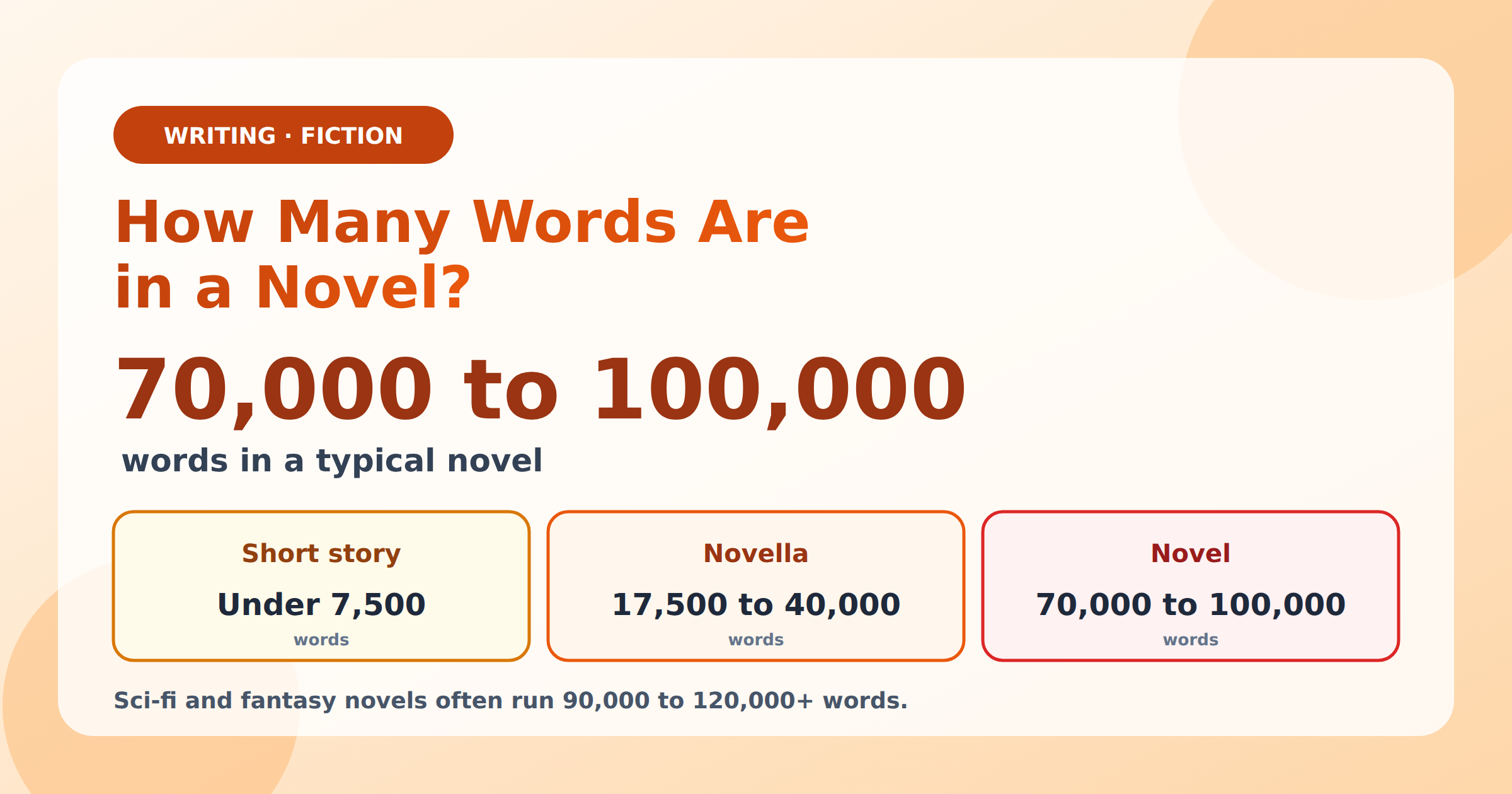
Most adult novels contain 70,000 to 100,000 words. If you are writing toward traditional publication, a manuscript of roughly 80,000 to 90,000 words is the safest target across many adult-fiction categories.
That single range answers the surface question, but it hides four different questions writers are actually asking, and it flattens real differences between genres. Fantasy, science fiction, romantasy, and historical fiction run longer. Category romance, young adult, middle grade, and tightly focused literary novels run shorter. And the number an agent wants from an unknown writer is not the number you will find on the bookshelf of your favorite bestseller.
There is no single perfect novel length. The right word count depends on your genre and subgenre, your readers' age group, whether you are a debut or an established author, whether you plan to query agents or self-publish, the number of characters, settings, viewpoints, and plotlines you are juggling, and whether every scene earns its place on the page.
This guide separates the technical definition of a novel from commercial publishing expectations, then gives you the tools to place your own manuscript. You will find current genre ranges, safer debut targets, page-count conversions, a chapter calculator, a word-count budgeting method, revision diagnostics, and clear answers to the questions writers ask most.
How many words are in a novel?
A typical adult novel runs 70,000 to 100,000 words, and 80,000 to 90,000 is the practical sweet spot for most debuts.
The Science Fiction and Fantasy Writers Association (SFWA) and the Hugo Awards classify any work of 40,000 words or more as a novel, but that is an award-category threshold, not the length agents and publishers expect from an adult commercial manuscript.
The table below shows query and submission targets for unpublished writers, based on current 2026 agent guidance. Published books span a wider range; the genre sections further down give both numbers.
Book type | Query word-count target |
|---|---|
Standard adult novel | 70,000–100,000 |
Safer adult debut target | 80,000–95,000 |
Literary fiction | 80,000–95,000 |
Commercial fiction | 80,000–100,000 |
Romance | 70,000–90,000 |
Mystery / thriller | 80,000–90,000 |
Horror | 70,000–100,000 |
Historical fiction | 90,000–120,000 |
Science fiction | 90,000–110,000 |
Fantasy | 90,000–120,000 |
Romantasy | 90,000–110,000 |
Young adult | 60,000–80,000 |
Middle grade | 40,000–60,000 |
These are planning and submission ranges, not strict laws, but the closer a debut sits to them, the fewer obstacles it faces at the acquisitions stage.
Key Takeaways
Most adult novels run 70,000 to 100,000 words, and 80,000 to 90,000 is a practical target for most debuts.
Awards classify anything over 40,000 words as a novel, yet that technical floor sits far below what agents expect in nearly every adult genre.
Fantasy, science fiction, romantasy, and historical fiction run longer; YA, middle grade, and category romance run shorter.
2026 agent guidance is stricter than bestseller averages, and debuts face the most scrutiny once they climb above 100,000 words.
Benchmark against recent debuts in your exact subgenre, not against famous outliers written by established authors.
A count far outside the range usually signals a structural problem. Revise the story; never pad or trim mechanically.
The four questions hidden inside "how long is a novel?"
Writers asking "how many words are in a novel?" are usually asking one of four different questions. Naming yours is the fastest way to the answer you actually need.
1. What technically counts as a novel?
Science fiction and fantasy award systems, including the Nebula and Hugo Awards, classify fiction of at least 40,000 words as a novel. This is a definitional floor, not a market recommendation.
2. How long are published novels?
Published books vary enormously, from short literary works to 150,000-word fantasy epics. This tells you what has been published, not what an agent wants from an unknown writer today.
3. What length is safest for a debut submission?
Current agent guidance is tighter than bestseller averages. The Manuscript Academy's 2026 genre guide recommends 80,000–95,000 words for debut literary fiction, 80,000–100,000 for commercial fiction, and 90,000–120,000 for fantasy.
4. What length can a self-published author use?
An independent author can release a short novella or a 150,000-word epic without anyone's approval. Length still drives printing cost, retail price, editing expense, audiobook length, reader expectations, pacing, and series-release speed.
Once you know which question you are really asking, the rest of this guide points you to the answer.
The four-lens framework: how to judge any manuscript's length
Those four questions map to four lenses you can hold up to any manuscript. Run your book through all four before you defend, or doubt, its word count.
Classification. Does the manuscript technically qualify as a novel, novella, or shorter work?
Market. What length do agents, publishers, retailers, and readers expect in your specific category?
Story. Does the manuscript contain enough conflict, development, and consequence to justify its length?
Format. Will the work be queried, self-published, serialized, released digitally, or printed?
A manuscript can pass one lens and fail another, and that mismatch is where problems hide. A 45,000-word adult thriller may technically be a novel (classification), yet still read as underdeveloped to agents (market and story). A 140,000-word fantasy may satisfy its story and its readers, yet create real production risk for a debut (format and market). The goal is not to pass one lens. It is to pass all four at once.
Novel vs novella vs novelette vs short story
The Nebula and Hugo Awards use the following length classifications for science fiction and fantasy:
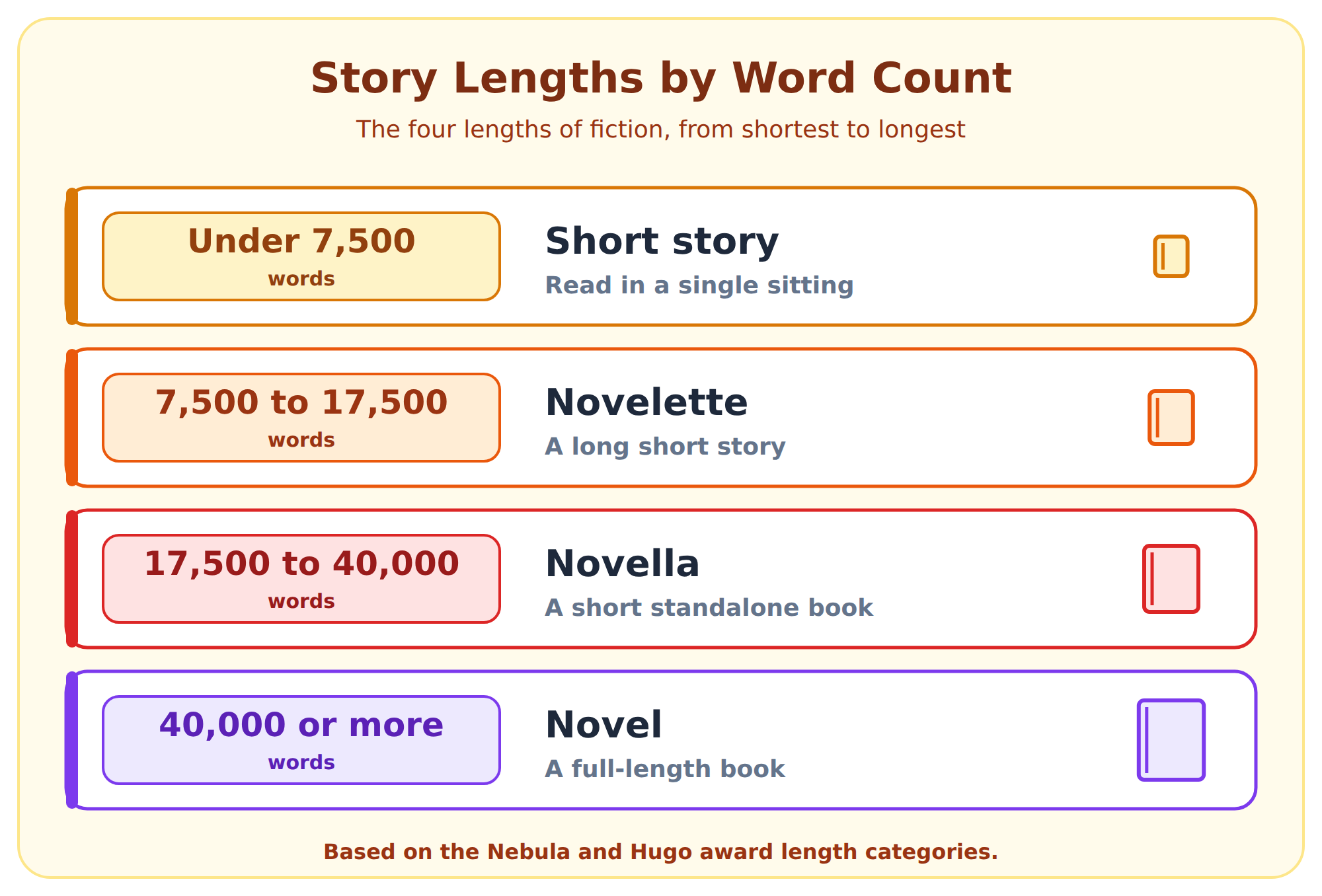
These definitions are useful reference points, but they are not universal rules that every publisher or bookstore follows. The same manuscript can be marketed differently depending on genre, format, and reader expectations: one publisher may call a short work a "short novel" while another markets a similarly sized book as a novella.
What is the average novel word count?
A useful general estimate is 80,000 to 90,000 words.
Publishing Talk points to roughly 80,000 words as a typical novel length, while The Write Practice and Career Authors have long used 90,000 words as a common commercial target. Reedsy gives the broader standard range of 70,000 to 100,000 words.
There is no official database recording the exact word count of every novel ever published. Reported figures are drawn from manuscript records, ebook text analysis, page-count estimates, publisher and author disclosures, editorial experience, and bestseller samples. That is precisely why responsible sources publish ranges rather than one deceptively precise average, and why you should be skeptical of any guide that claims a single magic number.
Marketplace medians vs agent targets: why the numbers online disagree
One reason online answers conflict is that they measure two different things: what gets written and edited, versus what agents want queried.
Reedsy published median word counts from projects in its editing marketplace, comparing 2023 and 2024. Its 2024 medians included 87,100 words for fantasy, 78,500 for mystery and thriller, 75,000 for romance, 73,900 for young adult, and 66,300 for literary fiction. These are Reedsy marketplace figures, a snapshot of projects that pass through one platform, not a full census of published novels.
Current 2026 agent guidance often recommends higher or narrower targets for manuscripts being actively queried.
Category | Reedsy 2024 marketplace median | 2026 debut query guidance |
|---|---|---|
Fantasy | 87,100 | 90,000–120,000 |
Science fiction | 71,300 | 90,000–110,000 |
Mystery / thriller | 78,500 | 80,000–90,000 |
Literary fiction | 66,300 | 80,000–95,000 |
Romance | 75,000 | 70,000–90,000 |
Young adult | 73,900 | 60,000–80,000 |
Middle grade | 33,100 | 40,000–60,000 |
Query ranges: Manuscript Academy 2026 agent guide.
This gap does not mean one dataset is wrong. It means the two are answering different questions. Marketplace projects mix publication routes and stages; finished or edited books can legitimately fall outside submission norms; agents weigh acquisition risk differently from readers buying a finished book; and a median is not the same as a recommended range. Read the marketplace numbers to understand the market, and the agent numbers to plan your query.
How many words should a debut novel have?
For most adult debuts, aim for 80,000 to 95,000 words unless your genre has a strong reason to run shorter or longer.
The 2026 Manuscript Academy guide gives these debut targets:
Debut category | Current target |
|---|---|
Adult literary fiction | 80,000–95,000 |
Commercial fiction | 80,000–100,000 |
Mystery / thriller | 80,000–90,000 |
Contemporary romance | 70,000–90,000 |
Historical romance | 80,000–100,000 |
Science fiction | 90,000–110,000 |
Fantasy | 90,000–120,000 |
Romantasy | 90,000–110,000 |
Young adult | 60,000–80,000 |
Middle grade | 40,000–60,000 |
The same guide warns that literary debuts above 100,000 words face "significant market resistance," and that fantasy debuts above roughly 130,000 words need to be extraordinary to justify the production cost. Career Authors echoes this: manuscripts over 100,000 words make many publishers nervous, even as science fiction, fantasy, and historical fiction retain higher accepted ranges.
Treat these figures as guardrails that inform your decisions, not numbers that override the needs of your story.
Why debuts face stricter expectations than bestsellers?
Established authors come with a sales history. Their publishers can forecast demand, print runs, pricing, and reader commitment with reasonable confidence. A debut author is an unknown quantity, so an unusually long debut raises a stack of practical questions at once: higher production and shipping costs, more editing time, greater pacing risk, tighter retail-price math, heavier reader commitment, larger translation and audiobook bills, and an untested ability to revise at scale.
As agent Noelle Falcis Math has observed, "once the word count starts to get a little bit up there, their interests may wane," particularly for debut authors. Amazon's KDP printing model makes the cost side concrete: paperback printing is calculated as a fixed base cost plus a per-page charge, so every additional page directly raises production cost once a book exceeds the base page range.
A long manuscript is not automatically a bad one. It simply asks publishers and readers to accept more cost and more commitment, so it has to earn that ask.
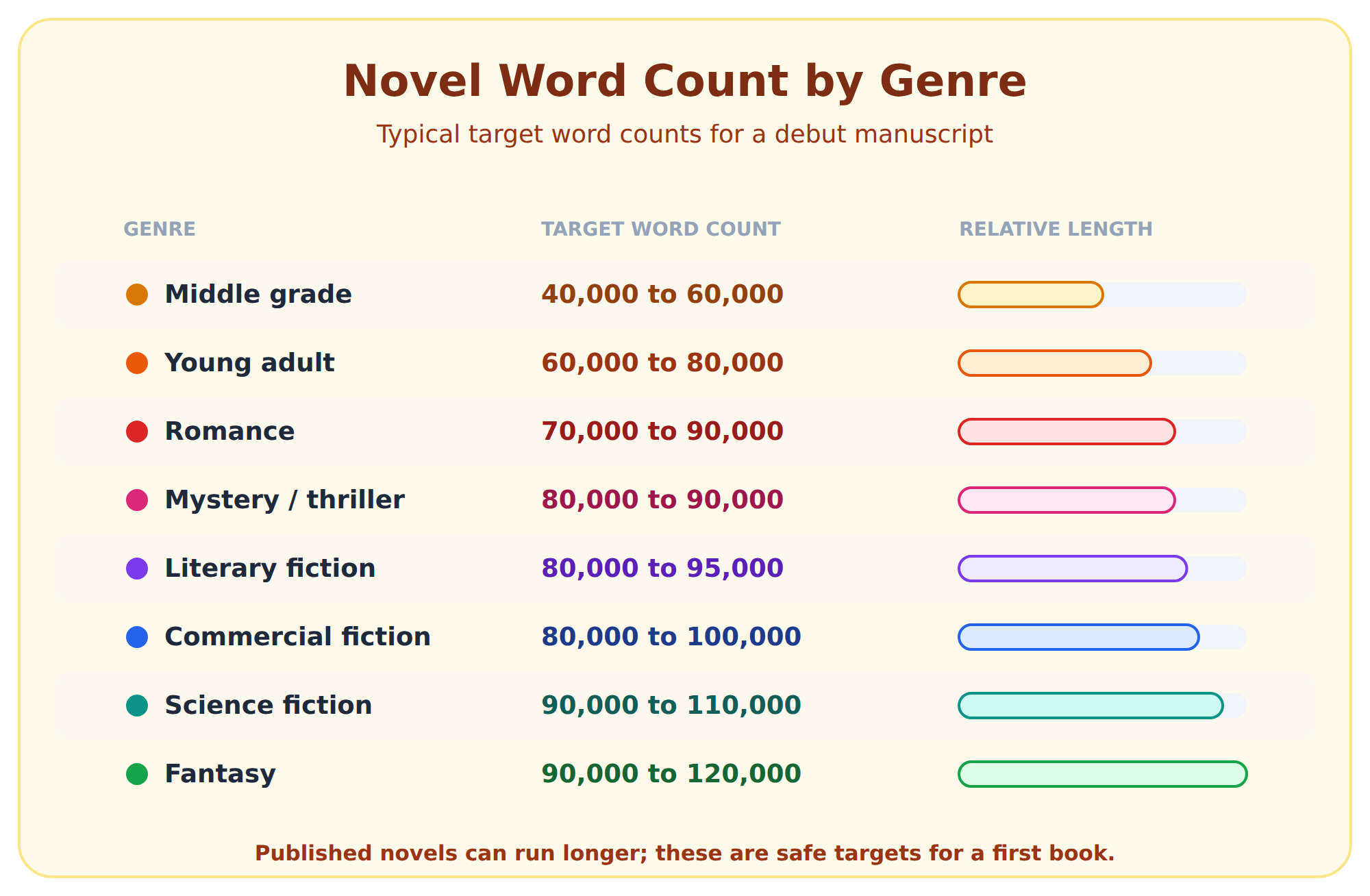
Novel word count by genre
Each section below gives the range for published books in the category and, where 2026 agent guidance differs, the narrower query target for debuts.
Commercial fiction
Query target: 80,000–100,000 words.
Commercial novels prize a clear premise, accessible prose, strong character motivation, and a plot that keeps moving. For a debut, the lower-to-middle part of this range is usually easier to position. A manuscript over 110,000 words often signals room to cut: fewer subplots, fewer viewpoints, a faster opening, tighter scene transitions, less backstory, and fewer repeated explanations.
Literary fiction
Published range: 70,000–100,000 words. Query target: 80,000–95,000 words.
Literary fiction tolerates real variation. A concentrated novel can work below 70,000 words, while a multigenerational or structurally ambitious story may pass 100,000. The 2026 Manuscript Academy guidance places debut literary fiction at 80,000–95,000, with resistance building past 100,000; Career Authors cites 80,000–100,000 as common for contemporary literary novels, with shorter and longer exceptions. One caution: slow pacing, dense description, and sheer length do not, by themselves, make a book literary.
Upmarket and women's fiction
Query target: 75,000–100,000 words.
These categories blend accessible plotting with deeper character and thematic weight. Career Authors places women's fiction around 75,000–100,000 words, with 80,000–90,000 as a particularly reliable range.
Romance
Query target: 70,000–90,000 words, though length varies sharply by publisher and subgenre.
Category-romance imprints often publish exact submission requirements. When they do, those numbers override any general guidance, including this table.
Mystery
Published range: 70,000–90,000 words. Query target: 80,000–90,000 words.
A traditional mystery needs room for the central crime, the suspects, the clues, the misdirection, the investigation, the revelation, and the consequences. Cozy mysteries may run as short as 60,000–70,000 words; more intricate mysteries approach 90,000. For debut queries, Career Authors centers mystery on 80,000–90,000 words.
Thriller and suspense
Query target: 80,000–90,000 words, with some flexibility up to about 95,000 for espionage or complex international stories.
Thrillers live and die on pace. Length that feels immersive in epic fantasy feels sluggish in a tightly plotted thriller. The genre punishes padding faster than almost any other.
Crime fiction
Query target: 80,000–95,000 words.
Police procedurals, legal thrillers, organized-crime novels, and psychological crime each demand different amounts of space. Rather than lean on a broad "crime" average, benchmark against recent comparable titles in your specific subgenre.
Horror
Published range: 70,000–100,000 words.
Contained horror can work near the lower end; historical, supernatural, or speculative horror often needs more room. Reedsy's marketplace median for horror jumped from 50,000 words in 2023 to 61,800 in 2024, a swing that says more about the volatility of small marketplace samples than about any industry-wide shift. Do not mistake that median for a published-novel average.
Historical fiction
Query target: 90,000–120,000 words.
Historical fiction often needs extra space for unfamiliar social rules, political context, material culture, multiple generations, real events, and wider geography. Career Authors recommends roughly 90,000–120,000 words while stressing that shorter is currently safer. Let the research support the narrative; you do not have to spend every fact you discovered.
Science fiction
Query target: 90,000–110,000 words.
Science fiction may need room to establish technology, social systems, scientific premises, political structures, unfamiliar settings, and the downstream consequences of speculative change. A near-future thriller can run shorter; a space opera spanning several planets and viewpoints will run longer.
Fantasy
Query target: 90,000–120,000 words.
Fantasy is granted more space because readers absorb new cultures, geography, magic systems, creatures, histories, and political factions as they go. Debuts above roughly 130,000 words become materially harder to position, so treat that as a soft ceiling rather than a stretch goal.
Epic fantasy
Query target: 100,000–130,000 words for a debut.
Published epic fantasy can run far longer, but famous series are poor benchmarks for an unpublished writer. A genuinely large story may justify multiple viewpoint characters, several regions or nations, political conflict, military campaigns, and interlocking plotlines. "Epic" should describe the scale of the story, not the volume of unedited exposition.
Romantasy
Query target: 90,000–110,000 words.
Romantasy has to develop both a central romantic arc and a convincing fantasy conflict, which is why it sits higher than contemporary romance. The Manuscript Academy's current target is 90,000–110,000 words, with a little more room for heavily built secondary worlds or historical settings.
Action and adventure
Query target: 70,000–95,000 words.
Action novels reward speed and clear forward momentum. A longer manuscript should justify its size with real changes in setting, stakes, character, or conflict, not another round of escapes and confrontations that leave the story where it started.
Word count by reader age
Young adult
Query target: 60,000–80,000 words.
Contemporary YA typically sits near 60,000–75,000 words, while YA fantasy, horror, and science fiction stretch higher. Manuscripts over 90,000 words need a compelling genre or structural reason. Published YA runs a little wider, down to about 55,000.
Middle grade
Query target: 40,000–60,000 words.
Current 2026 agent guidance recommends roughly 40,000–50,000 words for contemporary middle grade and up to about 60,000 for fantasy or adventure, with scrutiny rising past 65,000 (where agents start questioning whether the book is truly middle grade). Published younger middle-grade titles can run shorter, down to about 30,000 words.
Chapter books
Typical range: approximately 5,000–20,000 words.
Chapter books vary by reading level, series format, illustration density, and publisher. They generally feature short chapters, a small cast, clear chronological action, few subplots, accessible vocabulary, and generous spacing or illustrations.
Picture books and early readers
These are books but are not usually classified as novels. Ideal length depends heavily on reader age, illustration format, and individual publisher requirements.
The green–yellow–red zone system for your manuscript
Once your draft is complete, place its word count in one of three zones. This is the fastest way to know whether you have a polishing job or a structural one.
🟢 Green zone. Your manuscript falls inside the current range for its genre. Keep revising for quality; do not chase a different number.
🟡 Yellow zone. Your manuscript sits roughly 5,000 to 15,000 words outside the range. Study recent comparable titles, then investigate pacing, development, and repetition before you query.
🔴 Red zone. Your manuscript is substantially outside the range, say a 45,000-word adult thriller or a 160,000-word debut literary novel. Do structural revision before querying.
A red-zone count does not prove the story is bad. It means the manuscript will likely face questions before anyone considers its quality, and your job is to remove that friction before an agent ever sees the number.
Is [X] words enough for a novel? The threshold questions answered
Is 40,000 words enough for a novel?
Technically, yes. The Nebula and Hugo Awards classify any work of 40,000 words or more as a novel. Commercially, it is short for most adult genres. It may suit a short literary novel, a category romance, a compact science fiction work, a self-published short novel, or a younger-reader book. Do not treat the technical minimum as an ideal market target.
Is 50,000 words enough for a novel?
Yes, but it sits on the short side for much adult fiction. Fifty thousand is also the famous NaNoWriMo target, which is why the question spikes every November. That challenge calls 50,000 words a novel; most adult publishers call it a starting point. It can work for category romance, some literary fiction, YA contemporary, middle grade, cozy or highly concentrated genre fiction, and self-published short novels. It will read as underdeveloped for epic fantasy, historical fiction, space opera, complex thrillers, or multigenerational stories. The real question is not whether 50,000 words is allowed. It is whether that length delivers the experience your genre promises.
Is 60,000 words enough?
Sixty thousand words is a legitimate novel length for literary fiction, contemporary romance, YA, cozy mystery, and focused commercial fiction. For adult fantasy, historical fiction, or complex science fiction, it often signals that the world, plot, or character arcs need more development.
Is 80,000 words a good novel length?
Yes. Eighty thousand words is one of the most reliable targets for an adult debut. It falls inside current recommendations for literary fiction, commercial fiction, mystery, thriller, romance, women's fiction, and much horror and historical fiction. It is long enough to support a developed plot without automatically raising production or pacing concerns. If you are unsure where to aim, aim here.
Is 100,000 words too long?
Not necessarily. One hundred thousand words is normal for fantasy, science fiction, historical fiction, romantasy, complex commercial fiction, and multi-viewpoint stories. It runs long for category romance, cozy mystery, contemporary YA, or a tightly focused literary novel. Manuscripts above 100,000 words draw more scrutiny, but genre remains the deciding factor.
Is 120,000 words too long for a debut?
It depends entirely on genre. A 120,000-word debut can work for adult fantasy, epic fantasy, science fiction, historical fiction, and historical romantasy. It is hard to justify for contemporary romance, standard mystery, literary fiction, contemporary YA, or cozy fiction. At this length, your query, premise, opening pages, and pacing all have to work overtime.
Is 150,000 words too long?
For an unpublished debut, yes, it is long. A 150,000-word manuscript can still succeed, especially in epic fantasy, but current professional guidance generally favors cutting or splitting before you query. First, audit for repeated scenes, unnecessary viewpoints, sprawling backstory, excess worldbuilding, multiple climaxes, and the telltale sign of two complete books stitched together.
Published bestseller length is not a query target
Kindlepreneur's Amazon bestseller study reported average lengths of roughly 109,000 words for fantasy, 102,000 for historical fiction and horror, 98,000 for literary and science fiction, 91,000 for mystery/thriller/suspense, and 90,000 for romance.
These numbers are useful for understanding what readers buy, but the dataset includes established authors, self-published writers, long-running series, category anomalies, and previously successful intellectual property. Famous individual titles skew further still: the fifth Harry Potter novel alone runs about 257,000 words, but J.K. Rowling was a global bestseller by then, not a debut. Use bestseller data to read the market; use current agent guidance to plan a debut query. They are different tools for different jobs.
Why word count matters at all?
Reader expectations. Readers form expectations from the books already on the shelf in their preferred category. A thriller reader expects pace and concentration; an epic-fantasy reader welcomes a bigger world and cast; a middle-grade reader needs a manageable reading experience. Your word count is a promise about the kind of book you are handing them.
Story health. An unusual count often reveals a story problem. Too short can mean missing escalation, thin character development, weak obstacles, unearned consequences, or an incomplete resolution. Too long can mean repetitive scenes, too many viewpoints, unnecessary exposition, repeated emotional beats, excessive setup, or subplots disconnected from the main story.
Commercial reality. Longer print books cost more to manufacture, because printing cost is tied partly to page count. Amazon KDP's paperback formula is a fixed base cost plus page count times a per-page rate, which drives the minimum viable retail price and squeezes royalties. More words also mean more copyediting, proofreading, typesetting, translation, and narration. And positioning matters: a very short book can look like poor value if marketed as a standard full-length novel, while a very long one may demand a higher price or intimidate casual readers.
Traditional publishing vs self-publishing
Issue | Traditional publishing | Self-publishing |
|---|---|---|
Word-count flexibility | Lower | Higher |
Agent screening | Usually required | Not required |
Acquisition risk | Publisher evaluates it | Author carries it |
Print expense | Publisher's concern | Author's pricing concern |
Genre conformity | Highly important | Still important |
Short works | Harder in some categories | Easier to release digitally |
Long series | Publisher controls strategy | Author controls strategy |
Reader expectations | Important | Equally important |
If you are querying: use a word count close to current genre expectations, report word count rather than page count (agents note that page count changes the moment a manuscript is typeset), and round sensibly, normally to the nearest thousand.
If you are self-publishing: you can publish at almost any length, but you still have to decide how readers will perceive and pay for the work. A shorter manuscript can shine as a novella, a series prequel, a rapid-release romance, an ebook exclusive, or a serialized story. A longer work brings higher print costs, a higher minimum price, steeper editing bills, slower release schedules, and a longer audiobook. Creative freedom does not erase commercial consequences; it just moves them onto your desk.
How many pages are in a novel?
Word count is more reliable than page count, because page totals shift with trim size, typeface, font size, margins, line spacing, dialogue density, chapter openings, illustrations, and ebook settings.
A rough published-book estimate is 250 to 300 words per page. The Novelry recommends 250 words for a simple calculation; Publishing Talk uses about 275. If you want to run the conversion for your own manuscript, a words-to-pages counter does it instantly.
Word count | At 250 words/page | At 300 words/page |
|---|---|---|
40,000 | 160 pages | 133 pages |
50,000 | 200 pages | 167 pages |
60,000 | 240 pages | 200 pages |
70,000 | 280 pages | 233 pages |
80,000 | 320 pages | 267 pages |
90,000 | 360 pages | 300 pages |
100,000 | 400 pages | 333 pages |
120,000 | 480 pages | 400 pages |
150,000 | 600 pages | 500 pages |
These are estimates, not guaranteed final page totals.
How many words are in a 300-page novel?
A 300-page novel commonly contains about 75,000 to 90,000 words: 75,000 at 250 words per page, 82,500 at 275, and 90,000 at 300. Dialogue-heavy books run fewer words per page because of white space; dense literary or historical prose runs more.
How many chapters should a novel have?
There is no required chapter count. Use this formula:
Total word count ÷ average chapter length = estimated number of chapters.
Average chapter length | Approx. chapters in an 80,000-word novel |
|---|---|
1,500 words | 53 |
2,000 words | 40 |
2,500 words | 32 |
3,000 words | 27 |
4,000 words | 20 |
5,000 words | 16 |
Reedsy's analysis of 50 books suggests 2,000 to 4,000 words is a useful general chapter range for adult fiction, with major differences by genre and style. End a chapter where the story creates a decision, a discovery, a reversal, a question, a change of location or viewpoint, or a new consequence, not where you hit an arbitrary word target. Uniform chapter length is a formatting preference, never a rule.
The word-count budget method
Instead of hoping your draft accidentally lands at the right length, build a flexible budget before you write.
Step 1: set a target range. Example for a mystery: 78,000 minimum, 85,000 preferred, 92,000 upper limit.
Step 2: allocate the major sections. For an 85,000-word novel:
Section | Approx. share | Word budget |
|---|---|---|
Opening and setup | 20% | 17,000 |
Rising complications | 30% | 25,500 |
Midpoint to final crisis | 30% | 25,500 |
Climax and resolution | 20% | 17,000 |
Step 3: estimate scenes. If your target is 85,000 words and your average scene runs 1,500 words, that is roughly 57 scenes.
Step 4: check your trajectory. At 25% of your planned scenes, your draft should sit near 25% of the target, unless your outline deliberately front-loads or back-loads longer sections. A quick way to stay honest is to keep a running word count of the draft and compare it against the section budgets above.
Step 5: revise structurally, not evenly. Do not shave 10% off every chapter. Cut or expand according to what each part of the story actually needs.
This is a planning aid, not a cage. Adjust it as the draft teaches you what the story is.
How to research your own market range
Generic genre tables are a starting point, not a finish line. Career Authors recommends surveying around 15 recently published comparable titles of your own.
Choose books that are:
Published within the last three to five years
In your exact subgenre
Written for the same age category
Similar in scope and ambition
Debuts where possible
Published through your intended route
Standalone novels rather than box sets
Avoid leaning on famous classics, sequels by bestselling authors, omnibuses, special editions, celebrity books, extreme outliers, or books written for another age group. Record what you find:
Comparable | Year | Subgenre | Pages | Estimated words | Debut? |
|---|---|---|---|---|---|
Book 1 | 2025 | Mystery | 310 | 82,000 | Yes |
Book 2 | 2024 | Mystery | 340 | 90,000 | No |
Book 3 | 2023 | Mystery | 295 | 78,000 | Yes |
Use the median of your list, not the average. One enormous outlier can otherwise drag your target in the wrong direction.
Should you worry about word count during the first draft?
Know your target range, but do not stop mid-scene to hit it precisely. A practical sequence: pick a broad genre target, outline enough conflict to support it, write the complete first draft, set the draft aside briefly, diagnose structural problems, revise scenes and character arcs, recheck the word count, and save sentence-level editing for last.
Reedsy advises writers not to obsess over word count during initial drafting, but to revise once the whole story can be evaluated. Writing coach Tiffany Hawk offers the same balance: take word count seriously during revision and query prep, not while it can paralyze the draft.
What to do if your novel is too short?
Do not add filler. A low count almost always means a missing part of the story, not a missing quota of words.
Check the central goal. What does the protagonist want, why can't they get it immediately, what happens if they fail, and does the goal grow harder over time?
Strengthen escalation. Each major development should raise risk, urgency, cost, difficulty, emotional pressure, or moral conflict.
Examine character development. Does the protagonist start with a meaningful flaw, make choices that create consequences, face pressure to change, and earn the final transformation? Important relationships need their own goals, conflict, change, consequences, and moments of decision.
Mine complications from the existing story. A trusted ally wants something incompatible. A solution creates a bigger problem. New information changes the protagonist's goal. Success carries an unexpected cost. A personal relationship collides with the external conflict.
Add a subplot only if it earns its place. A useful subplot pressures the protagonist, reinforces or challenges the theme, complicates the central goal, intersects with the main plot, and reaches a real resolution.
Get outside feedback. Beta readers and critique partners flag what feels rushed, unclear, emotionally incomplete, or underdeveloped. Scribophile emphasizes critique as a way to diagnose whether a manuscript needs expansion or trimming.
What to do if your novel is too long?
Start with structure, not adjectives.
Run the scene test. For every scene, note the viewpoint character, their immediate goal, the obstacle, what changes, what new information appears, the consequence, and why the next scene must follow. A scene that changes nothing may not be necessary.
Combine duplicate scenes. Look for scenes that repeat the same warning, argument, clue, realization, relationship conflict, or worldbuilding beat.
Shorten the opening. Many manuscripts spend too long on "normal life" before the disruption. Ask whether the story can begin closer to the inciting event, with the character already under pressure, after the introductory backstory, or at the first irreversible decision.
Reduce exposition. Include worldbuilding only when it changes a decision, an obstacle, a relationship, or the reader's understanding of the conflict. Reedsy's editors flag unnecessary movement, repeated exposition, historical information dumps, weak modifiers, and overused words as the usual sources of bloat.
Review viewpoint characters. Every viewpoint demands space for introduction, motivation, emotional development, plot relevance, and resolution. Remove, merge, or shrink viewpoints that don't provide essential value.
Cut repeated internal monologue. A character does not need to relitigate the same fear after every conversation.
Check for two complete books. Your manuscript may be two novels in a trench coat if it has a major climax near the middle, a new central goal afterward, a large time jump, a substantially different cast or setting, two complete antagonist arcs, or two distinct emotional journeys.
Should you split a long novel?
Split only when each resulting book can stand as a complete reading experience. A strong first volume needs its own central goal, meaningful escalation, a climax, a resolution to the primary conflict, and open possibilities for later books. Current 2026 agent guidance favors presenting the first manuscript as a standalone novel with series potential rather than submitting half a story that cannot stand alone. Never divide a manuscript arbitrarily at the midpoint.
How to check your word count (and why tools disagree)?
Different tools count differently. Word, Google Docs, and Scrivener each handle hyphenated words, ellipses, and headings in their own way, so two programs can disagree by a few hundred words on the same manuscript. That gap never matters at query scale, since you are rounding to the nearest thousand anyway. To sanity-check your software, paste a chapter into a standalone word counter and compare before you rely on any single total.
How word count should appear in a query?
State the title, genre or category, rounded word count, and confirmation that the manuscript is complete. For example:
THE GLASS HARBOR is a complete 87,000-word adult mystery.
Do not report page count. Current agent guidance explicitly prefers word count, because page totals change during production. Always follow each agent's individual submission instructions.
Does the prologue count?
Yes. A prologue is part of the narrative manuscript and counts toward the total, as do chapters, interludes, in-narrative epigraphs, and an epilogue. For querying, use the approximate total from your writing software. Do not manually inflate it with estimated jacket copy or future acknowledgments.
How long does it take to write a novel?
That depends on your writing schedule, research load, experience, revision process, and target length. For an 80,000-word first draft:
Average daily output | Drafting days |
|---|---|
250 words | 320 |
500 words | 160 |
750 words | 107 |
1,000 words | 80 |
1,500 words | 54 |
2,000 words | 40 |
These are writing days, not calendar deadlines. A finished novel also needs time for planning, research, rest, structural revision, feedback, rewriting, copyediting, and proofreading.
The novel word-count decision tree
Work through these questions in order.
Who is the reader? Adult, young adult, middle grade, or chapter-book reader.
What is the exact subgenre? "Fiction" is too broad. Choose psychological thriller, cozy mystery, contemporary romance, epic fantasy, space opera, literary family drama, historical romantasy, and so on.
How will it be published? Queried to agents, submitted to a small press, self-published, serialized, or released as an ebook novella.
Is it a debut? Stay closer to the expected range when you lack a sales history.
What do recent comparables show? Weigh recent books, not famous exceptions.
Is the story complete? A correct count cannot rescue a missing arc or a weak ending.
Is every major section necessary? Remove repetition before you defend the total.
Common word-count mistakes
Using the technical minimum as the ideal. Forty thousand words may classify as a novel, but it rarely makes the best target for an adult fantasy or thriller.
Treating 90,000 as a universal rule. It fits many adult debuts, not every category.
Comparing yourself with famous outliers. An established author's 250,000-word sequel is not a realistic benchmark for a debut query.
Counting pages instead of words. Page count shifts with formatting.
Padding a short manuscript. Extra weather, travel, and repeated dialogue will not fix an underdeveloped plot.
Cutting every chapter equally. Structural problems are rarely spread evenly.
Ignoring age category or subgenre. Seventy thousand words means very different things in adult fantasy versus contemporary middle grade, and a cozy mystery and an espionage thriller need different scope.
Assuming self-publishing removes reader expectations. Readers still weigh price, length, pacing, and value against other books in the category.
Querying before the manuscript is complete. For most debut fiction, finish and revise the whole novel first.
Final novel word-count checklist
Before you decide your manuscript is ready:
Have I identified the correct age category and exact subgenre?
Is my target based on current guidance and recent comparable debuts?
Is the manuscript complete?
Does the protagonist have a developed arc, and does the conflict escalate?
Does every subplot affect the central story?
Does every viewpoint add essential information?
Are any two scenes performing the same function?
Is backstory slowing the opening?
Can I explain why the story needs its current length?
Am I reporting words rather than pages, and following each agent's guidelines?
Most adult novels contain 70,000 to 100,000 words, and 80,000 to 90,000 remains the practical target for most debut writers. But the most accurate answer requires four separate questions. Does the work technically qualify as a novel? Does it fit the current market for its genre? Does the story justify its length? Does the intended publishing format support it?
Do not chase one universal number. Study recent comparable books, apply current agent and publisher guidance, finish the story, then revise until every remaining scene develops character, advances conflict, reveals necessary information, or creates meaningful consequence.
Your novel should not be as long as possible. It should be exactly as long as its complete, well-paced story requires, while staying recognizable to the readers and the market you hope to reach.
Frequently Asked Questions
How many words are usually in a novel?
Most adult novels contain about 70,000 to 100,000 words, with 80,000 to 90,000 as the most common target.
What is the ideal word count for a first novel?
For most adult debuts, 80,000 to 95,000 words is a practical target. Genre can justify a shorter or longer manuscript.
What is the minimum length of a novel?
The Nebula and Hugo Awards classify works of 40,000 words or more as novels. Individual publishers often expect more.
How many words are in a 200-page novel?
About 50,000 to 60,000 words, at 250 to 300 words per page.
How many words should be in one chapter?
Many adult-fiction chapters run around 2,000 to 4,000 words, but effective chapters can be much shorter or longer.
Do chapter titles count toward word count?
Your writing software may include them, but their effect is negligible. Use the approximate manuscript total rather than adjusting every heading.
Should you include word count in a query letter?
Yes. State the rounded manuscript word count along with the title, genre, and category.
Should you include page count in a query?
Usually not. Word count is more useful, because page count changes with formatting and typesetting.
Are fantasy novels always longer?
No. Epic and secondary-world fantasy often run long, but urban, cozy, comic, and tightly focused fantasy can be considerably shorter.
Can self-published novels be shorter?
Yes. Independent authors have more freedom, especially with ebooks and series, but the book should still be marketed accurately and satisfy readers.
Does Kindle Unlimited encourage longer books?
Because Kindle Unlimited pays based on pages read, some writers believe it rewards length, but a longer book does not automatically perform better. Reader retention, satisfaction, and category fit still decide the outcome.
Should you pad or trim a manuscript just to hit the expected range?
No. Add material only when it improves conflict, character, setting, or consequence, and cut only repetition or unnecessary structure. Diagnose why the count is off instead of moving the number mechanically.
Can a novel be one million words?
Technically there is no universal maximum, but a work that long is extremely difficult to publish and market as a single conventional printed novel.
Is a series counted as one novel?
No. Each volume normally has its own word count and must deliver a satisfying reading experience. Award systems may classify a complete series separately under their own rules.