Ernest Hemingway: The Old Man and the Sea Full Study Guide
Read a clear guide to Ernest Hemingway’s The Old Man and the Sea, including the full plot, main themes, symbols, characters, ending, and meaning.
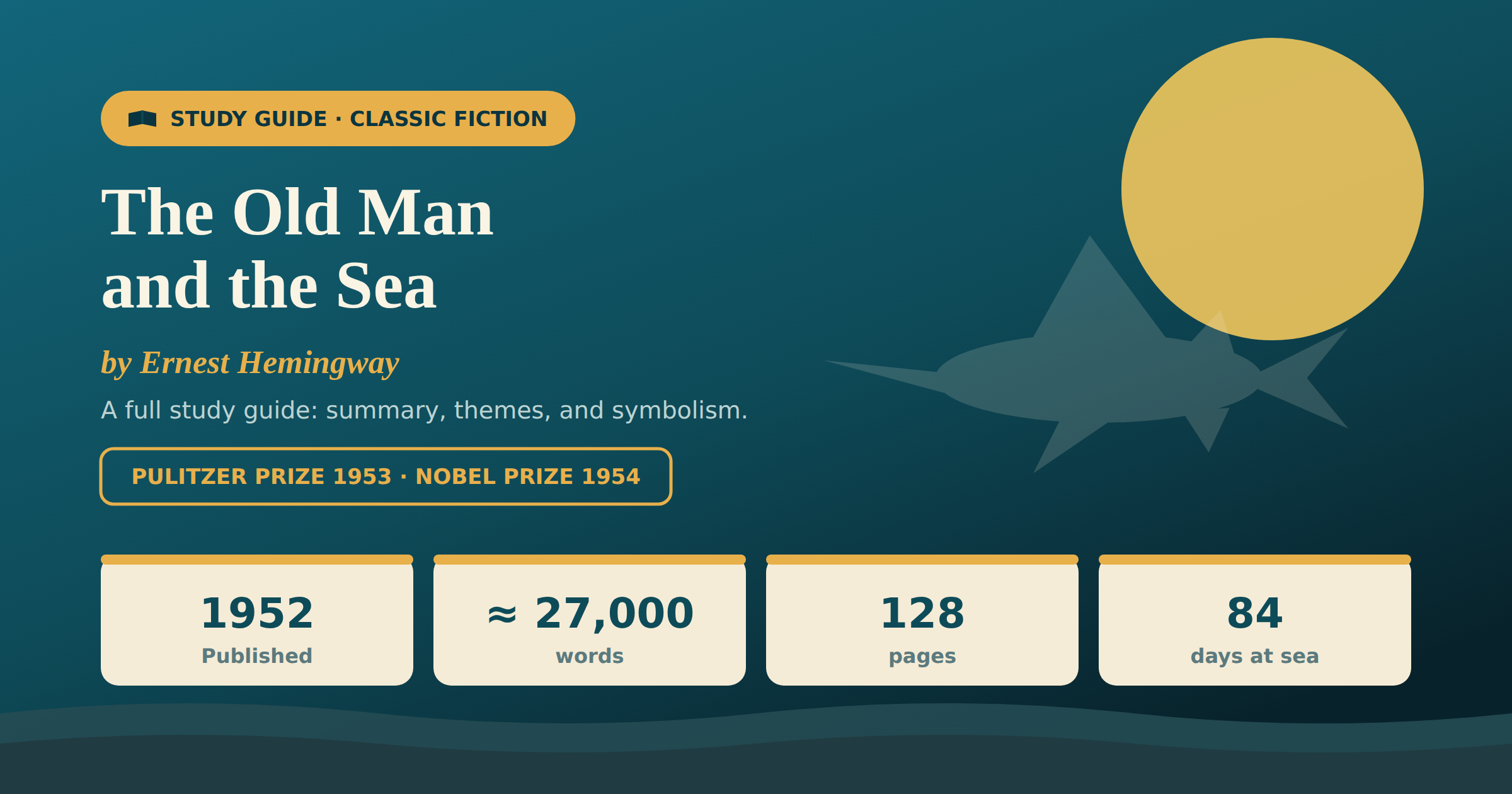
Ernest Hemingway's The Old Man and the Sea looks like a simple fishing story. An aging Cuban fisherman hooks an enormous marlin, struggles with it for days, and tries to bring it home.
Yet the novella asks a much larger question: what does success mean when you give everything you have but lose the visible reward?
That question explains why readers still debate Santiago's journey. Some see him as a triumphant hero. Others believe his pride causes an avoidable failure. Both interpretations have strong support because Hemingway separates achievement from outcome. Santiago loses the marlin, but he recovers his dignity, proves his skill, and renews his relationship with Manolin.
Spoiler warning: this guide explains the complete plot and ending.
Image suggestion: A weathered book cover or a photo of a small wooden skiff on open water. Alt text: "Cover image for a study guide to Ernest Hemingway's The Old Man and the Sea."
Quick Answer
The Old Man and the Sea is a 1952 novella by Ernest Hemingway about Santiago, an elderly Cuban fisherman who has gone 84 days without catching a fish. On the 85th day, he hooks a giant marlin and struggles with it for three days. He finally captures it, but sharks consume the marlin before he reaches home. Santiago returns with only its skeleton.
The main message is that a person's worth cannot always be measured by material results. Santiago loses the fish, but his courage, discipline, endurance, and love for his craft remain. The ending is therefore both tragic and hopeful.
The Old Man and the Sea at a Glance
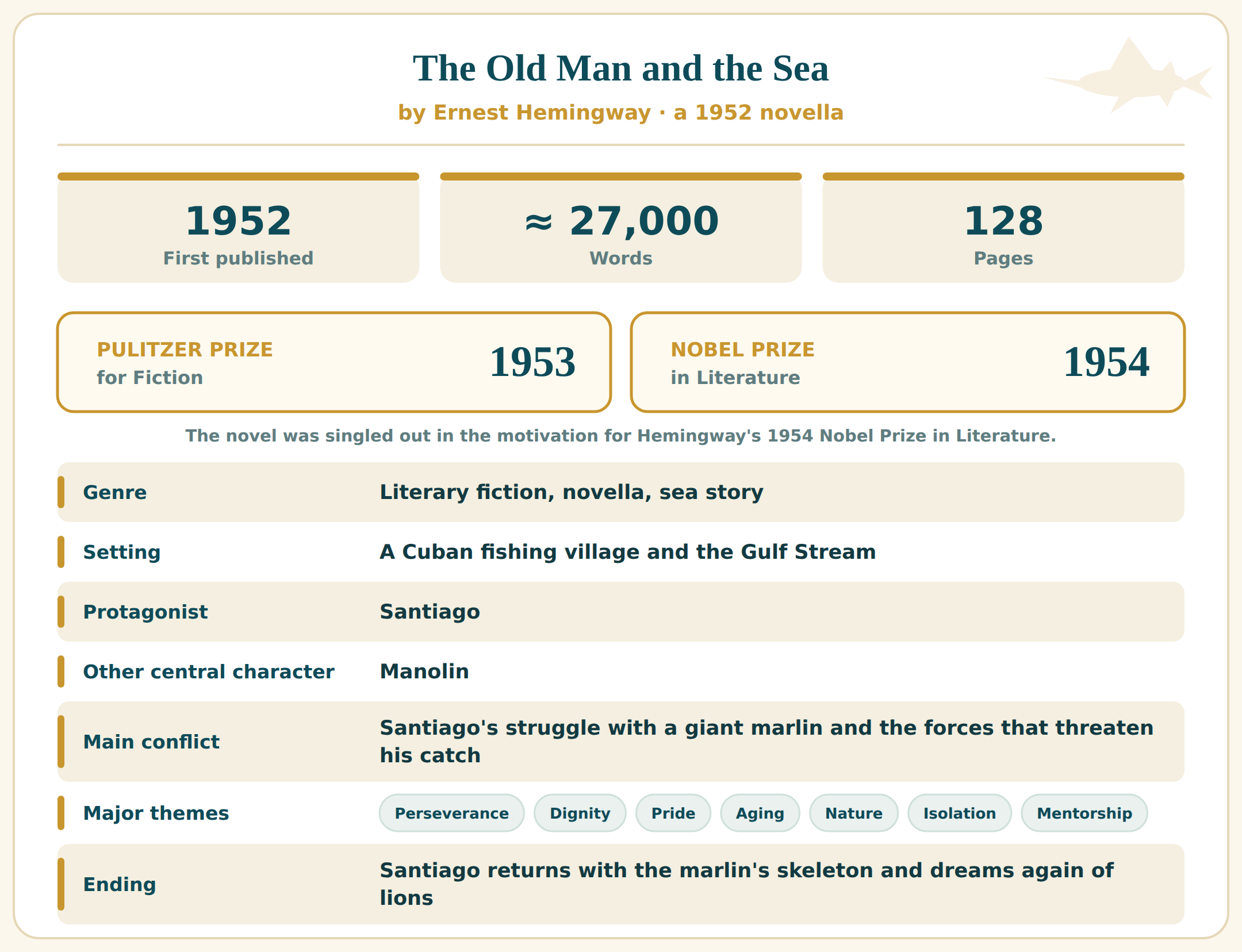
The official publisher's edition identifies the book as a 128-page work of literary fiction. Page counts vary across formats and editions. For fuller background, see the Encyclopaedia Britannica entry on the novel.
What Is The Old Man and the Sea About?
At its most literal level, the novella is about an old fisherman attempting to end a long streak of bad luck.
At a deeper level, it explores:
How people preserve dignity during failure
Whether effort can matter without a reward
When determination becomes dangerous pride
How aging changes ability without erasing identity
Whether humans belong to nature or struggle against it
Why companionship matters even to independent people
How knowledge passes from one generation to another
Hemingway does not provide one final answer. Instead, he creates a situation in which victory and defeat exist at the same time.
Complete Plot Summary
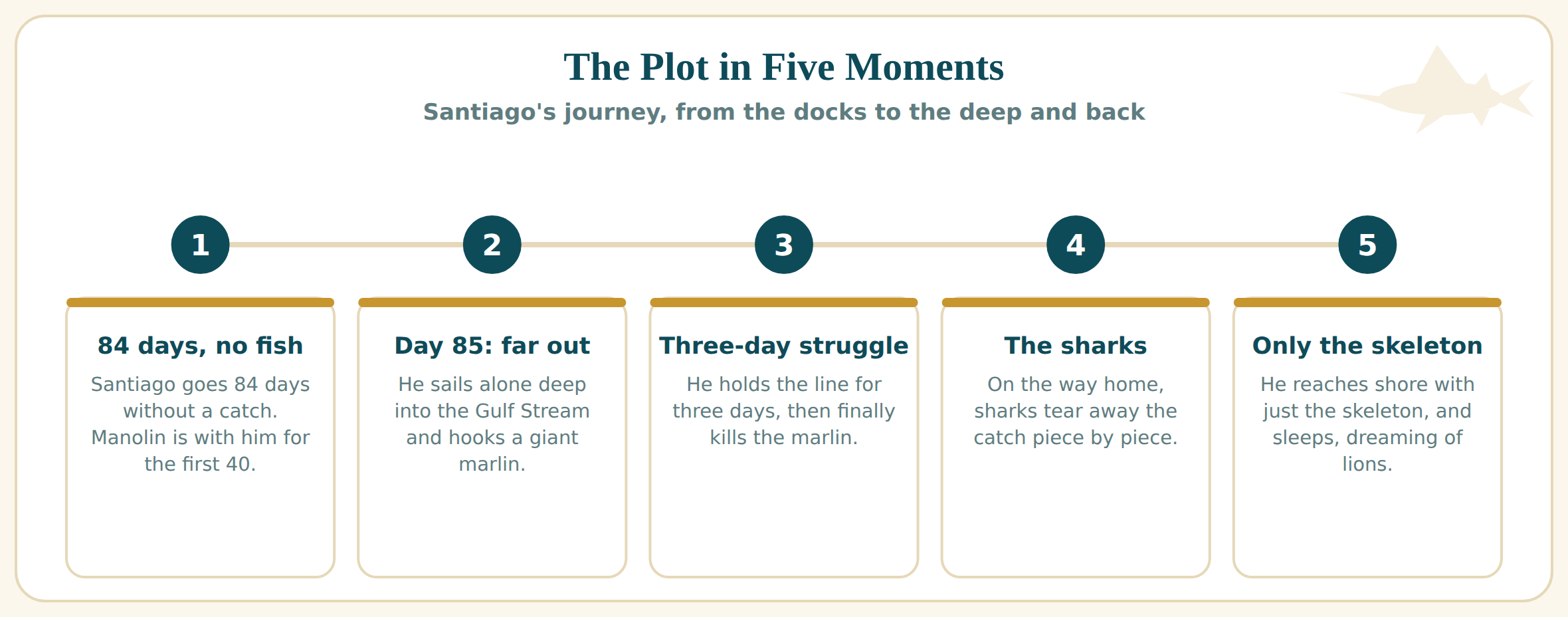
Santiago's 84 Days Without a Fish
Santiago is an experienced but poor fisherman living near Havana, Cuba. He has gone 84 consecutive days without catching a fish.
People in the village consider him extremely unlucky. Manolin, a boy whom Santiago taught to fish, worked beside him during the first 40 days. Manolin's parents eventually ordered the boy to join a more successful boat.
The decision separates them professionally but not emotionally. Manolin continues helping Santiago carry his equipment, find bait, obtain food, and prepare for future trips. Their conversations reveal mutual loyalty. Santiago gives Manolin experience and wisdom, while Manolin gives Santiago companionship and hope.
Santiago's reputation has declined, but his confidence has not disappeared. He decides that the 85th day will be different.
Santiago Travels Farther Out
Before sunrise, Santiago rows alone into the Gulf Stream. He goes farther from shore than the other fishermen.
This choice demonstrates courage and professional confidence, but it also introduces the novella's central question about pride. Is Santiago wisely trusting his experience, or is he taking an unnecessary risk because he wants to prove himself?
Eventually, a large marlin takes his bait. The fish is so powerful that Santiago cannot pull it into the boat. Instead, the marlin begins towing the small skiff farther out to sea.
The Struggle With the Marlin
The contest continues for three days. Santiago experiences exhaustion, hunger, loneliness, and physical pain. However, he does not think of the marlin merely as an object to be sold. He admires its power, endurance, beauty, and dignity.
He begins treating the fish as a worthy equal. This creates the novella's most important contradiction. Santiago respects the marlin. Santiago feels connected to it. Santiago still believes he must defeat it.
Their struggle becomes more than hunter against prey. Each participant tests the other. The marlin allows Santiago to demonstrate who he is, while Santiago recognizes in the marlin the same courage he values in himself.
After an extended contest, Santiago succeeds in bringing the marlin alongside his boat. The fish is too large to place inside, so he secures it to the skiff and begins sailing home.
Image suggestion: A simple map of the Gulf Stream off Havana with a marked route out to sea. Alt text: "Map of the Gulf Stream near Havana where Santiago hooks the marlin in The Old Man and the Sea."
The Sharks Arrive
The victory does not last. Blood in the water from the lashed marlin draws the first shark, and others soon follow.
Santiago fights them with the equipment available to him, but each confrontation costs him another tool or another part of the fish. His determination remains, yet his practical ability to protect the catch steadily disappears.
By the time he reaches the village, the sharks have consumed the usable parts of the marlin. Only its enormous skeleton remains tied to the boat. Santiago has completed an extraordinary feat, but he cannot sell or eat his catch.
Santiago Returns Home
Santiago carries his mast back to his small home and falls asleep.
The marlin's skeleton amazes the local fishermen. It proves that Santiago caught something exceptional, even though the tourists who later see it misunderstand what kind of creature it was.
Manolin finds Santiago and is deeply moved by his condition. He brings him coffee and announces that they will fish together again, regardless of what his parents say.
The novella ends with Santiago asleep and dreaming of lions on an African beach, an image associated with his youth, strength, freedom, and hope.
What Does the Ending Mean?
The ending is not simply sad or happy. It operates on several levels at once. In practical terms Santiago loses, because he returns without a usable fish, and he even admits that sailing so far from shore contributed to the disaster. In almost every other sense he gains something. He ends any doubt about his fishing ability, proves his endurance to himself, earns renewed respect from the community, strengthens his bond with Manolin, and returns with knowledge that can be passed to the boy. His dream of the lions suggests that hope survives.
The ending therefore asks readers to distinguish having a victory from becoming victorious in character. Santiago loses the product of his work without losing everything his work revealed. (The full "before and after" picture appears later in A Modern Reading: Santiago's Forms of Wealth.)
Why Do the Tourists Misidentify the Skeleton?
The tourists see the remains but do not understand the experience behind them. Their mistake illustrates the gap between appearance and reality. To an uninformed observer, the skeleton is only a strange object. To Santiago, Manolin, and the fishermen, it records a remarkable struggle.
This moment also warns readers against shallow judgment. Santiago's return may look like failure unless the full story is known.
Does Santiago Die at the End?
No. Santiago is alive at the end of the novella. He sleeps while Manolin watches over him and makes plans to fish with him again. The final dream is not presented as his death. It points back toward youth, energy, memory, and renewal.
The Main Message of The Old Man and the Sea
The main message is that dignity comes from how a person responds to hardship, not only from whether that person receives a reward. Santiago cannot control every outcome, but he can control his preparation, courage, discipline, effort, and response to loss.
The novella does not teach blind persistence, though. Santiago's choice to travel too far complicates the lesson. Two truths hold at once. A painful result does not erase the value of courageous effort, and courage does not remove the consequences of poor judgment or overreaching. That tension, rather than a tidy moral, is what the book leaves you with.
Major Themes
1. Perseverance and Human Dignity
Santiago continues working after 84 unsuccessful days. During his struggle, he repeatedly adapts to physical discomfort and damaged equipment. His perseverance is not presented as loud or dramatic. It appears through repeated actions, practical decisions, and self-control.
Hemingway suggests that dignity is something people practice. It is visible in the way Santiago performs his work even when nobody is watching.
2. Success, Failure, and the Limits of Results
If success means returning with a profitable fish, Santiago fails. If success means demonstrating skill, confronting fear, and maintaining self-respect, he succeeds.
This difference is the center of the novella. Hemingway separates three elements that people often treat as identical:
Effort: what Santiago does
Outcome: what remains when he returns
Meaning: what the experience reveals about him
Outcomes matter, but they do not always provide a complete measurement of human worth.
3. Pride and Overreaching
Santiago's pride helps him attempt something extraordinary. It also encourages him to travel dangerously far from the protection of the village. Pride is therefore both productive and destructive.
Constructive pride | Destructive pride |
|---|---|
Preserves self-respect | Rejects reasonable limits |
Motivates preparation | Encourages unnecessary risk |
Supports perseverance | Makes retreat feel shameful |
Protects professional identity | Ties worth to constantly proving oneself |
The story does not ask readers to reject pride completely. It asks when confidence stops serving a person and begins controlling that person.
4. Humans and Nature
Santiago does not treat the natural world as a simple enemy. He loves the sea, observes birds, respects the marlin, and understands the habits of marine life. Yet he also catches and kills animals to survive.
This produces an ethical tension. Santiago belongs to the natural world but also competes within it. He admires the marlin while causing its death. The sharks are destructive from his perspective, but they are also behaving according to their nature.
Hemingway fished Cuban and Gulf Stream waters for roughly two decades and developed detailed first-hand knowledge of marlin, sharks, currents, and deep-sea fishing. That experience, documented in the JFK Library's Hemingway and the Gulf Stream materials, helps make the setting feel observed rather than invented.
5. Isolation and Companionship
Much of the story places Santiago alone at sea, but Manolin remains present in his thoughts. Santiago's self-talk helps him maintain focus, organize decisions, and respond to isolation. He also imagines what Manolin might do or say.
His experience shows that independence and human connection are not opposites. Santiago can perform the struggle alone partly because his relationship with Manolin has given him emotional support. When he returns, the relationship becomes even more important. The ending moves away from isolated achievement and toward shared knowledge.
6. Aging, Ability, and Identity
Santiago's age affects his physical strength, social status, and economic security. It does not erase his expertise.
Contemporary scholarship in aging studies increasingly reads the novella as a story about aging masculinity and late-life creativity, interpreting Santiago's self-talk as a form of everyday resourcefulness that helps him navigate isolation. This lens expands the novel beyond the familiar lesson about perseverance. Santiago is not attempting to become young again. He is trying to determine what his experience, identity, and abilities still mean in later life.
7. Mentorship and Legacy
Manolin is not simply a helper. He represents the continuation of Santiago's knowledge. Santiago may not bring back a usable fish, but he brings back a story, evidence of skill, and lessons Manolin can carry forward.
From this perspective, the most valuable thing Santiago preserves is not the marlin. It is his legacy.
Character Guide
Character | Role | Importance |
|---|---|---|
Santiago | Aging Cuban fisherman and protagonist | Represents endurance, expertise, pride, dignity, and the challenges of aging |
Manolin | Santiago's young apprentice | Represents loyalty, hope, companionship, and the next generation |
The marlin | Santiago's great opponent | Reflects beauty, nobility, professional ambition, and Santiago's idealized self |
The sharks | Creatures that consume the catch | Represent destruction, uncontrollable consequences, time, chance, or natural appetite |
Joe DiMaggio | Baseball player admired by Santiago | Serves as a model of discipline and performance under difficulty |
Other fishermen | Santiago's professional community | Reflect changing public judgment, from mockery or pity to respect |
Tourists | Outside observers | Show how easily visible evidence can be misunderstood |
Important Symbols and Motifs
Hemingway resisted interpretations that reduced every object to a fixed symbolic equation. A better approach is to treat these elements as both literal and suggestive.
The Marlin
The marlin can represent Santiago's greatest professional goal, an ideal opponent, beauty and dignity in nature, the challenge that gives his abilities meaning, or a reflection of Santiago himself. Santiago and the marlin are opponents, but they are also doubles. Both are proud, determined, isolated, and unwilling to surrender easily.
The Sharks
The sharks are often interpreted as symbols of time, destruction, critics, bad luck, uncontrollable consequences, or the forces that consume the product of human effort. However, the sharks are not necessarily villains in a moral sense. They follow instinct. The tragedy comes partly from Santiago bringing the marlin into an environment where its loss becomes increasingly likely.
The Sea
The sea can be read as nature, life itself, an unpredictable universe, a workplace, a source of beauty and danger, or a space where Santiago can express his full identity. Santiago does not merely fight the sea. He reads it, depends on it, respects it, and belongs to it.
The Lions
Santiago dreams of lions he once saw on an African beach during his youth. They suggest youthful energy, courage, freedom, pride, memory, and hope for renewal. The final dream matters because Santiago does not end the story imagining the sharks or mourning the marlin. His mind returns to an image of life and possibility.
Joe DiMaggio and Baseball
Baseball gives Santiago a connection to the wider world, and Joe DiMaggio becomes a standard of professional excellence and endurance. The baseball references also balance the loneliness of the sea. While Santiago is physically isolated, he remains mentally connected to a shared cultural experience.
The Mast
When Santiago carries the mast back to his home after returning, the image supports a Christian interpretation of his suffering. His injured hands and repeated moments of physical burden contribute to the same pattern. The novella does not need to be read as a strict Christian allegory, but the religious parallels are difficult to ignore. Even the name Santiago is the Spanish form of Saint James, traditionally associated with fishing and pilgrimage.
The Marlin's Skeleton
The skeleton is both failure and proof. It has no commercial value, but it makes Santiago's achievement visible. It functions like a record from which the original event can be reconstructed. The tourists misunderstand it. The fishermen do not. Meaning depends on knowledge.
Why Is Manolin So Important?
Manolin provides five things Santiago cannot supply entirely for himself:
Practical assistance: he helps with food, bait, and equipment.
Emotional support: he continues believing in Santiago.
Social connection: he prevents Santiago from becoming completely isolated.
A future: he can preserve Santiago's knowledge.
A different measure of success: his loyalty shows that Santiago's worth is greater than his recent catch record.
Manolin's decision to fish with Santiago again completes the emotional movement of the story. The novella begins with forced separation and ends with chosen reunion.
Is The Old Man and the Sea Based on a True Story?
It is inspired by real experiences and people, but it is fiction. Hemingway spent years fishing in Cuban waters. The JFK Library identifies Cuban fisherman Gregorio Fuentes as one of the models for Santiago, not necessarily the single real-life old man behind the entire story.
Hemingway had also heard stories about fishermen struggling with giant fish, and he had written an earlier account involving an old fisherman and a marlin. The most accurate conclusion is that Santiago is probably a composite character, the fishing environment reflects Hemingway's real knowledge, and the central events were transformed into fiction. The novella should not be treated as a factual biography of Gregorio Fuentes.
Hemingway's Writing Style
Simple Language, Complex Meaning
Hemingway builds meaning from short, simple sentences, concrete details, repeated actions, and limited explanation. The language is accessible, but the interpretation is not always easy. Readers must infer Santiago's emotions and the story's larger meaning from what he does, notices, and repeats.
The Iceberg Principle
Hemingway's approach is commonly called the iceberg principle. The visible events form the smaller part of the story, while larger emotional and philosophical meanings remain beneath the surface. In this novella, the visible action is uncomplicated. A fisherman leaves. He catches a fish. Sharks consume it. He returns. Beneath that plot are questions about aging, professional identity, pride, nature, faith, failure, and legacy.
Repetition as Experience
Some readers find the book repetitive because Santiago repeatedly adjusts the line, monitors the fish, studies his condition, and talks to himself. The repetition has a purpose. It makes the reader experience duration. A three-day struggle should not feel like a short action scene. The repeated tasks turn endurance from an abstract theme into the form of the narrative itself.
Fable-Like Structure
The small cast, elemental setting, simple conflict, and universal themes give the novella the quality of a fable. Unlike a traditional moral fable, however, it does not provide one neat lesson. Santiago's courage and pride cannot be separated easily. His achievement and mistake occur together.
Why Is The Old Man and the Sea So Famous?
It Revived Hemingway's Literary Reputation
The novella appeared after a period in which Hemingway's work had received significant criticism. Its success was widely viewed as a return to form. It was first published in Life magazine in September 1952 and then released by Scribner.
It Won the Pulitzer Prize
The Old Man and the Sea received the 1953 Pulitzer Prize for Fiction.
It Was Named in Hemingway's Nobel Prize Citation
When Hemingway received the 1954 Nobel Prize in Literature, the award specifically praised his narrative mastery as recently demonstrated in The Old Man and the Sea. The official Nobel Prize record also recognizes his broad influence on modern prose style.
It Supports Multiple Interpretations
The story can be read as an adventure, a tragedy, a fable, a study of aging, a Christian allegory, a meditation on artistic creation, an ecological conflict, a story about work and professional identity, or a lesson about mentorship. That interpretive flexibility has helped keep it relevant in classrooms and literary discussions.
Why Do Some Readers Dislike the Book?
Not every reader considers it a masterpiece. Common criticisms include:
The plot feels too simple.
The fishing details feel repetitive.
Santiago's self-talk feels unnatural.
The symbolism seems too obvious.
The message about endurance can feel overstated.
Santiago's overconfidence makes his loss seem avoidable.
The limited cast and setting can feel emotionally narrow.
These frustrations appear frequently in reader discussions about the book's reputation. Other readers respond that the slow pace is part of the design and that the story's simplicity creates room for interpretation. A productive question is not merely, "Was the book enjoyable?" It is also, "What experience was the form designed to create?"
Was Santiago's Journey a Mistake?
This is one of the best questions for interpreting the novella.
Argument that Santiago makes a mistake
He travels farther out than is reasonably safe.
Pride influences his decision.
He lacks enough support and equipment.
He cannot protect the catch during the return.
He later recognizes that distance contributed to the loss.
Argument that the journey was necessary
He needs to restore confidence in his abilities.
The struggle reveals his remaining strength.
The catch changes how others see him.
Manolin returns to him.
Avoiding all risk would have produced survival without renewal.
The strongest interpretation holds both positions together. The journey is materially unwise but personally transformative.
A Modern Reading: Santiago's Forms of Wealth
Traditional analyses focus on whether Santiago wins or loses. A broader framework considers what he actually possesses before and after the journey, across several dimensions at once.
Dimension | Before the journey | After the journey |
|---|---|---|
Material | Very little | Still very little; the marlin is lost |
Reputation | Weak and declining | Restored by the marlin's skeleton |
Personal character | Doubted by others | Courage and self-respect proven |
Relationship | Manolin separated by his parents | Manolin commits to returning |
Knowledge and legacy | Deep but questioned | Demonstrated and ready to pass on |
This framework explains why the ending can feel hopeful even though Santiago returns without the marlin. His economic situation has not improved, but his social, relational, and professional identity has changed.
How to Write an Essay About The Old Man and the Sea?
Step 1: Choose a Debatable Question
Avoid topics that only require plot summary. Better questions include:
Does Santiago's pride save him or defeat him?
Is the ending tragic, hopeful, or both?
How does Manolin change the meaning of Santiago's journey?
Does the novella present nature as an enemy?
How does aging affect Santiago's identity?
What does the marlin's skeleton prove?
Why is material failure different from moral defeat?
Step 2: Build a Two-Sided Thesis
Strong literary arguments acknowledge tension.
Thesis template: Although Santiago appears to ________, Hemingway uses ________ and ________ to show that ________.
Example: Although Santiago returns without a usable fish, Hemingway uses the marlin's skeleton and Manolin's renewed loyalty to show that material loss does not erase professional dignity or personal influence.
Step 3: Use the C-T-T-S Method
For every body paragraph, include:
Claim: state what the paragraph argues.
Textual evidence: refer to a specific moment from the novella.
Technique: explain the symbolism, contrast, repetition, imagery, or characterization.
Significance: connect the evidence to your thesis.
Step 4: Separate Observation From Interpretation
Observation | Interpretation |
|---|---|
Santiago returns with a skeleton | His achievement survives as evidence even after its economic value is destroyed |
Manolin promises to return | The journey restores Santiago's role as a mentor |
Santiago dreams of lions | His hope and inner vitality remain |
Tourists misidentify the skeleton | Outsiders judge visible objects without understanding their history |
Step 5: Avoid One-Word Symbolism
Do not write, "The sea symbolizes life," and stop. Explain how the symbol behaves. For example: the sea resembles life because it is necessary, beautiful, unpredictable, and beyond complete human control. Santiago depends on it even while struggling against its dangers.
Before you submit, it also helps to check your draft against your assignment's limit. You can paste your essay into a free word counter to confirm the length and tighten any padded sentences.
Essay Thesis Ideas
Santiago loses the marlin but succeeds in recovering his identity as a fisherman and mentor.
The sharks represent not evil but the uncontrollable consequences of Santiago's decision to go too far.
Manolin, rather than the marlin, is the true source of hope in the novella.
Santiago's pride is both the quality that enables his achievement and the flaw that prevents him from recognizing limits.
The final dream transforms the ending from pure tragedy into psychological renewal.
Hemingway uses the marlin as Santiago's double, making their conflict a test of identity rather than a simple contest between man and animal.
The tourists' mistake shows that evidence has little meaning without context.
Santiago's greatest legacy is not the fish but the knowledge and example he passes to Manolin.
Film Adaptations
Several screen adaptations have introduced the story to new audiences.
1958 Feature Film
The 1958 film was directed by John Sturges and starred Spencer Tracy as Santiago. Its running time is roughly 86 to 89 minutes, and its score by Dimitri Tiomkin won an Academy Award.
1990 Television Film
A 1990 television version starred Anthony Quinn as Santiago. It expands the original story with additional characters and framing material.
1999 Animated Short Film
Aleksandr Petrov's painted animation won the Academy Award for Best Animated Short Film at the 2000 ceremony, an unusual achievement for a hand-painted film.
The Old Man and the Sea endures because it refuses to make success simple. Santiago catches the fish but cannot keep it. He proves his ability but also discovers his limits. He returns without money, yet regains respect. He performs the struggle alone, yet ends with the promise of companionship.
The marlin's skeleton is the perfect final record of that contradiction. It is the remains of a loss and proof of an achievement. Santiago's experience ultimately teaches that outcomes matter, but they do not tell the whole story. What you learn, preserve, demonstrate, and pass to another person may become the more lasting victory.
Frequently Asked Questions
What is the short summary of The Old Man and the Sea?
An elderly Cuban fisherman named Santiago catches a giant marlin after 84 unsuccessful days. He struggles with it for three days, but sharks consume the fish as he sails home. He returns with its skeleton, gains renewed respect, and reunites with his apprentice Manolin.
What is the main theme?
The central theme is dignity in struggle. The book examines whether courage and perseverance can retain value when they do not produce a material reward.
What is the moral of the story?
The story suggests that failure should not be measured only by what a person brings home. Character, effort, knowledge, and relationships can survive loss. It also warns that pride and determination need limits.
What does the marlin symbolize?
The marlin can represent an ideal opponent, Santiago's greatest ambition, the beauty of nature, or a reflection of Santiago's own dignity and endurance.
What do the sharks symbolize?
They can represent destruction, time, chance, criticism, natural appetite, or the forces that consume human achievements. No single interpretation explains every detail.
What do the lions symbolize?
The lions suggest youth, courage, freedom, pride, memory, and continuing hope. Their return in the final dream makes the ending more optimistic.
Why does Santiago admire the marlin?
He recognizes qualities in the fish that he values in himself, including endurance, strength, dignity, and determination. Defeating such an opponent allows him to test his own identity.
Why does Santiago talk to himself?
His self-talk helps him remain focused, make decisions, manage isolation, and preserve a sense of companionship. Recent age-studies scholarship also treats it as a form of late-life creativity.
Why is Joe DiMaggio mentioned?
DiMaggio represents professional excellence and perseverance. Thinking about him helps Santiago compare his own struggle with the discipline of a respected athlete.
What is Santiago's greatest flaw?
His greatest flaw is arguably pride. Pride protects his dignity and motivates his extraordinary effort, but it also contributes to his decision to travel too far.
Why is Manolin absent from the fishing trip?
Manolin's parents believe Santiago is unlucky and order the boy to work on a more successful boat. His absence increases Santiago's isolation and makes their reunion more meaningful.
Is the ending happy or sad?
It is both. Santiago loses the marlin and remains poor, but he restores his reputation, retains his dignity, reunites with Manolin, and ends the story dreaming of lions.
Is The Old Man and the Sea a novel or novella?
It is most accurately described as a novella because it is shorter and more concentrated than a typical novel. At roughly 27,000 words it sits well below the usual word count of a full-length novel.
How many pages is the book?
The common Scribner paperback edition has 128 pages. Other editions may have different page counts because of font size, formatting, introductions, and notes.
How long does it take to read?
Many readers can finish it in roughly two to three hours. Careful reading for symbols and analysis may take longer. You can estimate your own pace with a reading time calculator.
How many chapters does it have?
Standard editions generally present the story as a continuous narrative rather than a conventional sequence of numbered chapters. Study guides often divide it into days or major stages for easier analysis.
Where does the story take place?
It begins in a Cuban fishing community near Havana and moves into the Gulf Stream, where Santiago hooks the marlin.
Is The Old Man and the Sea a true story?
No. It is fiction informed by Hemingway's fishing experience, real Cuban fishermen, and stories he had heard about enormous catches.
Why was The Old Man and the Sea banned?
Calling it a widely banned book is misleading. It does not appear on the American Library Association's current most frequently challenged books lists. Some library guides document isolated local objections or challenges, often involving language, but it has not faced censorship on the scale of many commonly banned classics. Compare the ALA's challenged-book records with documented local lists before repeating broad claims.
Is the book suitable for younger readers?
It is commonly taught in secondary schools. The prose is accessible, but the themes require careful thought. The story includes fishing, animal death, physical struggle, and some mature language, without relying on graphic description.
Why is the book considered a masterpiece?
Its reputation comes from its compressed storytelling, layered meaning, memorable protagonist, technical control, and ability to turn a simple event into a universal argument about work, aging, pride, loss, and dignity.