Hippopotomonstrosesquipedaliophobia: (Fear of Long Words)
Hippopotomonstrosesquipedaliophobia means fear of long words. Learn its pronunciation, spelling, symptoms, causes, and the treatments that work for phobias.
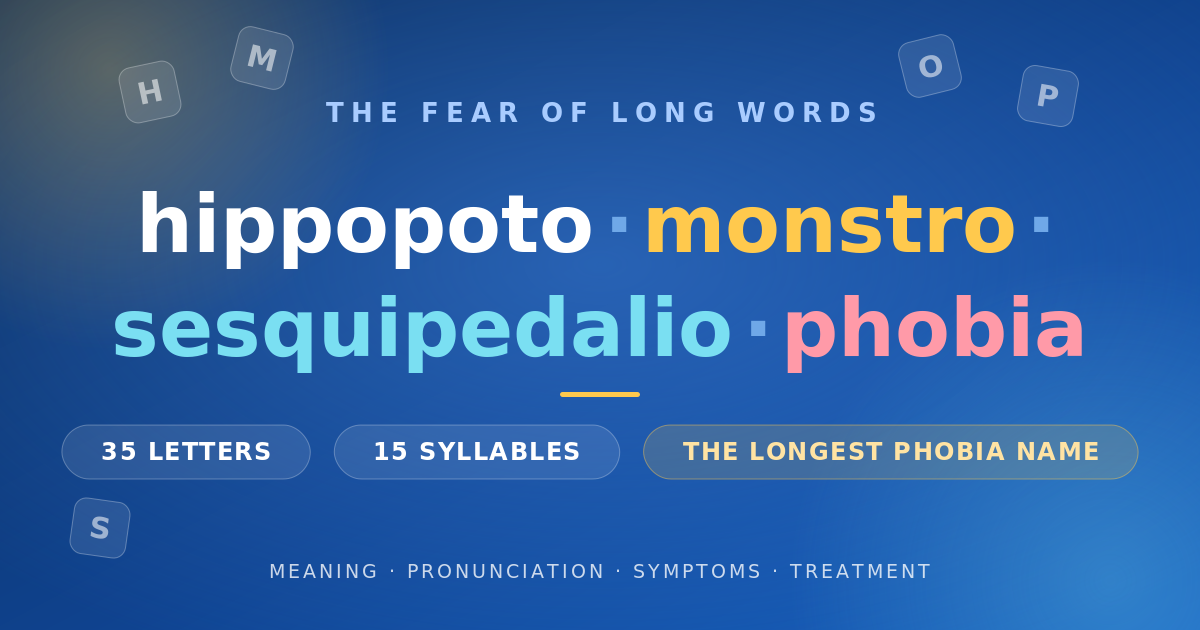
Quick Answer: Hippopotomonstrosesquipedaliophobia is a humorous, informal term for fear of long words. Its principal spelling has 35 letters; a 36-letter form with an extra "p" is also widely circulated (Wiktionary). It is not a named DSM-5-TR or ICD-11 diagnosis. If persistent fear or avoidance causes meaningful impairment, a professional may assess for specific phobia, social anxiety, a reading disorder, or another explanation. Exposure therapy is well supported for specific phobias generally (MSD Manual), but this exact word-related fear has not been studied in dedicated clinical trials.
The name is arguably the cruelest prank in psychology: if long words frighten you, the label for your fear is the exact stimulus that triggers it. That irony has made the word a popular piece of internet trivia. Behind the joke, though, can sit a real, assessable form of anxiety, one that may keep a student silent in class or lead an adult to avoid vocabulary-heavy tasks. This guide covers the linguistic facts, the clinical picture, and practical tools: a three-question differential, a self-check, an example exposure ladder, and scripts for classrooms and meetings.
This is educational content, not a diagnosis or treatment plan. If word-related anxiety is affecting your work, studies, or daily life, a licensed mental health professional can assess and treat it.
Key Facts
Question | Short answer |
|---|---|
What does it mean? | Intense fear or anxiety triggered by long or complex words |
How many letters? | 35 (principal spelling); a 36-letter form with an extra "p" circulates widely |
How many syllables? | 15 |
Shorter informal synonym | Sesquipedalophobia |
Official diagnosis? | Not by name; assessed as specific phobia, social anxiety, or another condition |
Is the fear real? | The label is humorous; the anxiety can be genuine and disruptive |
Typical onset (specific phobias) | Often childhood, median around age 8 (Eaton et al.) |
Best-supported treatment | Exposure-based therapy and CBT, based on evidence from specific phobias generally (Mayo Clinic) |
Outlook | Generally favorable when specific phobias are treated |
What Is Hippopotomonstrosesquipedaliophobia?
Hippopotomonstrosesquipedaliophobia is an intense, persistent fear of long words. A person with this fear may feel a spike of anxiety, dread, or even a panic response when they see a lengthy word on a page, hear complex vocabulary, or, worst of all, have to read or pronounce a long word in front of other people. Common triggers include reading aloud, pronouncing technical terms, anticipating a reading task, and worrying about looking uninformed after a mispronunciation.
Two clarifications matter. First, there is no universal definition of a "long word"; perceived difficulty and feared consequences usually matter more than the letter count. Second, someone with this fear isn't simply "bad at big words": the defining feature of any phobia is fear out of proportion to real danger that interferes with normal life (NHS), such as avoiding a class or giving up reading.
Is it a real phobia? The honest answer
The accurate answer has three layers:
The word is not a medical term. You will not find it in the DSM-5-TR or the WHO's ICD-11. It was invented as wordplay, not clinical nosology.
The fear pattern can still be assessed. The DSM-5-TR doesn't list any individual phobias by name (there is no entry for fear of spiders or flying either); it defines specific phobia by criteria (MSD Manual). A persistent, impairing fear of long words that meets those criteria can be diagnosed, typically as specific phobia, other type.
Sometimes it's better explained another way. For some people the core fear is being judged while saying the word, which points to social anxiety disorder; for others the driver is a reading difficulty. The most appropriate clinical framework depends on whether the central problem is fear of the words themselves, fear of social judgment, a reading difficulty, or a combination of these factors. That is why the differential questions below matter more than the label.
💡 The Irony Trap: For someone who actually fears long words, this term is uniquely cruel: the name of the fear is the trigger itself. Clinicians and educators may simply say "fear of long words" or "reading anxiety" instead. If you're supporting someone, consider doing the same; the giant word can land as a taunt.
How to Pronounce and Spell It?
A common American English pronunciation is:
hip-uh-pot-uh-MON-struh-ses-kwih-pih-DAL-ee-uh-FOH-bee-uh
IPA: /ˌhɪpəˌpɑtəˈmɑnstɹəˌsɛskwɪpɪˌdɑlɪəˈfoʊbɪə/
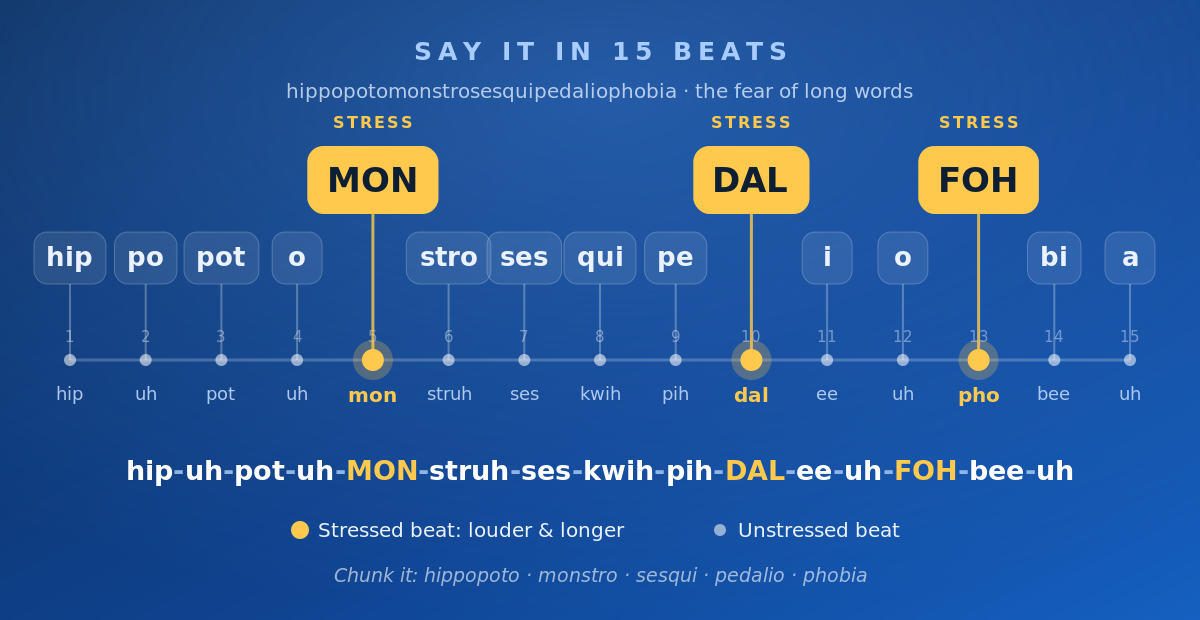
The word divides into 15 syllables (paste any word into a syllable counter to check a count like this yourself):
Syllable group | Sounds like |
|---|---|
hip-po-pot-o | as in "hippopotamus" |
mon-stro | as in "monstrous" |
ses-qui | SES-kwih |
pe-dal-i-o | pih-DAL-ee-uh |
pho-bi-a | FOH-bee-uh |
Don't try to swallow the word whole. Read each chunk, pause, then blend: hippopoto · monstro · sesqui · pedalio · phobia. Say each chunk slowly, join them gradually, mark the stressed beats (MON, DAL, FOH), and finish by using the full word in a sentence. As a playful, nonstandard construction, it has no single "official" pronunciation.
35 or 36 letters?
The principal 35-letter spelling is:
H-I-P-P-O-P-O-T-O-M-O-N-S-T-R-O-S-E-S-Q-U-I-P-E-D-A-L-I-O-P-H-O-B-I-A
A useful memory pattern: HIPPO + POTO + MONSTRO + SESQUIPEDALIO + PHOBIA
Spelling | Letters | Status |
|---|---|---|
hippopotomonstrosesquipedaliophobia | 35 | Principal form; the Wiktionary headword, used throughout this article |
hippopotomonstrosesquippedaliophobia | 36 | Widely circulated, including on major health sites, but Wiktionary labels it a common misspelling, possibly used deliberately |
The forms are not equally standard: the 35-letter version is the dictionary headword; the doubled-p form is a very common misspelling whose extra letter arguably strengthens the joke. You can paste either into a character counter and verify the count in seconds.
Where Did the Word Come From? Etymology and History
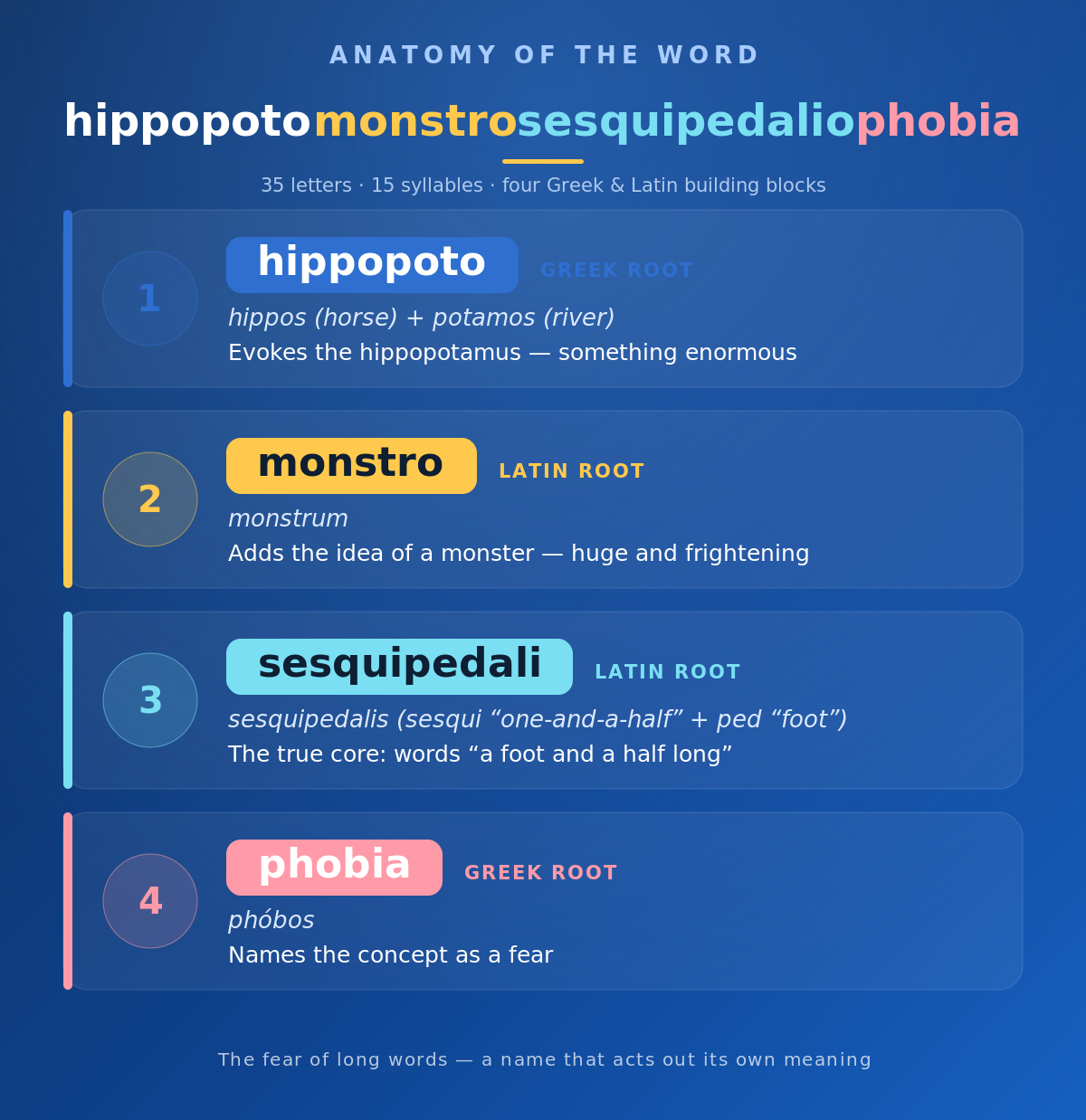
The word is an engineered exaggeration: a deliberately extended hybrid coinage assembled from Greek and Latin elements, built less for precision than for maximum length (unlike a true portmanteau, which blends word forms and meanings). The root breakdown below follows the etymology given by Wiktionary.
Word part | Origin | Literal meaning | What it adds |
|---|---|---|---|
hippopoto- | Greek hippos (horse) + potamos (river), via "hippopotamus" | River horse | Suggests something enormous |
-monstro- | Latin monstrum | Monster | Amplifies "huge and frightening" |
-sesquipedali(o)- | Latin sesquipedalis (sesqui = one and a half + pes/ped = foot) | A foot and a half long | The real core: very long words |
-phobia | Greek phóbos | Fear | Names it as a fear |
The meaningful root is sesquipedalian, a real English adjective meaning "given to using long words." Around 19 BC, the Roman poet Horace mocked bombastic writing in his Ars Poetica with the phrase sesquipedalia verba, literally "words a foot and a half long." Adding -phobia to that root produces the shorter informal synonym sesquipedalophobia. The "hippopotamus" and "monster" prefixes were bolted on later purely to inflate the word until its size acted out its own meaning.
As for who coined the extended form, nobody knows for certain. It is widely attributed to American poet Aimee Nezhukumatathil, who popularized it around 2000 in a poem, per BBC Science Focus. Yet in an interview with Divedapper, she said the idea came partly from a printed phobia list among her mother's medical books, suggesting the term was already circulating; Wiktionary's earliest print citation is The Scotsman, April 2002. The safest summary: one genuine classical root, two comic prosthetics, an uncertain coiner, and more than two decades of internet fame.
Is It the Longest Word in English?
No, and "longest" depends on which dictionary and which inclusion rules you use.
Merriam-Webster identifies the 45-letter lung-disease term pneumonoultramicroscopicsilicovolcanoconiosis as the longest word entered in most standard dictionaries.
Collins names a 31-letter chemical name, dichlorodiphenyltrichloroethane (the full name of DDT), as the longest entry in its flagship dictionary, and explains that words coined chiefly for length tend not to meet its inclusion criteria.
Titin's frequently cited 189,819-letter name is a systematically generated chemical name, not a conventional dictionary word (Merriam-Webster).
The defensible claim: hippopotomonstrosesquipedaliophobia is commonly described as the longest phobia name, and one of the longest playful words in English.
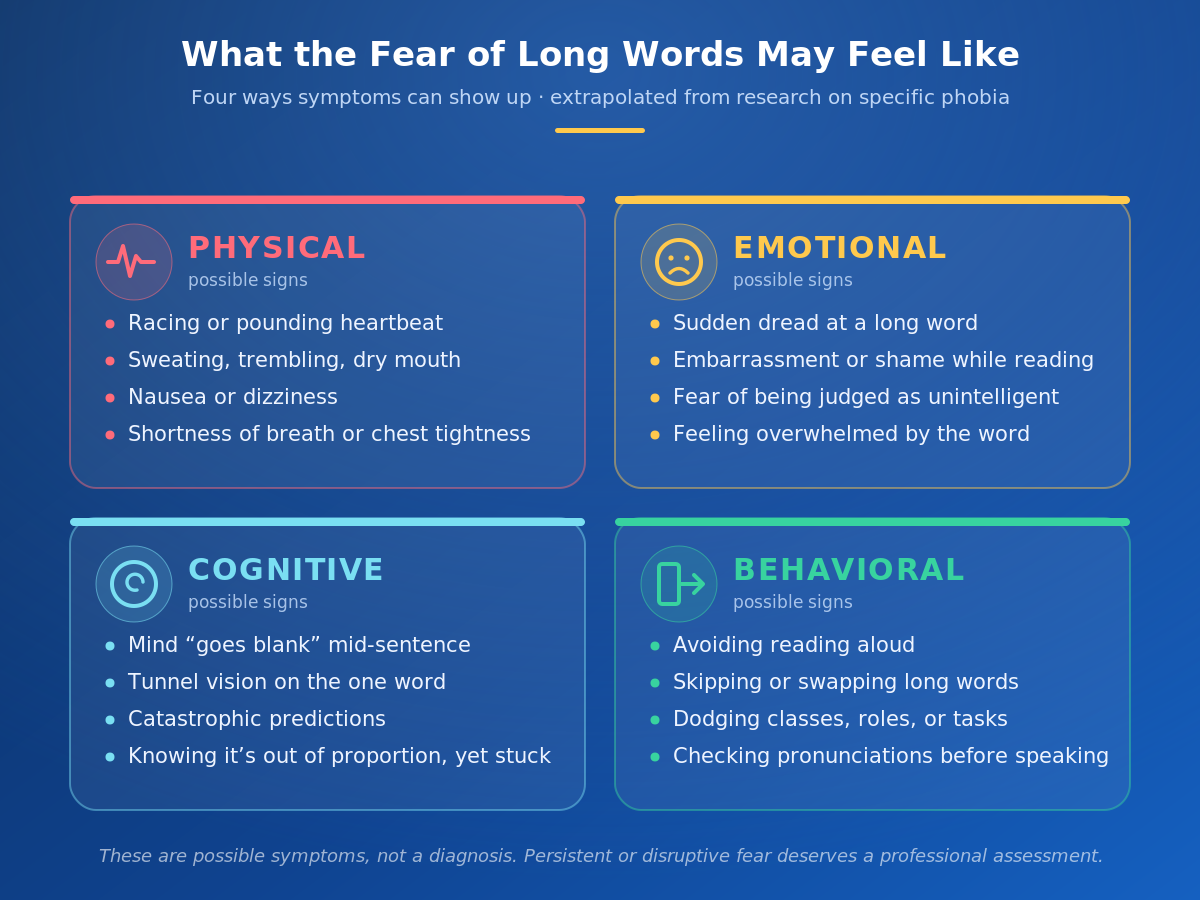
Symptoms: What the Fear of Long Words May Feel Like
Because this exact word-related fear has not been studied independently, the following are possible symptoms extrapolated from research and clinical descriptions of specific phobia and social anxiety.
Physical: racing heartbeat, sweating, trembling, shortness of breath, dry mouth, nausea, dizziness, and in severe episodes panic-attack-level symptoms. The NHS overview of phobias lists similar physical reactions across phobia types.
Emotional: sudden dread at the sight of a long word, embarrassment, shame about reading ability, fear of being judged as unintelligent.
Cognitive: the mind "going blank" mid-sentence, tunnel vision where the word becomes the only thing on the page, and catastrophic predictions ("everyone will think I'm stupid"). Some people recognize that their fear is out of proportion yet still struggle to control the response.
Behavioral: possible examples include avoiding reading aloud, skipping or substituting long words, choosing courses or roles to sidestep technical vocabulary, and repeatedly checking pronunciations. Anticipation may feel worse than the moment itself: a reader might scan ahead for difficult words or begin avoiding reading for pleasure.
Across ages: in children, this kind of fear may surface as dread before reading time, stomachaches on reading days, or a sudden "I hate reading"; research on specific phobias shows they often begin in childhood, with a median onset around age 8. In adults, it may show up as declined presentations or avoided vocabulary-heavy tasks.
Rule of thumb: Disliking jargon is universal. It moves toward phobia territory when fear is persistent (six months or more), out of proportion to any danger, and causes real avoidance or distress in daily life (MSD Manual).
Do You Have It? Differential, Self-Check, and What an Evaluation Looks Like
Three questions worth asking
Fear or difficulty involving long words may reflect one or more of these patterns. These questions can help identify topics to discuss with a professional, but they cannot determine a diagnosis. Combinations are common.
1. Does the fear fire even when you're completely alone? Anxiety with no audience and no stakes resembles a specific phobia of the words themselves.
2. Is the fear really about being watched and judged? Comfort alone but panic when others might hear you points to scrutiny as the core fear, a pattern resembling social anxiety.
3. Are long words genuinely harder for you to read? If you have a long history of slow or effortful reading, persistent difficulty decoding unfamiliar words, and ongoing trouble with spelling, screen for dyslexia or another reading difference before assuming pure phobia. A comprehensive assessment reviews educational history and a range of reading and language skills. Fear that grows from a real decoding difficulty is understandable distress about a support gap, and exposure therapy is not a substitute for reading intervention.
Start: Does a long word trigger anxiety even when you are completely alone?
Yes → the pattern resembles a specific phobia of the words themselves.
No → Is the fear mainly about others hearing and judging you?
Yes → the pattern resembles social anxiety.
No → Are long words consistently hard to decode, spell, or read?
Yes → screen for dyslexia or another reading difference.
No → Other explanations are possible. If the difficulty is persistent or disruptive, consider a professional or educational assessment.
Feature | Specific phobia of long words | Social anxiety presentation | Reading difference (e.g., dyslexia) |
|---|---|---|---|
Trigger | The word itself, even alone | Audience and judgment | The decoding task |
Reading silently, alone | Still anxious | Mostly fine | Slow and effortful, but not fearful (until judged) |
Support often explored with a professional | Exposure-based therapy / CBT | CBT approaches for social anxiety | Educational assessment + reading support |
Can they overlap? | Yes, frequently | Yes | Yes; fear often develops on top |
Related fears people confuse with it: glossophobia (public speaking), bibliophobia (books and reading itself), and logophobia (words in general). Naming the right problem is half the treatment plan.
A brief self-check
These are general reflection prompts informed by symptoms and diagnostic features clinicians may consider. Not every item is a formal diagnostic criterion, and no number of checked items establishes a diagnosis.
Seeing or anticipating a long word triggers immediate fear or anxiety, almost every time
The reaction includes physical symptoms (racing heart, sweating, trembling, nausea)
I actively avoid situations where I might face long words
I know the fear is out of proportion to any real danger, but that knowledge doesn't reduce it
This has lasted six months or longer
It causes real distress or interferes with school, work, or relationships
I rearrange parts of my life (courses, roles, hobbies) around avoiding long words
This checklist cannot diagnose a disorder. If fear or avoidance is persistent, has lasted six months or longer, or interferes with school, work, or daily life, consider speaking with a qualified professional.
What actually happens at an evaluation?
There is no lab test or online quiz for this fear; a clinician takes a history and matches the pattern against recognized conditions. Under DSM-5-TR criteria, as summarized by the MSD Manual, a specific phobia diagnosis involves marked fear of a specific trigger, an immediate anxiety response, avoidance or intense distress, disproportionate fear, six months or more of duration, significant impairment, and no better explanation by another condition.
A common worry is "Will the doctor laugh at me, since this isn't even an official phobia?" Assessing anxiety respectfully is a basic professional standard, and you never need to say the novelty word: "I have severe anxiety about reading and pronouncing long words" is enough. Bring notes on your triggers, symptoms and duration, what you avoid, and any history of reading or spelling difficulty.
What Causes the Fear of Long Words?
The exact causes of specific phobias remain incompletely understood, and no study has examined this particular fear. What research describes are possible pathways and risk factors, which often combine:
A humiliating public moment. One possible pathway described in personal accounts is stumbling over a word while reading aloud and being laughed at or harshly corrected; conditioning can then pair "long word" with "shame" so the alarm fires even with no audience. Round-robin and popcorn reading provide limited fluency practice, and educators have reported these formats can be stressful or embarrassing for some struggling readers. No research has established them as a common cause of fear of long words.
Underlying reading differences. Dyslexia can make long words genuinely more effortful, and repeated public struggle can grow into anticipatory dread. The International Dyslexia Association describes how stress and anxiety commonly develop when students expect mistakes or ridicule.
Family vulnerability and temperament. Family history of phobias and anxiety disorders raises risk; a three-generation national study in PLOS ONE found phobic disorders aggregate in families. An inhibited temperament and heightened threat-circuitry reactivity appear in the risk profile described by the StatPearls review of specific phobia.
Learned and observed fear. Fear responses can be absorbed secondhand, such as by watching a sibling get mocked for misreading, a pathway noted in the StatPearls review.
The avoidance cycle
A long word appears.
The person predicts embarrassment or failure.
Anxiety spikes.
The word or situation is avoided.
Anxiety drops, bringing instant relief.
The brain logs avoidance as what "saved" them.
The next long word feels just as threatening, or worse.
Avoidance can maintain or strengthen fear by preventing corrective learning: the person never discovers that the feared outcome usually doesn't happen or is manageable (Knowles & Olatunji, 2019). Exposure-based treatment works by interrupting this cycle.
Treatment: What the Evidence Shows
An honest caveat first: no clinical trial has tested treatment for fear of long words specifically. Everything below comes from research on specific phobias and related anxiety conditions generally, and is applied here by reasonable extension.
Exposure therapy and CBT
Exposure therapy gradually and safely brings you into contact with the feared trigger so your nervous system can learn it is survivable. Gradual, repeated exposure is identified as the leading treatment for specific phobias (Mayo Clinic), and the current MSD Manual reports that exposure therapy is more effective than no treatment in approximately 85% of people with specific phobias (MSD Manual), with some people benefiting from as little as a single extended session. Two often-cited findings add detail, with their limits noted:
In Öst's foundational 1989 study, a historical trial involving other specific phobias, a single guided exposure session averaging about two hours left roughly 90% of participants much improved or recovered at long-term follow-up.
In the ASPECT trial, one-session treatment was non-inferior to multisession CBT for childhood specific phobias on the trial's primary outcome at six months; this does not mean every phobia can be treated in one session, and the trial did not study fear of long words.
CBT pairs exposure with cognitive work: catching catastrophic predictions ("if I mispronounce this, everyone will think I'm stupid") and testing them against evidence. When the pattern points to social anxiety, CBT approaches for social anxiety disorder are the usual fit. The goal is not perfect pronunciation but a realistic response to mistakes, uncertainty, and temporary anxiety.
Digital and VR formats
A 2025 meta-analysis in Frontiers in Psychiatry (33 randomized trials, 3,182 participants) found VR-based therapy improved anxiety symptoms, and a separate 2025 meta-analysis found VR exposure produced outcomes comparable to in-person exposure for specific phobia and social anxiety (Kuleli et al., 2025). These studies are heterogeneous, many carry risk-of-bias limitations, and none tested word-related fears. Digital exposure may eventually offer a useful format for word-related fears, but this is a plausible adaptation rather than an established treatment supported by direct trials.
Medication and regulation skills
Medication is not a standard primary treatment for specific phobia. A prescriber may treat a co-occurring anxiety or depressive disorder separately or, in limited circumstances, consider a short-term option for an unavoidable event. Exposure-based treatment remains the principal psychological treatment. The WHO specifically cautions that benzodiazepines, one class of anti-anxiety medicine, carry dependence risks. Breathing and grounding skills won't treat a phobia on their own, but they can help you stay in a practice exercise rather than fleeing it.
Approach | Evidence base | Best fit |
|---|---|---|
Exposure therapy | Strongest for specific phobias generally | Fear of the words themselves |
One-session treatment (OST) | RCT-supported for some specific phobias | Focused, single-trigger phobias |
CBT | Strong across anxiety disorders | Social-anxiety presentations; co-occurring worry |
VR / digital exposure | Promising but heterogeneous; untested for word fears | Access barriers; privacy preference |
Reading / speech support | Essential when a skills gap exists | Dyslexia and decoding difficulties |
Medication | Adjunct only; not primary for specific phobia | Co-occurring anxiety or depression |
The treatment gap
Two separate studies, using different populations and definitions, point the same direction. In the U.S. NESARC survey analyzed by Stinson and colleagues (2007), only 8.0% of people with specific phobia reported receiving treatment specifically for it, and the mean age at first treatment was 31.3, decades after typical childhood onset. In the cross-national World Mental Health Surveys, Wardenaar and colleagues found that about 23.1% of people with a 12-month specific phobia reported receiving any treatment. The figures shouldn't be blended into one statistic, but both studies found that most respondents with specific phobia reported receiving no treatment, despite generally favorable treatment outcomes.
The Word Ladder: An Example Graded-Exposure Hierarchy
Disclosure: the Word Ladder below and the SPEAK method that follows are original educational frameworks created for this article. They illustrate widely used exposure and chunking principles, but they are not validated clinical protocols. Treat the ladder as an optional self-help exercise for mild discomfort; if fear is intense, long-standing, or causing real impairment, build a plan with a therapist instead.
A note on method: contemporary exposure research emphasizes learning that your feared predictions don't come true, or that you can tolerate the anxiety, rather than requiring anxiety to fall to a target number in every session. Practical guidance:
Before each step, write down what you predict will happen; afterward, compare it with what actually happened. That comparison is the active ingredient.
Brief, regular practice may be easier to sustain than infrequent intensive practice, and varying the words, settings, and formats helps new learning stick. A therapist can help determine an appropriate pace.
Expect ups and downs, and if practice feels overwhelming, involve a professional rather than pushing through alone.
Step | Task | Practice words |
|---|---|---|
1 | Look at printed 4-5 syllable words, silently, alone | curiosity, calculator, celebration |
2 | Read 5-6 syllable words silently in sentences | refrigerator, encyclopedia, congratulations |
3 | Say medium-long words aloud, alone | unbelievable, responsibility, characteristic |
4 | Write long words by hand, breaking them into chunks | incomprehensible, uncharacteristically |
5 | Read a paragraph with long words aloud, alone, recording yourself | environmentalist, internationalization |
6 | Read long words aloud to one trusted person | antidisestablishmentarianism, counterrevolutionaries |
7 | Use a long word in live conversation or a low-stakes meeting | onomatopoeia, otorhinolaryngologist |
8 | Final step: a word that matters to you personally | your choice: a term from your work or studies, or, if you like, hippopotomonstrosesquipedaliophobia itself |
Need fresh material between rungs? A random word generator can supply practice words at whatever length you're ready for. The point of the final step isn't party-trick fluency; it's discovering that the word that looms largest for you can become a sequence of small, manageable syllables.
The SPEAK Method: A 5-Step Practice Routine
Use this repeatable drill during ladder practice, the instant any intimidating word appears:
S: Slow the breath. Slow, comfortable breathing may help you settle before tackling the word.
P: Partition the word. Break it into visual chunks: hippo · poto · monstro · sesqui · pedalio · phobia. A word can't overwhelm you in pieces.
E: Emphasize one chunk at a time. Say each piece slowly and separately. No blending yet.
A: Assemble and repeat. Blend the chunks slowly, three times. Speed comes last, not first.
K: Keep climbing. Repeat tomorrow with a slightly harder word; confidence is built by reps.
The 60-Second Playbook: When a Long Word Ambushes You
The ladder builds long-term change; this playbook is for right now: the meeting agenda, the reading circle, the presentation slide.
Breathe low and slow first. Slow, comfortable breathing may help some people remain present during a stressful moment. Anxiety often rises and then eases, although the timing and intensity vary between people.
Chunk the word. Long words are trains of short words: oto-rhino-laryngology, photo-synthesis. Read the chunks, not the word.
Bridge with a synonym if needed. "Fridge" for refrigerator, "ENT specialist" for otorhinolaryngologist. Substitution is a legitimate coping tool; treat it as a bridge you're gradually retiring, since growing avoidance is the pattern that feeds fear.
Use technology without shame. Text-to-speech pronounces any word privately, dictionary apps show phonetics, and previewing a document to rehearse its two or three danger words is what confident speakers already do.
A script for the worst case: if you stumble publicly, the recovery line "That word's a mouthful. Let me take another run at it" names the moment, keeps you in control, and reads as composure.
Bonus tool, the prediction test: before a feared moment, write down what you predict ("they'll laugh if I make a mistake"); afterward, record what actually happened. Comparing the two builds the corrective learning that exposure depends on.
Helping a Child Who Fears Long Words
School reading experiences appear frequently in personal accounts of this fear, and specific phobias often begin in childhood (Eaton et al., The Lancet Psychiatry), though onset age alone does not establish the classroom as the cause. For children, fear of long words can involve anxiety, reading skills, or both, so support should address confidence and skills together.
For parents:
Chunk long words together like a puzzle rather than a test.
Normalize mistakes out loud and model recovering from them yourself.
Offer calm, specific feedback without interrupting every attempt. Correct selectively, avoid public embarrassment, and continue appropriate reading instruction or specialist support.
Keep sessions short and low-pressure, and praise effort as well as accuracy.
If struggle is severe or persistent, request a dyslexia or learning assessment; addressing a root reading difficulty can reduce associated anxiety.
For teachers:
Use volunteer-based, paired, choral, or teacher-modeled reading so no child is ambushed.
Let students preview and rehearse passages before any public reading.
Praise attempts and recoveries, and shut down peer laughter.
If a child suddenly avoids reading or reports stomachaches on reading days, screen gently for both anxiety and a reading difference rather than assuming laziness.
In the ASPECT trial, one-session treatment was non-inferior to multisession CBT on the trial's primary outcome at six months; the trial did not study fear of long words.
Template a student can use: "Long unfamiliar words make me anxious when I have to read without preparation. Could I get the passage or vocabulary list beforehand so I can practise and participate?"
Managing Long Words at Work
Complex vocabulary shows up in legal documents, technical presentations, medical material, and unfamiliar names. Practical, no-disclosure-needed options:
Request technical terms and agendas before meetings, and build a personal pronunciation glossary.
Add phonetic spellings to speaking notes, rehearse with a colleague, and pace run-throughs with a speaking time calculator.
Preview documents privately with text-to-speech, and substitute plain language where precision isn't lost; a readability checker shows where simpler wording works.
Template: "Could you share the technical terms and names before the presentation? Reviewing them in advance helps me present the information clearly."
When to Seek Professional Help?
Consider an evaluation when the fear has persisted for months, triggers intense physical anxiety, drives avoidance of school, work, reading, or presentations, or may be tangled with dyslexia or speech difficulties. Young people can start with a parent, teacher, school counselor, or doctor; adults with a primary care provider or licensed therapist.
How Common Is It? What the Data Does (and Doesn't) Say
No established prevalence estimate exists for fear of long words specifically, so precise figures should be treated cautiously. For context on the broader category:
NIMH reports 9.1% past-year and 12.5% lifetime prevalence of specific phobia among U.S. adults, and 19.3% lifetime among adolescents. These figures come from older national survey datasets (collected in the early 2000s), not recent measurements.
Past-year prevalence in those surveys was roughly twice as high in women (12.2%) as in men (5.8%) (NIMH).
The WHO's fact sheet (updated September 2025) estimates 359 million people, or 4.4% of the global population, were living with an anxiety disorder in 2021. That covers all anxiety disorders combined, not specific phobia.
These figures describe broad categories; they cannot tell you whether fear of long words is common or rare.
Frequently Asked Questions
Is hippopotomonstrosesquipedaliophobia a real phobia?
The word is informal and appears in no diagnostic manual, but persistent, impairing fear of long words can be assessed and treated under standard categories such as specific phobia or social anxiety disorder (MSD Manual).
What is the fear of long words called?
Hippopotomonstrosesquipedaliophobia. A shorter informal alternative is sesquipedalophobia. Neither is a formal clinical diagnosis; clinically, the pattern would be documented under specific phobia or social anxiety disorder.
How do you pronounce it?
Hip-uh-pot-uh-MON-struh-ses-kwih-pih-DAL-ee-uh-FOH-bee-uh. Easiest route: say "hippopoto," then "monstro," then "sesquipedaliophobia."
How many letters and syllables does it have?
35 letters and 15 syllables in the principal spelling; a widely circulated 36-letter form is labeled a common misspelling by Wiktionary.
Who coined the word?
No one knows for certain. Poet Aimee Nezhukumatathil is widely credited with popularizing it around 2000 (BBC Science Focus); Wiktionary's earliest print citation is from 2002, and the concept traces to Horace's sesquipedalia verba around 19 BC (Merriam-Webster).
Is it the longest word in the dictionary?
It depends on the dictionary: Merriam-Webster cites a 45-letter lung-disease term as the longest in most standard dictionaries, while Collins' flagship dictionary tops out at a 31-letter chemical name. This word is commonly described as the longest phobia name.
Is it linked to dyslexia?
It can be: harder decoding invites more public struggle, and fear can grow on top of the difficulty (International Dyslexia Association). Evaluation should screen for both.
How do you get over a fear of long words?
Graded exposure with a therapist is the best-supported approach for specific phobias generally (Mayo Clinic); self-guided practice may help with mild discomfort.
Can children have it?
Yes. Specific phobias often begin in childhood, and school reading experiences appear in personal accounts. In ASPECT, one-session treatment was non-inferior to multisession CBT on the trial's primary outcome at six months; the study did not examine fear of long words.
Is there a fear of short words?
There is no established clinical term for fear of short words, although informal internet coinages occasionally appear. The established neighbors are logophobia (words generally), bibliophobia (books), and glossophobia (public speaking).
This article is for information only and isn't a substitute for professional diagnosis or treatment. If anxiety around words, reading, or speaking is interfering with your life, a licensed mental health professional can help.
References
Research and clinical literature
Öst, L.-G. (1989). One-session treatment for specific phobias. Behaviour Research and Therapy, 27(1), 1-7. https://doi.org/10.1016/0005-7967(89)90113-7 (PMID: 2914000; https://pubmed.ncbi.nlm.nih.gov/2914000/)
Wright, B., et al. (2023). One session treatment (OST) is equivalent to multi-session cognitive behavioral therapy (CBT) in children with specific phobias (ASPECT): Results from a national non-inferiority randomized controlled trial. Journal of Child Psychology and Psychiatry, 64(1), 39-49. https://doi.org/10.1111/jcpp.13665 (PMID: 35915056; PMCID: PMC10087411)
Wright, B., Tindall, L., Scott, A. J., et al. (2022). One-session treatment compared with multisession CBT in children aged 7-16 years with specific phobias: The ASPECT non-inferiority RCT. Health Technology Assessment, 26(42), 1-174. https://doi.org/10.3310/IBCT0609 (PMC9638885)
Stinson, F. S., et al. (2007). The epidemiology of DSM-IV specific phobia in the USA: Results from the National Epidemiologic Survey on Alcohol and Related Conditions. Psychological Medicine, 37(7), 1047-1059. PMID: 17335637. https://pubmed.ncbi.nlm.nih.gov/17335637/
Wardenaar, K. J., et al. (2017). The cross-national epidemiology of specific phobia in the World Mental Health Surveys. Psychological Medicine, 47(10), 1744-1760. https://doi.org/10.1017/S0033291717000174 (PMID: 28222820; https://pubmed.ncbi.nlm.nih.gov/28222820/)
Eaton, W. W., Bienvenu, O. J., & Miloyan, B. (2018). Specific phobias. The Lancet Psychiatry, 5(8), 678-686. DOI: 10.1016/S2215-0366(18)30169-X. https://pmc.ncbi.nlm.nih.gov/articles/PMC7233312/
Steinhausen, H.-C., Jakobsen, H., Meyer, A., Jørgensen, P. M., & Lieb, R. (2016). Family aggregation and risk factors in phobic disorders over three generations in a nation-wide study. PLOS ONE, 11(1), e0146591. DOI: 10.1371/journal.pone.0146591. https://journals.plos.org/plosone/article?id=10.1371/journal.pone.0146591
Zeng, W., Xu, J., Yu, J., & Chu, X. (2025). Effectiveness of virtual reality therapy in the treatment of anxiety disorders in adolescents and adults: A systematic review and meta-analysis of randomized controlled trials. Frontiers in Psychiatry, 16. DOI: 10.3389/fpsyt.2025.1553290. https://www.frontiersin.org/journals/psychiatry/articles/10.3389/fpsyt.2025.1553290/full
Kuleli, D., Tyson, P., Davies, N. H., & Zeng, B. (2025). Examining the comparative effectiveness of virtual reality and in-vivo exposure therapy on social anxiety and specific phobia: A systematic review and meta-analysis. Journal of Behavioral and Cognitive Therapy, 35(2), 100524. https://doi.org/10.1016/j.jbct.2025.100524
Knowles, K. A., & Olatunji, B. O. (2019). Enhancing inhibitory learning: The utility of variability in exposure. Cognitive and Behavioral Practice, 26(1), 186-200. https://doi.org/10.1016/j.cbpra.2017.12.001 (PMID: 31787834; PMC6884337)
Kuhn, M. R., & Schwanenflugel, P. J. (2006). All oral reading practice is not equal, or how can I integrate fluency into my classroom? Literacy Teaching and Learning, 11(1), 1-20. https://pmc.ncbi.nlm.nih.gov/articles/PMC4214377/
StatPearls: Specific Phobia. NCBI Bookshelf, NBK499923. https://www.ncbi.nlm.nih.gov/books/NBK499923/
Clinical reference and health organizations
MSD Manual Professional Edition: Specific Phobias (DSM-5-TR criteria; exposure effective in approximately 85% of treated patients). https://www.msdmanuals.com/professional/psychiatric-disorders/anxiety-and-trauma-and-stressor-related-disorders/specific-phobias
Mayo Clinic: Specific phobias, diagnosis and treatment. https://www.mayoclinic.org/diseases-conditions/specific-phobias/diagnosis-treatment/drc-20355162
NIMH: Specific Phobia statistics. https://www.nimh.nih.gov/health/statistics/specific-phobia
NIMH: Social Anxiety Disorder: More Than Just Shyness. https://www.nimh.nih.gov/health/publications/social-anxiety-disorder-more-than-just-shyness
NHS: Phobias overview. https://www.nhs.uk/mental-health/conditions/phobias/overview/
WHO: Anxiety disorders fact sheet (updated September 2025). https://www.who.int/news-room/fact-sheets/detail/anxiety-disorders
American Psychiatric Association: DSM-5-TR. https://www.psychiatry.org/psychiatrists/practice/dsm
WHO: ICD-11. https://icd.who.int/en
International Dyslexia Association: Dyslexia Basics (https://dyslexiaida.org/dyslexia-basics/); Testing and Evaluation (https://dyslexiaida.org/testing-and-evaluation/); The Dyslexia-Stress-Anxiety Connection (https://dyslexiaida.org/the-dyslexia-stress-anxiety-connection/)
Language, media, and education
Wiktionary: hippopotomonstrosesquipedaliophobia (headword, misspelling label, etymology, 2002 first citation). https://en.wiktionary.org/wiki/hippopotomonstrosesquipedaliophobia
Healthline: What Is Hippopotomonstrosesquippedaliophobia? (medically reviewed). https://www.healthline.com/health/hippopotomonstrosesquippedaliophobia
Psych Central: Hippopotomonstrosesquippedaliophobia: Do You Fear Long Words? (medically reviewed). https://psychcentral.com/anxiety/hippopotomonstrosesquippedaliophobia
Collins Dictionary Language Blog: The Longest Word in the Collins English Dictionary. https://blog.collinsdictionary.com/language-lovers/the-longest-word-in-the-collins-english-dictionary/
Merriam-Webster: sesquipedalian (https://www.merriam-webster.com/dictionary/sesquipedalian); The Longest Long Words List (https://www.merriam-webster.com/wordplay/longest-words-ever)
BBC Science Focus: What is hippopotomonstrosesquippedaliophobia? https://www.sciencefocus.com/science/what-is-hippopotomonstrosesquippedaliophobia
Divedapper: Interview with Aimee Nezhukumatathil. https://www.divedapper.com/interview/aimee-nezhukumatathil/
Edutopia: 11 Alternatives to Round Robin (and Popcorn) Reading. https://www.edutopia.org/blog/alternatives-to-round-robin-reading-todd-finley