How Long Should a Scholarship Essay Be in Canada?
Learn the ideal scholarship essay length in Canada, what to do without a word limit, and how to handle maximums, characters, paragraphs, pages.
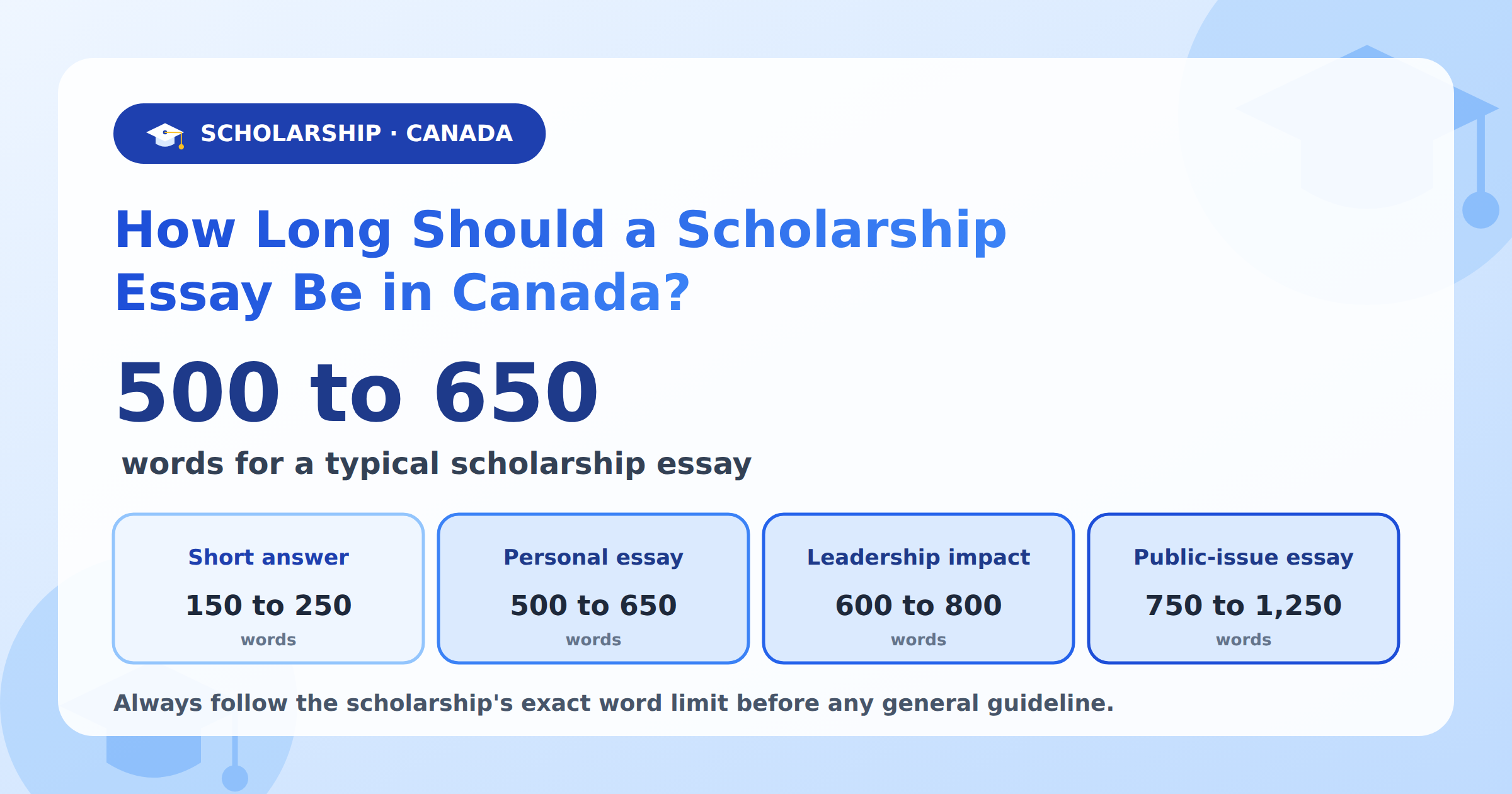
A strong scholarship essay in Canada is long enough to answer the prompt with specific evidence, but short enough to respect the selection committee's time. For a typical personal essay with no stated limit, that usually means 500 to 650 words. There is no universal Canadian scholarship essay length, though: current requirements range from short 150-word responses to researched essays over 1,000 words.
Your first responsibility is not to reach a standard number. It is to follow the exact instructions for that scholarship. This matters because Canadian students have thousands of awards to consider. The ScholarshipsCanada database listed 98,283 awards in its 2025 report, while Statistics Canada reports that average undergraduate tuition for 2025–2026 reached $7,734 for Canadian students and $41,746 for international students. A carefully prepared application can compete for funding that makes a real difference to your education costs.
Key Takeaways
Follow the scholarship's stated word, character, or page limit exactly.
If no limit is given, aim for 500–650 words for a standard personal scholarship essay.
Short responses usually need 150–400 words, while researched essays may require 750–1,250 words.
Never exceed a stated maximum, even if the application form accepts additional text.
Focus on specific actions, evidence, and reflection instead of filling the available space.
Quick answer
If the scholarship gives a word limit, follow it exactly. If no length is provided, use these practical targets:
Type of response | Recommended length |
|---|---|
Simple short-answer question | 150–250 words |
One focused experience or achievement | 250–400 words |
Personal scholarship essay | 500–650 words |
Broad personal statement | 500–750 words |
Multi-part leadership or community-impact prompt | 600–800 words |
Researched public-issue essay | 750–1,250 words, with sources |
Multiple essay questions | Treat each response separately |
For a typical personal scholarship essay with no stated limit, 500–650 words is the safest starting range. If the question can be fully answered in 350–450 focused words, do not add filler simply to reach 500.
There is no standard scholarship essay length in Canada
Published Canadian requirements show how widely essay lengths vary:
Canadian application or program | Published requirement |
|---|---|
UBC International Scholars application | Four essay questions of about 150–250 words each |
Rotman Commerce application-based awards | 500-word essay for certain awards |
750–850 words | |
1,000–1,250 words | |
St. Michael's College John L. Lee Memorial Scholarship | 1,000-word essay |
These examples reveal several important distinctions: a short personal response is not the same as a complete scholarship essay, a personal statement is not the same as a researched issue essay, a portal's technical capacity is not necessarily the intended essay length, and different questions in the same application can carry different expectations.
Western University is a useful example. Its 2026 National Scholarship application asks for a 1,000–1,250-word researched essay, but other sections use character limits of 500, 600, 5,000, or 7,000 characters. The essay also needs a title, double spacing, APA references, and a word count on the final page. Length is only one part of following the instructions.
How to interpret scholarship word-count instructions?
Small differences in wording can completely change what you should submit.
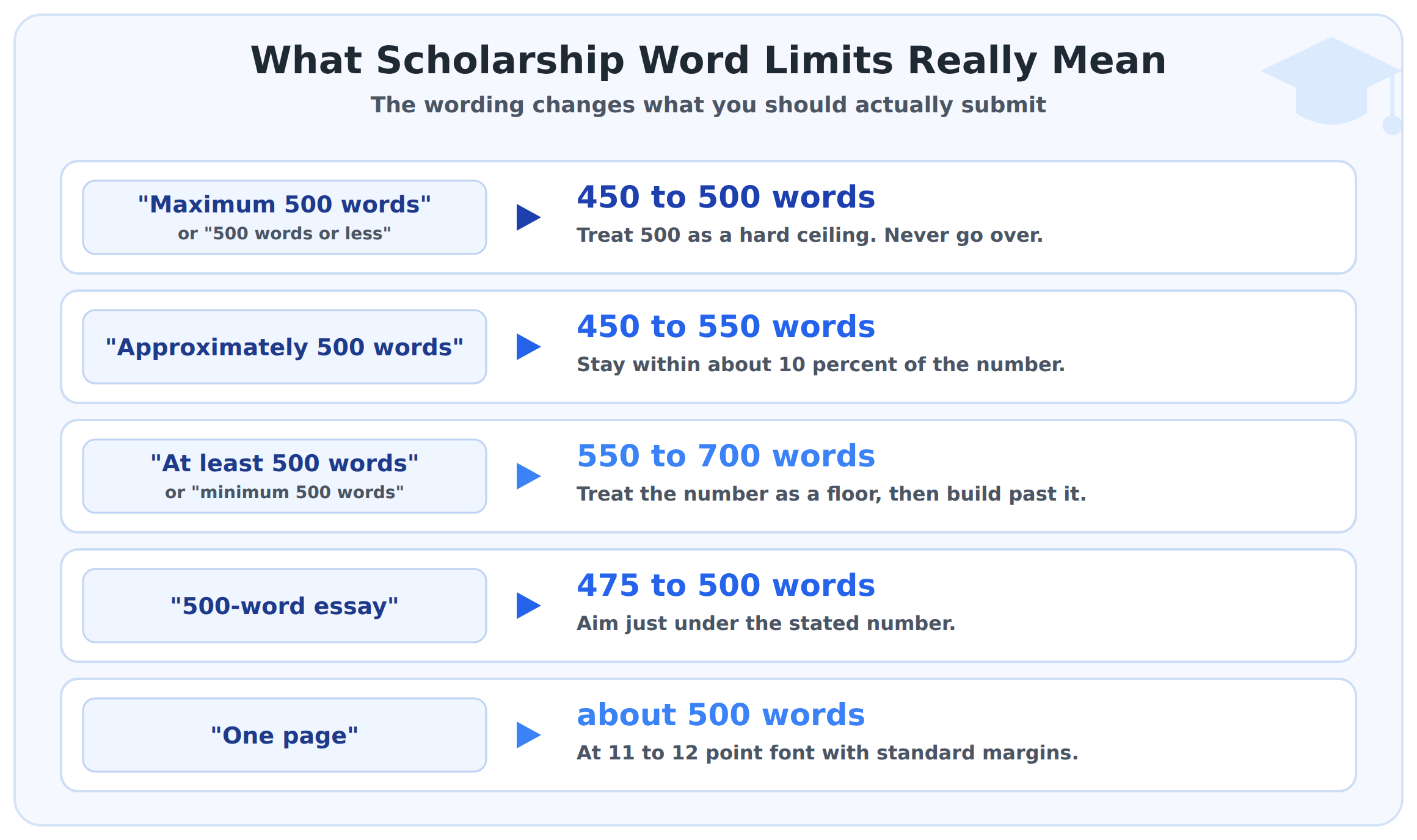
"Maximum 500 words" or "500 words or less"
Treat 500 as a hard ceiling. Your response can contain 430, 475, or 499 words, but it should not contain 501. Even if an online form accepts more text, the committee may treat the extra words as a failure to follow instructions. A sensible final target is 450–500 words, provided the response is complete.
"Approximately 500 words"
You have limited flexibility, not unlimited flexibility. Aim to stay within about 10% of the requested length: a practical range is 450–550 words, a stronger target is 475–525, and 600 or more becomes risky. Likewise, "approximately 250 words" calls for a response close to 250, not 350 or 400.
This situation is common: an application asks for "approximately 250 words" but provides a 2,500-character field. Honour both instructions and keep the response close to 250 words. The character allowance is the technical ceiling, not permission to ignore the stated word target.
"At least 500 words" or "minimum 500 words"
Here 500 is the floor rather than the ceiling. Do not submit 497 words. But you also do not need to double the length simply because no maximum is listed. For an ordinary personal prompt, roughly 550–700 words is usually enough. A 1,137-word response may be technically eligible under "500 words or more," yet still be unnecessarily long unless the prompt requires that depth. Meeting a minimum does not make every longer response equally effective.
"500-word essay"
This wording can be ambiguous. Unless the application defines a range, treat 500 as a close target rather than a number you can greatly exceed. Aim for about 475–500 words, and if you are unsure whether 500 is a maximum, ask the scholarship administrator before submitting.
"One page"
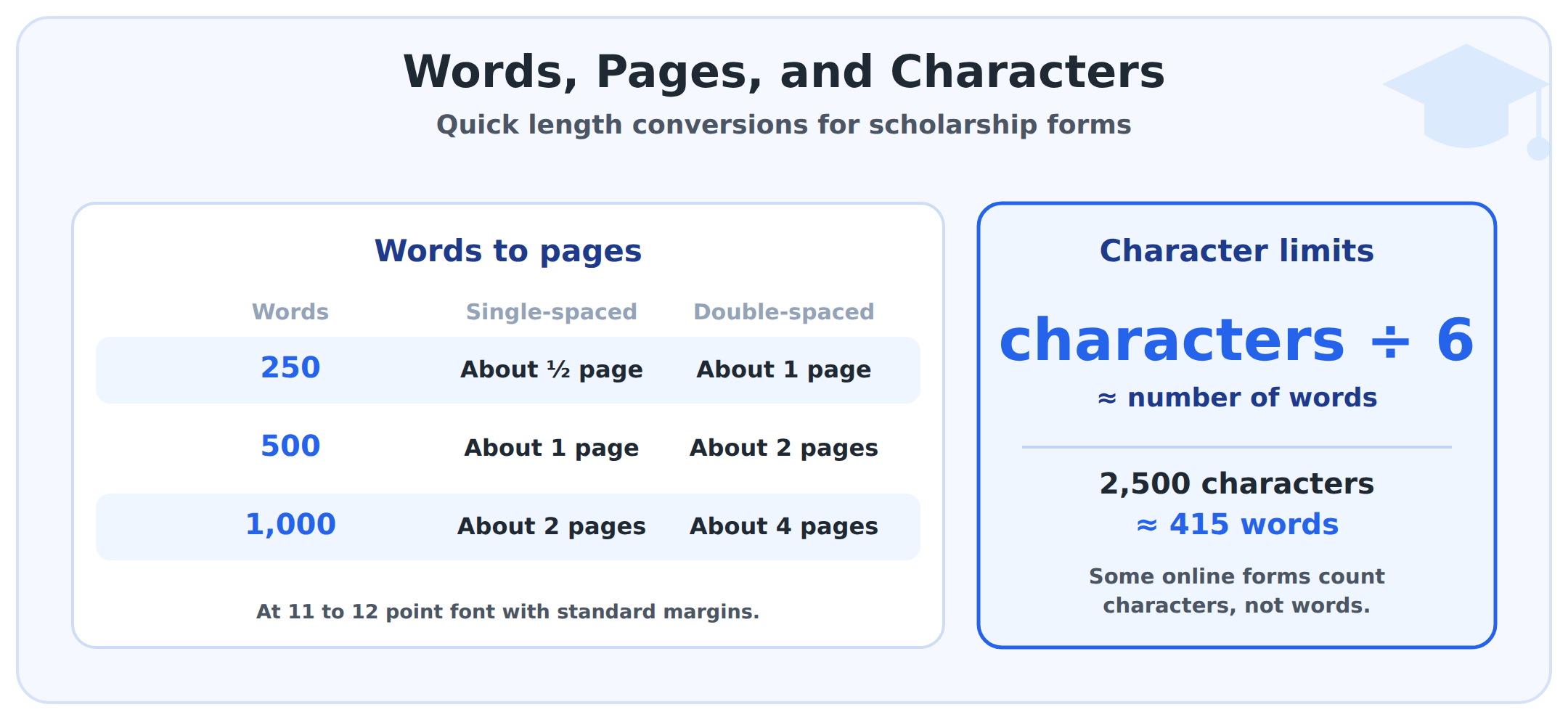
Page limits depend on formatting. Unless told otherwise, use a readable 11- or 12-point font and standard margins.
Word count | Single-spaced | Double-spaced |
|---|---|---|
250 words | About ½ page | About 1 page |
500 words | About 1 page | About 2 pages |
750 words | About 1½ pages | About 3 pages |
1,000 words | About 2 pages | About 4 pages |
1,250 words | About 2½ pages | About 5 pages |
Page estimates change with font, headings, paragraph spacing, and margins. For a detailed breakdown of these variables, see our guide to how many pages 500 words is under standard formatting. If the scholarship provides both a page limit and a word limit, stay within both.
What if the scholarship gives no word limit?
This is one of the most common sources of anxiety. Students worry that a short essay will look lazy, while a long one may exhaust the reader. A large text box is a frequent cause of confusion: a field that accepts 4,000 words (or characters) is usually a technical safeguard, not a target. Write to the scope of the prompt, not the capacity of the box. Use this four-part decision process instead.
1. Measure the scope of the prompt
Count the distinct tasks in the question. A narrow prompt such as "Describe one volunteer experience that changed your perspective" can often be answered well in 250–400 words. A broad prompt such as "Explain your background, leadership experience, educational goals, financial circumstances, and intended community impact" may require 600–800 words. The more independent questions you must answer, the more space you need.
2. Identify the response type
Ask what the committee is actually requesting: a quick explanation, a personal story, a statement of financial need, a leadership reflection, a career-goals statement, or a persuasive or researched essay. A researched public-issue essay needs more space than a brief reflection, because it may require evidence, analysis, solutions, and references.
3. Look for indirect clues
Check the whole application for a PDF template, a character counter, a downloadable rubric, formatting instructions, sample essays, previous winning entries, different labels such as "short response" and "long essay," or instructions elsewhere in the FAQ or portal. Do not assume the maximum capacity of the text box is the recommended length.
4. Contact the scholarship provider
If the instructions remain unclear, ask a short, specific question:
Hello, I am preparing my response to the community leadership question. I could not find a preferred word count in the application guidelines. Is there a recommended range or maximum length for this response? Thank you.
ScholarshipsCanada recommends contacting the administrator when requirements are unclear, and advises applicants not to exceed stated limits or drastically undershoot them.
Use the prompt-density method to choose your length
Instead of asking only "How many words should I write?", work out how much useful content the prompt actually requires. Give yourself one content unit for each of the following that the prompt calls for:
Context: What situation were you in?
Action: What did you personally do?
Evidence: What result, number, or concrete change can you show?
Reflection: What did you learn?
Direction: How did the experience shape your education or career?
Fit: Why does this scholarship connect with your goals?
Impact: What will become possible if you receive the award?
Content units needed | Suggested length |
|---|---|
2–3 units | 150–300 words |
4–5 units | 300–500 words |
6–7 units | 500–750 words |
Research and source analysis added | 750–1,250 words |
This framework prevents two common mistakes: writing a long autobiography for a narrow prompt, and giving a shallow response to a complex question.
How close should you get to the maximum?
You do not need to use every available word, but you should use enough space to develop your answer. A helpful target is to finish within 10–20 words of the limit under a 250-word maximum, use about 85–100% of the allowance for a 250–500-word maximum, and use about 80–100% for a broad 500–1,000-word maximum. For a very large technical limit, ignore the percentage rule and follow the prompt's scope. These are practical targets, not official rules: a focused 430-word response can beat a repetitive 500-word one.
Your essay is probably underdeveloped when it makes claims without examples, lists activities without explaining your contribution, mentions goals without showing how you will reach them, describes financial need without explaining the scholarship's practical effect, or ends before connecting your experience to the award.
Your essay is probably too long when it repeats the same lesson in different language, includes your entire life story, turns your résumé into paragraphs, describes events unrelated to the prompt, uses several examples where one strong example would work, or adds background before answering the actual question.
A practical structure for a 500-word scholarship essay
A 500-word essay has room for one central story, meaningful reflection, and a clear connection to the scholarship. It does not have room for every achievement you have ever earned.
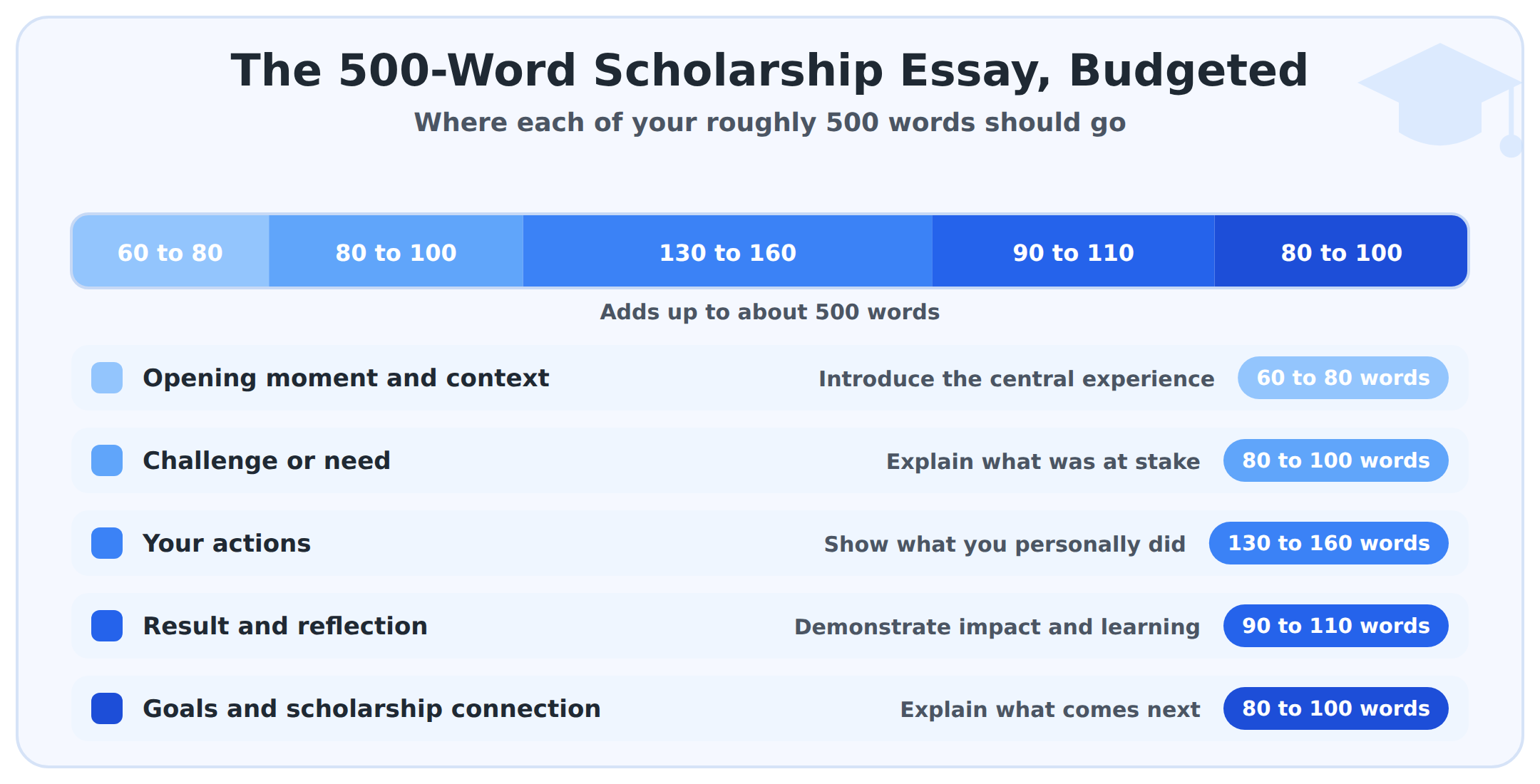
As a worked example, take the prompt "Describe a community contribution and explain how this scholarship would support your future goals." Open with a specific moment from the project rather than a general statement about volunteering. Set the situation by explaining the problem the community faced and why you became involved. Show your action by naming the responsibilities you took and the decision or initiative that was yours. Give the result with measurable evidence where possible, such as participants reached, funds raised, hours contributed, or a process improved. Reflect on how the experience changed your understanding of leadership. Then make the scholarship connection by identifying the educational step the award would support and the impact you hope to create afterward.
This structure is more persuasive than a rigid five-paragraph school format. Scholarship committees want a clear, personal response, not a formula that forces every idea into equal-sized paragraphs.
How many paragraphs should a scholarship essay have?
There is no mandatory number. Paragraphs should change when the idea, time, setting, or purpose changes. These ranges usually work:
Essay length | Typical paragraph count |
|---|---|
150–250 words | 2–4 paragraphs |
300–500 words | 4–6 paragraphs |
500–750 words | 5–8 paragraphs |
750–1,250 words | 7–12 paragraphs |
A 500-word essay usually works well with four to six paragraphs. Avoid one enormous block of text, especially when pasting into an online form. After drafting, a paragraph counter can help you spot a dense essay with too few breaks or a choppy response with too many short paragraphs.
Words and characters are not the same
This distinction causes preventable mistakes. Words are counted as individual units separated mainly by spaces, while characters include letters, numbers, punctuation, and usually spaces. Some portals even count paragraph breaks as characters. For rough planning, divide a character limit that includes spaces by six:
Character limit | Rough word estimate |
|---|---|
500 characters | About 80 words |
1,000 characters | About 165 words |
2,000 characters | About 330 words |
2,500 characters | About 415 words |
5,000 characters | About 830 words |
These are estimates, not guarantees: short words produce a higher word count, while long academic terms produce a lower one. If the application gives both limits, satisfy both, because a portal that allows 2,500 characters does not override an instruction asking for approximately 250 words. Before submitting, confirm the response with a reliable word counter, then check the number shown inside the application portal. If the application measures characters instead, use a character counter that displays totals both with and without spaces.
Should the title and references count?
There is no universal rule, so check the application instructions. Unless the scholarship says otherwise, assume the title, headings, in-text citations, quotations, footnotes, and captions may count toward the total. A reference list may or may not be excluded, so ask the provider if including it could put you over the limit. Western University's National Scholarship instructions are unusually specific: applicants must write 1,000–1,250 words, include the count on the final page, and provide APA references. That is why copying generic formatting advice from another scholarship can be risky.
How to make every word earn its place?
Selection committees learn more from evidence and reflection than from impressive-sounding adjectives. Compare a vague claim like "I am a passionate and hardworking leader who has always cared deeply about helping my community" with a specific one: "When attendance at our weekly food drive declined, I reorganized volunteer shifts and created a sign-up system that filled 34 open positions within two weeks." The second version establishes leadership through an observable action and result.
Use the Action-Evidence-Meaning test on each main paragraph: what did you do (action), what changed because of it (evidence), and what did the experience teach you or prepare you to do (meaning)? If a paragraph contains none of these, it may not deserve space. If your draft still feels repetitive or unclear, these practical tips for fixing paragraphs can help you tighten sentences without removing important evidence.
How to write the essay step by step?
Copy the complete prompt into your working document. Do not rely on memory. Include the word or character limit, formatting requirements, and submission instructions.
Turn the prompt into a checklist. "Describe your leadership, explain its community impact, and connect it to your career goals" contains three required tasks, and your final essay must visibly answer all three.
Research the scholarship provider. Look at its mission, selection criteria, and previous recipients, and choose experiences that truthfully demonstrate the values it funds. Do not insert the organization's keywords mechanically; show alignment through relevant actions and goals.
Choose one central message. Complete the sentence "After reading my essay, the committee should understand that I am someone who ______." This decides which details belong.
Draft without forcing the exact count. It is fine for the first draft to run over. Concentrate on answering the question and producing useful material.
Run the Fit-Proof-Purpose review. For every paragraph, ask whether it fits the prompt, proves its point with evidence rather than unsupported claims, and serves a purpose in showing your character, goals, or suitability. Remove or rewrite paragraphs that fail two of the three tests. Use Action-Evidence-Meaning while drafting to build a strong paragraph, and Fit-Proof-Purpose while editing to decide whether to keep it.
Check clarity and readability. Read the essay aloud, since your ear catches repetition and awkward sentences your eyes skip. You can also use a readability checker to flag difficult passages and overly long sentences. Treat the score as an editing signal, not a grade: the essay should sound natural and polished, not simplified to satisfy a number.
Check the final count in two places. Use your writing software first, then paste the response into the application and check its counter, since different systems handle hyphenated words, numbers, and symbols differently.
Preview the submission. Look for missing paragraph breaks, cut-off sentences, lost italics or headings, unsupported special characters, the wrong scholarship or organization name, and accidental notes left in the document. Keep a copy of the submitted version.
Scholarship essay formatting in Canada
Follow the application's formatting rules before using general advice. When no format is specified, use a readable 11- or 12-point font, standard margins, clear paragraph breaks, and left-aligned text. Use double spacing for an uploaded formal essay, or single spacing with a blank line between paragraphs for many online forms. Give the file a descriptive name such as FirstName-LastName-Scholarship-Essay.pdf, and submit PDF or DOCX only when the application accepts that format. Do not add elaborate colours, decorative fonts, borders, or photographs unless creative presentation is requested.
Does a scholarship essay need a title?
Usually not, unless the instructions require one, the response is uploaded as a separate formal essay, a title helps identify the chosen topic, or the scholarship is an essay competition. Do not use a title if it consumes valuable space in a short online response without adding meaning.
Personal essay versus researched essay
Most scholarship responses are personal and do not need academic sources. A researched issue essay is different. Use sources when the prompt asks you to analyze a public issue, explain causes, defend a position, examine solutions, discuss policy or research, or provide evidence beyond your own experience. Western's 2026 scholarship essay, for example, requires applicants to examine an issue of public concern, discuss its causes and potential solutions, and provide APA references. Treating that assignment like a purely personal narrative would fail to answer the prompt. For a personal essay, your lived experience is usually the primary evidence; for a researched essay, combine credible evidence with your own analysis.
Can you reuse a scholarship essay?
You can reuse ideas, experiences, and portions of a previous draft, but you should not submit the same untouched essay everywhere. Check each version against the exact prompt, the provider's mission, the award name, the required length, the selection criteria, and the requested type of response. EducationQuest recommends preparing material around recurring themes while still writing for the individual scholarship.
A useful personal content bank can include leadership experiences, community contributions, academic goals, career plans, financial context, challenges and lessons, and measurable achievements. Build each new essay from the relevant material rather than combining old essays until the response becomes oversized or unfocused.
Can you use AI to write a scholarship essay?
Check the scholarship's rules first, because some providers prohibit AI-generated work or require disclosure. Even when the instructions do not mention AI, the essay should remain an honest representation of your experiences, thinking, and voice. Western University explicitly requires original work written by the applicant and treats plagiarism seriously.
A cautious approach is to use digital tools for limited support, such as organizing your own notes, identifying unclear sentences, checking grammar, or testing whether every part of the prompt is answered. Do not let a tool invent experiences, accomplishments, quotations, financial circumstances, or community impact. You should be able to explain and defend every sentence you submit.
Final scholarship essay checklist
Requirements
I answered every part of the prompt.
I stayed within the word, character, and page limits.
I followed the required font, spacing, and file format.
I checked whether the title and references count.
I used the correct scholarship and organization names.
Content
My essay has one clear central message.
I used specific actions and examples, and explained my personal contribution.
I included results or evidence where possible.
I reflected on what I learned and connected it to my future goals.
I explained how the scholarship would help.
Quality and integrity
Every statement is honest and accurate, and the writing sounds like me.
I removed filler and repeated ideas.
Someone I trust reviewed the essay.
I checked the final count after pasting or uploading.
I previewed the complete application and saved a copy of the submitted version.
There is no official scholarship essay length used across Canada. Current requirements range from roughly 150-word responses to essays of 1,250 words or more. Work in this order of priority: follow the scholarship's exact instructions, answer every part of the prompt, stay below all maximums and above all minimums, use the available space for actions, evidence, and reflection, aim for 500–650 words for a standard personal essay when no limit exists, and ask the provider when the wording is unclear.
Your strongest essay is not the one that uses the most words. It is the one that gives the committee enough specific evidence to understand who you are, what you have done, and why supporting your education would be a worthwhile investment.
Frequently Asked Questions
How long should a scholarship essay be in Canada?
Follow the scholarship's published limit. When none is given, about 500–650 words is a reliable target for a standard personal essay. Short responses may need only 150–400 words, while researched or multi-part essays may need 750–1,250.
Is 500 words enough for a scholarship essay?
Yes. Five hundred focused words are enough to tell one meaningful story, explain your actions, show what you learned, and connect the experience to the scholarship. Choose one central message rather than a full autobiography.
Can I go five or ten words over the limit?
Do not assume a small overage is acceptable. A committee may enforce the limit strictly and an online form may cut off the ending, so revise to stay within the published maximum.
What if the scholarship only provides a minimum?
Meet the minimum, then use only the extra space a complete answer needs. If the minimum is 500 words with no maximum, roughly 550–700 words suits most personal prompts.
Is 1,000 words too long for a scholarship essay?
Not when the scholarship asks for it. Western University currently requires 1,000–1,250 words for its National Scholarship. Without such instructions, 1,000 words is usually too long for a simple personal prompt.
Should I focus on the character limit or the word limit?
Follow both. If the question asks for about 250 words and the portal allows 2,500 characters, write close to 250 words while staying below 2,500 characters. The character allowance is usually a technical maximum, not the intended length.
Do scholarship essays need citations?
Personal scholarship essays normally do not, unless the prompt asks for research or factual analysis. Researched public-issue essays may require in-text citations and a reference list.
Can I write a scholarship essay in the first person?
Yes. Personal scholarship essays commonly use "I," because the committee wants to understand your actions, experiences, values, and goals.
Should I include financial hardship?
Include financial circumstances when the prompt asks about need, or when they directly explain how the award would affect your education. Keep the focus on your plans, resourcefulness, and the award's practical impact.
Is a scholarship essay the same as a university essay?
No. A scholarship essay focuses on your experiences, character, goals, and suitability for an award, while a university assignment develops an academic argument using course evidence. The expected length also differs, as explained in our guide to university essay length in Canada.
What makes a Canadian scholarship essay stand out?
Specificity, reflection, and fit. Show what you did, provide evidence of the result, explain what you learned, and connect it to the provider's selection criteria. A detailed but focused story beats a long list of achievements.