How Long Should a University Essay Be in Canada?
Learn how long a university essay should be in Canada, with word counts by level, page estimates, section formulas, limit rules, and practical writing tips.
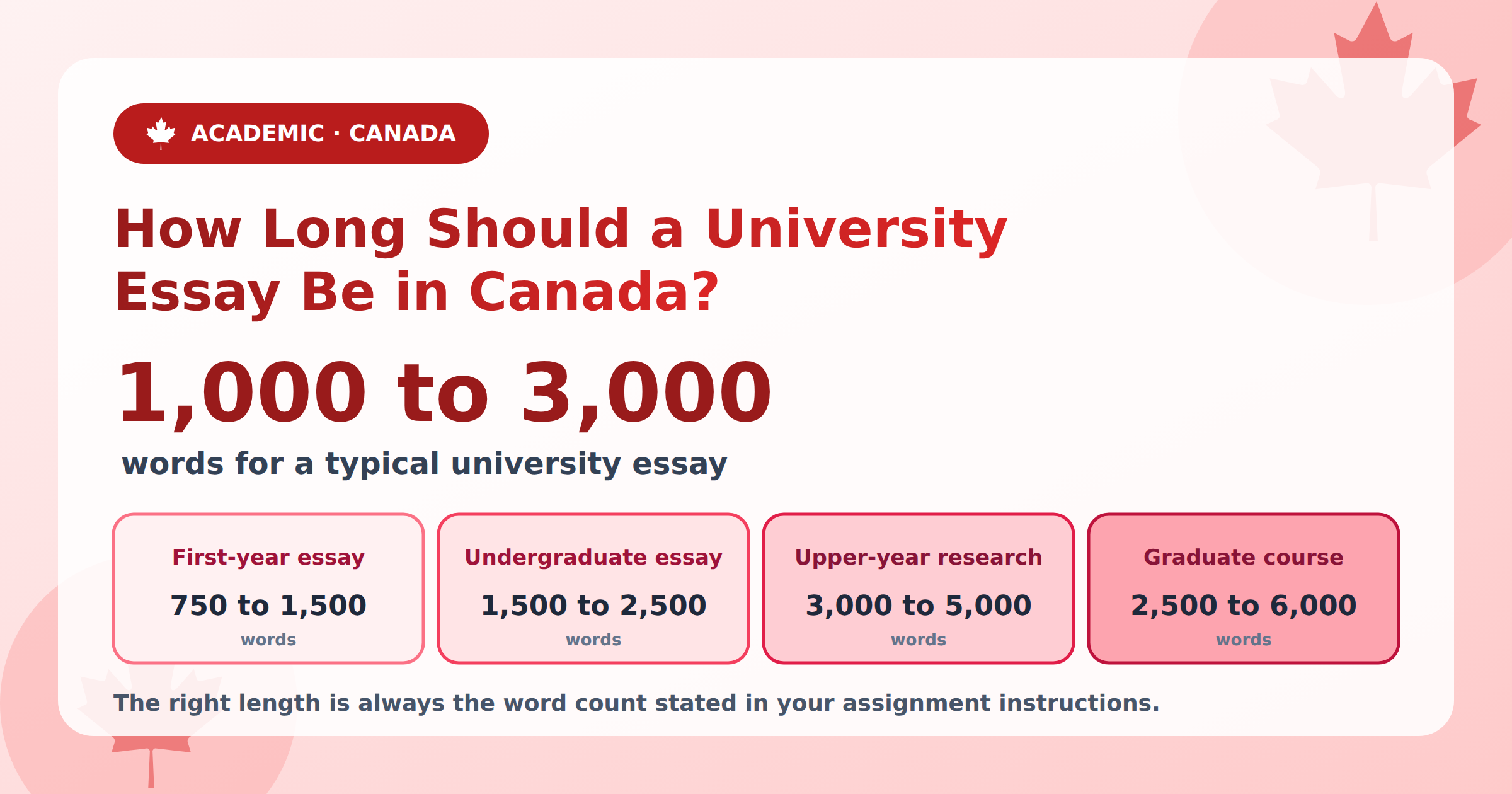
A university essay in Canada is commonly 1,000 to 3,000 words, but there is no nationwide standard. Short course responses may run only 200 to 750 words, standard undergraduate essays are often 1,500 to 2,500 words, major upper-year assignments may reach 3,000 to 5,000 words, and graduate papers can be longer.
The correct length is always the one stated in your assignment instructions, grading rubric, course syllabus, departmental policy, or a clarification from your instructor. Use the general ranges in this guide only when no specific length has been provided.
Quick answer
For planning purposes, these ranges are useful:
Canadian university assignment | Practical length |
|---|---|
Short response or mini-essay | 200–750 words |
First-year short essay | 750–1,500 words |
Standard undergraduate essay | 1,500–2,500 words |
Longer undergraduate term essay | 2,500–4,000 words |
Major upper-year research essay | 3,000–5,000 words |
Graduate course essay | 2,500–6,000 words |
University application response | Often 250–650 words, program-specific |
These are planning benchmarks, not Canadian regulations. Concordia describes short essays as 200–750 words, a University of Manitoba teaching example assigns 800–1,000 words, and broad contemporary guides place many undergraduate essays between 1,500 and 2,500 words, or as wide as 1,500 to 5,000.
Key Takeaways
There is no Canada-wide word-count requirement for university essays, and your professor's instructions override every general range online.
A standard undergraduate essay is often around 1,500–2,500 words; short assignments may be only 200–1,000 words; upper-year and research-heavy papers may reach 3,000–5,000 words.
Canadian university essays are not required to have exactly five paragraphs, and a focused argument should determine your paragraph count.
The body should receive most of your available words.
Do not assume you may automatically go 10% over the limit. Bibliographies are often excluded, but this varies by course.
Being substantially under target may indicate insufficient analysis, and more words do not automatically produce a higher grade.
Is there a standard essay length at Canadian universities?
No. Canadian universities do not follow one national word-count standard for essays. Even within the same institution, requirements differ between faculties, departments, courses, professors, assignment types, and academic levels.
Concordia University describes short essays ranging from 200 to 750 words. A University of Manitoba writing workshop uses an 800–1,000-word assignment example. University of Toronto Scarborough guidance discusses assignments expressed as six to eight pages. Queen's University states directly that the instructor sets minimum and maximum limits.
The University of Toronto's Faculty of Arts & Science also requires the consequences of exceeding a word limit to be stated in the assignment instructions. This reinforces that length rules are course-specific rather than universal.
What does "university essay" mean?
The phrase can refer to several different documents, and the expected length shifts with each one.
Academic course essay
This is an assignment written for a class. It normally presents a thesis, evidence, analysis, and a conclusion. Common examples include argumentative essays, literary analyses, historical essays, comparative essays, critical responses, reflective essays, and case analyses. This article focuses mainly on this category.
Research paper
A research paper is usually longer and more source-intensive than a standard essay. It may contain headings, a literature review, methodology, or other discipline-specific sections.
University application essay
An admissions response or personal statement differs from a course essay. It is usually shorter and focuses on experience, motivation, character, or program fit. For example, Queen's University currently sets a 335-word limit for its supplementary written response and warns that exceeding it can negatively affect the application.
Graduate statement of purpose
A graduate application statement commonly discusses academic preparation, research interests, career goals, program fit, and potential supervisors. Its length is set by the individual program.
Thesis or dissertation
A thesis or dissertation is not simply a long essay. It is a major research project with its own departmental and graduate-school requirements.
University essay length by academic level
First-year undergraduate essays
Practical range: 750–2,000 words. First-year students may receive a mix of 200–750-word responses, 800–1,000-word short papers, 1,200–1,500-word analytical essays, and longer 2,000-word assignments. First-year workloads vary widely by assignment type, which is why the tables in this guide show different first-year figures: treat 750–2,000 words as the outer envelope and the specific brief as the real target. The purpose is often to test whether you can interpret a prompt, develop a thesis, organize an argument, use course sources, cite correctly, and move beyond summary. A University of Manitoba example assigns an 800–1,000-word paper requiring both description and critique with scholarly sources.
Second- and third-year essays
Practical range: 1,500–3,000 words. As courses become more specialized, assignments may require a narrower research question, more scholarly sources, greater engagement with counterarguments, more independent analysis, and stronger integration of evidence. The number of paragraphs should grow with the argument rather than staying fixed at five.
Upper-year term essays
Practical range: 2,500–5,000 words. Upper-year assignments may demand independent research, engagement with scholarly debates, a longer comparative analysis, more complex theoretical frameworks, and several sections or lines of argument. Broad academic-writing guides place undergraduate assignments as high as 5,000 words, although many normal course essays remain shorter.
Graduate course essays
Practical range: 2,500–6,000 words. Graduate papers often require greater depth, stronger source evaluation, and engagement with disciplinary scholarship. A graduate "essay" may resemble a research paper, including a literature review, a theoretical framework, close analysis, methodological discussion, or original synthesis. The precise limit depends entirely on the program and professor.
University essay length by assignment type
Assignment type | Practical range |
|---|---|
Discussion response | 200–500 words |
Short essay | 200–750 words |
Critical response | 500–1,000 words |
Reflective essay | 750–1,500 words |
First-year analytical essay | 1,000–2,000 words |
Comparative essay | 1,500–3,000 words |
Literary or historical analysis | 1,500–3,500 words |
Research essay | 2,000–5,000 words |
Upper-year term paper | 3,000–5,000 words |
Graduate seminar paper | 3,000–6,000 words |
These ranges are for planning. An assignment labelled "critical response" could be 500 words in one course and 2,000 in another, so the label alone never tells you the length.
Does the subject affect essay length?
Yes, but there are no universal discipline-wide limits. What actually changes the length is the genre of writing a discipline favours, not the faculty name on the door.
Humanities
History, literature, philosophy, classics, and cultural studies often assign longer argumentative essays, because students must interpret primary texts and engage with existing scholarship, and that interpretive work takes words.
Social sciences
Political science, sociology, psychology, and anthropology may require essays, research papers, policy analyses, or literature reviews. Length depends heavily on which of those formats the course assigns.
Business
Assignments may include case analyses, reflective papers, position papers, business reports, and strategic recommendations. A report often uses headings and concise sections rather than continuous prose, so its word count behaves differently from a traditional essay.
Sciences and engineering
Students may write short analytical responses, lab reports, technical reports, research summaries, ethics essays, or literature reviews. These formats can contain fewer continuous-prose words, because tables, equations, data, and figures perform part of the analytical work. In short, the assignment genre matters more than the faculty name.
The RULES hierarchy for finding your correct length
Work through this order before relying on any online average.
R: Read the assignment brief. Look for an exact word count, a word-count range, a page limit, formatting requirements, required sources, and included or excluded sections.
U: Use the rubric. A rubric shows how much space each task deserves. If analysis is worth 50% of the grade, it should take substantially more room than background summary.
L: Look at the syllabus and course policies. The syllabus may spell out penalties, word-count tolerance, what counts, formatting, and citation requirements.
E: Examine departmental guidance. A department may have conventions that differ from general university advice.
S: Seek clarification. Ask your professor or teaching assistant when the instructions are ambiguous. The University of Manitoba specifically advises students to confirm length and research requirements with the professor.
How should you divide the word count?
A useful starting split is roughly 10% introduction, 80% body, and 10% conclusion (allow 8–12% at each end). This 10–80–10 distribution is a planning tool rather than a rigid rule, and it matches the general guidance most writing centres give.
Total length | Introduction | Body | Conclusion |
|---|---|---|---|
750 words | 75 | 600 | 75 |
1,000 words | 100 | 800 | 100 |
1,500 words | 150 | 1,200 | 150 |
2,000 words | 200 | 1,600 | 200 |
2,500 words | 250 | 2,000 | 250 |
3,000 words | 300 | 2,400 | 300 |
4,000 words | 400 | 3,200 | 400 |
5,000 words | 500 | 4,000 | 500 |
You may need a longer introduction when the reader requires definitions, historical context, or an explanation of the theoretical approach.
The university essay word-budget method
A section budget prevents an oversized introduction and a rushed conclusion. Suppose you have a 2,000-word essay.
Step 1: reserve the introduction and conclusion. Introduction 200 words, conclusion 200 words, leaving a body budget of 1,600 words.
Step 2: identify the main analytical tasks. If your thesis needs four main sections, that is 1,600 ÷ 4 = 400 words per section.
Step 3: assign evidence and analysis. A 400-word section might use 40–60 words for the topic sentence and claim, 100–130 for context or evidence, 170–210 for analysis, and 40–60 to connect back to the thesis.
Step 4: adjust by importance. Not every argument deserves equal space. A central argument may take 500 words while a supporting qualification takes 250. The budget should reflect the logic of the essay. When you are ready to draft against these targets, keep a running total with a reliable word counter so no single section quietly overruns.
How long should the introduction be?
For most university essays under 3,000 words, the introduction is often one focused paragraph. Longer, more complex papers may need two or more introductory paragraphs. A strong introduction usually names the topic or problem, gives essential context, sets the essay's scope, states a clear thesis, and briefly signals the argument's direction.
Concordia advises writers of short essays to get to the point quickly, provide minimal context, state the thesis, and preview the main points. The University of Calgary presents the introduction as a narrowing structure that moves from the topic to context and finally the thesis.
Essay length | Suggested introduction |
|---|---|
500 words | 50–75 words |
1,000 words | 80–120 words |
1,500 words | 120–180 words |
2,000 words | 160–240 words |
3,000 words | 240–350 words |
5,000 words | 400–600 words |
Very short essays justify a proportionally larger opening, so the 500-word row sits slightly above 10%. Do not spend 500 words introducing a 1,500-word essay.
How long should the conclusion be?
A conclusion often takes about 8–12% of the total. It should return to the thesis, synthesize the main findings, explain their significance, answer the prompt directly, and avoid introducing a major new argument. The University of Calgary advises students not merely to restate the thesis but to gather the arguments, explain their significance, and relate the topic to broader issues where appropriate.
How many paragraphs should a university essay have?
There is no fixed number. The University of Toronto states that university essays should contain as many paragraphs as the argument requires, rather than following a predetermined five-paragraph model, and Trent University similarly identifies the five-paragraph structure as too simplistic for many university assignments.
Essay length | Possible paragraph range |
|---|---|
500 words | 3–5 paragraphs |
750 words | 4–6 paragraphs |
1,000 words | 5–8 paragraphs |
1,500 words | 7–11 paragraphs |
2,000 words | 9–14 paragraphs |
3,000 words | 12–20 paragraphs |
These are not requirements. A paragraph should end when its analytical task is complete.
How should a body paragraph be structured?
The University of Calgary presents the MEAL plan: a Main idea, an Example, Analysis, and a Link to the thesis. In practice that means stating the claim, presenting a quotation, fact, example, or scholarly position, explaining how the evidence supports the claim, and connecting the result back to the overall thesis. If a paragraph contains more evidence than analysis, the essay drifts toward description rather than argument.
How many pages is a university essay?
Using approximately 250 words per double-spaced page:
Word count | Approximate double-spaced pages |
|---|---|
250 words | 1 page |
500 words | 2 pages |
750 words | 3 pages |
1,000 words | 4 pages |
1,250 words | 5 pages |
1,500 words | 6 pages |
2,000 words | 8 pages |
2,500 words | 10 pages |
3,000 words | 12 pages |
4,000 words | 16 pages |
5,000 words | 20 pages |
This estimate assumes a 12-point readable font, double spacing, 2.54 cm (one-inch) margins, and standard paragraph formatting. Charts, headings, block quotations, footnotes, and spacing all change the final page count, which is why word count is the more reliable measure. To convert your own draft instantly, use our words to pages counter.
Should you write to the minimum or maximum of a range?
Suppose the assignment says 1,500–2,000 words. Your first goal is to stay within that range. A sensible target is around 1,700–1,900 words, which gives enough room for development while leaving space for later edits.
Some instructors expect students to use most of the available space. One University of Toronto Scarborough guide advises that when an assignment allows six to eight pages, it is better to produce eight than six, because argument development requires space. That is course-specific advice, not a national rule. Use the upper portion of the range when the topic requires comparison, several sources must be analyzed, counterarguments are expected, the assignment carries substantial weight, or your evidence needs explanation. Do not add repetition merely to reach the maximum.
Can you go 10% over the word count in Canada?
Do not assume so. Some general academic guides describe a possible plus-or-minus 10% allowance, but this is not a universal Canadian rule. Scribbr correctly notes that the allowance depends on the course and institution. The University of Toronto's Faculty of Arts & Science handbook states that the consequences of exceeding the limit should be specified in the assignment instructions, and gives "text beyond the word count limit will not be assessed" as one possible policy.
Canadian course policies vary widely: text beyond the limit may not be marked, a fixed grade penalty may apply, the assignment may be rejected, a small tolerance may be accepted, or the professor may treat the count as a strict maximum.
The safest rule
If the instructions say maximum 2,000 words, stay at or below 2,000.
If they say 1,800–2,000 words, stay within the range.
If they say approximately 2,000 words, ask whether a tolerance applies.
If a plus-or-minus 10% allowance is written in the syllabus, use it only when necessary.
Treat the stated count as the target, not as the starting point for adding another 10%.
What happens if an essay is too short?
Being substantially under the expected length usually points to a content problem rather than a word problem: an overly broad or weak thesis, insufficient evidence, too much summary and too little analysis, missing counterarguments, unexplained quotations, an incomplete answer to the prompt, or a conclusion reached too quickly. Queen's University notes that an essay substantially below the guideline probably does not cover the topic in enough detail, while emphasizing that length by itself does not produce a better mark.
This is one of the most common length problems students face. A draft can feel finished because the initial ideas are all on the page, yet the word count stays low because those ideas have not been developed through evidence and analysis. The fix is to deepen the thinking, not to inflate the text.
How to lengthen an essay without adding filler?
Recheck every part of the prompt. A question may ask you to explain, compare, evaluate, apply, and discuss implications. Students often answer only the first task.
Add analysis after evidence. After each quotation or example, ask what it demonstrates, why it matters, how it supports the thesis, whether another interpretation exists, and what its limitations are.
Compare sources. Instead of presenting sources one after another, explain where they agree, where they disagree, why their methods differ, and which position is more convincing.
Address a counterargument. A well-handled counterargument strengthens rather than weakens the thesis.
Define important terms. Clarify contested or discipline-specific language.
Develop the consequences. Explain the significance of your findings rather than stopping at the immediate point.
Narrow the thesis. A vague thesis produces shallow paragraphs; a precise thesis creates specific analytical tasks.
What happens if an essay is too long?
An overlength essay usually contains repeated claims, unnecessary background, overlong quotations, too many examples, tangential research, several versions of the same conclusion, an unfocused thesis, or paragraphs that perform multiple unrelated tasks. Queen's Classics advises that careful removal of redundancy, unnecessary words, and digressions can sometimes cut a seemingly tight essay by as much as 20%.
How to shorten an essay without losing marks?
Cut repeated ideas. Keep the clearest version of each point.
Shorten the background. Include only the context needed to understand your argument.
Replace long quotations. Paraphrase where the exact wording is not essential.
Remove empty openings such as "it is important to note that," "throughout the history of humanity," "there are many different reasons why," and "it can clearly be seen that."
Narrow the scope. A smaller argument analyzed well beats a broad topic treated superficially.
Combine sentences. "Due to the fact that the policy was unsuccessful, it was eventually withdrawn by the government" becomes "Because the policy failed, the government withdrew it."
Test every paragraph. If a paragraph does not directly help answer the assignment question, remove or rewrite it.
What usually counts toward the word count?
There is no universal rule, but the main essay text normally counts.
Element | Usually counted? |
|---|---|
Introduction, body, conclusion | Yes |
Direct quotations | Usually |
In-text citations | Often |
Headings | Varies |
Footnotes and endnotes | Varies |
Title and title page | Usually not |
Reference list or bibliography | Often not |
Appendices | Usually not |
Tables and figure captions | Varies |
Official Canadian course examples differ. One University of Toronto assignment excludes footnotes and bibliography, while a recent Queen's psychology syllabus excludes in-text citations and the reference section. Never delete citations or conceal words to manipulate the total. Confirm the rule instead.
Do references count toward a Canadian university essay?
Often not, but you cannot assume this. Check whether the assignment says "main text only," "including citations," "excluding bibliography," "including footnotes," or "all-inclusive word count." When the instructions are silent, ask your professor.
How long should a Canadian university application essay be?
Application essays are usually shorter and stricter than academic course essays. The required length may be expressed in words, characters, pages, or as a timed written response. Queen's currently limits its supplementary written response to 335 words, and other programs set their own limits.
When a portal gives both a word and a character allowance, follow the written application instructions and contact the admissions office if the two appear inconsistent. This mismatch is a frequent source of confusion, because an online text box will often accept more characters than the stated word maximum allows.
The RANGE method for writing to any limit
The RULES hierarchy helps you find the right length before you start. The RANGE method helps you write to that length once you have it.
R: Read the entire prompt. Identify every required task, source, and formatting rule.
A: Allocate the words. Reserve space for the introduction, analytical sections, and conclusion before drafting.
N: Narrow the thesis. Choose an argument small enough to prove within the assigned length.
G: Gather selective evidence. Use the strongest evidence rather than every source you found.
E: Edit to the exact target. Remove repetition, confirm what is included, and verify the final count.
Final Canadian university essay checklist
Before submitting, confirm:
I followed the assignment's exact word or page range.
I checked whether a tolerance is explicitly allowed.
I know what is included in the count.
I answered every directive verb in the prompt.
My thesis is specific and arguable.
My introduction is proportional to the essay.
Most of my words are devoted to evidence and analysis.
Each paragraph performs one clear task.
I moved beyond description and summary.
Every source is cited correctly.
My conclusion explains the argument's significance.
I removed repetition and irrelevant background.
I included an accurate word count if requested.
My formatting follows the syllabus, and I asked the instructor about any ambiguity.
For many Canadian undergraduate assignments, 1,500 to 2,500 words is a useful general expectation, but that is not a national standard. Your actual target comes from the assignment brief, syllabus, rubric, department, and instructor. A 500-word response can demand more precision than a 3,000-word term essay, while a long paper can still fail if it replaces analysis with repetition.
Use the RULES hierarchy to find the length (read the brief, use the rubric, look at the syllabus, examine departmental guidance, and seek clarification), then apply the RANGE method to hit it (read, allocate, narrow, gather, and edit). The goal is never to write the longest essay possible. It is to use the available space to make a clear, well-supported argument that answers the assigned question completely.
Frequently Asked Questions
How long is a typical university essay in Canada?
A standard undergraduate essay is often around 1,500–2,500 words. Short responses may be 200–750 words, while longer term essays may reach 3,000–5,000 words.
How long is a first-year university essay?
Many first-year essays are approximately 750–2,000 words, though shorter responses and longer research assignments both occur.
How long is an upper-year university essay?
Upper-year analytical or research essays commonly range from 2,000 to 5,000 words, depending on the course.
How long does it take to write a 2,000-word essay?
With research already done, drafting is often three to five hours, but budget at least as much time again for outlining, source-checking, and revision.
Does single or double spacing change the word count?
No. Spacing changes the page count, not the number of words, which is exactly why instructors specify words rather than pages.
Can I use AI to reach the word count?
Padding a draft with AI-generated filler is both an academic-integrity risk and easy for markers to spot. Length should come from added analysis, not added text.
Can I go 10% over my university essay word count?
Only when the assignment, syllabus, or instructor explicitly permits it. There is no automatic Canadian 10% rule.
How far under the word count can I be?
Stay within any stated minimum. When only one target is given, aim close to it, generally within about 5%, unless the instructor sets a different tolerance.
Is it bad to be 100 words under?
For a 3,000-word essay, 100 words under may be insignificant. For a 500-word response it is 20% of the assignment and may signal missing development.
Do quotations count toward the word count?
Usually yes, because they appear in the main text, but check the assignment instructions.
Does the bibliography count?
Often not, but policies vary, so confirm before you submit.
How many sources should a university essay use?
The assignment instructions decide this. Source quality and relevance matter more than an arbitrary total.
Can I finish a 2,000-word essay in one day?
It is possible, especially when the research is complete, but rushing leaves less time for outlining, source checking, revision, and proofreading.
Is a longer essay more likely to receive a better grade?
No. Canadian university guidance emphasizes clarity, logic, evidence, and analysis rather than length for its own sake.
Does a university essay have to contain five paragraphs?
No. Canadian university writing centres explicitly advise students to move beyond the fixed five-paragraph model.
What should I do when no length is given?
Check the rubric and syllabus, compare the assignment's weight and complexity with your other coursework, and ask the professor or teaching assistant.