The Hardest Wordle Answers for Canadian Players
Discover the hardest Wordle answers for Canadian players, why ROUGH topped 2025, the biggest streak traps, and proven strategies for solving them.
Some Wordle answers are difficult because they contain rare letters. Others hide a repeated vowel, use an unfamiliar spelling, or leave you trapped among several nearly identical words.
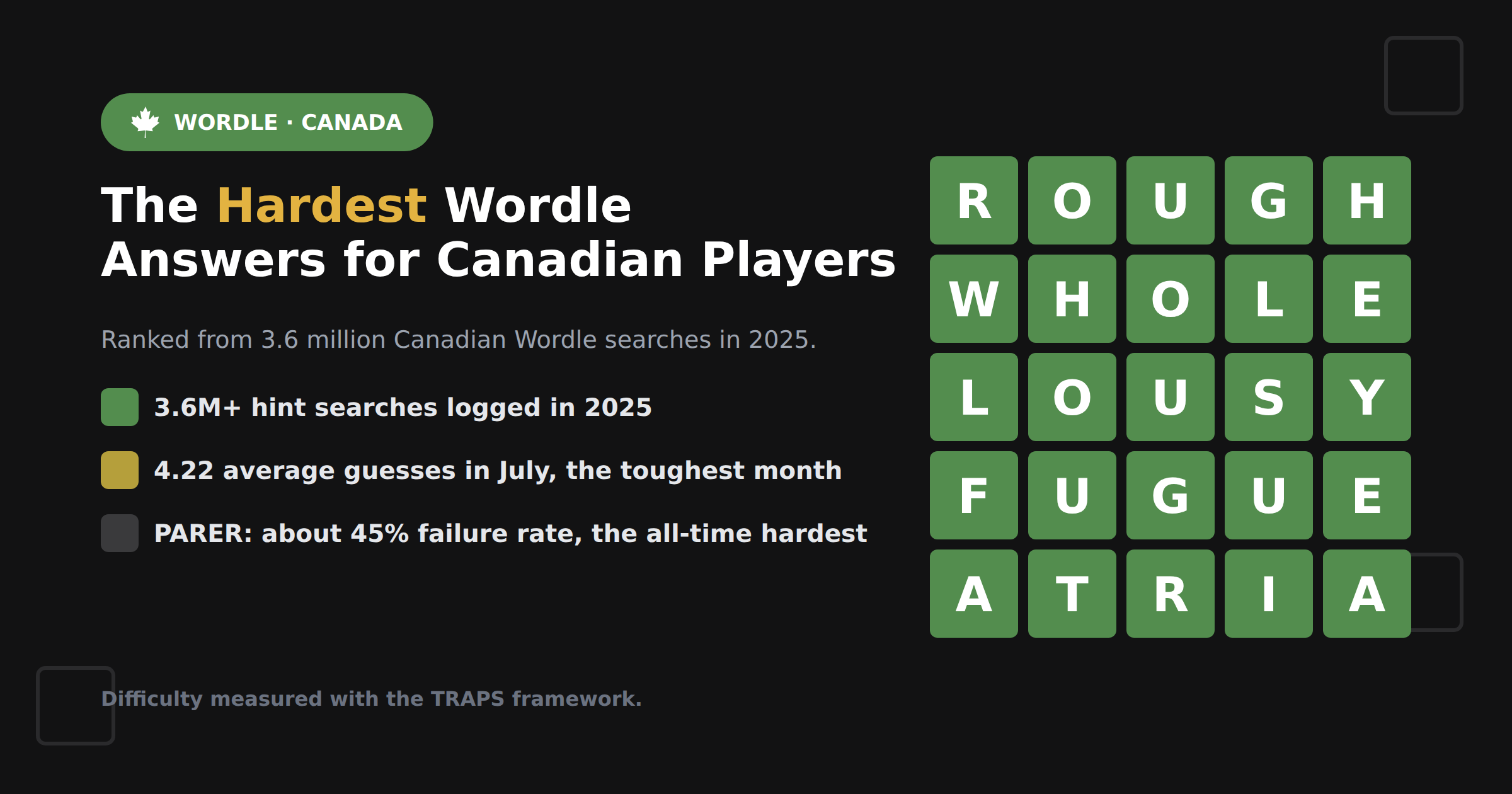
For Canadian players, ROUGH was the hardest Wordle answer of 2025 by search demand, producing the country's largest spike in hint searches. WHOLE, LOUSY, FUGUE, and ATRIA completed the top five. But "hardest" depends on what is being measured: Canadian search activity points to ROUGH, while player-performance data identifies EAGER as the most punishing Wordle of 2025, and across historical puzzles PARER remains one of the strongest candidates for the hardest Wordle answer ever.
Historical spoiler warning: This article reveals answers from previous Wordle puzzles. It does not reveal today's answer.
Quick answer
The five hardest Wordle answers for Canadian players in 2025, by hint-search demand, were:
ROUGH: June 1, 2025
WHOLE: July 27, 2025
LOUSY: August 17, 2025
FUGUE: November 9, 2025
ATRIA: July 6, 2025
This ranking comes from Canadian search behaviour. A study reported by Village Life examined Google Trends data and more than 110 hint-related keyword variations, and found that Canadians made more than 3.6 million Wordle hint searches during 2025, seeking a hint 25 times more often than the answer. These results do not mean ROUGH had the highest failure rate; they mean it produced the strongest Canadian demand for help under that study.
What does "hardest Wordle answer" actually mean?
Different studies produce different winners because they do not measure difficulty the same way.
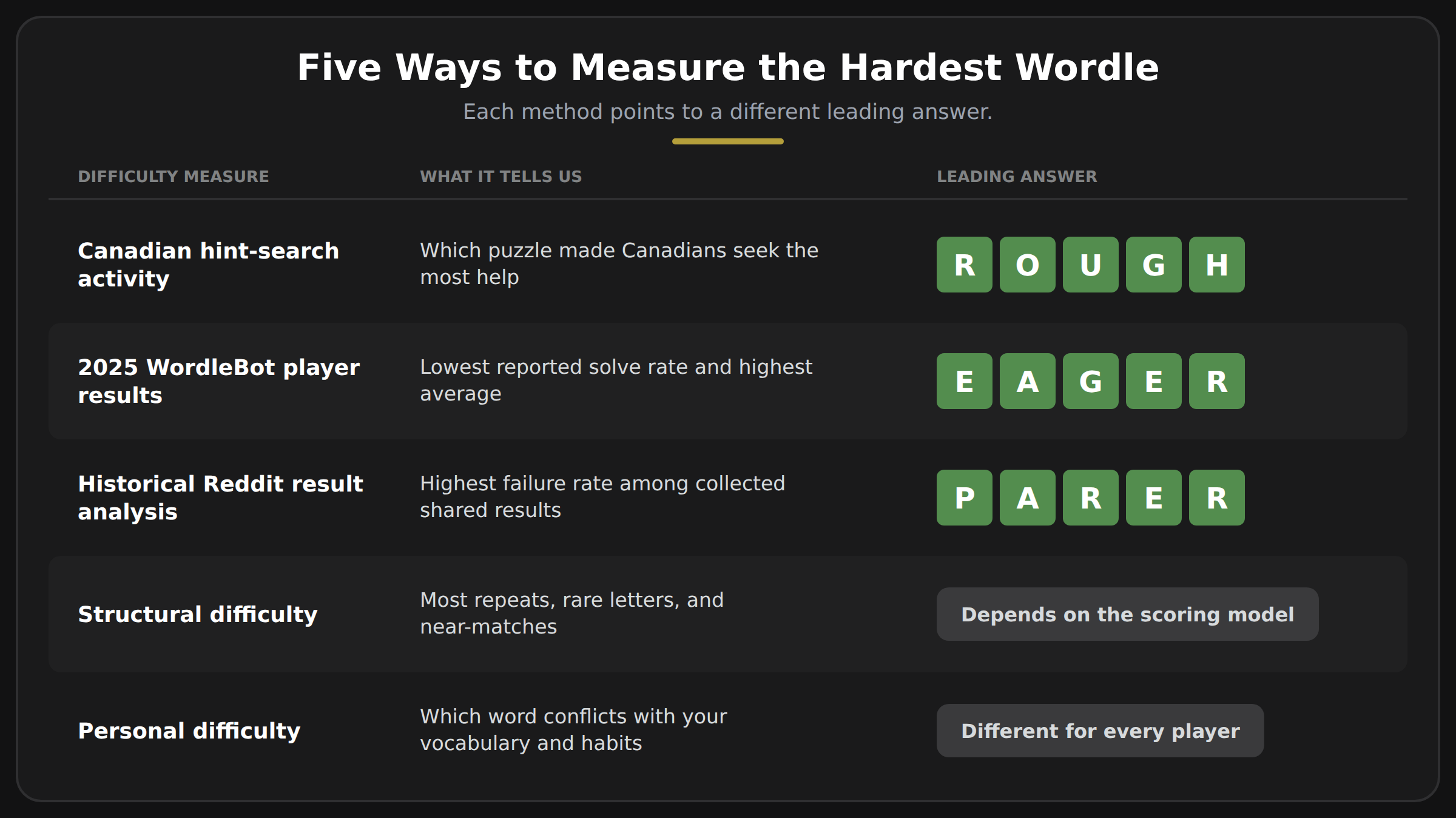
Search volume is a useful but indirect signal, affected by the day of the week, media attention, search habits, and the popularity of a particular hint page. Actual solve rates are more direct, but they depend on who is playing: WordleBot users, Reddit posters, and casual players are not the same population. The most reliable conclusion is therefore layered. ROUGH was the hardest Canadian search-driven Wordle of 2025, EAGER was the hardest 2025 answer in the cited player-performance data, and PARER is a leading all-time answer when historical failure rates are considered.
Canada's five hardest Wordle answers of 2025
1. ROUGH (Wordle #1,443, June 1, 2025)
ROUGH looks familiar, but its spelling is extremely inefficient for a Wordle player. The OUGH sequence does not follow an obvious sound-to-letter pattern, G and H may go untested by common opening words, and U is less likely to appear in popular starters such as CRANE, STARE, or SLATE. A strong first guess can still return five grey tiles, leaving a very large candidate pool. ROUGH proves an important point: an everyday word can be harder than an obscure one, because you may know the word perfectly and still fail to uncover its letters efficiently.
Lesson: When your opening guess produces little information, prioritize unused consonants rather than searching only for vowels.
2. WHOLE (July 27, 2025)
WHOLE combines a common ending with less frequently tested opening letters. W and H are often absent from statistically popular starting words, the initial WH combination is easy to overlook, and a discovered O, L, or E does not immediately reveal the word's structure. Players can spend several turns repositioning vowels while leaving the critical consonants untouched.
Lesson: Finding two vowels does not necessarily mean you are close. Ask which consonant pair could connect them.
3. LOUSY (August 17, 2025)
LOUSY is another familiar word with an unhelpful arrangement. It contains O, U, and a vowel-like Y, the OU sequence can appear in many positions, and a final Y may not be tested until late in the game. Players who focus heavily on A, E, and I can miss its vowel structure. LOUSY produced the strongest hint-search spike in both British Columbia and Alberta.
Lesson: Treat Y as a possible vowel when your regular vowels do not create a convincing answer.
4. FUGUE (November 9, 2025)
FUGUE is almost designed to punish standard Wordle habits. U appears twice, the answer contains only four unique letters, and its written form does not map neatly onto its pronunciation. F and G may remain untested after a vowel-heavy opening, and players often assume a second U would waste answer space. Remember that a grey U tile does not always mean U is absent: when you guess a word containing the same letter twice, Wordle colours each occurrence according to how many copies are actually in the answer.
Lesson: Once you have eliminated many common letters, reconsider whether a confirmed letter might appear twice.
5. ATRIA (July 6, 2025)
ATRIA is the plural of atrium. It is valid English, but less common in everyday conversation than most Wordle answers. A appears twice, the answer ends in A (an uncommon Wordle ending), and it contains three vowel positions. Its plural form may not occur to players who expect singular nouns. Wordle generally avoids ordinary plurals ending in S or ES, but that does not exclude every plural, and irregular or classical forms such as ATRIA can still appear.
Lesson: Do not interpret "Wordle avoids plurals" as "a Wordle answer can never be plural."
Which answers were hardest in each Canadian province or territory?
The same study reported different leading hint-search words across Canada.
Reported region | Answer with the largest hint-search spike |
|---|---|
Ontario and Manitoba | ROUGH |
British Columbia and Alberta | LOUSY |
Quebec | FUGUE |
Nova Scotia | ATRIA |
Prince Edward Island | SWING |
Saskatchewan, New Brunswick, and Northwest Territories | DOWEL |
Newfoundland and Labrador | MINTY |
Yukon | COVEN |
Nunavut | TENOR |
WHOLE ranks second nationally but leads no single region, because the national ranking aggregates search demand spread across the country rather than concentrated in one province. Treat these regional findings as directional rather than exact measurements of failure. The published search-volume figures were not presented as normalized rates, and some appear unusually high relative to the populations involved, so the raw provincial totals should not be read as audited player counts.
The hardest Wordle answers of 2025 by player performance
Canadian search data tells only part of the story. A separate ranking based on reported New York Times averages and solve rates produced a very different list.
Rank | Answer | Date | Avg | Solve rate | Main difficulty |
|---|---|---|---|---|---|
1 | EAGER | May 15 | 6.0 | 49% | Double E and the _AGER trap |
2 | ROWER | Jan 19 | 5.7 | 64% | Repeated R and many similar words |
3 | GOFER | Jul 25 | 5.6 | 64% | Common ER ending but unexpected G and F |
4 | WOUND | Oct 12 | 5.3 | 75% | Large _OUND family |
5 | JUMPY | Jul 10 | 5.6 | 78% | Rare J and several rhyming alternatives |
6 | SAVVY | Jul 28 | 5.3 | 79% | Double V and repeated pattern |
7 | WAFER | Jan 9 | 5.3 | 80% | WAGER, WATER, WAVER and other alternatives |
8 | BASTE | Mar 20 | 5.1 | 80% | _ASTE guessing trap |
9 | KRILL | Apr 4 | 5.2 | 81% | GRILL, DRILL, FRILL and similar answers |
10 | TIZZY | Jul 21 | 5.4 | 83% | Double Z and repeated-letter structure |
These figures were compiled from WordleBot and player data in Tom's Guide's review of the hardest 2025 puzzles.
Why EAGER was so punishing?
EAGER was solved by only 49% of the cited sample and averaged 6.0 guesses across roughly 1.78 million games. The answer combines three hazards: it repeats E, it ends with the extremely common ER pattern, and the _AGER frame has several plausible completions, including LAGER, PAGER, and WAGER. Players could uncover four useful positions and still have too many candidates for the turns remaining, which is often more dangerous than having only one or two green tiles.
July 2025 was an unusually difficult month
July contributed several major streak traps, including JUMPY, GOFER, TIZZY, SAVVY, and POPPY. One analysis put the month's average at about 4.22 guesses, describing it as the most difficult month recorded since WordleBot began tracking results, with GOFER averaging 5.6 and JUMPY reaching 5.2. That does not prove Wordle is becoming steadily harder. Difficulty normally arrives in clusters, and a difficult week can be followed by several straightforward puzzles.
What is the hardest Wordle answer ever?
PARER is one of the best-supported answers. A 2026 analysis of more than 266,000 Wordle result posts on Reddit, published by WordsRated, estimated these historical failure rates:
Answer | Puzzle | Estimated failure rate |
|---|---|---|
PARER | #454 | 44.98% |
CORER | #1,214 | 31.35% |
ROWER | #1,310 | 25.60% |
GOFER | #1,497 | 25.32% |
EAGER | #1,426 | 22.94% |
Every answer in that top five ends in ER. You may notice that EAGER's failure rate here (22.94%) looks very different from the 49% solve rate cited earlier, but the two figures measure different things and should not be ranked against each other. EAGER's 49% is a same-day WordleBot solve rate drawn from a very large casual-player sample, while PARER's 44.98% is an estimated failure rate from publicly shared Reddit results, a smaller and more experienced group who may also share wins and losses at different rates. On its own dataset, PARER remains one of the hardest answers on record, and EAGER remains the hardest of 2025 in the WordleBot sample. Neither number invalidates the other, but rankings from different datasets should not be combined as though they came from a single experiment.
Why some Wordle answers are so hard: the TRAPS framework
You can evaluate a possible answer using five difficulty signals.
Signal | Question to ask | Examples |
|---|---|---|
T: Twins | Could one letter appear more than once? | EAGER, FUGUE, SAVVY |
R: Rival answers | Are there several words with almost the same pattern? | ROWER, WOUND, KRILL |
A: Awkward letters | Does it contain J, Q, X, Z, V, or another under-tested letter? | JUMPY, TIZZY, INBOX |
P: Peculiar spelling | Is its spelling hard to predict from its sound? | ROUGH, FUGUE |
S: Specialized vocabulary | Is it uncommon, technical, regional, or grammatically unexpected? | ATRIA, KEFIR, LORIS |
A word showing four or five TRAPS signals is likely to be a difficult answer even when its meaning is familiar.
Repeated letters
Repeated letters create two problems. First, players naturally try to maximize coverage by using five unique letters, which is usually helpful early but delays testing duplicate letters. Second, the colour feedback can be misunderstood: if you enter two copies of a letter but the answer contains only one, the extra copy shows grey, and that does not cancel the green or yellow copy. Repeated letters appear in roughly 15% of potential answers, with E, O, and L among the most commonly repeated, according to Tom's Guide's answer-pattern analysis.
One-letter word families
These are some of the most dangerous Wordle traps:
_IGHT: EIGHT, FIGHT, LIGHT, MIGHT, NIGHT, RIGHT, SIGHT, TIGHT
_OUND: BOUND, FOUND, HOUND, MOUND, POUND, ROUND, SOUND, WOUND
_OWER: COWER, LOWER, MOWER, POWER, ROWER, SOWER, TOWER
_ASTE: BASTE, HASTE, PASTE, TASTE, WASTE
_RILL: DRILL, FRILL, GRILL, KRILL, TRILL
SHA_E: SHADE, SHAKE, SHALE, SHAME, SHAPE, SHARE, SHAVE
These patterns feel promising because you have several green tiles, but they can leave more possible answers than remaining guesses. Players often call this the "one letter, many words" problem, and the Wordle community consistently identifies IGHT, OUND, ATCH, SHAE, and _OWER as the most painful families.
Uncommon letters in common words
JUMPY is not obscure. Its difficulty comes from J being unlikely to appear in a typical opening guess, and from the existence of BUMPY, DUMPY, and LUMPY. The lesson is simple: vocabulary familiarity and puzzle difficulty are not the same thing.
Unfamiliar vocabulary
Words such as KEFIR, LORIS, ATRIA, and MYRRH create a recognition problem. Even when your tiles strongly suggest the answer, you may dismiss it because it does not feel like a normal Wordle word. English contains hundreds of thousands of words, far more than Wordle's answer list, as our guide to how many words are in the English language explains, so an unfamiliar entry is always possible. A candidate should not be rejected solely because you rarely use it.
The Canadian spelling problem
Wordle uses American English conventions, which creates a small but real challenge for Canadian players.
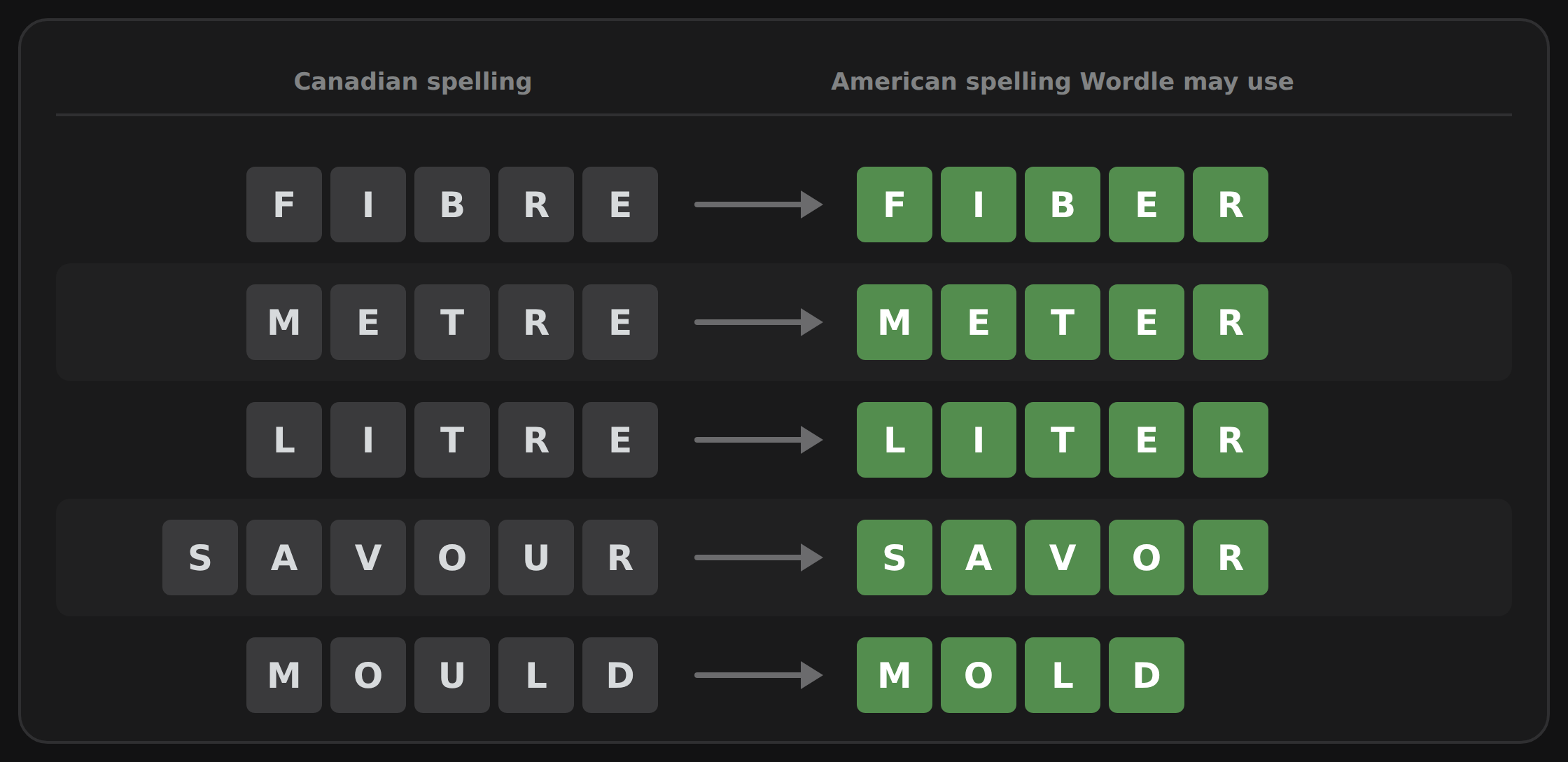
Canadian and other non-American players have reported being slowed by answers such as FIBER because the American letter order did not come to mind quickly. This does not mean Wordle gives Canada a different puzzle: the daily answer is the same for players worldwide. It means Canadians occasionally need to switch from their normal spelling instincts to the game's American dictionary. A useful reminder: if a nearly complete answer looks wrong in Canadian English, test whether the American spelling rearranges or removes a letter.
Wordle and Canuckle are not the same game
Canuckle is a Canadian-themed game inspired by Wordle, with answers connected to Canadian geography, history, culture, or vocabulary. That changes the answer pool. Canuckle has used words such as ABOOT, BANFF, SPUDS, FOXES, KLICK, BRIER, and CURDS, some of which would be unlikely or impossible as standard Wordle answers, and it has allowed ordinary plural forms that Wordle generally avoids. An early performance analysis explained by YourDictionary identified FOXES at 5.80 average guesses and KLICK at 5.56 as especially difficult Canuckle answers. If you play both games, do not automatically transfer Wordle's expected-answer rules to Canuckle.
How to solve the hardest Wordle answers?
1. Begin with a balanced word
A useful starter covers frequent vowels and consonants without repeating letters. Strong, readable options include RAISE, SLATE, CRANE, TRACE, STARE, and IRATE. A 2026 analysis estimates the overall average Wordle score at about 3.80 and lists RAISE, SALET, RAILE, and SAINE among the most efficient openers, though some of those are unusual words. A familiar starter you can use consistently is often more practical than an obscure word with a tiny mathematical advantage.
2. Do not spend two turns only chasing vowels
A common mistake is opening with ADIEU and then entering another vowel-heavy word. That can identify the vowel structure while leaving too many possible consonants. After a vowel-heavy opener, your next guess should normally test common consonants such as R, S, T, L, N, C, D, and H.
3. Count letters, not just colours
After each guess, take a quick inventory: which letters are confirmed, which positions are confirmed, which letters are excluded, whether a confirmed letter could appear twice, and whether a grey duplicate revealed that the answer contains only one copy. This prevents the common mistake of treating every grey tile as a complete ban on that letter.
4. Count the remaining word family
Suppose you reach _IGHT. Do not immediately guess FIGHT, then LIGHT, then NIGHT. First list the plausible initial letters, and if there are more candidates than remaining turns, you need an elimination guess. The rule: candidate count greater than guesses remaining means you should use a probe word.
5. Use a discriminating guess in normal mode
A discriminating guess is not meant to be the answer; it tests several letters that separate your remaining candidates. If the possible answers are EIGHT, FIGHT, MIGHT, NIGHT, RIGHT, SIGHT, TIGHT, and WIGHT, the word STERN tests S, T, E, R, and N in one turn, and its feedback can remove several candidates at once. Because this may temporarily ignore green tiles, it works best in normal mode.
6. Avoid locking into a pattern too early in hard mode
Hard mode requires you to reuse revealed clues, which can prevent you from entering the best elimination word. If you sense a large family such as SHA_E or _OWER, test the uncertain letters before turning too many positions green. Players sometimes call this "pillar avoidance": avoid building a fixed pattern until the number of remaining answers is manageable. Hard mode does not simply make you play better; in certain word families, its restrictions can make a puzzle genuinely more difficult.
7. Separate valid guesses from likely answers
Wordle accepts many obscure words as guesses because they help you test letters, but that does not mean every accepted word is equally likely to be the daily answer. Use unusual words as information tools, and favour familiar vocabulary when choosing between possible final answers, unless the tiles strongly point elsewhere.
A Turn-Four rescue checklist
If you reach your fourth guess without a clear answer, pause before entering another word and check the following.
Have I considered a repeated letter?
Could Y be functioning as a vowel?
Am I trapped in a large word family?
Are there more candidates than turns remaining?
Have I tested R, S, T, L, and N?
Have I ignored J, V, W, X, or Z for too long?
Could the answer use an American spelling?
Could it be an uncommon plural or irregular form?
Am I choosing a likely answer, or merely the first word I noticed?
Would a probe word eliminate more candidates than another direct guess?
This short pause is often more valuable than trying to guess faster.
Common mistakes that cause Wordle losses
Most losses trace back to a handful of habits. Each links to the section that explains the fix in full.
Mistake | Why it costs you |
|---|---|
Reading green tiles as progress | Four greens with seven possible last letters and two turns left is still a losing position. Measure progress by candidates remaining, not tiles. |
Forgetting repeated letters | Eliminating a letter after one use breaks words like EAGER, SAVVY, and EERIE. See repeated letters. |
Testing too many vowels | Consonants separate similar answers; chase them once one or two vowels are known. See how to solve, step 2. |
Treating every accepted guess as likely | The accepted-guess dictionary is far larger than the answer pool. See step 7. |
Excluding previously used answers | Since February 2026, old solutions can return. See 2026 changes. |
Guessing a family one word at a time | One probe word can test several opening letters at once. See step 4. |
How to get help without spoiling the answer?
Canadians sought hints 25 times more often than answers in 2025, which suggests many players want assistance without losing the satisfaction of finishing themselves. A layered hint system gives you control over how much you reveal: start with a category hint (noun, verb, or adjective), then a meaning hint (a short definition without letters), then a pattern hint (number of vowels or repeated letters), then a position hint (first or final letter), then a strong hint (a synonym or a sentence with a blank), and only reveal the answer as the final option.
Wordle changes Canadian players should know in 2026
Previous answers can now return
For years, many experienced players eliminated words that had already appeared. That strategy became unreliable in February 2026, when Wordle began reintroducing selected previous solutions. Only a small number of repeats had appeared by mid-2026, but the change means an old answer can no longer be safely discarded, as TechRadar's dated archive of past solutions tracks.
Repeated-letter puzzles remain dangerous
The April 27, 2026 answer EERIE contained three E's. It averaged about 4.4 guesses, and roughly 10% of players failed to solve it within six attempts. The lesson matters more than the individual answer: once several common letters are eliminated, repeated vowels should move higher on your candidate list.
The hardest Wordle answer for Canadian players in 2025 was ROUGH, based on hint searches. EAGER caused worse results in a large 2025 player-performance sample, while PARER remains one of the strongest all-time candidates. The most difficult answers usually combine at least two hazards: repeated letters, large families of similar words, rare or under-tested consonants, unusual spelling patterns, unfamiliar vocabulary, or American spellings that feel less natural to Canadians.
You cannot control which answer appears, but you can avoid the habits that cause most losses. Use a balanced opening word, stop chasing only vowels, count the remaining candidates, consider repeated letters, and play a discriminating guess before a word family consumes your final turns.
Frequently Asked Questions
What was the hardest Wordle answer for Canadians in 2025?
ROUGH, according to Canadian hint-search activity, followed by WHOLE, LOUSY, FUGUE, and ATRIA.
What was the hardest Wordle answer worldwide in 2025?
It depends on the dataset. EAGER had the lowest reported solve rate in one major player-performance ranking, with 49% solving it, while a separate US search-volume study placed INBOX first because it caused the largest increase in hint searches.
What is considered the hardest Wordle answer ever?
PARER is frequently ranked first. A Reddit-result analysis estimated a 44.98% failure rate, while historical WordleBot reporting gave it an average of about 6.3 guesses (WordleBot counts an unsolved puzzle as 7 when averaging, so a figure above 6 reflects a high failure rate).
Why was ROUGH so difficult?
ROUGH uses the irregular OUGH spelling pattern and several letters that common opening words miss, so it can leave a player with very little useful information after the first two guesses.
Why are words ending in ER so difficult?
There are many five-letter ER words, and several share three or four positions. ROWER, CORER, PARER, RIPER, ROVER, and GOFER all create large candidate families.
Are double letters common in Wordle?
Common enough that you must actively consider them. Repeated letters appear in roughly 15% of potential answers, with E, O, and L among the most frequent.
What is the best Wordle starting word?
There is no single best word for every goal. RAISE, SALET, SLATE, CRANE, and TRACE are strong information-based options; RAISE performs especially well in mathematical rankings, while SLATE and CRANE are more familiar.
Is ADIEU a good starting word?
ADIEU identifies vowels quickly but tests only one consonant, which can leave too many consonant possibilities for later turns. A balanced word such as RAISE or SLATE usually provides more complete information.
Does Wordle use Canadian spelling?
Wordle follows American English, so Canadians may encounter FIBER instead of FIBRE, METER instead of METRE, or SAVOR instead of SAVOUR.
Does every country get the same Wordle answer?
Yes. Standard New York Times Wordle uses the same daily answer worldwide. Search behaviour and average results differ between countries, but the puzzle does not.
Does Wordle use plural words?
Wordle generally avoids ordinary plural answers ending in S or ES, but other plural forms can appear. ATRIA, for example, is a plural form.
Can Wordle repeat an old answer?
Yes. Wordle began reintroducing selected previous answers in February 2026, so a word should no longer be excluded solely because it has appeared before.
Is hard mode actually harder?
It can be. Hard mode forces you to reuse revealed clues, which may prevent a strategic probe word, so large families such as IGHT, OWER, and SHA_E can be more dangerous.
Are obscure Wordle guesses possible answers?
Not necessarily. Wordle accepts a larger dictionary of valid guesses than its pool of likely daily answers, so an obscure word can help you test letters without being a likely solution.
Is Wordle getting harder?
Not in a straight line. July 2025 was unusually difficult, but puzzle difficulty tends to rise and fall in clusters rather than trend steadily upward.