How to Start a Debate: Opening Formula, Examples, Speeches
Learn how to start a debate with a proven opening formula, four hook examples, sentence starters, a full sample opening speech, roles, rebuttal tips.
The first 30 seconds of a debate decide whether the room listens to you or tunes out. A strong opening tells the judges you are prepared, frames the whole motion on your terms, and gives your team momentum. A weak one makes even good arguments hard to hear.
This guide shows you exactly how to start a debate, step by step. You get a proven opening formula, four hook types with real examples, a bank of sentence starters you can copy, a full 90-second sample opening speech you can read aloud, opening lines for each speaker role, plus the format, rebuttal, etiquette, and judging knowledge that beginners usually miss. It works for a school debate, a competitive tournament, or a class assignment.
How Do You Start a Debate?
To start a debate, open your speech with a hook in the first 10 to 15 seconds (a surprising statistic, a short scenario, a rhetorical question, or a quote), then give a formal greeting to the chair, judges, and audience, state the motion and your side, define any key terms, and finish your introduction with a roadmap of your two or three main points. Keep the whole opening to about 15 percent of your speaking time. Example: "Ninety percent of us checked a phone in the last hour. Good morning, Madam Chair, judges, and worthy opponents. Our team stands firmly for the motion that social media does more harm than good, and I will prove it in three ways."
The opening in one glance | What to do | Time |
|---|---|---|
1. Hook | Grab attention with a stat, story, question, or quote | 10-15 sec |
2. Greeting | Address the chair, judges, audience, and opponents | 5 sec |
3. Motion + side | State the topic and whether you are for or against | 10 sec |
4. Define terms | Clarify what the motion means | 10-15 sec |
5. Roadmap | Preview your 2-3 main arguments | 15 sec |
Key Takeaways
A strong debate opening has five parts: hook, greeting, motion and side, definitions, and a roadmap.
The hook comes first and should last only 10 to 15 seconds.
Keep your entire introduction to about 10 to 15 percent of your total speaking time.
Define the key terms of the motion early so you control how the debate is framed.
Your roadmap (a preview of your points) helps judges follow and score you.
The first speaker sets up the case; later speakers rebut, extend, and summarize.
Judges reward matter (content), manner (delivery), and method (structure), so a clear opening scores on all three.
Practice your first minute out loud until you can deliver it without reading.
What Is a Debate? (A Quick Foundation)
A debate is a structured argument in which two sides, one proposing a motion and one opposing it, present their cases to an audience or a panel of judges. Unlike an ordinary discussion, a debate has fixed rules, timed speeches, assigned roles, and a winner decided on the strength of argument and delivery.
The thing that separates debating from public speaking is rebuttal: you not only build your own case, you show why the other side is wrong. That two-way pressure is why a confident, well-planned opening matters so much. It sets the tone before anyone has to defend anything.
A few core debating terms you will see throughout this guide:
Motion (or resolution): the statement being debated, usually starting with "This house believes that…"
Proposition (Affirmative): the team arguing in favor of the motion.
Opposition (Negative): the team arguing against it.
Rebuttal: directly answering and disproving the other side's arguments.
Point of Information (POI): a short interruption offered to the speaker holding the floor.
The Goal of Your Opening
Before the formula, understand what a great opening is actually trying to do. It has three jobs:
Capture attention. The judges have heard dozens of openings. Give them a reason to sit up.
Define the ground. Whoever defines the key terms controls what the debate is about. Do this first and you fight on your own terrain.
Signpost your case. Tell the room where you are going so they can follow, and score, every point you make.
Do these three things and you have already out-prepared most opponents.
How to Start a Debate: The 5-Step Opening Formula
Here is the sequence that works in almost every format. Follow it in order.
Step 1: Open With a Hook (First 10-15 Seconds)
Never open with "Hello, my name is…". Lead with something that earns attention. The four reliable hook types are below.
Step 2: Give a Formal Greeting
Address the room in order of seniority. A safe, standard greeting:
"Good morning, respected Chairperson, honorable judges, worthy opponents, and members of the audience."
Adjust the wording to your format. Some competitions expect "Madam Speaker" or "Mr. Chairman."
Step 3: State the Motion and Your Side
Leave no doubt about what you are arguing and which side you are on.
"Today's motion is that homework should be banned in primary schools, and our team stands firmly against it."
Step 4: Define the Key Terms
Say what the motion actually means so the other side cannot twist it later. Keep it fair and reasonable.
"By 'homework,' we mean structured practice tasks done at home, not hours of busywork."
A classic teaching example: if the motion is about "cats," define it as domestic pet cats, not tigers and lions. Reasonable definitions win; extreme ones get challenged.
Step 5: Preview Your Points (The Roadmap)
Close your introduction by previewing your two or three main arguments. This is the single easiest way to look organized.
"I will prove our case in three ways: homework builds independent study habits, it reinforces classroom learning, and it keeps parents involved."
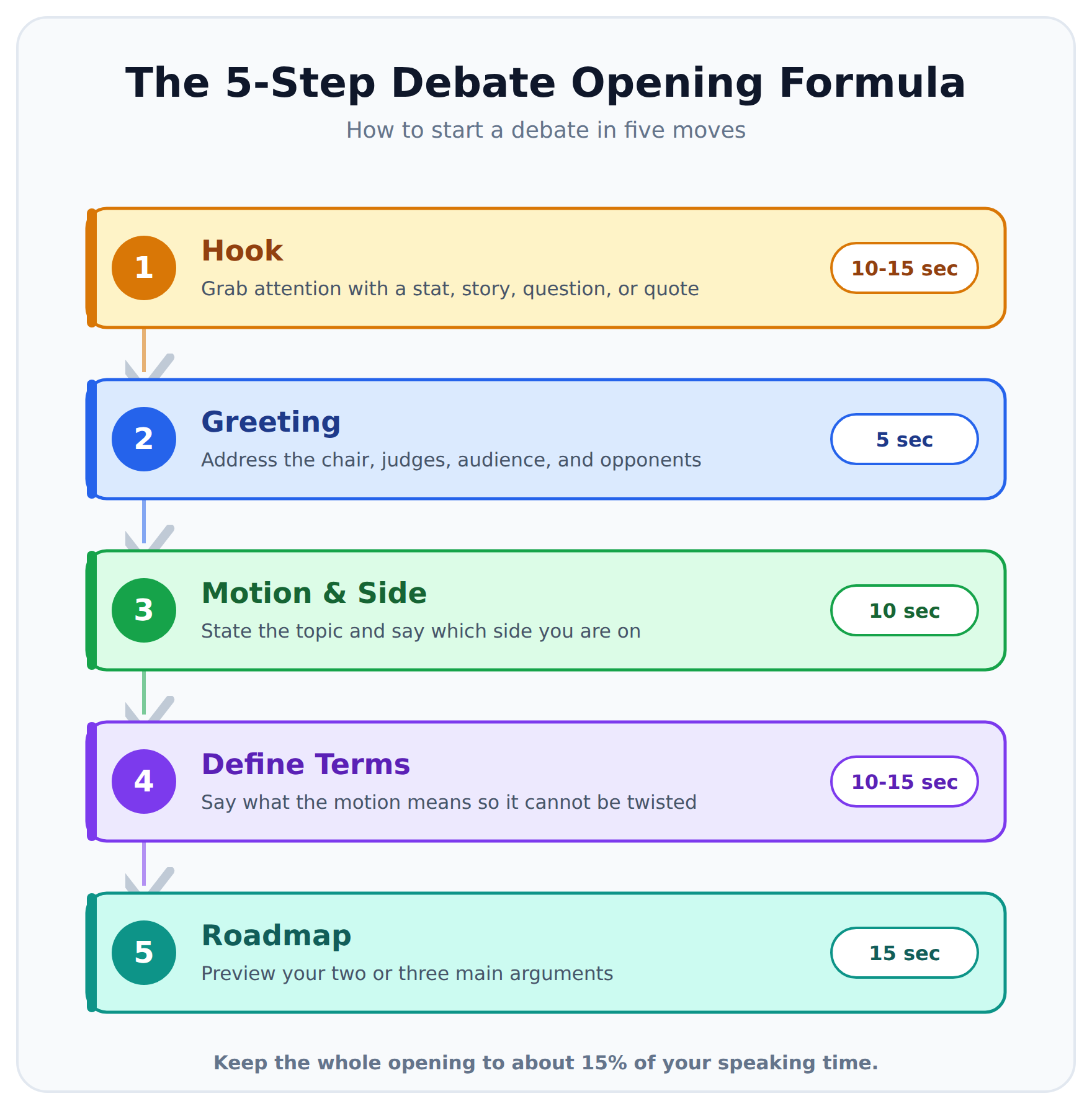
Follow the five steps in order and keep the whole opening to about 15 percent of your speaking time.
4 Types of Hooks to Start a Debate (With Examples)
The hook is the highest-leverage sentence in your whole speech. Pick one type and make it tight.
Hook Type | Why it works | Example |
|---|---|---|
Statistic | Instant credibility and surprise | "One in three teenagers reports symptoms of anxiety linked to social media." |
Scenario / story | Pulls the audience into a moment | "Imagine you are sixteen, and the app that connects you to your friends is quietly rating your worth." |
Rhetorical question | Makes the audience take a side in their heads | "How many of you have checked a screen in the last hour without even deciding to?" |
Quote | Borrows authority and sounds polished | "Nelson Mandela said education is the most powerful weapon to change the world. So why are we debating whether to weaken it?" |
Two rules for hooks: keep it under 15 seconds, and make it clearly connect to your motion. A clever line that has nothing to do with the topic wastes your best moment.
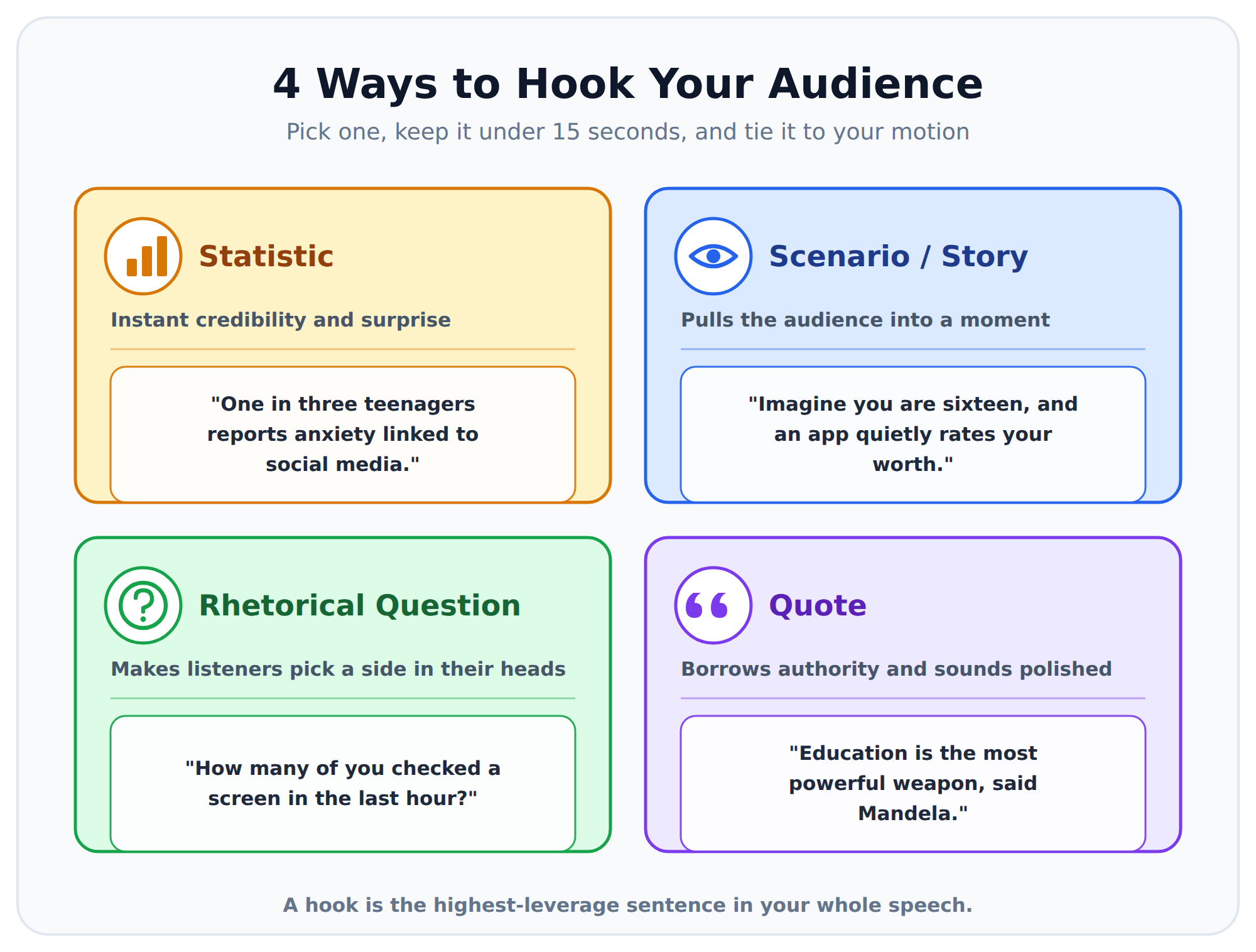
Pick one hook type, keep it under 15 seconds, and tie it straight to your motion.
Weak Opening vs Strong Opening
The difference is almost always structure and specificity.
Element | Weak Opening | Strong Opening |
|---|---|---|
First line | "Hello, today I'm going to talk about phones." | "Ninety percent of us checked a phone in the last hour." |
Greeting | Skipped or mumbled | Clear and confident, addressed to the chair and judges |
Position | Vague ("phones are kind of bad") | Explicit ("we stand firmly for the motion") |
Definitions | None | Key terms defined up front |
Roadmap | None | "I will prove this in three ways…" |
Result | Judges are unsure where you stand | Judges can follow and score every point |
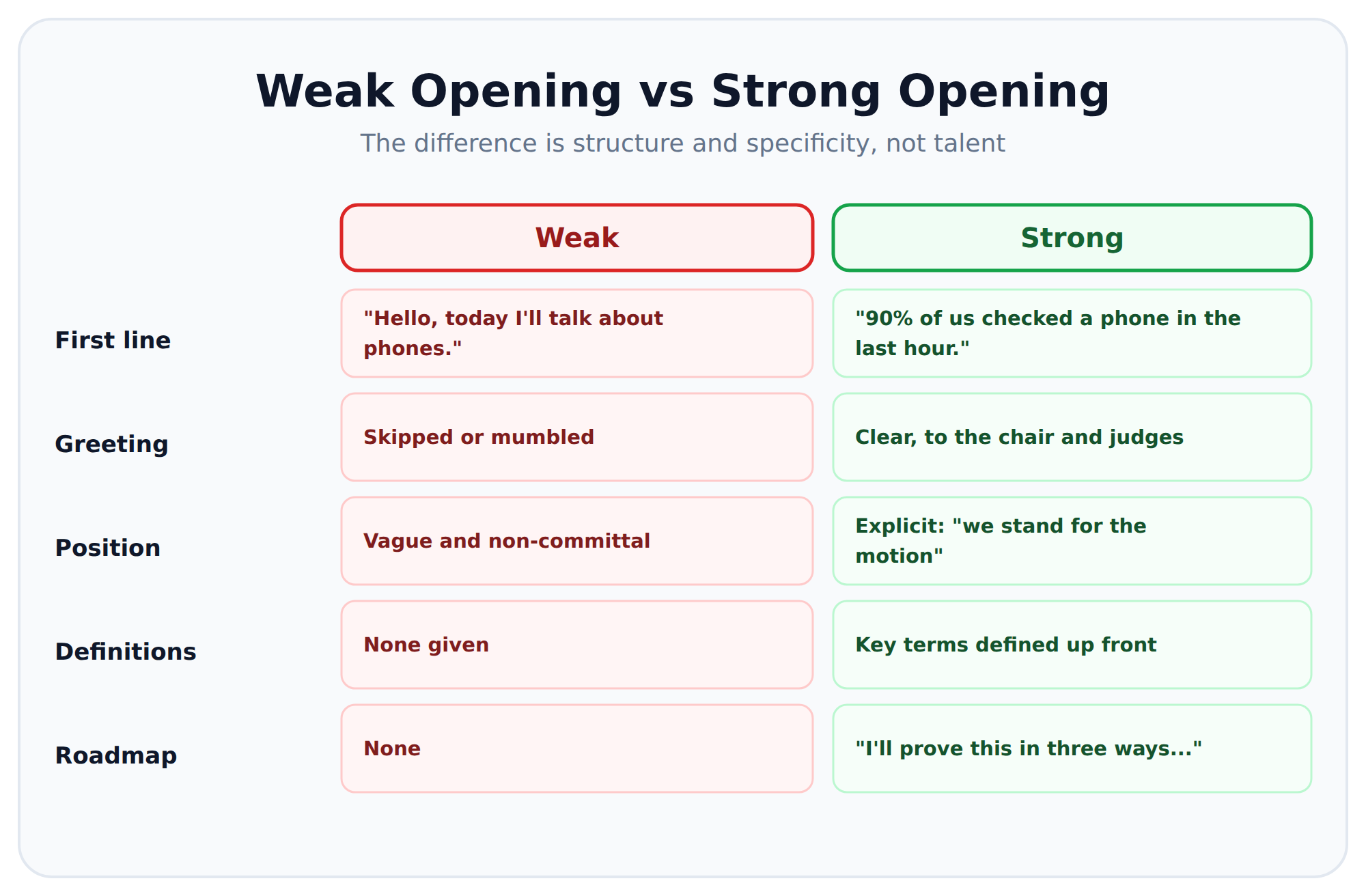
The difference is almost always structure and specificity, not talent.
Sentence Starters for Debate (Copy-and-Use Bank)
Keep this list beside you while you prepare, grouped by function so you can grab the right phrase fast. For openings that work beyond debate too, see our full list of sentence starters.
To open your speech
"Today, I stand firmly in favor of the motion that…"
"Our team strongly opposes the idea that…"
"The question before us today is simple:…"
To introduce your first point
"My first argument is that…"
"Let me begin with the most important point:…"
"The first reason we support this motion is…"
To add evidence
"According to a study by…"
"The evidence clearly shows that…"
"Consider the following example:…"
To disagree or rebut
"I respectfully disagree with my opponent because…"
"While that may sound reasonable, it overlooks the fact that…"
"Even if we accepted their point, which we do not, it still fails because…"
To conclude
"For all these reasons, we strongly urge you to support the motion."
"In summary, the evidence leaves us with one conclusion:…"
"Remember: this debate comes down to one thing…"
A Full Sample Debate Opening Speech (90 Seconds)
Most guides give you fragments. Here is a complete opening you can read aloud, timed to about 90 seconds. Motion: This house believes that social media does more harm than good. Side: Proposition.
"How many of you have checked a screen in the last hour, without even deciding to?
Good morning, respected Chairperson, honorable judges, worthy opponents, and members of the audience. My name is Ayesha, and I am the first speaker for the proposition.
Today's motion is that social media does more harm than good, and our team stands firmly in favor of it. By 'social media,' we mean platforms built to maximize the time we spend on them, such as Instagram, TikTok, and X. By 'more harm than good,' we mean the overall balance of effects on mental health, attention, and truth.
We will prove our case in three ways. First, social media is engineered to be addictive, and that addiction damages young people's mental health. Second, it rewards outrage and misinformation over accurate information. Third, it replaces deep, real-world relationships with shallow, measured ones.
My second speaker will handle the economic and free-speech arguments the opposition is about to raise. But make no mistake: even the people who built these platforms limit their own children's use of them. That should tell us everything. I now hand over to argue our first point."
Notice the structure: hook, greeting and self-introduction, motion and side, definitions, roadmap, a line of pre-emptive rebuttal, and a clean handover. That is a complete, judge-friendly opening.
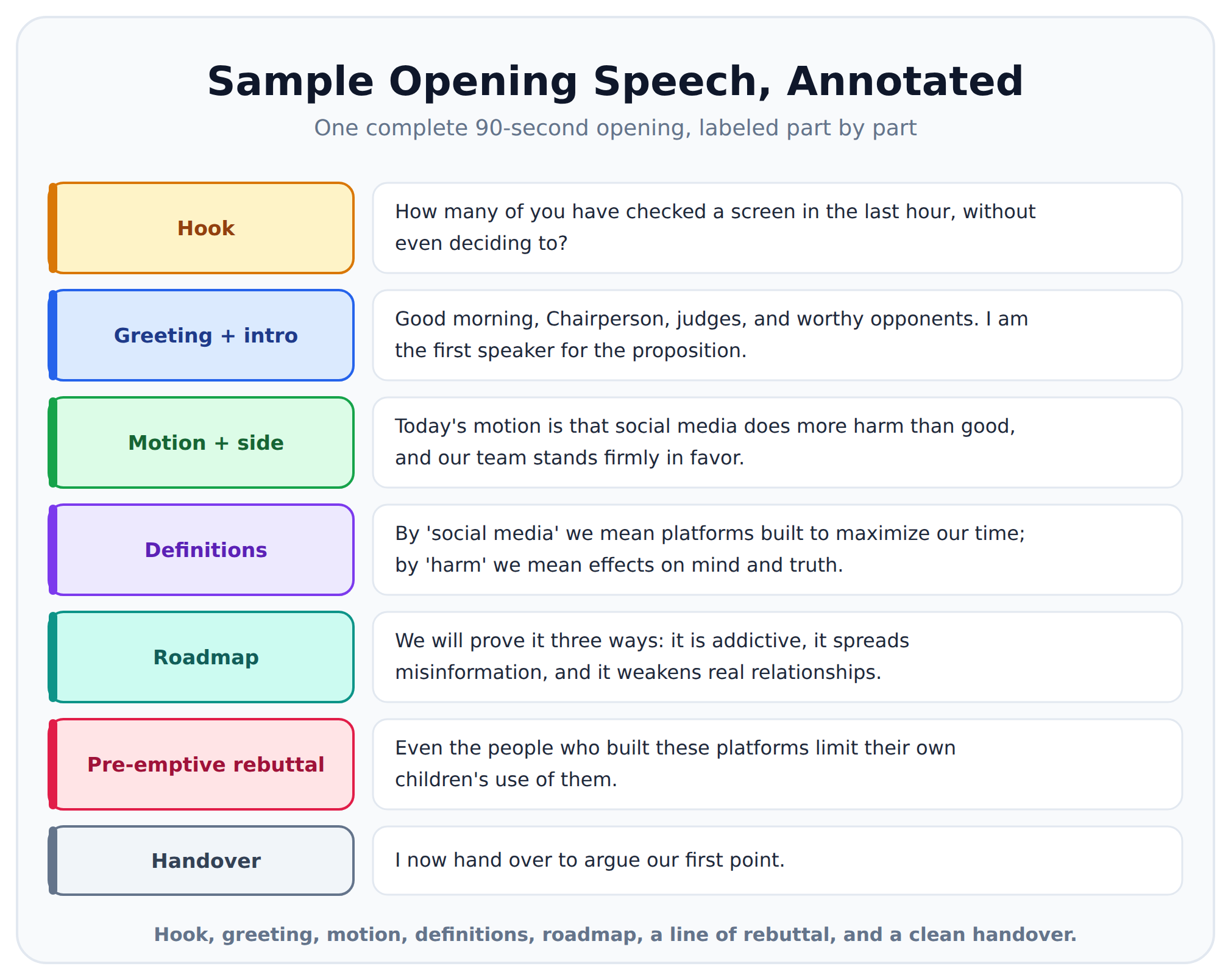
One complete opening: hook, greeting, motion, definitions, roadmap, a line of rebuttal, and a clean handover.
Opening Lines by Speaker Role
Debates are team events. The first speaker opens the case, but every role has its own job. Match your opening to your slot.
Role | Main job in the opening | Sample opening line |
|---|---|---|
First Proposition | Define the motion, set up the case, preview points | "We stand for this motion, and I will define exactly what it means before we begin." |
First Opposition | Accept or challenge the definition, state the clash | "We accept our opponents' definition, but we reject their conclusion, and here is why." |
Second speakers | Rebut, then extend with new arguments | "Before I add our next argument, let me dismantle the case you just heard." |
Third speaker / Whip | Rebut and summarize the key clashes, no new arguments | "This debate comes down to two questions, and we win both." |
Understand the Debate Format Before You Start
Your opening changes slightly depending on the format. The most common ones:
Format | Structure | Best for |
|---|---|---|
British Parliamentary | 4 teams, 8 speakers, government vs opposition | University and international tournaments |
World Schools (WSDC) | 2 teams of 3, mix of prepared and impromptu | School competitions worldwide |
Lincoln-Douglas | 1 vs 1, values-based | US high school |
Policy (CX) | 2 vs 2, evidence-heavy | US high school and college |
Classroom / school | 2 teams, simplified rules | Beginners and assignments |
In every one of these, the opening formula in this guide still applies. Only the timing and the number of speakers change.
Roles, Timing, and Room Setup
A standard three-speaker school debate looks like this:
Chairperson: introduces the motion and the speakers and keeps order.
Timekeeper: signals time with bells or cards (one bell to start, one near the end, two at time).
Adjudicator (judge): scores each speaker and decides the winner.
Speakers: alternate sides, Proposition then Opposition, first through third.
Typical school timing is three to five minutes per speaker. Keep your introduction to roughly the first 15 percent of that, then move into arguments.
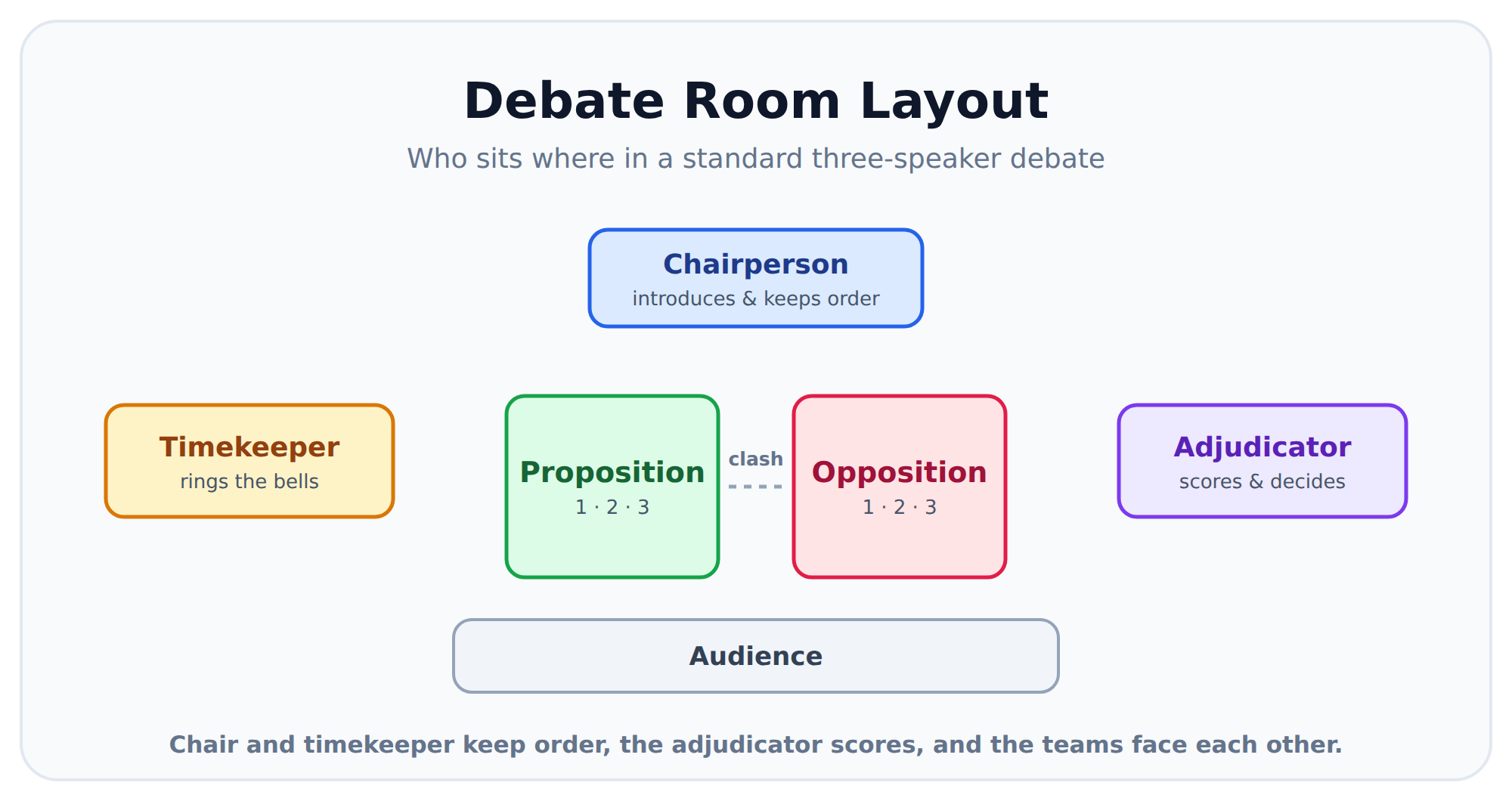
A standard three-speaker debate: chair and timekeeper keep order, the adjudicator scores, teams face each other.
How to Build the Argument After Your Opening?
Your opening promises points. Deliver them with a simple, judge-proof structure called Claim, Evidence, Impact.
Claim: state the argument in one sentence. "Social media harms teen mental health."
Evidence: back it with a fact, study, or example. "A 2023 study in JAMA Psychiatry linked heavy use to higher rates of depression."
Impact: explain why it matters and tie it back to the motion. "If the tool making our children anxious is optional, we should treat it that way."
Use this three-part shape for every main point and your case will feel airtight. To make each point persuasive, balance the three classic appeals of logos, ethos, and pathos: sound logic, credible evidence, and a touch of emotion.
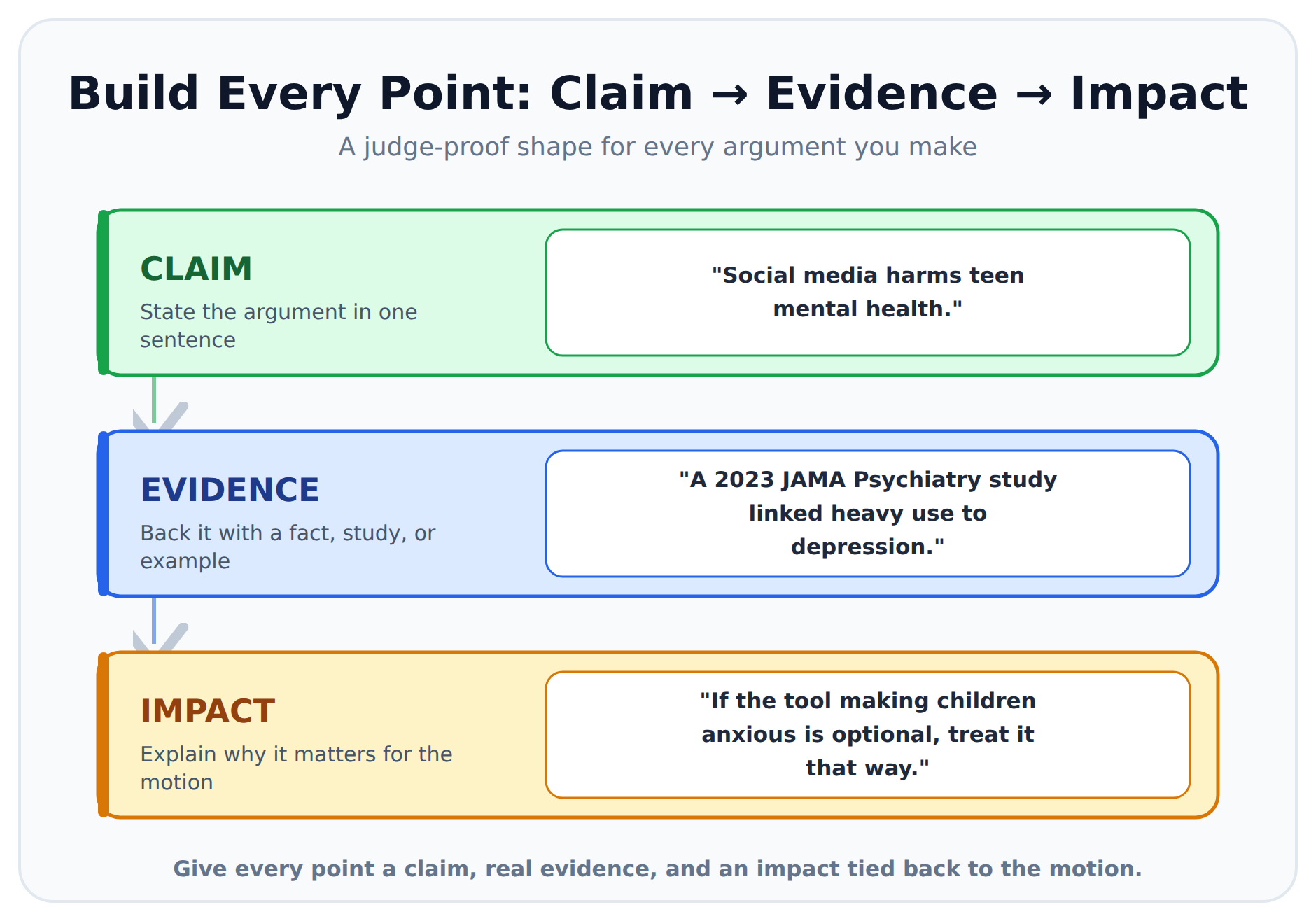
Give every argument a claim, real evidence, and an impact tied back to the motion.
How to Handle Rebuttal From the Start?
Even in your opening, you can plant the seeds of rebuttal. The strongest move is the "even if" concession:
"Even if we agreed that social media connects people, which we partly do, that connection does not outweigh the harm to their mental health."
This shows the judges you have anticipated the other side. When your turn to rebut fully arrives, name their argument, explain why it is weak (wrong facts, wrong logic, or low importance), and replace it with your own.
Debate Etiquette and Points of Information
Good manners win judges. A few conventions:
Address the chair, never the opponents directly, when speaking.
Stay calm and respectful even under attack. Aggression reads as weakness.
To offer a Point of Information, stand and say "Point of information" or "On that point." The speaker may accept or decline.
If you hold the floor, accept one or two POIs to look confident, but keep control of your time.
Thank the chair before you sit down.
How Debates Are Judged (What the First Minute Should Score)?
Judges usually score on three things. A strong opening scores on all three at once.
Criterion | What it means | How your opening earns it |
|---|---|---|
Matter | The content and logic of your case | A clear motion, fair definitions, a preview of real arguments |
Manner | Delivery, tone, and body language | A confident hook and greeting, eye contact, steady pace |
Method | Structure and use of time | A signposted roadmap the judge can follow |
In many school formats the rough weighting is content around 50 percent, delivery around 30 percent, and structure around 20 percent. Your opening is the first place a judge sees all three.
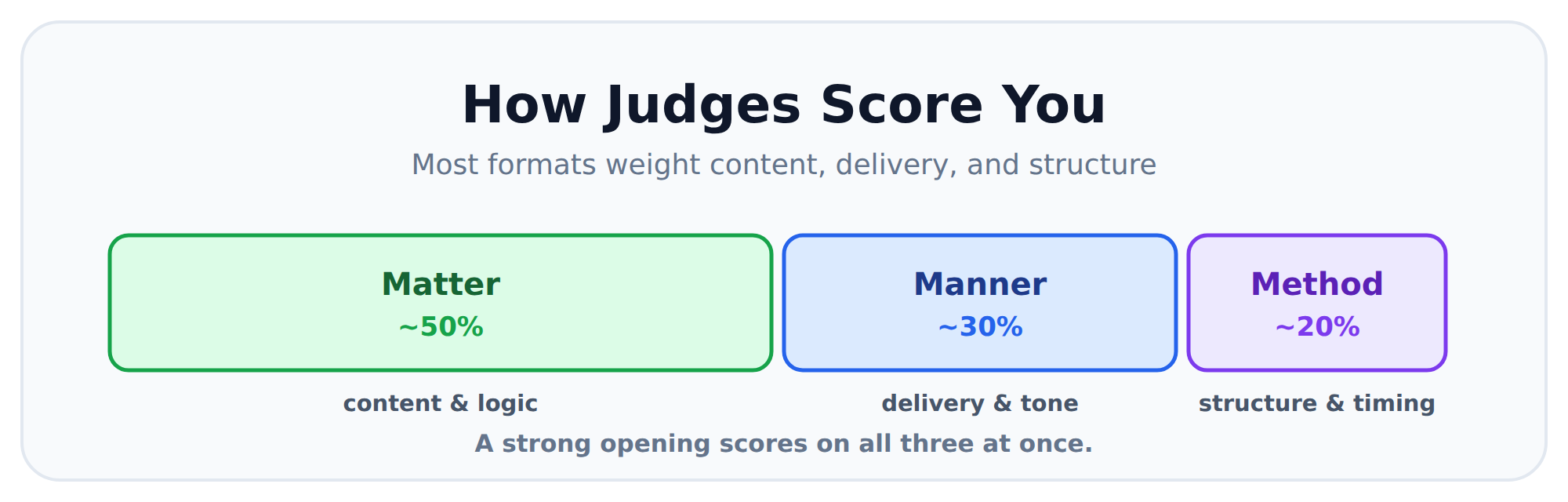
Most formats weight content around 50%, delivery around 30%, and structure around 20%.
Delivery: Voice, Body Language, and Nerves
Voice: vary your pace and volume. Pause after your hook to let it land. Do not rush.
Body language: stand tall, keep your hands visible, and make eye contact with the judges, not your notes.
Notes: use small cue cards with keywords, not full sentences. A red dot at the end of a key point reminds you to look up.
Nerves: slow your first breath, deliver your first line from memory, and remember that a little adrenaline sharpens you. Preparation is the real cure for fear.
Keep your wording tight, since short, clear simple sentences are easier to deliver under pressure and easier for judges to follow. The University of North Carolina Writing Center's guide to delivering a speech is a useful companion here.
Common Mistakes to Avoid
Opening with "Hello, my name is…" instead of a hook.
Forgetting to state your side clearly.
Skipping definitions and letting the other team frame the motion.
Cramming five arguments into a preview instead of two or three strong ones.
Reading the whole speech word for word from a page.
Running over time, which many judges penalize.
Being rude to opponents rather than tough on their arguments.
Practice Drills to Sharpen Your Opening
The 60-second drill: pick a random motion and deliver a full opening in 60 seconds, no notes.
Hook rotation: write four hooks (stat, story, question, quote) for the same motion and test which lands best.
Definition duel: practice defining a tricky motion in one fair sentence.
Mirror or camera: record your first minute and watch for eye contact and pace.
Impromptu topics: draw a topic from a hat and speak for one minute after 30 seconds of prep.
As you rehearse, paste your draft into a word counter and run it through a readability checker to keep the language simple and the length under control.
5 Sample Debate Openers by Topic
Quick, adaptable openings for common school motions.
1. Homework should be banned "Last night, millions of children cried over worksheets they will never remember. Respected judges, we stand for banning homework in primary schools."
2. School uniforms should be compulsory "Should a child's education depend on the brand of their shoes? We say no, and that is why we support compulsory uniforms."
3. Social media should be banned for under-16s "By the time you finish this sentence, a teenager somewhere has been shown content designed to keep them scrolling. We stand for protecting under-16s from it."
4. Junk food should be banned in schools "We are teaching children algebra on a fuel of sugar and salt. Today we argue that junk food has no place in a school canteen."
5. Exams should be abolished "We measure a fish by its ability to climb a tree, then call it a failure. Our team argues that exams do the same to students."
Your Pre-Debate Checklist
Run through this before you speak:
I have a hook ready for the first 15 seconds.
I know my greeting and can say it confidently.
I can state the motion and my side in one sentence.
I have fair definitions for the key terms.
I have a roadmap of two or three points.
Each point follows Claim, Evidence, Impact.
I have one pre-emptive rebuttal ready.
My opening fits inside 15 percent of my time.
My notes are keywords on cue cards, not full sentences.
I have practiced my first minute out loud.
Starting a debate well is a skill you can learn, not a talent you are born with. Lead with a hook, greet the room, state your side, define your terms, and lay out a roadmap. Keep it inside the first 15 percent of your time, then move into clear Claim, Evidence, Impact arguments.
Practice your first minute until you can say it without looking down, and you will walk to the podium calm instead of nervous. Master the opening, and the rest of the debate follows.
Frequently Asked Questions
How do you start a debate speech?
Start with a hook in the first 10 to 15 seconds, such as a statistic, a short scenario, a rhetorical question, or a quote. Then greet the chair and judges, state the motion and your side, define the key terms, and preview your two or three main points.
What is a good opening line for a debate?
A good opening line is short, surprising, and clearly tied to the motion. For example: "Ninety percent of us checked a phone in the last hour, so let's talk about whether social media is helping or harming us."
How do you introduce yourself in a debate?
Give your greeting first, then your name and role: "Good morning, honorable judges. My name is Sara, and I am the first speaker for the proposition." Keep it brief so you can move into your hook and argument.
How long should a debate opening be?
Your introduction should take about 10 to 15 percent of your total speaking time. In a three-minute speech, that is roughly 20 to 30 seconds before you move into your first argument. A speaking time calculator tells you how long your words will take to say out loud.
What are the five steps to start a debate?
Hook, formal greeting, statement of the motion and your side, definition of key terms, and a roadmap of your main points.
How do you start a debate as the first speaker?
As first speaker, you define the motion, set out your team's overall case, and preview the points your side will prove. You lay the foundation the rest of your team builds on.
How do you begin a rebuttal?
Name the argument you are answering, explain why it fails (wrong facts, weak logic, or low importance), and replace it with your own point. A useful opener is "While that may sound reasonable, it overlooks the fact that…".
What should you not do when starting a debate?
Do not open with "Hello, my name is," do not hide your position, do not skip the definitions, and do not read your speech word for word. Judges reward clarity, confidence, and structure.
How do you start a debate for kids or beginners?
Keep it simple: a friendly greeting, one clear sentence about which side you are on, and two easy points. For example: "Good morning everyone. I think school should start later, and I have two reasons why."