How to Correctly Start a Debate Greeting: 7 Example Scripts
Learn the correct order to greet the chairperson, judges, and audience in a debate, plus 7 ready-made greeting scripts for school and competition.
The greeting is the very first thing the judges hear you say, and it sets the tone for your whole speech. A confident, correctly ordered greeting tells the room you are prepared and respectful before you make a single argument. A clumsy one, in the wrong order or rushed through, quietly costs you marks.
This guide shows you exactly how to start a debate greeting. You will find the correct order to address everyone in the room, seven sample greetings you can copy, formal and informal variations, and the common mistakes that lose easy points. The same structure works whether you are preparing for a class debate or a full competition.
How do you start a debate greeting?
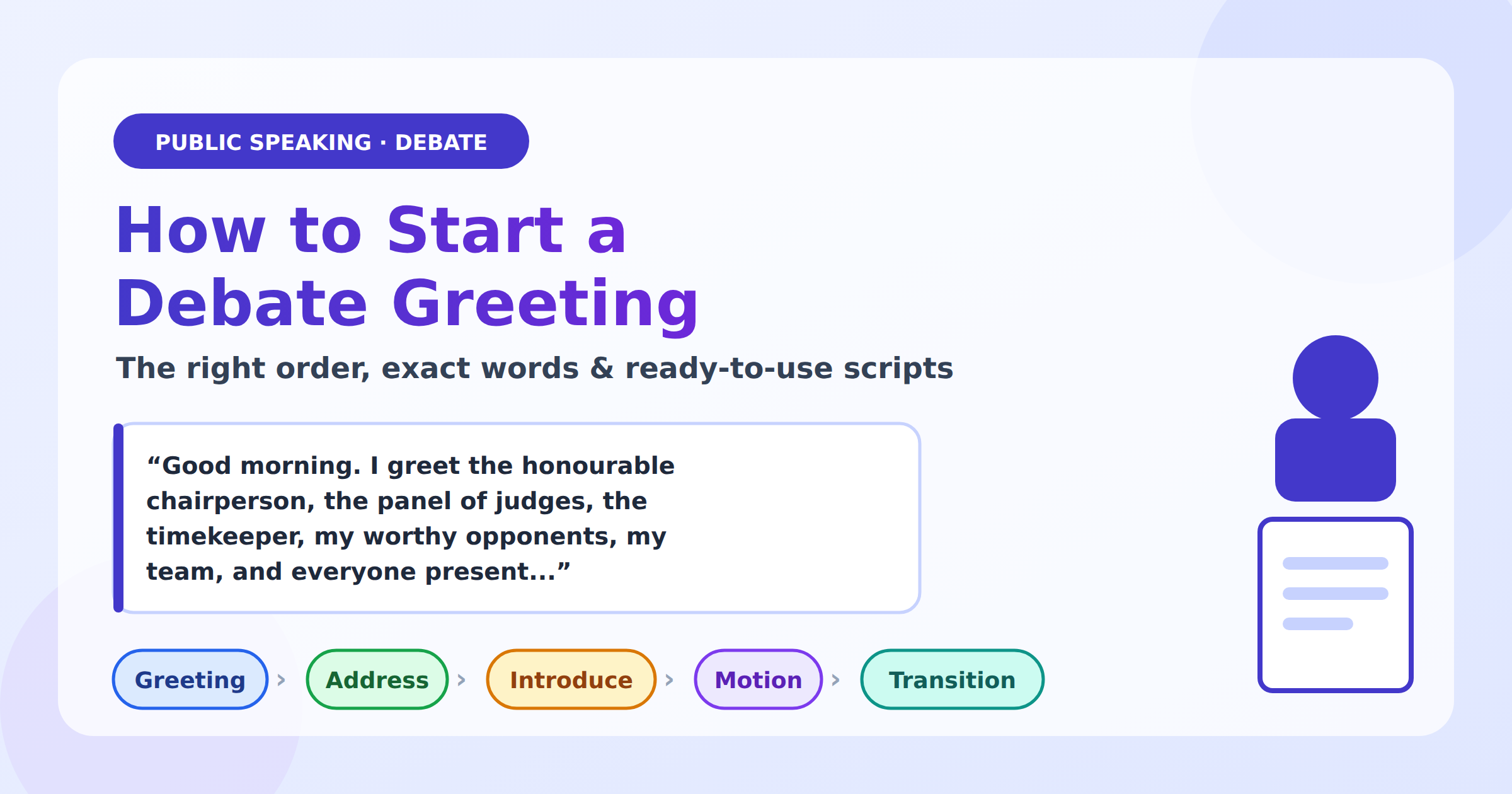
To start a debate greeting, greet the room and address each party in order of seniority: the chairperson or moderator, the panel of judges, the timekeeper, your opponents, your own team, and finally the audience. Then introduce yourself with your name and speaker position, state your side and the motion, and move into your speech. Example: "Good morning. I greet the honourable chairperson, the esteemed panel of judges, the accurate timekeeper, my worthy opponents, my able teammates, and everyone present. My name is Amara Nwosu, the first speaker for the proposition. Today's motion is that social media does more harm than good, and my team stands firmly in favour."
The greeting in one glance | What to say |
|---|---|
1. Greeting | "Good morning / afternoon / evening" |
2. Address each party (in order) | chairperson, judges, timekeeper, opponents, team, audience |
3. Introduce yourself | your name and speaker position |
4. State your side and the motion | for or against, plus the exact motion |
5. Transition | move into your hook or first argument |
Key Takeaways
Keep the greeting to about 30 to 60 seconds in a competition, and a little shorter in a casual class debate. It is not the place to rush or ramble.
Match the wording to the setting: fuller and more formal for a competition, shorter for a class debate.
In parliamentary formats like British Parliamentary and World Schools, skip the ceremonial greeting entirely. One line is the professional standard there.
Second and third speakers keep the greeting much shorter and get to their rebuttal quickly.
You can add your own confident style, but keep the standard structure underneath.
What is a debate greeting?
A debate greeting is the short, formal opening in which a speaker acknowledges everyone present before beginning their argument. It usually contains a courteous greeting, an acknowledgment of each group in the room, a short self-introduction, and a clear statement of your side and the motion.
Why bother getting it right? Debating is a formal event, and addressing the judges and officials properly shows you understand its conventions. There are also marks at stake: most judging sheets reward "manner" and structure, so a clean greeting scores points before you have argued anything. And there is a quieter benefit. A greeting you have rehearsed gives you a calm, controlled first thirty seconds, which settles your nerves for the rest of the speech.
The correct order of address in a debate
This is where most students slip. You address people from the most senior role down to the audience. The standard order:
Order | Who | How to address them |
|---|---|---|
1 | Chairperson / Moderator | "respected Chairperson," "Madam Chairlady," "Mr. Chairman," "the Moderator" |
2 | Panel of judges | "the honourable panel of judges," "esteemed adjudicators," "respected jury" |
3 | Timekeeper | "the accurate timekeeper," "our precise timekeeper" |
4 | Opposing team | "my worthy opponents," "the opposing team," "honourable opponents" |
5 | Your own team | "my able teammates," "my co-debaters," "my fellow proposition" |
6 | Audience and guests | "distinguished ladies and gentlemen," "invited guests, teachers, and fellow students" |
The logic is simple: acknowledge authority first (the people running and scoring the debate), then the other competitors, then everyone watching. If your debate has no separate chairperson, start with the panel of judges. If there is no timekeeper, simply skip that line.
One common variation: many school debates in Nigeria and across West Africa greet the accurate timekeeper before the panel of judges ("the Chairman, the accurate timekeeper, the panel of judges..."). Both orders are accepted, so follow whichever one your school or competition uses. You will see this school-style order in the secondary school examples further down.
The 5-part debate greeting formula
Follow these five steps in order and your greeting will be correct every time.
Step 1: open with a greeting
Choose the greeting that matches the time of day (see the table below). Keep it warm and clear.
Step 2: address each party in order
Run through the room from the chairperson down to the audience, using the order above. You do not have to name every group if the setting is casual, but in a competition you should.
Step 3: introduce yourself
State your name and your speaker position: for example, "the first speaker for the proposition." Judges write this down for their records, so never skip it.
Step 4: state your side and the motion
Say the motion exactly as it is written, then make your side unmistakable: "My team stands firmly in favour," or "We strongly oppose this motion."
Step 5: transition into your speech
End the greeting with a clean handover into your hook or first argument, so there is no awkward pause. For example: "and I will now present our first argument."
Time-of-day greeting variations
Always match the greeting to the actual time of the debate. Getting this wrong is a small but noticeable slip.
Time of debate | Use |
|---|---|
Before noon | "Good morning" |
Noon to about 5 p.m. | "Good afternoon" |
After about 5 p.m. | "Good evening" |
Any time / safe option | "Good day" or "Greetings to you all" |
Formal vs informal greetings
The wording changes with the setting. Use the fuller version for competitions and the shorter one for a normal class debate.
Element | Formal (competition) | Informal (class debate) |
|---|---|---|
Greeting | "Good morning, distinguished chairperson..." | "Good morning, everyone." |
Order of address | Full, all six groups named | Judges and classmates, kept short |
Titles | "honourable," "esteemed," "distinguished" | "respected," or none |
Self-introduction | Name plus exact speaker position | Name and side |
Motion | Stated word for word | Stated simply |
Length | 45 to 60 seconds | 15 to 30 seconds |
One important exception: parliamentary formats
In British Parliamentary and World Schools debating, judges expect you to get to your argument fast, and a long ceremonial greeting can actually cost you. In those formats the professional standard is a single line ("Madam Speaker, members of the House") followed immediately by your case. The full order of address taught in this guide belongs in school, inter-house, and traditional competition settings, where judges expect it and reward it. When in doubt, watch the speaker before you or ask the organisers.
Debate greeting examples you can copy
Swap your own name, side, and motion into any of these. Each one is a complete greeting you can read aloud exactly as written. Example 1 is the safest all-purpose model; if you only memorise one, make it that one.
1. First speaker, proposition (neutral / international)
"Good morning. I greet the honourable chairperson, the esteemed panel of judges, the accurate timekeeper, my worthy opponents, my able teammates, and everyone present. My name is Daniel Okafor, and I am the first speaker for the proposition. Today's motion is that social media does more harm than good. My team stands firmly in favour, and I will now present our first argument."
2. First speaker, opposition
"Good afternoon, respected judges, precise timekeeper, worthy opponents, and members of the audience. My name is Aisha Bello, the first speaker for the opposition. While the proposition supports the motion that social media does more harm than good, my team firmly disagrees, and I will show you exactly why."
3. Secondary school style (widely used in Nigeria and West Africa)
"Good day to the Chairman, the accurate timekeeper, the honourable panel of judges, my co-debaters, and the distinguished ladies and gentlemen present here today. My name is Chukwuemeka Obi, speaker number one for the proposition. The topic of today's debate is that examinations should be abolished in secondary schools. I stand to support the motion."
Note the phrasing "Good day to the Chairman." In many schools you will hear speakers drop the "to" and say "Good day the Chairman." Both are accepted in that tradition, so use whichever version your school uses and stay consistent within your own speech.
4. Second speaker (shorter greeting)
"Good morning once again, honourable judges and everyone present. My name is Maria Santos, the second speaker for the proposition. Before I add our next argument, I will respond to the points raised by the opposition."
5. Formal competition (parliamentary / World Schools)
"Madam Speaker, honourable judges, and members of the House, my name is James Carter, first proposition. We stand to propose the motion that this house would ban single-use plastics, and I will begin with our first substantive point."
6. Short and simple (younger students or a quick class debate)
"Good morning, everyone. My name is Priya Sharma. I am for the motion that homework should be banned in primary schools, and here are my three reasons."
7. Evening or formal event
"Good evening, distinguished chairperson, esteemed judges, worthy opponents, and honoured guests. I am Leo Martins, first speaker for the affirmative, and tonight we stand in support of the motion that school uniforms should be compulsory."
For fuller first, second, and third speaker models, the debating association Debating SA publishes free example speeches.
Phrase bank: ways to address each group
Mix and match these to keep your greeting natural and confident.
Chairperson: respected Chairperson · Madam Chairlady · Mr. Chairman · the Moderator. When you don't know the chairperson's title or gender, "respected Chairperson" is always safe.
Judges: honourable panel of judges · esteemed adjudicators · respected jury · distinguished judges
Timekeeper: the accurate timekeeper · our precise timekeeper · the diligent timekeeper
Opponents: my worthy opponents · the opposing team · honourable opponents · my able challengers
Your team: my able teammates · my co-debaters · my fellow proposition (or opposition)
Audience: distinguished ladies and gentlemen · fellow students · members of the audience · invited guests, teachers, and the student body
How to transition from the greeting into your speech?
Never let the greeting trail off into silence. Land one of these transitions and move straight into your hook or argument:
"...and I will now present our first argument."
"With that, let me begin."
"Allow me to open with a simple question."
"Let me start with a fact that may surprise you."
"Now, let me state our case."
For even more openers you can adapt to a debate, see this list of sentence starters.
Greetings for second and third speakers, and online debates
The first speaker carries the full ceremonial greeting. Everyone after them keeps it brief. The second speaker gives a shortened version, like Example 4 above: "Good morning once again, honourable judges and everyone present," then their name and position, then straight into rebuttal.
The third speaker can be briefer still. "Honourable judges, once again" is enough, because their job is rebuttal and summary, and every second spent on ceremony is a second lost.
In an online debate the same order applies, but compress it: "Good morning, honourable judges, worthy opponents, and everyone joining us today." Look directly into the camera as you say it, exactly as you would make eye contact with the judges in a room.
Common debate greeting mistakes to avoid
Greeting the audience before the judges. This is the classic error. Authority first, audience last.
Rushing. Nerves make students race through the greeting, and every judge has watched a first speaker sprint through it in eight seconds flat. Slow down; this is the calm part.
Filler words. "Ehhm, so, like, basically" before or during the greeting lowers your credibility right away.
Fumbling the motion or your side. Memorise the exact wording of the motion, because misquoting it looks careless, and make sure the room knows within seconds whether you are for or against.
Forgetting your speaker position. Judges need "first speaker for the proposition" for their scoresheet.
Letting it run long. Over 60 seconds and you are eating into your own argument time.
Tired clichés. A flat "Good evening, ladies and gentlemen" with nothing else wastes your opening. Add the full address and your position.
Delivery: how to say the greeting well
Pace: speak slowly and clearly, and pause for a beat after the greeting before your name. Nobody ever lost a debate by pausing one second too long.
Eye contact: look at the judges as you address them, not at your notes.
Posture: stand tall, shoulders back, hands calm. Toastmasters' guide to gestures and body language is worth ten minutes if you tend to fidget.
Volume: project to the back of the room from the first word.
Length: aim for 30 to 60 seconds total. A speaking time calculator tells you exactly how long your greeting takes to say out loud.
Clarity: keep the wording tight. Simple sentences are easier to deliver under pressure and easier for judges to follow.
Practice: rehearse the greeting until you can deliver it from memory, so you walk up calm instead of nervous.
Debate greeting for secondary school students
School debates, especially in Nigeria and across West Africa, use the fuller ceremonial style shown in Example 3 above. Beyond the wording, a few school-specific rules apply.
If you are representing a school or house, name it right after your own name: "My name is Ngozi Eze of Government College Umuahia, speaker number one for the proposition." If a principal, guest of honour, or panel of teachers is present, greet them immediately after the chairperson. And in inter-house debates where your classmates are judging, keep the titles. "Honourable panel of judges" applies whether the judge is a teacher or a fellow student.
Finally, confirm your school's preferred order beforehand. Many schools greet the timekeeper before the judges, and using your school's convention will always score better than a "correct" order the judges aren't expecting.
Your debate greeting checklist
Run through this before you speak:
I chose the correct greeting for the time of day.
I address the chairperson, judges, and timekeeper before the audience.
I state my full name.
I state my speaker position (first, second, or third).
I say which side I am on.
I state the motion exactly as written.
I end with a clean transition into my speech.
My greeting fits inside 30 to 60 seconds.
I have practised it out loud until I can say it from memory.
A strong debate greeting is short, correctly ordered, and confident. Greet the room by the time of day, acknowledge the chairperson, judges, and timekeeper before the audience, introduce yourself with your name and speaker position, state your side and the exact motion, and move smoothly into your first point.
Pick one of the sample greetings above, swap in your details, and practise it out loud until it feels natural. Before you rehearse, paste your greeting into a word counter: around 70 to 130 words is usually enough to keep it inside the 30 to 60 second target. If you are planning the rest of your speech as well, this guide to how many words are in a speech shows typical word counts for one to ten minutes of speaking time. Master those first thirty seconds and you will walk to the podium calm and ready to win the room.
Frequently Asked Questions
How do you start a debate greeting?
Start with a greeting that fits the time of day, then work down the room by seniority, officials first and audience last, before giving your name, speaker position, side, and the exact motion. The whole opening should take under a minute and end with a line that launches your first argument.
What is the correct order of greeting in a debate?
Work from the top of the room down: the person chairing the debate comes first, followed by those scoring it (the judges) and timing it, then your rivals, then your teammates, and only then the people watching. A simple way to remember it: officials, competitors, spectators.
How long should a debate greeting be?
About 30 to 60 seconds. Long enough to acknowledge everyone and state the motion, short enough to leave time for your arguments.
How do you start a debate greeting in secondary school?
School greetings follow the same structure but are more ceremonial: a "Good day to..." salutation, the full list of officials (many schools place the timekeeper before the judges), your name and school or house, your speaker number, the topic word for word, and a clear "I stand to support (or oppose) the motion." Example 3 above is a complete model you can copy.
What is a good greeting for a debate competition?
Use the full formal version: "Good morning, distinguished chairperson, esteemed panel of judges, accurate timekeeper, worthy opponents, and honoured guests. My name is James Carter, first speaker for the proposition, and we stand to propose the motion that this house would ban single-use plastics."
Can I personalise my debate greeting?
Yes. Deliver it with your own confidence and natural style, but keep the standard structure and order of address underneath. Personality belongs in the delivery, not in a rearranged order.
Does the second speaker greet again?
Yes, but briefly. The second speaker gives a shorter greeting, such as "Good morning once again, honourable judges and everyone present," then moves quickly into rebuttal and their new argument. The third speaker is briefer still; "Honourable judges, once again" is enough before summarising the clash.
What should you say right after the greeting?
State your name and speaker position, then your side and the exact motion, and finish with a transition line that leads straight into your hook or first argument, so there is no awkward pause.
What is a formal way to address the judges in a debate?
Use respectful titles such as "the honourable panel of judges," "esteemed adjudicators," or "distinguished judges." Address them early, right after the chairperson or moderator.
What are the most common debate greeting mistakes?
The two that cost the most marks are getting the order wrong (audience before judges) and misquoting the motion. Close behind: racing through the words, opening with filler like "ehm, so," skipping your speaker position, and letting the greeting run past a minute.