How Many Words Are in the Japanese Language? (2026)
Japanese has ~500,000 dictionary words, but a native knows ~40,000 and you need far fewer. Get the real, sourced answer and the number that fits your goal.
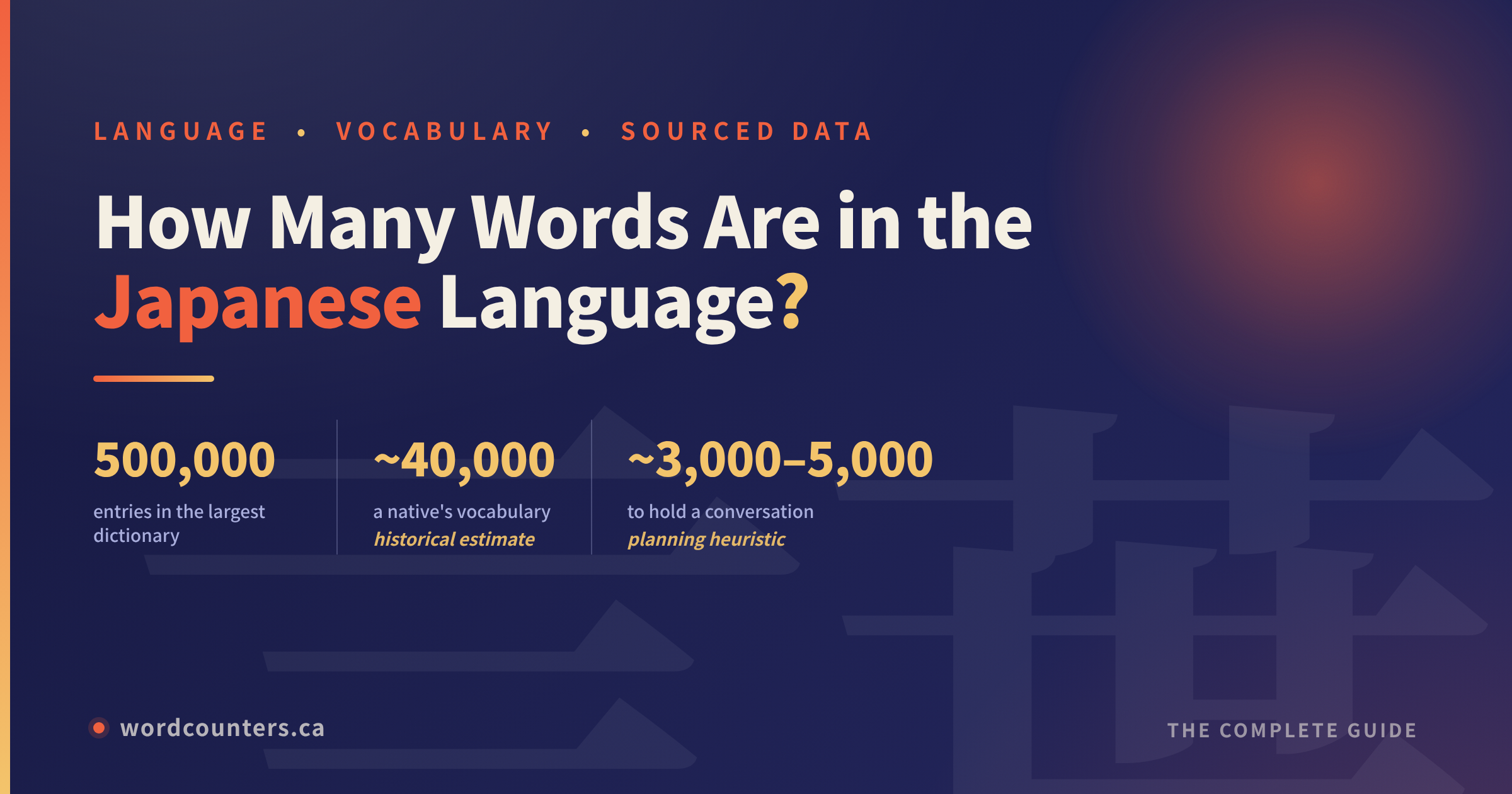
The largest general historical Japanese dictionary ever published, the Nihon Kokugo Daijiten, records about 500,000 entries and roughly one million citations [1]. Several major general print dictionaries record around 250,000 entries [2]. But a fluent adult only actively uses a fraction of that, and a learner needs far fewer still. The honest answer is that "how many words are in Japanese" is really four different questions wearing one coat, and the number you want depends on which one you're actually asking.
This guide untangles all four, with figures traced to dictionary publishers, government lists, and vocabulary research (see the numbered References at the end), and with estimates clearly flagged as estimates. By the end you'll have a defensible number for your situation, whether you're a linguist settling a debate, a learner planning your study, or just curious.
Key Takeaways
There is no single measurable word total for Japanese, because dictionaries, corpora, speakers, and tokenizers count different units.
The recorded lexicon runs to about 500,000 entries and a million citations in the largest historical dictionary [1], and around 250,000 in several major general print dictionaries [2].
A native adult knows on the order of tens of thousands of words; a dated estimate (Hayashi, 1971) suggests roughly 40,000 receptive, but no modern population average is established [16].
Learner requirements depend on the corpus and the coverage you want [6]. There is no official JLPT vocabulary count [11] and no universal number for "fluency"; the targets in this article are author planning heuristics.
Kanji are characters, not words. The current counts are 2,136 jōyō kanji [9], 1,026 kyōiku kanji [17], and 864 additional jinmeiyō kanji (as of June 2026) [10].
Japanese vs. English word counts can't be meaningfully compared, and the "English has a million words" claim is not accepted by lexicographers [13].
The smart question isn't "how many words exist" but "how many high-frequency words cover my specific goal." That's the number that changes your progress as a learner; the half-million in the dictionary never will.
Whatever brought you here, whether a debate to settle or a language to learn, you now have the numbers, the caveats behind them, and the framework to know which one you actually need.
The Four Numbers
The question you're really asking | The honest number | Source confidence |
|---|---|---|
How many words are recorded in Japanese? | ~500,000 entries in the largest historical dictionary; ~250,000 in a standard large dictionary [1][2] | High |
How many words does a native adult know? | Tens of thousands; a dated estimate (Hayashi, 1971) suggests ~40,000 receptive [16] | Low |
How many words do I need to function? | Roughly 3,000-5,000 supports everyday conversation (an author planning heuristic, not a proven threshold) | Estimate only |
How many words are in this text I'm holding? | Depends entirely on the text, and on how you count (see below) | It's a counting-method question, not a language question |
If you take one idea away, make it this: there is no single "true" word count for any language, Japanese included. Anyone who gives you one clean number without asking "for what purpose?" is oversimplifying. The rest of this article shows you why, and gives you the most defensible number for each purpose.
Why There's No Single Number (The Four Questions Framework)
Most articles online quote one figure (50,000, or 200,000, or half a million) and move on. They contradict each other because they're quietly answering different questions and rarely telling you which. Here's the framework that dissolves the confusion.
Question 1: The Recorded Lexicon. How many distinct words have been written down and defined by lexicographers? This is a dictionary-counting question. Answer: hundreds of thousands, depending on which dictionary and how you count (see the dictionary table below).
Question 2: The Mental Lexicon. How many words live in the head of a native speaker? This is a cognitive-science question, measured by vocabulary tests. Answer: tens of thousands, and it varies by person, age, education, and the test used.
Question 3: The Functional Threshold. How many words does a learner need to reach a specific goal, whether that's ordering lunch, watching anime, reading a newspaper, or passing the JLPT? This is a pedagogy question, answered with frequency and coverage data. Answer: usually a few thousand for basic goals, because a small set of common words does a lot of the work.
Question 4: The Token Count. How many words are in a particular passage of text? This is what a word counter tool measures, and it's why "count words in Japanese" pulls up character-counter apps. Answer: whatever the tool says, though what counts as a word is genuinely contested in Japanese (more on that shortly).
Many of the conflicting numbers online come from answering different questions; others are simply outdated or wrong. Working out which question a figure is answering is the first step to judging whether it is even right.
Question 1: How Many Words Are Recorded in Japanese Dictionaries?
If "how many words exist" means "how many have been catalogued," the answer lives in Japan's major dictionaries. Here are the figures, with publishers and editions.
Dictionary (Japanese) | Recorded entries / items | Publisher | Latest edition |
|---|---|---|---|
Nihon Kokugo Daijiten (日本国語大辞典) | ~500,000 entries + ~1,000,000 citations | Shōgakukan | 2nd ed., 13 main vols + supplement, 2000-2002 (3rd ed. in preparation) |
Daijirin (大辞林) | ~251,000 recorded terms | Sanseidō | 4th ed., 2019 |
Daijisen (大辞泉) | ~250,000 (2012 print); ~303,000 in the current digital edition | Shōgakukan | 2nd ed., 2012; digital ongoing |
Kōjien (広辞苑) | ~250,000 entries/items | Iwanami Shoten | 7th ed., 2018 |
Nihongo Daijiten (日本語大辞典) | ~200,000 Japanese entries (plus a separate English component) | Kōdansha | 2nd ed., 1995 |
Sanseidō Kokugo Jiten (三省堂国語辞典) | ~84,000 | Sanseidō | 8th ed., 2021 |
Shin Meikai Kokugo Jiten (新明解国語辞典) | ~79,000 | Sanseidō | 8th ed., 2020 |
Iwanami Kokugo Jiten (岩波国語辞典) | ~67,000 headwords | Iwanami Shoten | 8th ed., 2019 |
Sources: publisher listings and dictionary product documentation [1][2]. These are publisher-advertised entry or item counts, and what each publisher counts as an "entry" differs, so the totals are not strictly comparable.
The headline figure: ~500,000 entries
The Nihon Kokugo Daijiten (NKD) is a historical dictionary compiled over roughly four decades by thousands of specialists. Its second edition runs to 13 main volumes plus a supplementary volume and contains about 500,000 entries alongside roughly one million illustrative quotations, and a third edition is now in preparation. Its publisher, Shōgakukan, describes it as Japan's largest general Japanese dictionary, and it is often compared with the Oxford English Dictionary [1].
So "Japanese has about 500,000 words" is defensible, but it needs an asterisk. That half-million includes archaic Old and Middle Japanese, regional dialect, obsolete terms, and specialized vocabulary spanning more than a thousand years. It is emphatically not 500,000 words that a modern person could use or would recognize. It's the entire attic of the language, not the rooms people live in.
The caveat that explains the other numbers: "entries" vs. "items"
Here's a distinction almost no competing article mentions, and it explains why dictionary numbers seem to jump around. Japanese publishers usually advertise a count of 項目 (kōmoku, "items" or "recorded terms") rather than a count of distinct main headwords. Items can include sub-entries, set phrases, idioms, and compound sub-headwords. So an advertised total is not the same as "distinct modern words a person uses," and the figures are not strictly comparable from one dictionary to the next [2]. When you see "about 250,000," read it as the publisher's item count, not a census of the living vocabulary.
The Word-Counting Problem: What Even Is a "Word" in Japanese?
Before we go further, we have to confront the question that quietly breaks every count: what counts as one word in Japanese? English speakers rarely think about this because English politely puts spaces between words. Ordinary Japanese prose normally does not use spaces between words. Sentences run together with no gaps, so where one word ends and the next begins is a decision, not a given.
This isn't pedantry. It's the reason professional translators, linguists, and dictionary editors all arrive at different totals: Japanese grammar can slice words more finely than English intuition expects.
Take a sentence a Japanese schoolchild learns to parse: 花が咲いた (hana ga saita, "the flower bloomed"). Under traditional Japanese school grammar (gakkō bunpō), this is analyzed as four words (単語):
花 (hana): noun, "flower"
が (ga): subject-marking particle
咲い (sai): the verb 咲く (saku, "to bloom") in its continuative form, with the sound change that occurs before た
た (ta): auxiliary verb marking past tense
That auxiliary is the surprise: in this tradition, た is classed as an auxiliary verb (助動詞), a word in its own right rather than a mere suffix. But this is only one convention. A modern software tokenizer or a lexeme-based analysis might treat 咲いた as a single past-tense verb instead. Where you draw the boundary is a choice, and it changes the total.
It goes deeper. Serious vocabulary studies rarely count raw surface forms; they group inflected forms into lemmas or word families, and different corpora annotate words in different ways. NINJAL's Balanced Corpus of Contemporary Written Japanese (BCCWJ), for example, tags both "short-unit words" and "long-unit words" (along with other morphological information) rather than producing a single word-family count. Whether you count every inflected form, every dictionary lemma, or grouped word families can change your total substantially.
The practical upshot: Japanese translation is frequently priced per character rather than per word, which sidesteps the word-boundary problem, though rates and conventions vary between providers. When even the professionals avoid counting "words," you know the question is genuinely slippery.
So when you see any word count for Japanese, ask: Is this counting headwords? Lemmas? Word families? Every inflected form? Under whose segmentation rules? The honest answer to "how many words" always comes with a "counted how?"
The Four Vocabulary Layers: Where Japanese Words Come From
Japanese vocabulary is conventionally divided into four broad etymological categories (語種, goshu). Knowing them helps make sense of what fills the dictionary and where everyday words come from. Some individual words are debated, but the categories are:
和語 (wago): native Japanese words like やま (mountain), たべる (to eat), and うつくしい (beautiful).
漢語 (kango): Sino-Japanese words built from Chinese-derived roots like 火山 (volcano), 経済 (economy), and 学校 (school).
外来語 (gairaigo): loanwords from other languages, mostly modern English, like コンピューター (computer), テレビ (TV), and コーヒー (coffee).
混種語 (konshugo): hybrids that mix categories, like 消しゴム (keshi-gomu, "eraser," native + Dutch loan) and 歯ブラシ (toothbrush, native + English).
How the layers break down
Analysis of the Shinsen Kokugo Jiten (73,181 general entries) gives this dictionary composition:
Layer | Share of dictionary entries |
|---|---|
漢語 Kango (Sino-Japanese) | 49.1% |
和語 Wago (native) | 33.8% |
外来語 Gairaigo (loanwords) | 8.8% |
混種語 Konshugo (hybrid) | 8.4% |
Source: word-origin analysis of the Shinsen Kokugo Jiten, 8th ed. (2002) [3].
The largest single share of the dictionary is Sino-Japanese (kango), at roughly half of entries. These Chinese-derived roots recombine into a very large number of compounds, which is a big part of why the kango layer is so large.
The nuance experts know: dictionary counts are not usage counts
Here's a subtlety that separates a real understanding from a surface one. What dominates the dictionary is not necessarily what dominates running text. Surveys by Japan's National Language Research Institute (the body now known as NINJAL) measured word origins two ways: by type (distinct words) and by token (how often words actually appear in running text). A survey of 90 magazines published in 1956 found:
Layer | By type (distinct words) | By token (running text) |
|---|---|---|
和語 Wago (native) | 36.7% | 53.9% |
漢語 Kango (Sino-Japanese) | 47.5% | 41.3% |
外来語 Gairaigo (loanwords) | 9.8% | 2.9% |
混種語 Konshugo (hybrid) | 6.0% | 1.9% |
Source: National Language Research Institute, survey of 90 magazines published in 1956 (research reports published later) [4].
Read across the two columns and a pattern appears. Sino-Japanese words are many but individually rarer (lots of distinct terms, each used less often). Native words are fewer but constant, because the highest-frequency verbs, particles, and everyday words are native wago. That's why native words make up only ~37% of distinct words but ~54% of actual running text.
Loanwords are often said to have risen over time. A later NINJAL magazine analysis (1994) put gairaigo at about 35.8% of distinct word types, against 9.8% in the 1956 study [4]. Read this trend as suggestive rather than exact: the researchers cautioned that the two surveys used different sampling conditions, that the later data included advertising copy, and that the segmentation rules can inflate the count of distinct loanword types.
Question 2: How Many Words Does a Native Speaker Know?
This is the question most people think they're asking, and it's where you should be most skeptical of confident numbers, including in this article.
Japanese native-speaker vocabulary is normally estimated in the tens of thousands. Reviewing older Japanese studies, Hayashi (1971) inferred that adult receptive vocabulary was approximately 40,000 words [16]. That underlying research is dated and methodologically limited, so treat it as a historical estimate rather than a modern population average. Any precise count here is an estimate, not a measurement.
For comparison, the English side has been measured more rigorously. A large 2016 study (Brysbaert, Stevens, Mandera & Keuleers) found the average 20-year-old American knows about 42,000 lemmas (dictionary base words), with most people falling in a central range of roughly 27,000-52,000, and vocabulary continuing to grow by several thousand more words into middle age [5].
So the fairest statement is: educated adult native speakers of both Japanese and English know somewhere in the tens of thousands of words. The two figures are not measured the same way, so you cannot reliably say one language's speakers know "more" than the other's.
Receptive vs. productive: the distinction that resolves most arguments
Whenever two people argue about vocabulary size, they're usually conflating two different things:
理解語彙 (receptive/passive vocabulary): words you recognize when you read or hear them. This is the big number.
使用語彙 (productive/active vocabulary): words you actually produce when speaking or writing. This is much smaller.
Your receptive vocabulary is generally larger than your productive one. So "how many words do you know" has two right answers depending on which you mean. A single quoted figure without this distinction is nearly meaningless.
Question 3: How Many Words Do You Actually Need?
This is what most learners are really asking when they type "how many words are in Japanese." Not "how big is the dictionary" but "how big a mountain am I climbing?" The reassuring part: for practical goals, far less than the dictionary suggests, because word frequency is steeply lopsided. The important caution: the specific targets below are author planning heuristics, not scientifically verified thresholds.
The frequency principle (why the first few thousand words matter most)
In any language, a small number of common words accounts for a large share of what you encounter. Learn the highest-frequency words first and your comprehension climbs quickly at the start, then levels off. This is the single most useful idea in vocabulary planning. Run any passage through a word frequency counter or a unique word counter and you'll see the same lopsided pattern in your own text: a handful of words repeat constantly while most appear only once or twice.
We can see it clearly with kanji. Across one large Japanese news dataset, the frequency curve is steep:
Most frequent kanji | Approx. share of kanji occurrences |
|---|---|
Top 100 | ~45% |
Top 300 | ~72% |
Top 1,000 | ~96% |
These percentages refer only to kanji-character occurrences in the project's 3,753-article Japanese Wikinews dataset; kana and punctuation are excluded [8].
The same general shape holds for words, but with an important Japanese-specific caveat below.
What coverage research actually shows?
You'll find tidy tables online claiming "the top 5,000 words cover 90% of Japanese." Be careful: the exact figures depend heavily on the corpus and on how words are counted.
Corpus-based Japanese coverage research (Matsushita, using the VDRJ and NINJAL corpora) gives a more cautious picture: reaching about 95% coverage of text takes on the order of 9,000-12,000 lemma-like words, and 98% coverage takes roughly 20,000-24,000, depending on the corpus [6]. These numbers cannot be converted directly into a universal fluency threshold; they describe text coverage, not the point at which someone becomes "fluent."
What is well established qualitatively (Satoshi Sato, 2014, using a NINJAL balanced corpus) is the direction: Japanese has a lower concentration of high-frequency words than English, so you generally need more distinct words in Japanese to reach the same percentage of text coverage [7]. In plain terms, Japanese vocabulary tends to be a slightly longer climb than English for equivalent comprehension.
Goal-based vocabulary targets (planning heuristics only)
Here's a practical map. Every figure here is an author planning heuristic informed by proficiency guidelines and second-language reading research, not a sourced threshold. Treat them as rough waypoints, not measurements.
Your goal | Rough word target (heuristic) | Notes |
|---|---|---|
Survival / tourist basics | ~1,000-2,000 | Enough to order, ask directions, handle transactions |
Everyday conversation | ~3,000-5,000 | Covers common daily topics; slang and specialised terms add to the load |
Comfortable anime / TV | ~3,000-6,000+ | Casual and slang-heavy speech can be harder than the number suggests |
Reading a newspaper | Many thousands, plus the 2,136 jōyō kanji | Newspapers generally use the jōyō list as a baseline, with exceptions and supplied readings |
JLPT N1 / advanced | ~10,000 (community estimate) | The top of the JLPT ladder; see the caveat below |
Reading novels / literature | Highest of all; no clean number | Non-standard kanji, archaic and stylistic vocabulary |
Novels sit at the top because literary vocabulary is vast and unpredictable. If you're curious how long the books themselves run rather than how many words you need to read them, our breakdown of how many words are in a novel covers typical counts by genre.
For context, second-language reading research (Nation and others) associates roughly 98% coverage of a text with comfortable independent reading, and around 95% coverage with following the gist with occasional lookups. As the coverage figures above show, hitting those coverage levels in Japanese takes many thousands of words, but "coverage" is not the same thing as "fluency."
JLPT vocabulary by level (unofficial)
The Japanese-Language Proficiency Test is the most common yardstick, so here are the commonly cited numbers, with a firm warning.
Level | Vocabulary (est.) | Kanji (est.) |
|---|---|---|
N5 | ~800 | ~100 |
N4 | ~1,500 | ~300 |
N3 | ~3,700 | ~650 |
N2 | ~6,000 | ~1,000 |
N1 | ~10,000 | ~2,000 |
These are community or legacy estimates, not official figures [11].
The warning learners deserve to hear: the JLPT organizers do not publish official vocabulary, kanji, or grammar lists for the current test [11]. Every per-level count you see online, including this one, is either a legacy figure from the pre-2010 test or a community estimate reverse-engineered from past exams. Use them as rough guideposts only. And note the official description of N1 is the ability to understand Japanese used in a variety of circumstances, not "native equivalence," so N1 should not be treated as equal to native reading ability [11].
Kanji vs. Words: The Confusion That Trips Up Almost Everyone
The most common mistake in this whole topic is treating kanji and words as the same thing. They are not, and conflating them produces bad conclusions like "Japanese only has 2,000 characters, so it's a small language." Let's clear it up.
The kanji counts (current as of July 2026):
常用漢字 (Jōyō kanji): 2,136, the government's list of characters for everyday use, set in 2010 [9]. The jōyō list is the government's guideline baseline for kanji used in general social life; knowing the characters alone does not guarantee reading comprehension.
教育漢字 (Kyōiku kanji): 1,026, the subset taught in elementary school, grades 1-6 [17].
人名用漢字 (Jinmeiyō kanji): 864, additional characters permitted in personal names. This figure was updated on June 26, 2026, when 勒 was added; jōyō plus jinmeiyō now gives 3,000 characters permitted for personal names [10].
About 50,000 characters are indexed by the largest kanji dictionary (the Dai Kan-Wa Jiten), a figure that includes many obsolete, variant, and Chinese-only characters almost no one uses [15].
Why kanji are not words:
A kanji is a building block, not a word. 山 (mountain) is a word by itself, but most vocabulary comes from combining kanji: 火山 (volcano), 山脈 (mountain range), 登山 (mountain climbing), 火山灰 (volcanic ash). Roughly 2,000 kanji generate tens of thousands of words.
One kanji can map to many words. The character 生 has many readings (including sei, shō, i-, u-, ha-, nama, ki), each tied to different words.
Many words use no kanji at all. Every katakana loanword (コーヒー), every hiragana grammatical word (particles, conjunctions), and the inflected tails of native verbs and adjectives exist outside the kanji count entirely.
So: the 2,136 jōyō kanji are the working core of a logographic writing system; "words" are the lexicon. They're different scales for different things. Learning your 2,136 jōyō kanji is a finite, achievable goal that unlocks tens of thousands of words, but it is not the same as "learning 2,136 words."
Question 4 & the Tool Intent: How to Count Words in a Japanese Text
Sometimes "how many words in Japanese" isn't about the language at all. It's someone with a document who needs a word count for pricing, subtitling, or an assignment. Because Japanese has no spaces, a naive word counter fails, and this trips people up constantly.
How to actually count a Japanese text:
For a linguistic word count, use a tokenizer and state its settings. Tools like MeCab, Sudachi, or Kuromoji (and the analyzers built into many CAT tools) split the continuous script into words using a dictionary. Different tokenizers use different dictionaries and segmentation modes, so they will give you different counts. Report which one you used.
For length estimates and translation work, Japanese text is often measured by characters rather than words. A character counter handles this reliably. There is no single industry rate: practices and prices vary widely between providers (one provider, for example, lists roughly ¥6,000 to ¥8,000 per 400 Japanese characters) [14]. Avoid any universal "characters ÷ N = words" shortcut; the ratio depends entirely on the text and the segmentation rules.
The meta-lesson is the same one from earlier: because "word" is a decision in Japanese, even software has to pick a convention. Two tools disagreeing doesn't mean one is broken; they're just using different definitions.
Japanese vs. English: An Honest Comparison
"Does Japanese have more words than English?" is one of the most-searched versions of this question. The satisfying answer is unsatisfying: the comparison isn't scientifically meaningful, and both languages land in the same broad range.
Here are the English anchors, with dates attached:
The Oxford English Dictionary describes itself as containing over 500,000 entries and 3.5 million quotations, spanning more than a thousand years of English [12]. Its June 2026 update added more than 900 new words, phrases, and senses (floordrobe, humblebrag, and life hack among them), a reminder that living lexicons keep changing [12]. That total is close to the Nihon Kokugo Daijiten's ~500,000 entries, and both are historical dictionaries spanning centuries.
You may also see an older, limited estimate of about 171,476 words "in current use" plus roughly 47,000 obsolete. That is an old figure, not the live OED entry count, so treat it as a historical estimate only [12].
And the claim to distrust: you may have read that "English has over 1,000,000 words." This traces to the Global Language Monitor, which declared English hit its millionth word ("Web 2.0") on June 10, 2009. That claim has been sharply criticized by linguists and is not accepted as a standard lexicographic count; one prominent critique on Language Log carried the word "hoax" in its title [13]. The method behind it, an opaque algorithm counting web hits and treating every spelling variant and blend as a new "word," is not accepted by lexicographers.
Why you can't really compare word counts across languages:
"Word" is defined differently in each. Lemma, word-form, word-family, sense, dictionary entry: each yields a wildly different total.
Morphology differs. Japanese compounds freely and inflects agglutinatively, so it can generate new forms almost without limit. English blends and derives differently. The counting rules that fit one language distort the other.
Historical vs. current. The half-million figures on both sides include centuries of dead vocabulary.
Dictionaries reflect editors' choices, not the language itself. Technical and scientific nomenclature (millions of chemical and species names) is usually excluded, according to each dictionary's editorial scope.
The intellectually honest bottom line: "Language A has more words than Language B" is not a claim that can be settled. Japanese and English both catalog on the order of hundreds of thousands of forms, and an educated adult in each knows tens of thousands. The size race is a mirage.
Myths & Dubious Claims to Retire
A quick fact-check box for the claims that spread fastest online:
"Japanese has 500,000 words." Misleading. That's the historical entry count of the largest dictionary, with ancient, dialectal, and technical terms across a millennium included. Not modern usable vocabulary.
"Learn 2,000 kanji and you know Japanese." Category error. Kanji are characters, not words. The 2,136 jōyō kanji unlock the writing system, not the lexicon.
"English has a million words." Not accepted by lexicographers (the Global Language Monitor claim).
"Japanese has more words than English" (or vice versa). Methodologically meaningless: the two languages count words on incompatible bases.
"You need X words to be fluent" as a hard fact. Fluency is undefined. Coverage research describes text coverage, not a fluency line.
Any exact JLPT per-level word count presented as "official." There is no official current JLPT vocabulary, kanji, or grammar list.
A Framework: The Vocabulary Iceberg
To hold all of this in your head, picture Japanese vocabulary as an iceberg. From the tip you use daily down to the frozen depths no one touches, the layers are:
Your active core: the words you actually produce in speech and writing every day. The visible tip.
Your passive knowledge: the much larger set of words you recognize when you read or hear them but rarely produce. Just below the waterline.
The functional language: enough to read newspapers, novels, and professional material.
The full modern dictionary: everything a contemporary reference catalogs, most of it specialized.
The historical record: the Nihon Kokugo Daijiten's complete archive, including centuries of archaic and dialectal terms. The dark base no single person ever "knows."
When someone asks "how many words are in Japanese," they're pointing at different depths of the same iceberg. A learner lives in the top layers. A lexicographer measures the bottom. Both are talking about "Japanese words," and both can be right, once you specify the depth.
Frequently Asked Questions
How many words are in the Japanese language in total?
The largest historical dictionary, the Nihon Kokugo Daijiten, records about 500,000 entries and roughly a million citations [1]. Several major general print dictionaries record around 250,000 entries [2]. There's no single official total, because what counts as an entry and which dictionary you use both change the answer.
How many words does the average Japanese person know?
Native-speaker vocabulary is normally estimated in the tens of thousands. Reviewing older Japanese studies, Hayashi (1971) inferred adult receptive vocabulary of roughly 40,000 words, but that research is dated and methodologically limited, so treat it as a historical estimate [16]. The comparable English figure is about 42,000 lemmas for a 20-year-old [5], but the two languages are not measured the same way, so they can't be directly compared.
How many words do I need to be fluent in Japanese?
There's no fixed number, and "fluent" is undefined. As a planning heuristic, roughly 3,000-5,000 words support everyday conversation, and advanced comprehension is often associated with the JLPT N1 range (about 10,000, a community estimate) [11]. Because frequent words do a lot of the work, you reach useful comprehension well before you approach a native's full vocabulary.
How many words do I need to watch anime or understand TV?
As a rough planning heuristic, around 3,000-6,000+ words, depending on genre. Casual and slang-heavy speech can be harder than the raw number suggests, while slice-of-life and children's shows are more forgiving.
How many words do I need to read a Japanese newspaper?
Newspapers generally use the 2,136 jōyō kanji as a baseline, with exceptions and supplied furigana readings for characters outside it [9]. Comfortable reading is usually estimated at many thousands of words, but there's no exact figure; it depends on the coverage you're aiming for [6].
Is Japanese vocabulary bigger than English?
Not in any way that can be proven. The OED describes itself as holding over 500,000 entries [12], and Japan's largest dictionary records about 500,000 entries [1], but the two count different units, so a genuine comparison isn't possible. Both languages catalog hundreds of thousands of forms.
How many kanji are there, and is that the same as words?
There are 2,136 jōyō (everyday-use) kanji [9], and about 50,000 characters are indexed by the largest kanji dictionary [15], but kanji are not words. They're building blocks: about 2,000 kanji combine to form tens of thousands of words. Many words also use no kanji at all.
Why do different sources give such different numbers?
Because they answer different questions (recorded lexicon vs. native knowledge vs. learner target vs. text length), count differently (entries vs. items vs. word families vs. inflected forms), and sometimes because a figure is simply outdated or wrong. Working out which question a number answers is the first step to judging it.
Do loanwords (katakana English) count as Japanese words?
Yes. Loanwords (gairaigo) are a fully established layer of the language and a growing share of everyday vocabulary; they made up 8.8% of entries in the cited 2002 Shinsen Kokugo Jiten analysis [3]. コーヒー (coffee) and テレビ (TV) are as "Japanese" as any native word.
How do you count words in a Japanese text that has no spaces?
For a linguistic word count, use a tokenizer (software like MeCab or Sudachi) and state its dictionary and segmentation mode, since different tokenizers give different counts. For length or translation estimates, Japanese text is often measured by characters rather than words, though practices and rates vary [14]. Avoid any fixed characters-to-words conversion ratio.
What's the fastest way to build Japanese vocabulary?
Learn words by frequency, the most common first, since a few thousand high-frequency words cover a large share of what you'll encounter. Pair a frequency-based approach with lots of reading and listening so the words appear in context rather than as isolated flashcards.
References:
[1] Nihon Kokugo Daijiten (日本国語大辞典), 2nd ed., Shōgakukan (2000-2002). Publisher information (third-edition project): https://www.shogakukan.co.jp/pr/nikkoku3/
[2] Major general dictionaries (full bibliographic entries; counts are publisher-advertised entry/item figures): Daijirin (大辞林), 4th ed., Sanseidō (2019); Kōjien (広辞苑), 7th ed., Iwanami Shoten (2018); Daijisen (大辞泉), 2nd ed., Shōgakukan (2012), and Digital Daijisen; Nihongo Daijiten (日本語大辞典), 2nd ed., Kōdansha (1995); Sanseidō Kokugo Jiten, 8th ed., Sanseidō (2021); Shin Meikai Kokugo Jiten, 8th ed., Sanseidō (2020); Iwanami Kokugo Jiten, 8th ed., Iwanami Shoten (2019).
[3] Shinsen Kokugo Jiten (新選国語辞典), 8th ed., ed. Kindaichi Kyōsuke et al., Shōgakukan (2002): word-origin (語種 goshu) breakdown of 73,181 general entries.
[4] National Language Research Institute (now NINJAL): vocabulary surveys of magazines (survey of 90 magazines published in 1956; 1994 magazine analysis). Comparison discussion, NINJAL/ANLP conference paper (2004): https://www.anlp.jp/proceedings/annual_meeting/2004/pdf_dir/P6-3.pdf
[5] Brysbaert, M., Stevens, M., Mandera, P., & Keuleers, E. (2016). "How Many Words Do We Know? Practical Estimates of Vocabulary Size Dependent on Word Definition, the Degree of Language Input and the Participant's Age." Frontiers in Psychology, 7:1116. https://www.frontiersin.org/journals/psychology/articles/10.3389/fpsyg.2016.01116/full
[6] Matsushita, T. Vocabulary Database for Reading Japanese (VDRJ) and corpus-based vocabulary/coverage research, Victoria University of Wellington research archive: https://researcharchive.vuw.ac.nz/xmlui/handle/10063/4476
[7] Sato, S. (2014). "Text Readability and Word Distribution in Japanese." LREC 2014: https://aclanthology.org/L14-1505/
[8] Kanji frequency dataset and methodology (Japanese Wikinews corpus, 3,753 articles; kana and punctuation excluded): https://scriptin.github.io/kanji-frequency/
[9] Jōyō kanji (常用漢字, 2010 list), Agency for Cultural Affairs (文化庁): https://www.bunka.go.jp/kokugo_nihongo/sisaku/joho/joho/kijun/naikaku/kanji/index.html
[10] Jinmeiyō kanji (人名用漢字): 864 characters following the addition of 勒, effective June 26, 2026. Regulation on kanji for personal names, e-Gov: https://laws.e-gov.go.jp/law/322M40000010094
[11] Japanese-Language Proficiency Test, official site: FAQ (the test publishes no official vocabulary, kanji, or grammar lists) at https://www.jlpt.jp/e/faq/ ; level summaries at https://www.jlpt.jp/e/about/levelsummary.html
[12] Oxford English Dictionary: Oxford University Press describes the dictionary as containing over 500,000 entries and 3.5 million quotations; June 2026 update (900+ new words/senses): https://corp.oup.com/news/oxford-english-dictionary-update-june-2026/
[13] Criticism of the Global Language Monitor "one-millionth word" claim, Language Log ("The million word hoax rolls along"): https://languagelog.ldc.upenn.edu/nll/?p=972
[14] Japanese translation pricing example (per-character rates), Japan Convention Services: https://www.convention.co.jp/en/activities/translation/fees/
[15] Morohashi Tetsuji, Dai Kan-Wa Jiten (大漢和辞典), Taishukan Shoten: indexes approximately 50,000 characters.
[16] Native-speaker vocabulary size (Japanese): Shirō Hayashi (林四郎), "語彙調査と基本語彙," National Language Research Institute Report 39 (1971), pp. 1-35, which inferred adult receptive vocabulary of approximately 40,000 words from older studies. Dated and methodologically limited; treat as a historical estimate rather than a modern population average. https://repository.ninjal.ac.jp/record/1020/files/kkrep_039_01.pdf
[17] Kyōiku kanji (教育漢字, 1,026 characters assigned by school grade), MEXT curriculum table: https://www.mext.go.jp/component/a_menu/education/micro_detail/__icsFiles/afieldfile/2019/11/22/1407073_02_1_2.pdf
Last updated: July 16, 2026. Many dictionary counts are publisher-advertised item counts whose definitions differ, and several vocabulary figures are estimates that depend on the test, corpus, or segmentation used; these are flagged as estimates in the text rather than presented as exact totals.