How Many Words Are in a Novella? (Full Length Guide)
Learn how many words are in a novella, how pages and genres affect length, and how to publish, structure, revise, and market shorter fiction successfully.
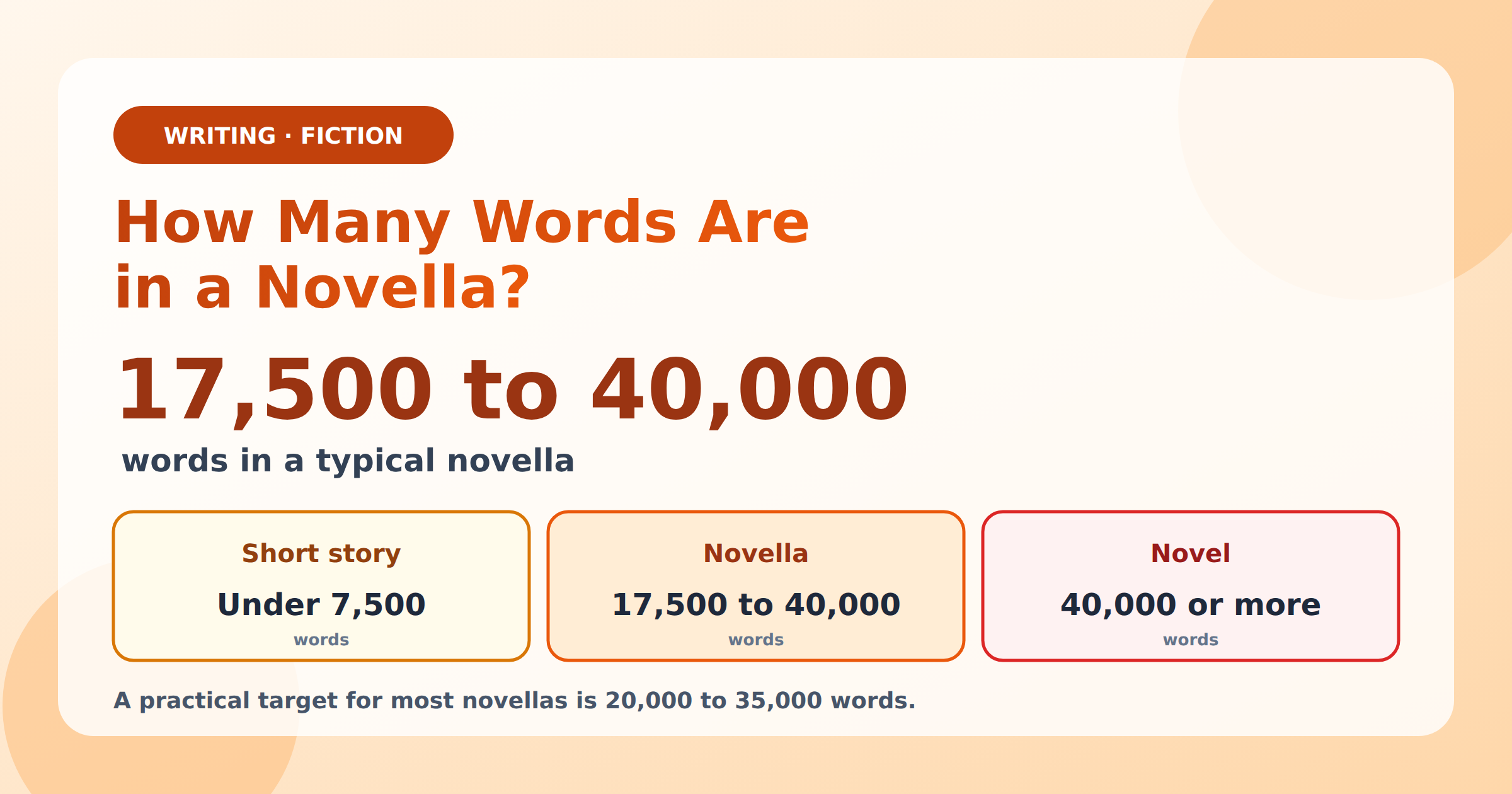
A novella usually contains 17,500 to 39,999 words under the widely used Nebula Awards classification. In everyday publishing you will also see broader ranges such as 15,000 to 40,000, 20,000 to 40,000, or even 20,000 to 50,000 words.
Why do the numbers differ? Because "novella" can describe three related but distinct things: an official award category, a submission category created by a publisher or contest, and a storytelling form positioned between a short story and a novel.
The safest general answer:
A novella is typically 17,500 to 40,000 words, with 20,000 to 35,000 words serving as a practical target for many writers.
This guide covers the official definition, page estimates, the differences between fiction formats, genre considerations, publishing options, story structure, revision strategy, and the questions writers ask most when a manuscript falls between a short story and a novel. For the longer end of the spectrum, see our companion guide on how many words are in a novel.
How many words are in a novella?
A novella generally contains 17,500 to fewer than 40,000 words. The Science Fiction and Fantasy Writers Association uses these categories for the Nebula Awards:
Fiction format | Word count |
|---|---|
Short story | Fewer than 7,500 words |
Novelette | 7,500 to fewer than 17,500 words |
Novella | 17,500 to fewer than 40,000 words |
Novel | 40,000 words or more |
These are formal award classifications for science fiction and fantasy, but they have become widely used reference points across fiction publishing. Individual publishers and contests define the form differently, so always follow the specific submission guidelines of the market you are targeting.
Novella length at a glance
Measurement | Practical answer |
|---|---|
Widely used official range | 17,500–39,999 words |
Simple rounded range | 20,000–40,000 words |
Common broader publishing usage | 15,000–50,000 words |
Practical drafting target | 20,000–35,000 words |
Estimated printed pages | About 60–160 pages |
Approximate reading time (250 wpm) | 70–160 minutes |
Typical structural scope | One main conflict, concentrated cast, limited subplots |
Page and reading-time figures reflect the core 17,500–40,000 range; works at the broader 50,000-word edge run proportionally longer (roughly 200 pages and 200 minutes).
Reedsy's 2026 guide uses 17,500–40,000 words. The Writer uses a broader range of roughly 20,000–50,000 words. Commercial usage is simply looser than the award classifications.
Key Takeaways
The most widely recognized novella range is 17,500–39,999 words.
A practical rounded target is 20,000–40,000 words.
Some publishers and guides accept works as short as 10,000 or as long as 50,000 words.
A novelette is normally shorter than 17,500 words; a work of 40,000 words or more is a novel under Nebula rules.
Page count is less reliable than word count.
A novella usually focuses on one main conflict and a concentrated cast, and may use chapters but requires no particular number.
Traditional Big Five publication is hard for an unknown novella writer; independent presses, contests, digital publishers, collections, and self-publishing offer other routes.
Never add filler simply to move a manuscript into another category. The guidelines of your chosen market override every general definition.
Why do novella word counts differ?
No single publishing authority controls how every fiction format is labeled. Different organizations use different definitions for different purposes.
Award classification
The Nebula Awards place novellas between 17,500 and fewer than 40,000 words. This is the clearest commonly referenced numerical definition.
Publisher classification
A publisher may define novella length according to its printing budget, editorial program, the genres it publishes, whether it releases print or digital books, how it prices shorter work, and the readers it serves.
Contest classification
Competitions set their own limits. The Clay Reynolds Novella Prize and The Malahat Review's Novella Prize illustrate how far the windows can diverge, so a 16,000-word manuscript might qualify for one novella competition while counting as a novelette under Nebula rules. Contest limits change from cycle to cycle, so always confirm the figure on the current call for entries.
Bookselling and marketing
Publishers sometimes market a shorter work as a "short novel" because the word novel is more familiar to general readers. That marketing choice does not necessarily change the underlying literary classification.
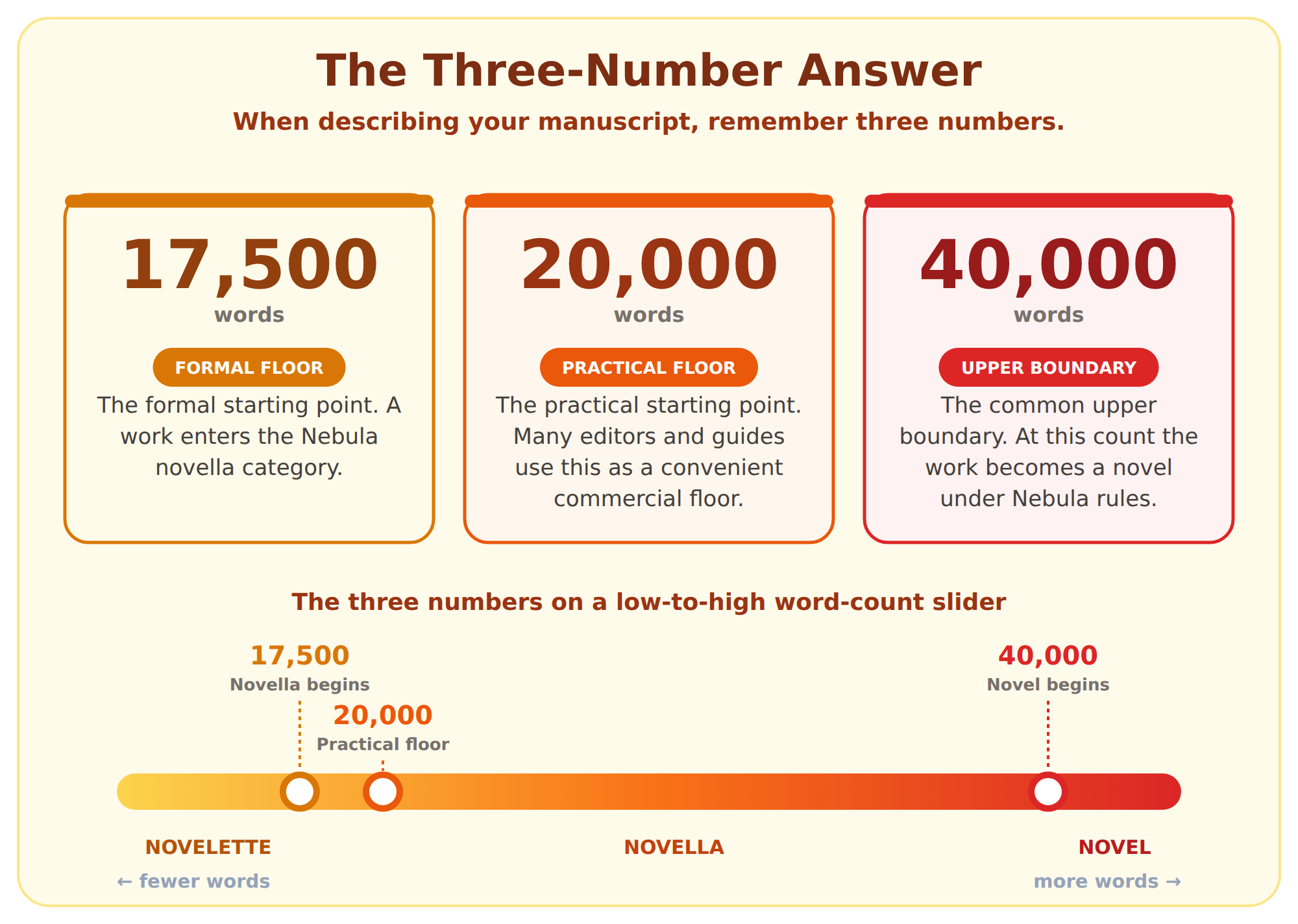
Use 17,500–39,999 for formal classification, 20,000–40,000 for simple reader guidance, and the exact publisher's limit when submitting.
Novella vs short story vs novelette vs novel
Format | Common word count | Typical scope |
|---|---|---|
Flash fiction | Fewer than 1,500 | One moment, image, decision, or reversal |
Short story | Up to 7,500 | One focused conflict with limited development |
Novelette | 7,500–17,499 | More developed than a short story but still compressed |
Novella | 17,500–39,999 | A complete central arc with room for depth |
Novel | 40,000+ | Wider scope, more development, greater structural flexibility |
The precise lower limit for a short story varies between magazines and competitions. The novella and novelette boundaries are clearest when award rules are being used.
What makes a novella different from a short story?
A novella is not merely a short story with extra description. It provides more room for character development, an extended chain of consequences, a deeper emotional arc, a more developed setting, several major scenes, and a fuller climax and resolution. A short story concentrates on one decisive moment; a novella shows how a conflict develops and transforms a character over a longer period.
What makes a novella different from a novel?
A novella usually has a narrower narrative design. A novel can comfortably carry several viewpoint characters, multiple major subplots, a large cast, numerous locations, a long timeline, extensive worldbuilding, and several major conflicts. A novella emphasizes concentration instead. Fiction Writers Review describes the form as commonly following one central character through a limited period and location while focusing on a single main action.
The SCOPE framework for a strong novella
Use the SCOPE framework to test whether your idea naturally fits novella length.
S: Single central conflict
The story should revolve around one dominant problem, question, mission, or transformation. For example: a woman must decide whether to reveal a family secret; a detective has one night to solve a disappearance; a stranded astronaut must repair one failing system; two former friends are forced to spend a weekend together. Secondary problems may appear, but they should feed the central conflict.
C: Concentrated cast
A novella can support several characters, but each should have a clear purpose. Ask whether the character affects the central conflict, whether they force a decision, whether two minor characters could be combined, and whether every named character truly needs a separate arc.
O: One dominant viewpoint
A single point of view is often the cleanest option. Two viewpoints can work when both are essential, but every new perspective requires its own setup, motivation, and development.
P: Pressurized time or place
A concentrated timeline or setting helps create unity: one evening, a weekend, a single journey, one building, an isolated town, or a short period before a deadline. A novella can cover years or several locations, but compression becomes harder.
E: Essential subplots only
A subplot should directly affect the protagonist's goal, the central relationship, the main decision, the climax, or the theme. Remove any subplot that could disappear without changing the ending.
How many pages are in a novella?
A novella is commonly estimated at about 60 to 160 printed pages, depending on layout. Using 250 to 300 words per page:
Word count | At 250 words/page | At 300 words/page |
|---|---|---|
15,000 | 60 pages | 50 pages |
17,500 | 70 pages | 58 pages |
20,000 | 80 pages | 67 pages |
25,000 | 100 pages | 83 pages |
30,000 | 120 pages | 100 pages |
35,000 | 140 pages | 117 pages |
40,000 | 160 pages | 133 pages |
50,000 | 200 pages | 167 pages |
Page count varies with trim size, font, font size, line spacing, margins, chapter openings, dialogue density, illustrations, and ebook settings. For that reason, writers, agents, contests, and publishers normally use word count rather than pages. To convert your own manuscript, a words-to-pages counter does it instantly.
Is a novella usually 90 to 120 pages?
Yes, many novellas fall between 90 and 120 pages. At 250 to 300 words per page, that represents roughly 22,500 to 30,000 words at 250 words per page, or 27,000 to 36,000 words at 300 words per page. Both estimates sit comfortably within common novella ranges. A 120-page book could still contain more or fewer words depending on formatting, so word count remains the more reliable measurement.
How long does it take to read a novella?
Reading speed varies, but at an illustrative 250 words per minute:
Novella length | Approximate reading time |
|---|---|
17,500 words | 70 minutes |
20,000 words | 80 minutes |
25,000 words | 100 minutes |
30,000 words | 2 hours |
35,000 words | 2 hours 20 minutes |
40,000 words | 2 hours 40 minutes |
Being readable in one or two sittings is often considered one of the form's defining pleasures. Fiction Writers Review highlights the novella's ability to create a concentrated experience whose overall structure stays present in the reader's mind. You can estimate your own manuscript's reading time in seconds.
Is [X] words a novella?
Is 10,000 words a novella?
Under Nebula rules, no. Ten thousand words is a novelette. However, some competitions and publishers use 10,000 words as their lower limit for a novella; The Malahat Review, for example, accepts 10,000–20,000 words in its novella contest. So the formal award classification is novelette, a possible contest classification is novella, and the correct submission decision is to follow the stated guidelines.
Is 15,000 words a novella?
It is below the Nebula threshold, so it is formally a novelette. Some publishers and contests still accept 15,000-word manuscripts as novellas, and contest floors in this range are common, so check the specific guidelines of your target market.
Is 17,000 words a novella?
It falls just below the 17,500-word Nebula threshold and technically remains a novelette under those rules. Do not add 500 unnecessary words merely to change the label. Check the guidelines of the publication, contest, or platform you intend to use.
Is 20,000 words a novella?
Yes, 20,000 words is a novella. It falls inside both the formal 17,500–39,999 Nebula range and the broader 20,000–50,000 range some guides use. Writers often worry that 20,000 words is "too short to be a book"; the more useful question is whether it tells a complete, satisfying story and whether your intended publisher accepts that length.
Is 25,000 words a novella?
Yes, 25,000 words is a novella. It sits comfortably within the standard range and gives enough room for a developed central conflict, character arc, and climax without requiring novel-sized scope.
Is 30,000 words a novella?
Yes, 30,000 words is a novella, near the middle of the standard range and often treated as a representative novella length. At 250–300 words per page, it produces roughly 100–120 printed pages.
Is 35,000 words a novella?
Yes, 35,000 words is a longer novella under Nebula classification, close to the novel boundary. At this length, make sure the story stays concentrated rather than reading like an underdeveloped novel.
Is 40,000 words a novella or a novel?
Under Nebula rules, 40,000 words is a novel, because the novella category ends below 40,000. In ordinary publishing conversation a 40,000-word manuscript may still be called a long novella, a short novel, or a compact novel, depending on the publisher and market. If your draft has grown past this boundary, our guide to novel word counts by genre shows where it now fits.
Is 50,000 words a novella?
It is usually considered a short novel rather than a novella. The Writer and Writer's Digest have historically used upper novella limits near 50,000 words, but contemporary award classifications place the novel boundary at 40,000. For marketing and querying, describe a 50,000-word manuscript by its age category, genre, publisher expectations, and submission guidelines.
How many chapters should a novella have?
There is no required number. A novella may use no numbered chapters, several long sections, ten medium chapters, twenty short chapters, or frequent scene breaks. Use this formula:
Total word count ÷ average chapter length = approximate chapter count
Novella length | 1,500-word chapters | 2,000-word chapters | 2,500-word chapters |
|---|---|---|---|
20,000 words | 13 | 10 | 8 |
25,000 words | 17 | 13 | 10 |
30,000 words | 20 | 15 | 12 |
35,000 words | 23 | 18 | 14 |
40,000 words | 27 | 20 | 16 |
Choose chapter breaks according to the story's rhythm. End a chapter when something meaningful changes: a discovery, a decision, a reversal, a new threat, a shift in location, a change of viewpoint, or a question the reader wants answered.
Novella length by genre
The formal award range does not change by genre. A 30,000-word romance and a 30,000-word science-fiction story are both novella length. Genre affects how those words are used.
Romance novellas
A romance novella may focus on one central couple, a limited timeline, one dominant emotional obstacle, few secondary relationships, and a complete romantic resolution. A practical range is often 20,000–40,000 words.
Mystery and crime novellas
A mystery novella works best with one central case, a limited suspect list, few major locations, a concentrated clue structure, and a direct investigation. A practical target is often 25,000–40,000 words.
Thriller and suspense novellas
The compressed format naturally supports deadlines, confined settings, pursuit stories, survival situations, and a small number of major reversals.
Horror novellas
Horror has a strong tradition of intermediate-length fiction, because concentrated stories can sustain dread without overexplaining the threat. The form works particularly well for one haunted setting, a single supernatural event, psychological deterioration, isolation, and body or cosmic horror built around one premise.
Science-fiction novellas
Science fiction rewards efficient worldbuilding. Focus on one speculative idea, a small set of consequences, one main location or mission, and only the technology the conflict actually needs.
Fantasy novellas
Avoid compressing an entire epic saga into 30,000 words. A fantasy novella works better around one quest, one city, one magical rule, one relationship, or a side story within an established world.
Literary novellas
Literary novellas often emphasize interior change, a concentrated relationship, a limited period, a symbolic situation, and the consequences of one decision or event. Treat these genre ranges as planning tendencies, not official classifications.
A 30,000-word novella structure template
The following structure provides a flexible starting point.
Section | Percentage | Approximate words |
|---|---|---|
Opening and disruption | 15% | 4,500 |
Escalation and complications | 40% | 12,000 |
Crisis and final confrontation | 35% | 10,500 |
Resolution | 10% | 3,000 |
Opening (0–4,500 words). Establish the viewpoint character, the immediate situation, the central desire, the disruption, and the main story question. A novella cannot usually afford several chapters of background before the conflict begins.
Escalation (4,500–16,500 words). Develop obstacles, consequences, relationship pressure, new information, and increasing commitment. Each scene should make the situation harder, more urgent, or more personally significant.
Crisis and climax (16,500–27,000 words). Force the protagonist to make the central decision, face the greatest consequence, act on what has changed, and confront the conflict directly.
Resolution (27,000–30,000 words). Show the immediate outcome, the emotional consequence, the new situation, and the final meaning of the central conflict. These percentages are a diagnostic tool for avoiding a slow opening or rushed ending, not a rigid rule.
How many scenes should a novella have?
The number depends on scene length and narrative style. For a 30,000-word novella:
Average scene length | Approximate scenes |
|---|---|
750 words | 40 |
1,000 words | 30 |
1,250 words | 24 |
1,500 words | 20 |
2,000 words | 15 |
A scene should normally contain a character goal, an obstacle or source of pressure, a development or decision, and a consequence that affects what follows.
Can you traditionally publish a novella?
Yes, but it can be harder than publishing a standard-length novel. Major commercial publishers may hesitate because a novella can require many of the same expenses as a novel, including acquisition, developmental editing, copyediting, cover design, typesetting, marketing, and distribution, while being harder to price at the same level. Reedsy's editor commentary describes Big Five placement as difficult for debut novellas while pointing to independent presses, specialist publishers, digital publishing, and self-publishing as more realistic paths.
Current novella publishing routes
Independent and small presses
Small presses are often more willing to publish concentrated, experimental, translated, literary, horror, or speculative fiction. The form's recent revival is driven largely by dedicated imprints: Tordotcom (now Reactor) built a major list around science-fiction and fantasy novellas, Melville House's "The Art of the Novella" series champions literary work in the form, and small presses across horror and literary fiction actively seek short, concentrated books that larger houses find hard to price. Before submitting, confirm each press's accepted genres, minimum and maximum word count, reading periods, whether unagented work is accepted, payment and rights, print and ebook plans, distribution, and whether any fees are required. Targeting an imprint's actual list, not just its word-count window, is the difference between a generic submission and a strategic one.
Novella competitions
Contests can provide publication, prize money, editorial attention, credibility, and a route to specialist presses. Current limits vary dramatically and change each cycle, so verify them on the live call for entries before you submit.
Literary magazines
Some magazines publish longer fiction in one issue, as a special supplement, digitally, or in serialized parts. Check each magazine's current guidelines, and do not assume that a publication accepting short stories will accept a 25,000-word novella.
Collections
A novella may appear alongside several short stories, in a collection of novellas, alongside work by multiple authors, or as part of a themed anthology.
Self-publishing
Self-publishing gives you control over length, format, pricing, release timing, cover and metadata, and series strategy. It also makes you responsible for editing, presentation, reader expectations, and marketing.
Series tie-ins and reader magnets
Independent authors often use novellas as prequels, side stories, holiday specials, character origin stories, newsletter incentives, or bridges between full-length novels. Even then, the story should feel complete rather than functioning only as an advertisement.
How do you query a novella?
First, confirm that the agent actually represents novellas, since many focus on full-length books that are easier to sell to large publishers. Your query should include the title, the exact category or genre, a rounded word count, the central character, the main conflict, the stakes, relevant comparison titles, and a brief author biography.
THE LAST WINTER SIGNAL is a complete 32,000-word science-fiction novella about an isolated radio operator who receives a warning from a future version of herself.
Do not hide the word count or describe a 28,000-word work as an 80,000-word novel. Guidance has shifted since older Writer's Digest advice called novellas near-unmarketable; current guidance still acknowledges the difficulty but points writers toward suitable independent presses, digital publishers, and specialist markets.
Should you expand a novella into a novel?
Expand it only when the story needs greater scope. Good reasons include an incomplete character arc, major consequences that happen too quickly, an underdeveloped antagonist or obstacle, a setting that would create meaningful additional conflict, an essential relationship that needs more time, an ending that feels unearned, or beta readers who consistently flag rushed sections. Weak reasons include believing longer automatically means more valuable, chasing an arbitrary total, adding unrelated subplots, repeating information, or wanting to call it a novel without changing the story.
What if your novella is too short?
A manuscript below your target may need development, but it may also simply be a novelette. Work through these questions:
Is the central goal strong enough? The protagonist should want something specific and difficult.
Are the stakes clear? Show what will be lost if the protagonist fails.
Does the conflict escalate? Each major scene should increase pressure or narrow the available options.
Is the character arc earned? The protagonist should not change completely after one minor event.
Are important consequences missing? A decision should affect later scenes rather than disappearing.
Does the ending feel rushed? Many short manuscripts spend too long on setup and too little on the climax and aftermath.
What if your novella is too long?
A manuscript above 40,000 words may be a short novel, or it may need tightening. Review it for repeated emotional realizations, exposition that does not affect the conflict, secondary characters with no essential role, multiple scenes performing the same function, long travel transitions, excessive backstory, too many viewpoints, and subplots disconnected from the climax. Do not cut solely to stay below 40,000 if the complete story genuinely works better as a short novel.
Should you pad a novella to reach 40,000 words?
No. Padding to clear an arbitrary threshold is one of the most common novella mistakes, and it almost always shows. It tends to produce repetitive dialogue, unnecessary description, slow pacing, weak subplots, characters who exist only to add scenes, and delayed conflict. A focused 22,000-word novella is stronger than a padded 40,000-word manuscript. Preserve the story's natural length and develop only the areas that are genuinely thin.
Famous novella examples
Approximate counts vary by edition, translation, and counting method, so treat these as ballpark figures rather than definitive totals.
Novella | Author | Approx. word count |
|---|---|---|
The Metamorphosis | Franz Kafka | 21,800 |
I Am Legend | Richard Matheson | 25,200 |
Strange Case of Dr Jekyll and Mr Hyde | Robert Louis Stevenson | 25,500 |
Breakfast at Tiffany's | Truman Capote | 26,400 |
The Old Man and the Sea | Ernest Hemingway | 26,600 |
A Christmas Carol | Charles Dickens | 28,500 |
Of Mice and Men | John Steinbeck | 29,200 |
Animal Farm | George Orwell | ~30,000 |
Ethan Frome | Edith Wharton | ~34,500 |
The Stranger | Albert Camus | ~36,750 |
Heart of Darkness | Joseph Conrad | ~38,000 |
These works are frequently classified as novellas, although marketing labels can differ between editions.
Novella planning and revision checklists
Planning checklist
Before drafting, answer:
What is the one central conflict?
Who is the main viewpoint character, and what do they want?
What makes the goal difficult, and what happens if they fail?
What event begins the main story?
How will the conflict escalate?
What is the central decision, and what is the climax?
How will the ending resolve the main question?
How many characters are truly necessary?
Can the timeline or location be concentrated?
Does every subplot affect the main conflict?
What is my intended publishing route, and what word-count limits does that market use?
Revision checklist
Before publishing or submitting, confirm:
The story contains a complete central arc.
The opening reaches the conflict quickly.
Every scene creates change, and the protagonist's choices affect later events.
The climax receives enough space, and the ending does not feel abrupt.
No subplot competes with the main story, and every viewpoint is essential.
Exposition appears only when needed, and repeated information has been removed.
The manuscript matches the target market's guidelines.
The description accurately identifies the work's length.
Beta readers understand the ending.
The final word count is calculated from the complete narrative manuscript.
The most reliable general answer is that a novella contains approximately 17,500 to 39,999 words, although individual publishers may use broader ranges. But word count alone does not create a successful novella. The form works best when it combines the focus of a short story with enough space for meaningful character development and escalating consequences.
Use the SCOPE framework (a single central conflict, a concentrated cast, one dominant viewpoint, a pressurized time or place, and essential subplots only), then check the rules of your intended publisher, contest, or platform. Do not stretch a complete 20,000-word story into 40,000 words to seem more substantial, and do not cut a strong 43,000-word story simply to preserve a label. Choose the form that serves the story, describe it accurately, and submit it to markets built to support its length.
Frequently Asked Questions
How many words are usually in a novella?
A novella usually contains 17,500 to fewer than 40,000 words. Many publishers use a rounded range of 20,000–40,000.
What is the average novella word count?
Roughly 25,000–30,000 words is a useful middle-of-the-range estimate. There is no complete industry census establishing one official average.
What is the minimum word count for a novella?
The Nebula Awards use 17,500 words. Some contests and publishers use lower limits such as 10,000 or 15,000.
What is the maximum word count for a novella?
Under Nebula rules the maximum is 39,999 words. Some commercial guides extend the category to 50,000 words.
How many pages is a 20,000-word novella?
Approximately 67–80 printed pages at 250–300 words per page.
How many pages is a 30,000-word novella?
Approximately 100–120 printed pages.
How much does a self-published novella earn or cost to price?
Novellas usually sit below full-novel ebook pricing. Many independent authors price them as low-cost entry points into a series or give them away as free reader magnets, rather than pricing them like a full-length novel.
How long is a novella as an audiobook?
At roughly 9,300 finished words per audio hour, a 30,000-word novella runs about 3 to 3.5 hours of narration.
Can a novella have chapters?
Yes. A novella can use numbered chapters, titled chapters, sections, or scene breaks, with no required total.
Can a novella have multiple points of view?
Yes, but each additional viewpoint consumes space. One dominant viewpoint is often more effective for a concentrated story.
Can a novella have subplots?
Yes. Keep them limited and make sure each one affects the central conflict or character arc.
Is a novella a book?
Yes. A novella can be published as a standalone print book, ebook, audiobook, magazine publication, or part of a collection.
Is a novella the same as a short novel?
The terms overlap but are not always identical. "Short novel" is often a marketing description, while "novella" can refer to a specific literary form or word-count category.
Are novellas hard to publish?
They can be difficult to place with major traditional publishers, especially for debut authors. Independent presses, contests, digital publishers, collections, and self-publishing provide other routes.
Do agents accept novellas?
Some do, but many focus on full-length novels. Research each agent's interests and recent sales before querying.
Should a novella be readable in one sitting?
It does not have to be, but the ability to read it in one or two sittings is closely associated with the form's concentrated effect.
Does a prologue count toward novella word count?
Yes. The prologue, chapters, interludes, and epilogue are all part of the narrative manuscript.
Should you call a 15,000-word story a novella?
Use the label required by your intended market. Under Nebula classification it is a novelette; some contests and publishers classify it as a novella.