What Is a Malapropism? Definition, Origin, 50 Examples
A malapropism is the mistaken use of a word in place of a similar-sounding one, producing a nonsensical and often funny result. Saying "he is the very pineapple…
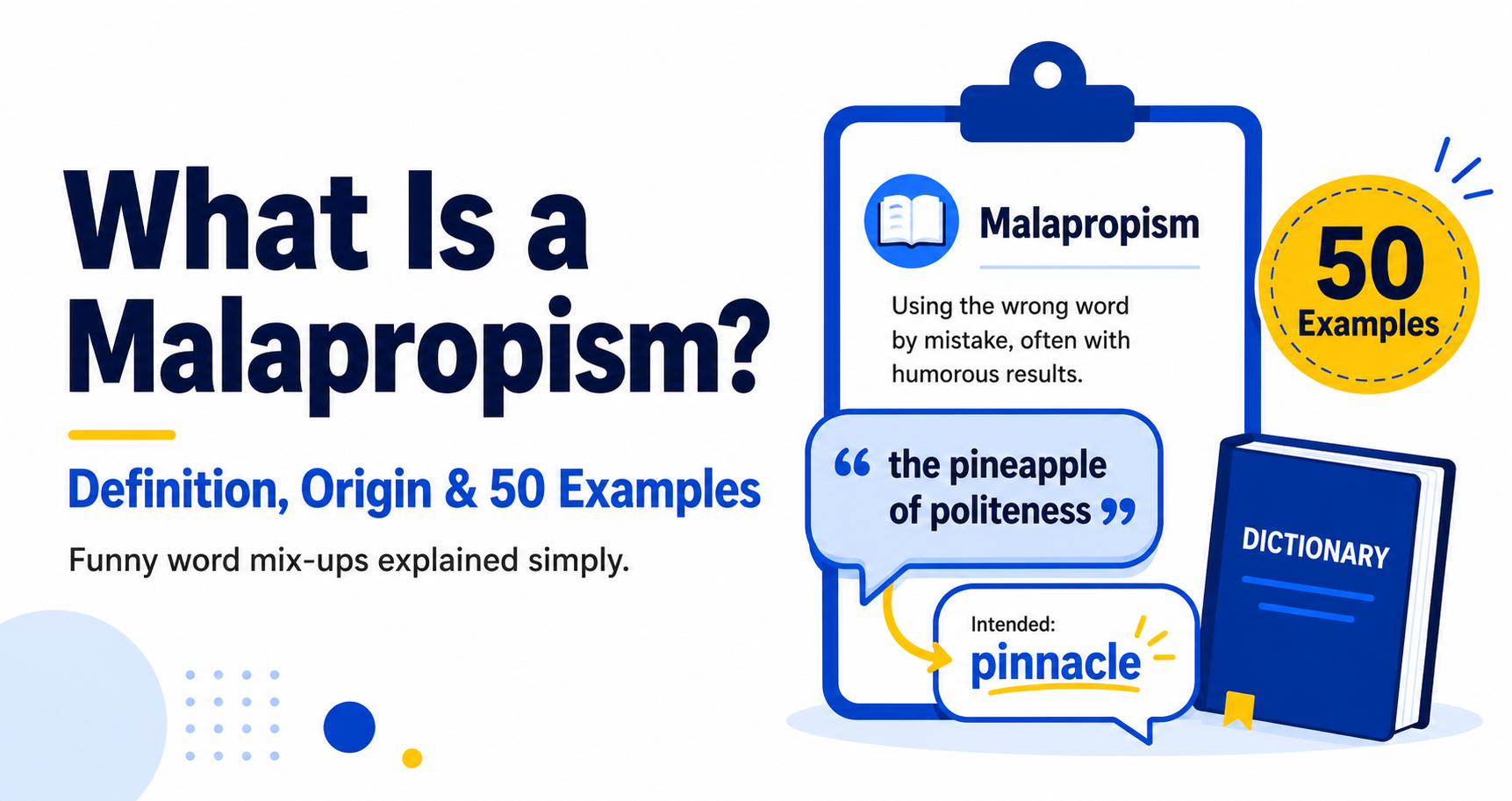
A malapropism is the mistaken use of a word in place of a similar-sounding one, producing a nonsensical and often funny result. Saying "he is the very pineapple of politeness" instead of "pinnacle" is a malapropism: the wrong word sounds like the right one but means something absurd. The term comes from Mrs. Malaprop, a character in a 1775 play who constantly mixed up her words. This guide explains where the word comes from, why malapropisms happen, how they differ from spoonerisms and eggcorns, and gives 50 examples to enjoy.
What is a malapropism?
A malapropism happens when a speaker reaches for one word and grabs a different word that sounds similar but means something else entirely. The mistake is usually unintentional, and the humour comes from the gap between what the person meant and the ridiculous thing they actually said. Because the swapped word sounds so close to the intended one, the listener can tell exactly what was meant, which is what makes the slip funny rather than simply confusing.
Three things define a true malapropism. The wrong word must sound similar to the right one. It must mean something different, usually something absurd in context. And the result should be a recognizable error, not just an unusual word choice. "Texas has a lot of electrical votes" works because "electrical" sounds like "electoral" but means something comically different.
Where does the word "malapropism" come from?
The word is named after Mrs. Malaprop, a character in Richard Brinsley Sheridan's 1775 comedy The Rivals. Mrs. Malaprop constantly misuses words for comic effect, calling someone "the very pineapple of politeness" and describing a person "as headstrong as an allegory on the banks of the Nile," where she means alligator. Sheridan built her name from the French phrase mal à propos, meaning "poorly placed" or "inappropriate," and the character was so memorable that her name became the standard term for the error.
Malapropisms existed in writing long before Mrs. Malaprop, though. Shakespeare used them for comedy nearly two centuries earlier. In Much Ado About Nothing, the constable Dogberry reports that his watch has "comprehended two auspicious persons," meaning apprehended two suspicious persons. Those slips are sometimes called dogberryisms in his honour.
50 funny malapropism examples
The table below collects 50 classic and everyday malapropisms, each with the word that was meant. Read them aloud and the sound-alike logic becomes clear: every wrong word is just one slip away from the right one.
# | The malapropism | Meant to say |
|---|---|---|
1 | the pineapple of politeness | pinnacle |
2 | a lot of electrical votes | electoral |
3 | I might fade into Bolivian | oblivion |
4 | a photogenic memory | photographic |
5 | all your eggs in one bastard | basket |
6 | the laughing stalk of the neighborhood | stock |
7 | beyond my apprehension | comprehension |
8 | made a mint | (an accidental pun) |
9 | a whole nother can of worms | another |
10 | the very pineapple of success | pinnacle |
11 | burn that bridge when we get to it | cross |
12 | a metaphysical crisis | metabolic / physical |
13 | a case of Arctic depression | artistic |
14 | use a fire distinguisher | extinguisher |
15 | a conformational conversation | informational |
16 | the sound of the cacophony | symphony |
17 | bans ethnic cleansing | discrimination |
18 | a vast suppository of knowledge | repository |
19 | renew my subscription | prescription |
20 | very mad banners | bad manners |
21 | innocent by-prayers | bystanders |
22 | the wind is very moisture today | moist |
23 | better Nate than lever | late than never |
24 | jump to delusions | conclusions |
25 | passed with flying carpets | colors |
26 | barking up the wrong dog | tree |
27 | it's not rocket surgery | rocket science / brain surgery |
28 | a rough pachyderm | patch |
29 | a self-defecating speech | self-deprecating |
30 | the brightest bulb in the toolbox | mixed metaphor |
31 | a man of great statue | stature |
32 | a wolf in cheap clothing | sheep's |
33 | plooking the books | cooking |
34 | skating on thin gravy | ice |
35 | a flaming hypocritter | hypocrite |
36 | a real social leopard | social leper / butterfly |
37 | stuck in traffic constipation | congestion |
38 | the way the cookie bounces | crumbles |
39 | circumcised the area on the map | circumnavigated |
40 | table that topic until we can decorate more | dedicate |
41 | I had divine interception | intervention |
42 | flamingo of the heart | angina |
43 | having an allegory right now | altercation |
44 | stop nicking your pose | picking your nose |
45 | a lot of perspirations | aspirations |
46 | get down to brass tax | brass tacks |
47 | a bit under the feather | under the weather |
48 | hyperventilation of information | revelation |
49 | a very impersonable impression | personable |
50 | out of sheer spiteness | spite |
A few of these, like "made a mint" or "the brightest bulb in the toolbox," are closer to puns or mixed metaphors than pure malapropisms, but they ride the same sound-alike humour, which is why they keep good company on any list.
Why do malapropisms happen?
Malapropisms usually appear when a speaker reaches for an impressive or unfamiliar word and the brain pulls a near neighbour by sound instead of by meaning. The mental dictionary stores words partly by how they sound, so under pressure, in a speech, an argument, or a quick reply, a similar-sounding word can slip out in place of the intended one. English makes this especially easy, because its enormous vocabulary is full of words that sound almost identical but mean very different things, like prescription and subscription, or stature and statue.
They are most common in speech rather than careful writing, because writing gives you time to check. That is also why a quick reread, or a tool that flags an odd word, catches most of them before they reach a reader.
Malapropism vs spoonerism vs eggcorn vs mondegreen
Malapropisms are one of several famous language slips, and they are easy to confuse. The table below sets them side by side so the differences are clear.
Slip | What happens | Example |
|---|---|---|
Malapropism | Wrong word swapped for a similar-sounding one, with absurd meaning | "dance a flamingo" for flamenco |
Spoonerism | Initial sounds of two words are swapped | "a blushing crow" for a crushing blow |
Eggcorn | A misheard phrase that still makes a kind of logical sense | "old-timers' disease" for Alzheimer's |
Mondegreen | A misheard lyric or phrase | "wrapped up like a douche" for the actual lyric |
The key difference is logic. A spoonerism swaps sounds between words. An eggcorn is a mishearing that the speaker has rationalized into something that seems to make sense. A mondegreen is specifically a misheard lyric. A malapropism has no logic behind it at all; it is simply the wrong word, and that is exactly why it is funny.
Malapropisms in literature and pop culture
Beyond Mrs. Malaprop and Shakespeare's Dogberry, malapropisms have long been a tool for writers who want a character to seem self-important yet out of their depth. A character who reaches for grand words and lands on the wrong ones reveals themselves in a single line, which is why the device shows up in comedy from the stage to the sitcom. The slips are affectionate as much as mocking, since everyone has reached for a big word and missed.
How to avoid malapropisms in your writing?
Malapropisms are charming in speech and deadly in a formal document, where they undercut your credibility. A few habits catch them before they reach a reader.
Habit | Why it helps |
|---|---|
Read your draft aloud | The ear catches a wrong word the eye glides over |
Look up any word you are unsure of | Confirms the meaning, not just the spelling |
Watch sound-alike pairs | affect/effect, prescribe/proscribe, stature/statue |
Let a draft rest, then reread | Distance makes the wrong word stand out |
If you write for clarity, a quick check helps. Pasting a draft into our readability checker shows where sentences get tangled enough to invite a slip, and the word frequency counter surfaces a word you have leaned on, which is often where an accidental swap hides. For a general count of how long your piece runs, the word counter tracks words and characters as you write.
Frequently Asked Questions
What is a malapropism in simple terms?
It is using the wrong word in place of a similar-sounding one, so the sentence comes out funny or nonsensical. Saying "dance a flamingo" instead of "flamenco" is a malapropism: the words sound alike but mean completely different things.
Where does the word malapropism come from?
It comes from Mrs. Malaprop, a character in Richard Brinsley Sheridan's 1775 play The Rivals, who constantly confused similar-sounding words. Her name is based on the French phrase mal à propos, meaning "poorly placed" or "inappropriate."
What is the difference between a malapropism and a spoonerism?
A malapropism swaps a whole word for a similar-sounding one, as in "pineapple" for "pinnacle." A spoonerism swaps the opening sounds of two words, as in "blushing crow" for "crushing blow." One is a wrong word, the other is a sound switch.
Are malapropisms grammatically incorrect?
They are word-choice errors rather than grammar errors. The sentence is usually grammatically fine; it is the meaning of one word that is wrong. That is why a malapropism reads as funny rather than broken.
What is a famous example of a malapropism?
One of the most famous is Mrs. Malaprop's "he is the very pineapple of politeness," where she means pinnacle. From Shakespeare, Dogberry's "comprehended two auspicious persons," meaning apprehended two suspicious persons, is another classic.
Sources
The definition, origin, and distinctions in this guide are drawn from standard language references, including Merriam-Webster, Wikipedia, and Scribbr, which trace the term to Mrs. Malaprop in Sheridan's 1775 play The Rivals and to earlier use by Shakespeare.