What Is a Good Word Count for a Thesis Statement? (Ideal Ranges, Examples, a Proven Trim Method)
A good thesis statement is 20-50 words, ideally 25-40. See ideal lengths by essay size, 9 real examples with word counts, and a 6-step method to trim yours fast.
Quick Answer
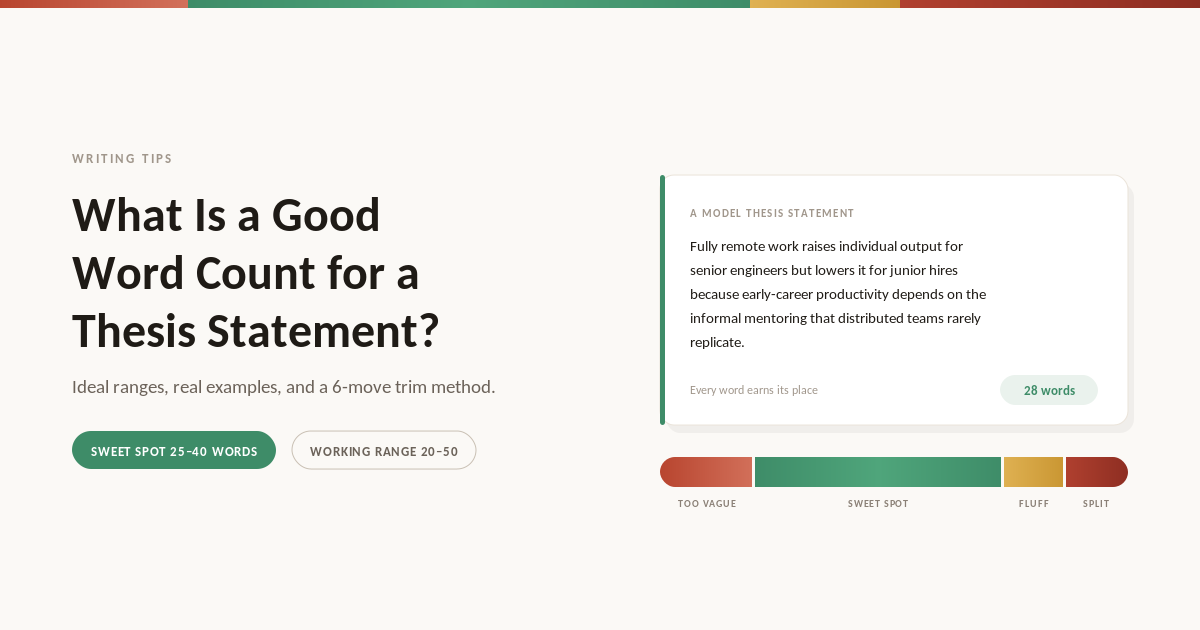
A good thesis statement is 20-50 words long, with 25-40 words being the sweet spot for most college essays. Keep it to one sentence when you can, and two sentences when your argument genuinely needs the room. Anything under 15 words is usually too vague to defend; anything over 50 words usually contains filler or should be split into two sentences.
There is no universal academic rule requiring an exact number. University writing centers emphasize clarity, specificity, and appropriate scope over word counts, and your instructor's requirements always take priority. But "20-50 words" is only useful if you know which end of the range your assignment falls into, when 40 words is fine and when it isn't, and how to fix a thesis that's too long or too short. This guide covers all of it, with exact word-count benchmarks, worked examples, and diagnostic tools you can apply to any assignment.
Key Takeaways
The working range is 20-50 words; the sweet spot is 25-40. Use it as a diagnostic, not a law, and your instructor's requirements always win.
Match your thesis to your paper: often about 1-4% of total length for essays of 1,000-5,000 words, with higher percentages possible in shorter essays and a thesis paragraph appropriate for some long works.
Count sentences before you count words. Consider splitting single sentences that exceed about 30 words instead of squeezing everything into one.
Grow by adding sentences, not clauses. That's how graduate-level theses stay readable at 52 words.
Concision ≠ brevity. Specificity often adds words and always adds strength. Cut fluff, not precision.
Don't confuse a thesis statement (one to two sentences) with a thesis or dissertation (an entire document). They have completely different word-count expectations.
Revise your thesis last so it matches what your paper actually argues.
Your grader isn't counting words. They're asking whether they know exactly what you're about to argue and why it matters. Nail that, and your word count will land in range on its own.
Thesis Statement Length
Assignment Type | Ideal Thesis Word Count | Sentences |
|---|---|---|
Timed exam / short response | 15-25 words | 1 |
Middle/high school 5-paragraph essay | 15-25 words | 1 |
Standard college argumentative or analytical essay | 20-40 words | 1 |
Undergraduate research paper | 30-50 words | 1-2 |
Graduate seminar paper | 40-60 words | 1-2 |
Master's/PhD thesis or dissertation (the claim in your introduction) | 60-120 words | 2-5 sentences (a short "thesis paragraph") |
These are practical targets, not mandatory limits. A clear 19-word thesis beats a padded 30-word thesis, and a precise 45-word thesis beats a vague 20-word one.
Key insight: as academic level rises, word count rises modestly, but the thesis should still present one controlling argument. You're adding precision and nuance, not more unrelated arguments.
First, Clear Up the Confusion: Thesis Statement ≠ Thesis (Dissertation)
"Thesis word count" is one of the most ambiguous searches in academic writing, and many pages answer the wrong question. Two completely different things share the name:
Term | What It Means | Typical Word Count |
|---|---|---|
Thesis statement | 1-2 sentences expressing your paper's main argument | 20-50 words |
Bachelor's thesis / capstone (the full document) | An entire undergraduate research project | 8,000-15,000 words |
Master's thesis (the full document) | An entire graduate research project | 15,000-40,000 words |
Doctoral dissertation (the full document) | An original contribution to a field | 70,000-100,000+ words |
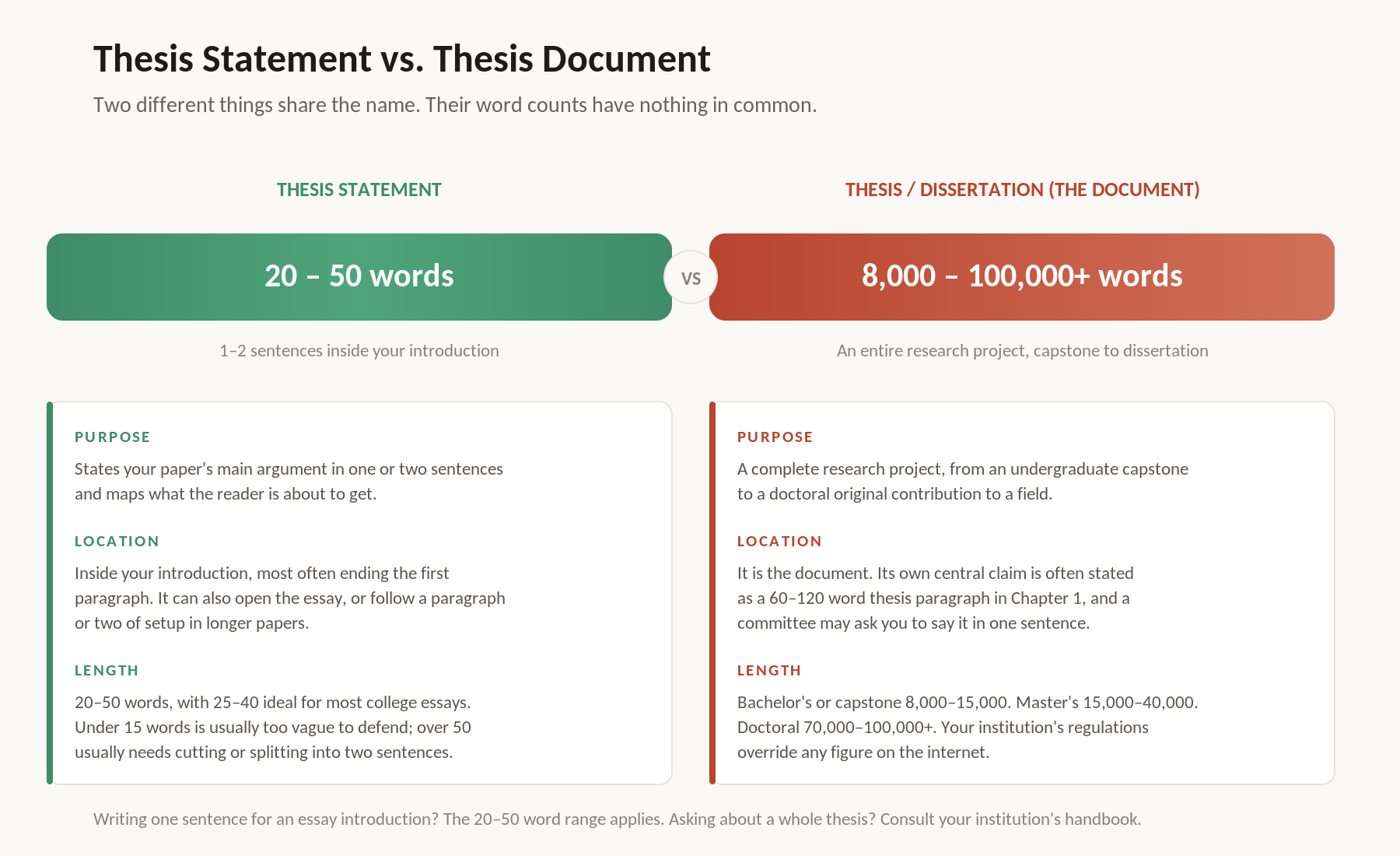
If you're writing one strong sentence for an essay introduction, the 20-50-word guidance applies to you. If you're asking about the length of an entire thesis or dissertation, consult your institution's handbook. Requirements vary considerably, and your graduate school's regulations override any figure on the internet. Often, the introduction through conclusion chapters are counted, while the abstract, references, and appendices are excluded, but institutional policies vary.
And here's the connection most people miss: a 100,000-word dissertation still needs a clear central claim, often developed in a 60-120-word thesis paragraph in Chapter 1. Committees may also ask candidates to state their thesis in one sentence during the defense. If you can't, that's a thinking problem, not a length problem.
Why There's No Single "Magic Number" (and What Writing Centers Actually Say)
Here's a gap most students never notice: the sites that give you a number such as 20-50 words are often content blogs, while major university writing centers generally give you no number at all.
Source | Position on Length | Gives a Word Count? |
|---|---|---|
UNC Chapel Hill Writing Center | "Usually a single sentence near the beginning of your paper (most often, at the end of the first paragraph)" | ❌ No |
Purdue OWL | Should be specific and cover only what you will discuss; typically ends the first paragraph | ❌ No |
Indiana University Writing Tutorial Services | "A one- or two-sentence condensation of the argument or analysis that is to follow" | ❌ No |
University of Toronto Writing Advice | Explicitly calls "must be one sentence" a myth: "Use two or three sentences if you need them" | ❌ No |
Popular writing guides / word-count tools | 20-50 words | ✅ Yes |
The takeaway: professional writing instructors measure thesis quality in sentences and specificity, not words. The 20-50-word range isn't arbitrary, though. It's the natural size a statement lands at when it does its three jobs:
States your topic (what you're writing about)
States your position or claim (what you argue about it)
Hints at your reasoning (why or how, often signaled by because, although, or since)
Doing all three in fewer than about 15 words usually produces something vague ("Social media affects teens"). Doing it in more than about 50 words usually means you're cramming your entire outline into one sentence instead of trusting your body paragraphs.
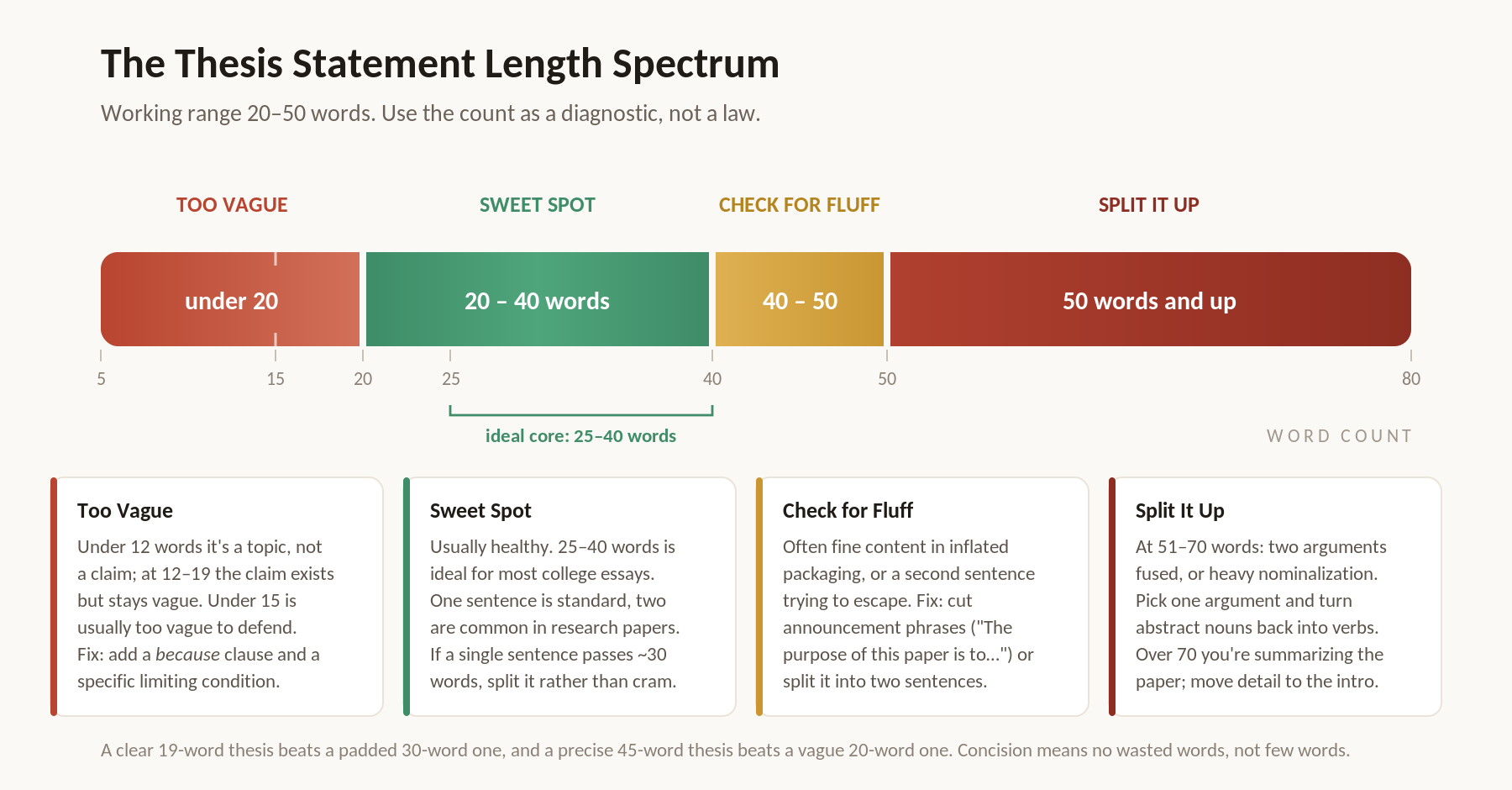
So use the word count as a diagnostic, not a law. If your thesis falls outside 20-50 words, that's not automatically an error. It's a signal to inspect something specific. The diagnostic table below tells you what.
The Proportional Rule: Match Your Thesis to Your Paper Length
A thesis for a 500-word timed exam and a thesis for a 40-page seminar paper cannot be the same length, because a thesis has one job: to accurately map everything that follows. A bigger paper needs a bigger map.
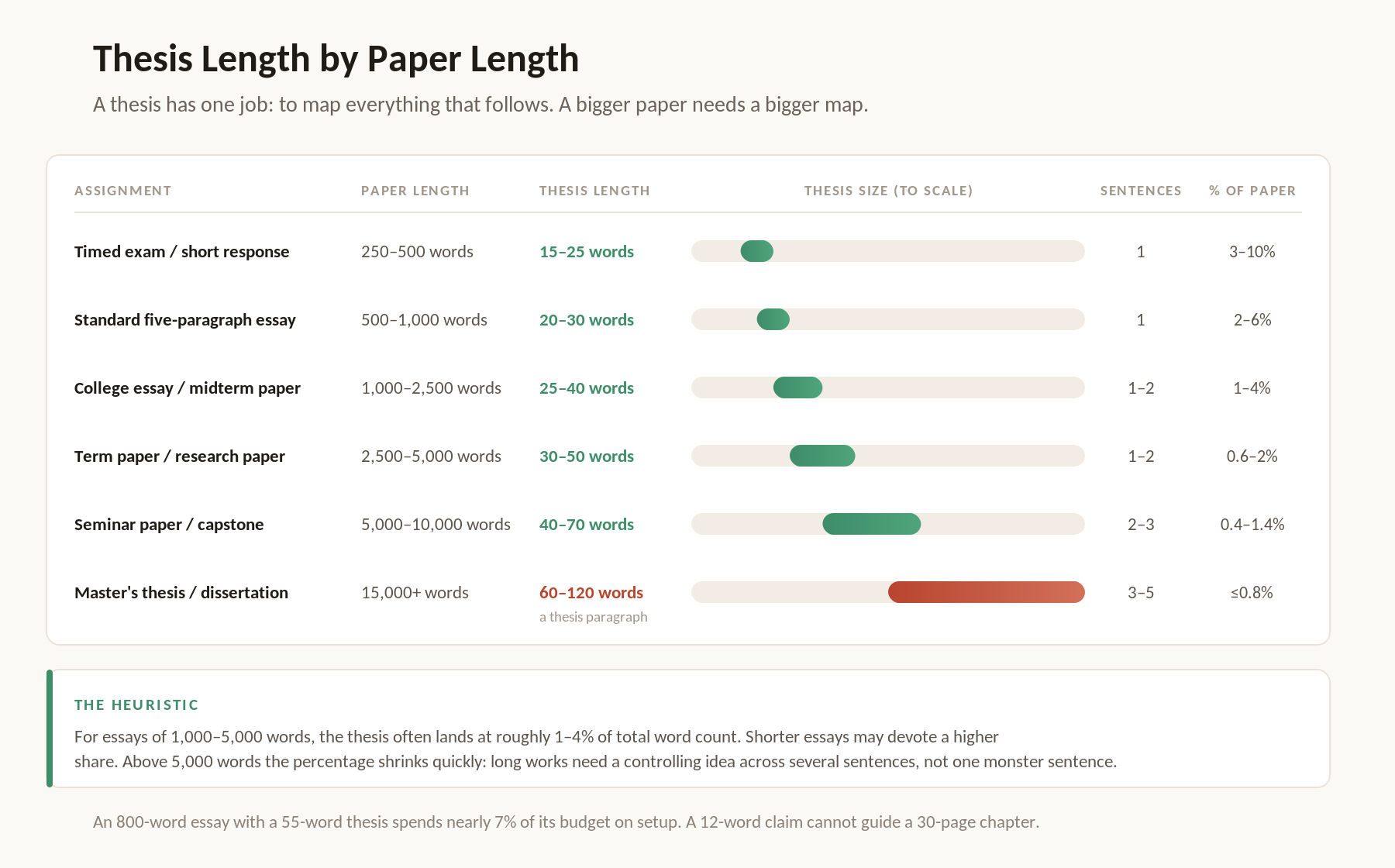
The heuristic: for essays of 1,000-5,000 words, your thesis will often land at roughly 1-4% of total word count. Shorter essays may devote a higher share to the thesis. Above 5,000 words, the percentage shrinks quickly. Long works need a controlling idea expressed across several sentences, not one monster sentence.
Why this matters practically: if you're writing 800 words and your thesis is 55 words, you've spent nearly 7% of your budget on setup. You may be overpromising. Conversely, if your central claim for a 30-page chapter is 12 words, you may not yet have done the thinking required to guide 30 pages.
Is 40 Words Too Long for a Thesis Statement?
No. A 40-word thesis statement is not too long. It falls comfortably within the accepted range and is close to ideal for a college research paper with a moderately complex argument.
Consider this 40-word example:
Although remote work can weaken informal communication, organizations that combine scheduled collaboration, documented decision-making, and flexible attendance policies are more likely to preserve team cohesion than organizations that require full-time office attendance without addressing the underlying causes of coordination problems.
Every part of it earns its place: a meaningful qualification, a specific subject, a clear position, the conditions supporting that position, and a contrasting alternative. A 40-word statement only becomes "too long" when it repeats itself, includes evidence that belongs in the body, or fuses unrelated arguments.
The 25-30-Word Sentence Guideline: Why Sentences Matter More Than Words
Here's the nuance most guides miss: 40 words can be fine, but a 40-word sentence may become difficult to follow when it contains too many clauses.
Federal plain-language guidance recommends an average sentence length of about 20 words.
Academic prose often uses longer sentences, although average length varies by discipline, audience, and genre.
Many readability formulas treat longer average sentence length as more difficult because each additional clause can increase working-memory load.
The practical rule: if your thesis exceeds 25-30 words and contains more than two subordinate clauses, consider splitting it into two sentences instead of trimming it further. Two shorter sentences often read better than one 40-word sentence, with little or no increase in total length.
Same idea, two formats:
❌ One 40-word sentence (hard to parse):
Although many educators argue that phone bans improve classroom focus, the available evidence suggests that bans reduce measured distraction only in schools that also restructure their assessment practices, which implies that the policy is a symptom of deeper design problems.
✅ Two sentences, 36 words (easy to parse):
Phone bans reduce classroom distraction only in schools that simultaneously restructure assessment practices. The policy therefore treats a symptom: what fragments student attention is not the device but an assessment system that rewards shallow, interruptible work.
Word count barely changed. Readability changed completely. "How many words?" is the second question. "How many sentences?" is the first.
The Length Diagnostic: What Your Word Count Is Telling You?
Don't just check whether you're in range. Check what being out of range means.
Your Thesis Is… | Most Likely Problem | The Fix |
|---|---|---|
Under 12 words | It's a topic, not a claim ("Social media harms teenagers.") | Add a because clause and a specific limiting condition |
12-19 words | A claim exists but is vague, obvious, or unfalsifiable | Add specificity: which group, which mechanism, compared to what |
20-40 words | ✅ Usually healthy | Run the Fluff-to-Function Audit below |
41-50 words | Fine content, inflated packaging, or a second sentence trying to escape | Cut announcement phrases; split into two sentences |
51-70 words | Two arguments fused, or heavy nominalization ("the utilization of…") | Choose one argument; convert abstract nouns back to verbs |
Over 70 words | You're summarizing the paper, not stating a claim | Move detail into the surrounding introduction; that's what it's for |
Beyond Length: The CLEAR Test for Thesis Quality
Word count tells you whether your thesis is the right size, not whether it's good. Run it through this five-part test to check both at once:
C: Claim (arguable): Could a reasonable, informed person disagree? If not, you have a fact or a topic, not a thesis. ("Many children consume sugar" fails; "Sugar taxes reduce childhood obesity more effectively than school nutrition programs" passes.)
L: Limited scope: Could you realistically prove this in the space you have? A five-page essay cannot explain every cause of climate change. Narrow the population, period, location, text, or mechanism.
E: Every word earns its place: No "I believe," "in my opinion," or "it is important to note that." Cut filler; keep necessary qualifiers like "primarily" or "in the short term."
A: Answers the assignment: Turn the prompt into a question; your thesis is the direct answer. This prevents restating the topic instead of arguing about it.
R: Reflects the finished paper: Every major promise in the thesis should be supported in the body, and the paper shouldn't develop a different argument than the one announced. A thesis is a working statement, not a permanent contract. Revise it after drafting.
If your statement passes all five checks and lands in the 20-50-word range, it's doing its job. If it passes CLEAR but runs long, you have a good idea buried in a wordy sentence. That's a trimming problem, not an argument problem. The next tools fix that.
The Fluff-to-Function Audit: Label Every Word
Every word in a strong thesis performs one of five functions. Label each word of your draft:
S: Subject: names what you're writing about
C: Claim: the arguable assertion (the part someone could dispute)
L: Limit: scope, condition, or qualifier ("only in," "for first-generation students," "between 1990 and 2010")
R: Reason: the because / although / since logic
W: Why it matters: the "so what?" (optional; more common at graduate level)
Articles, prepositions, and conjunctions get a structural pass. But if more than about 15-20% of your remaining words carry no S/C/L/R/W function, you have fluff, regardless of your total word count.
Worked example (28 words, with all substantive words functional):
"Fully remote work [S] raises individual output for senior engineers [C] but lowers it for junior hires [L/C] because early-career productivity depends on the informal mentoring that distributed teams rarely replicate [R]."
Compare the student's original draft:
"The purpose of this paper is to look at the topic of remote work and to discuss some of the various ways that it has been shown to have both positive effects and also some negative effects on the productivity of employees who work for large companies in the technology sector in recent years." (54 words)
Roughly 26 of those 54 words do no argumentative work at all. That's the real problem, not the 54.
The 6-Move Trim Method: 54 Words → 28 Words, Step by Step
Use this on any bloated thesis. We'll trim the 54-word draft above.
Move 1: Delete the announcement. Cut "The purpose of this paper is to," "In this essay I will argue," and "This paper examines." Your reader knows they're reading your paper. → "Remote work has both positive and negative effects on productivity for employees at large technology companies." (Shorter, but now too vague.)
Move 2: Kill "both positive and negative." This is the single most common thesis-killer. It isn't a position; it's a refusal to take one. Pick a side or name a specific trade-off with a mechanism. → "Remote work raises productivity for some technology employees and lowers it for others."
Move 3: Replace vague nouns with specific ones. "Some employees" → senior engineers. "Others" → junior hires. Specificity often adds words, and that's correct. You're spending words on precision, not padding. → "Remote work raises productivity for senior engineers but lowers it for junior hires." (13 words)
Move 4: Add the because. Indiana University's writing guide notes that strong theses often contain because, since, although, unless, and however. A causal clause turns an observation into an argument. → "…because early-career productivity depends on informal mentoring."
Move 5: De-nominalize. Turn abstract nouns back into verbs: "the utilization of" → "using"; "the implementation of a policy" → "implementing." Nominalizations often inflate word count without improving the meaning.
Move 6: Read it aloud. If you run out of breath, split it. If it takes more than 8-10 seconds to say, cut it down or divide it into two clean sentences.
Final result:
"Fully remote work raises individual output for senior engineers but lowers it for junior hires because early-career productivity depends on the informal mentoring that distributed teams rarely replicate." (28 words)
54 → 28 words: a 48% reduction with a stronger argument. That's the pattern. Good trimming makes theses shorter and sharper. If cutting words weakens your thesis, you're cutting the wrong words.
The 12 Phrases Quietly Inflating Your Thesis
Delete these on sight:
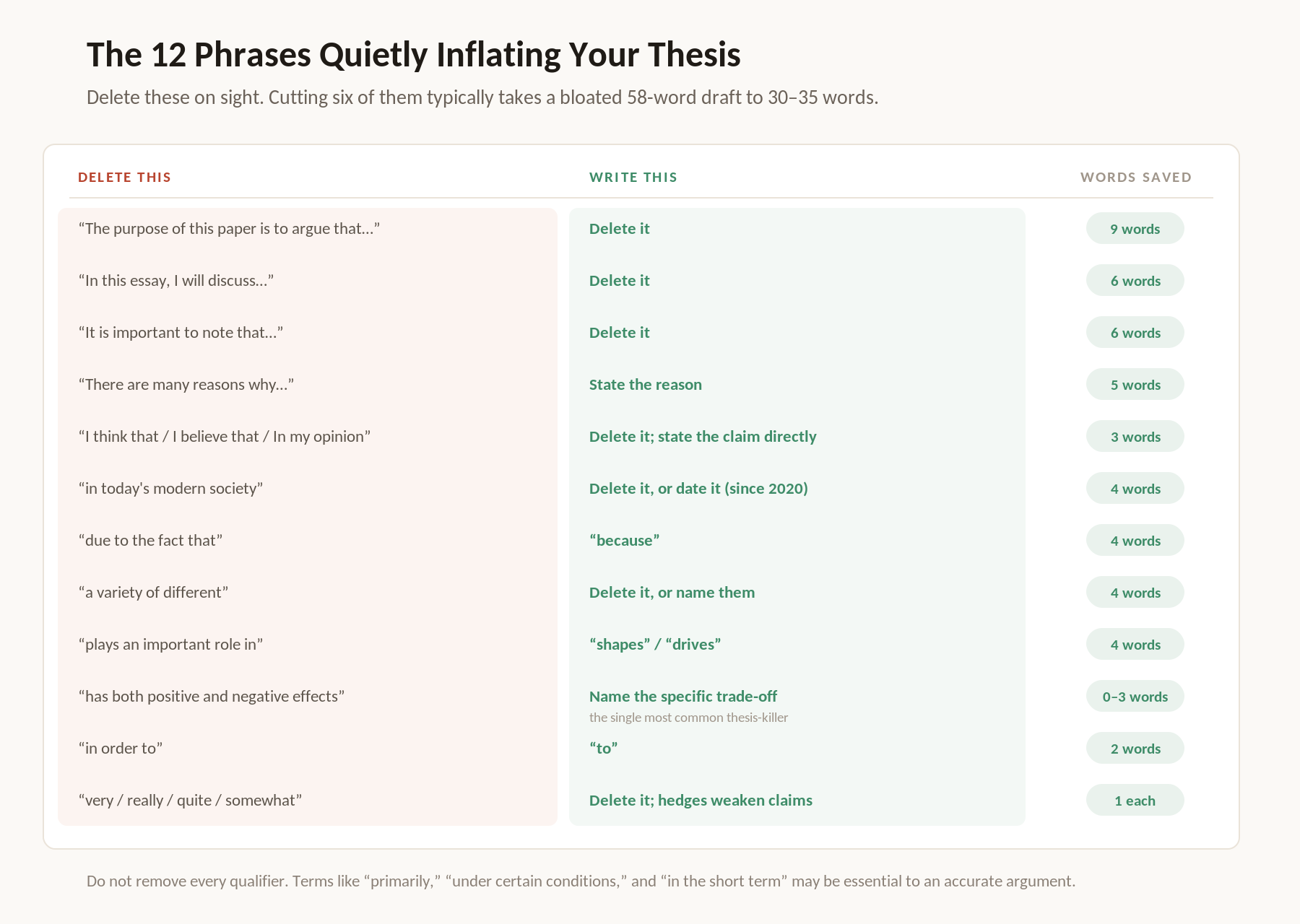
Cutting even six of these from a bloated 58-word draft typically lands you at 30-35 words without touching a single idea. Just don't remove every qualifier. Terms like "primarily," "under certain conditions," and "in the short term" may be essential to an accurate argument.
How to Expand a Thesis That's Too Short?
A short statement isn't automatically concise. It may simply be incomplete.
Too broad (4 words):
Remote work affects teams.
This identifies no type of effect, no circumstances, and no conclusion.
Focused (21 words):
Hybrid teams maintain cohesion when managers document decisions and reserve synchronous meetings for tasks that require debate, relationship-building, or rapid feedback.
To strengthen an underdeveloped thesis, add one or more of the following:
A specific population, text, or context
A defined period or location
The mechanism behind the claim
A necessary qualification ("although…," "only when…")
The paper's analytical conclusion or significance
9 Model Thesis Statements With Exact Word Counts
Real examples beat rules. Each of these sits in the healthy range; the count is listed so you can calibrate your own.
# | Paper Type | Thesis Statement | Words |
|---|---|---|---|
1 | Timed exam response | "Standardized tests measure a family's preparation resources more reliably than a student's academic potential, which makes them poor tools for admissions." | 21 |
2 | Analytical (literature) | "By shifting the narrator's attitude from admiration to distrust, the novel uses unreliable narration to show how personal loyalty can distort moral judgment." | 23 |
3 | Expository | "This report explains how urban tree cover reduces summer heat through shade and evapotranspiration, then compares the costs of three municipal planting strategies." | 23 |
4 | Compare and contrast | "Although both novels portray ambition as socially rewarded, the first treats failure as personal weakness, whereas the second exposes the institutions that define success." | 24 |
5 | Argumentative (standard essay) | "Public high schools should begin classes after 8:30 a.m. because later start times better align with adolescent sleep patterns and improve students' readiness to learn." | 25 |
6 | Cause and effect (STEM model) | "Nitrogen runoff from row-crop agriculture, not municipal wastewater, drives the summer expansion of the Gulf of Mexico hypoxic zone, as isotope tracing of watershed samples demonstrates." | 26 |
7 | Policy argument | "Congress should tie federal transit funding to zoning reform, because new rail lines in cities that ban apartments near stations deliver ridership gains too small to justify their cost." | 29 |
8 | Two-sentence thesis (research paper) | "Phone bans reduce classroom distraction only in schools that simultaneously restructure assessment practices. The policy therefore treats a symptom: what fragments student attention is not the device but an assessment system that rewards shallow, interruptible work." | 36 (2 sentences) |
9 | Graduate-level thesis paragraph | "Scholars have largely read municipal heat-action plans as technical adaptations to a warming climate. Drawing on three years of fieldwork in Phoenix and Ahmedabad, I argue that these plans function primarily as instruments of political legitimacy. They redistribute visibility rather than risk, protecting city administrations from blame while leaving outdoor workers exposed." | 52 (3 sentences) |
(Examples 6 and 9 model thesis structure, not verified empirical claims. Write your own from your own evidence.)
Notice the pattern: as a paper's ambition rises, the thesis grows by adding sentences, not by adding clauses to one sentence. Example 9 would be difficult to read as a single 52-word sentence. As three sentences, setup, claim, and significance, it's completely clear.
Templates You Can Adapt
Argumentative: [Subject] should [position] because [reason or mechanism] and [closely related reason].
Analytical: Through [technique, pattern, or evidence], [subject] reveals [interpretation and significance].
Expository: [Subject] can be understood by examining [category one], [category two], and [organizing relationship].
Compare-and-contrast: Although [subjects] share [similarity], they differ in [significant distinction], revealing [larger conclusion].
Cause-and-effect: [Outcome] results primarily from [specific cause or interaction], rather than [common alternative explanation].
Templates get you started; the final statement should use language specific to your subject.
Where the Thesis Goes, and How Placement Affects Length?
Placement and length are linked, a nuance most guides skip:
End of the introduction (most common): UNC and Purdue OWL both note that the thesis usually ends the first paragraph. Because the paragraph has already supplied context, the thesis may be shorter because you don't have to define terms inside it.
Opening sentence of the essay: a front-loaded thesis should usually be concise and immediately clear, often around 15-25 words, although there is no fixed rule.
After two or three paragraphs of setup (long papers, journal articles): the thesis may be longer (40-70 words) when it responds to literature or context already introduced.
The University of Toronto explicitly debunks the rule that the thesis must end paragraph one: some theses open the essay; others need a paragraph or two of introduction.
Practical rule: placement can influence thesis length, but the argument's complexity and the amount of necessary qualification matter more than where the statement appears.
Note that not every paper requires an explicit thesis: personal narratives, creative writing, some reflective essays, and lab reports (which use objectives or hypotheses instead) may not need one. Even then, the piece should have a clear controlling idea.
Three Myths That Cause Bad Word Counts
Myth 1: "A thesis statement must be exactly one sentence." False. The University of Toronto lists this among its thesis-statement myths ("Use two or three sentences if you need them"), and Indiana University defines a thesis as a "one- or two-sentence condensation." Forcing a complex argument into one sentence is a common cause of unreadable 50-word theses.
Myth 2: "A thesis must name three supporting points." Also false. The three-point formula is a teaching scaffold that can mechanically inflate a thesis. Use as many supporting lines of reasoning as the argument requires. Two reasons, or one deep reason, is often stronger.
Myth 3: "Shorter is always better." The most damaging myth. "Social media harms teenagers" is 4 words and nearly worthless: unspecific, hard to dispute meaningfully, and no map for the reader. Concision means no wasted words, not few words. A 40-word thesis where every word earns its place beats a 15-word thesis that says nothing.
The Word-Counter Discrepancy Nobody Warns You About
If you and a classmate count the same thesis and get different numbers, neither of you is necessarily wrong. Tools disagree:
Hyphenated words: Word and Google Docs generally count "well-being" as one word; some online counters split it into two.
Numerals and date ranges: "2019-2024" counts as one word in some tools and two in others.
Unspaced dashes: Some counters handle words joined by a dash differently.
What to do: use Microsoft Word or Google Docs as your reference because your instructor is likely to use one of them. Expect ±2-3 words of variation between tools, and never make an editorial decision over a 2-word difference. If you're at 51 words and panicking about a "50-word limit," you've misunderstood the guideline: it was never a limit.
Pre-Submission Thesis Checklist
Run your thesis through all ten before you submit:
Length: 20-50 words, or matched to my paper length via the proportional table
Sentences: no single sentence over about 30 words; split rather than cram
Arguable: an informed reader could reasonably disagree
Specific: no "good," "important," "impactful," or "positive and negative effects"
Answers the prompt: re-read the assignment question and check alignment word for word
Passes "So what?": the reader can tell why the claim matters
Passes "How and why?": the reasoning or mechanism is visible
No announcement phrases: doesn't begin "This paper will…" or "I believe…"
One central direction: no unrelated arguments fused together
Matches the finished draft: revised after writing, so it reflects what the paper actually argues
That last item is the most frequently skipped and most costly. Your pre-draft thesis is a hypothesis; the version that matches your finished argument is the thesis. Writing centers commonly recommend revisiting and revising it after drafting.
Frequently Asked Questions
What is the ideal word count for a thesis statement?
20-50 words, with 25-40 words ideal for most college essays. One sentence is standard; two are common in research papers. Under 15 words is usually too vague; over 50 usually needs cutting or splitting. Clarity and completeness matter more than the exact total.
Is 40 words too long for a thesis statement?
No. Forty words falls comfortably within the accepted range and is close to ideal for a college paper with a moderately complex argument. However, 40 words in a single sentence with multiple subordinate clauses can be hard to read. Consider splitting it into two shorter sentences.
Can a thesis statement be 50 words?
Yes, particularly for a complex analytical or research paper. Review it for background, evidence, and repetition that belong in the body, but don't shorten it if doing so removes essential nuance.
Can a thesis statement be two sentences?
Yes. Indiana University defines a thesis as a "one- or two-sentence condensation" of the argument, and the University of Toronto explicitly rejects the one-sentence rule. Use two sentences when the argument needs context or a concession, or when one sentence becomes grammatically hard to follow. The sentences should express one unified position.
Can a thesis statement be three sentences?
At the graduate level and in journal articles, yes. A "thesis paragraph" of three to five sentences (60-120 words) can suit a long document. For an undergraduate essay under 2,500 words, three sentences usually signal too much background or too many claims.
Can a thesis statement be too short?
Yes. Under about 12-15 words, a thesis is often too vague to be arguable. Check whether it's short because it's precise or because it's missing a reason, mechanism, or specific angle.
How long should a thesis statement be for a 500-word essay?
About 20-30 words in one sentence, roughly 4-6% of your total. Anything longer can consume space you need for evidence.
How long should a thesis statement be for a 1,000-word essay?
25-35 words, usually in one sentence. This is the classic sweet spot.
How long should a thesis statement be in a research paper?
30-50 words, often split across two sentences: one stating the claim and one stating the stakes or the gap it fills. Papers over 5,000 words can support 40-70 words.
Does a thesis statement have to include three points?
No. The three-point format is a teaching scaffold, not an academic rule. Include as many supporting lines of reasoning as the argument and assignment require.
Should a thesis statement start with "I believe" or "This paper will discuss"?
No. Announcement and opinion phrases add 3-8 words and little or no meaning. State the position directly unless first-person framing is required by your discipline.
Can a thesis statement be a question?
No. A question frames your inquiry; a thesis answers it. If your "thesis" ends in a question mark, you have a research question. Write its answer instead.
Should a thesis statement include evidence or citations?
Usually not. The thesis states the conclusion; the body presents the evidence. A citation may fit in disciplines where the thesis directly responds to another scholar, but don't crowd the statement with statistics or quotations.
Where should the thesis statement go?
Most often at the end of the first paragraph. It can open the essay or appear a paragraph or two into a longer paper. A complex argument introduced after substantial setup may reasonably require a longer thesis statement.
Does the thesis statement count toward the essay's word count?
Yes. It's part of your introduction and your total, unless assignment instructions say otherwise. Front and back matter, such as the title page, references, and appendices, may be excluded, particularly in longer works, but policies vary.
Is there an official word limit in APA or MLA?
No. APA, MLA, and Chicago govern citation and formatting, not thesis length. Any word count you see is pedagogical guidance, not a style rule.
Will a grader actually count the words in my thesis?
Almost never, unless the assignment imposes a specific limit. Rubrics usually grade clarity, arguability, specificity, and alignment with the paper, qualities that simply tend to produce 20-50-word statements. Word count is a proxy for quality, not usually the rubric itself.
How long is a thesis statement for a dissertation?
A dissertation's central claim may be stated in one sentence and then developed in a 60-120-word thesis paragraph in Chapter 1. The dissertation itself may run from tens of thousands to more than 100,000 words depending on the degree, discipline, and institution. Check your institution's handbook.
My thesis is 65 words. What do I do?
Run the 6-Move Trim: delete the announcement phrase, cut "positive and negative," de-nominalize abstract nouns, and swap "due to the fact that" for "because." If the argument is unified, split it into two sentences. If it contains unrelated arguments, choose the one with the strongest evidence.
When should I write the thesis statement?
Draft a working thesis after enough preliminary research to form a tentative answer, then revise it during and after drafting. Your final thesis should look different from your first. That's the process working, not failing.