How Many Words Are in Spanish Language? (RAE Data 2026)
Spanish has 93,111 entries in the RAE's 2014 dictionary, but no exact total. See the latest 2026 data, native vocabulary size, and realistic learner targets.
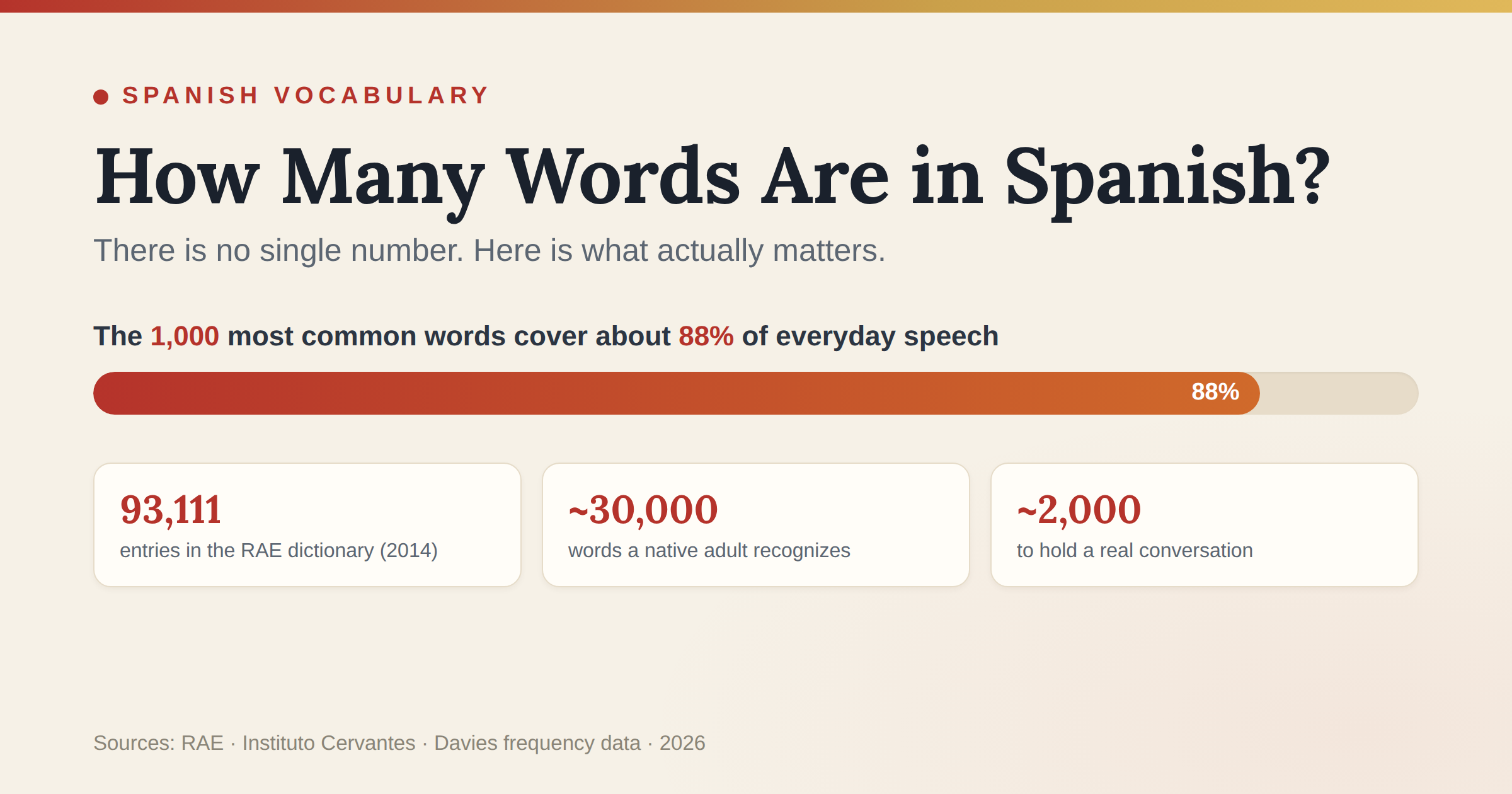
Spanish has no exact, official word count. The most authoritative reference, the Real Academia Española's Diccionario de la lengua española (DLE), listed 93,111 entries and 195,439 meanings in its 2014 print edition. The online DLE has since been revised, but the RAE has not published a new overall total. The figure rises when you include regional, technical, and inflected forms, and it falls sharply, to a few thousand, when you ask the question most people actually mean: how many words do I need to know?
The rest of this guide explains why the counts you see online disagree, gives the current figures from primary sources, compares Spanish to English honestly, and shows how many words carry real, everyday communication.
Quick Answer
What you are counting | Approximate number | Source |
|---|---|---|
Entries (entradas) in the RAE dictionary, 2014 print edition | 93,111 | |
Distinct meanings (acepciones) in that edition | 195,439 | |
All inflected word-forms (conjugations, plurals, agreement) | No official count; very large | Estimate |
Words a native adult recognizes in a lexical-decision task | ~30,000 | |
Words used in ordinary daily communication | ~1,000-1,500 (expert estimate) | |
Frequent words that give high text coverage for learners | ~2,000-3,000 |
The key idea: there is no single "true" number, because the honest answer depends on what you count as a word. Once you separate the different things people are measuring, the contradictions disappear.
Key Takeaways
There is no single official number. It depends on whether you count dictionary entries (about 93,000 in 2014), meanings (about 195,000), or all inflected forms (no official total, but far larger).
The 2014 print DLE contained 93,111 entries and 195,439 meanings. The online DLE has been revised since, but the RAE has not published a new overall total. A 24th edition is expected in 2026.
The claim that a historical dictionary holds 150,000+ Spanish words is unsupported; the RAE's historical dictionary is still in progress, with about 7,000 articles (7,015 monographs) published so far.
Native speakers recognize about 30,000 words in a lexical-decision task but use far fewer, an estimated 1,000 to 1,500, in ordinary daily communication.
Learners need far fewer words than the dictionary total suggests: about 1,000 words cover most everyday speech, and 2,000 to 3,000 give strong text coverage, though coverage is not the same as fluency or comprehension. These are planning estimates.
English dictionaries list more words than Spanish, but this reflects borrowing history and editorial scope. English has no authoritative exact total either, and the well-known "millionth word" claim was not credible.
The most useful shift is to stop asking "how many words are in Spanish?" and start asking "which couple of thousand words unlock the conversations I want to have?" That question has a clear, achievable answer.
Why There Is No Single Number?
Counting the words in a language sounds like it should be as simple as counting pages in a book. It is not, for three concrete reasons.
Languages do not have fixed edges. Spanish is official or national in about 20 countries and is spoken with native command by around 519 million people. New words enter constantly through slang, technology, and science, while others fade. Any count is a snapshot of a moving target.
"Word" has several legitimate definitions. Is hablar ("to speak") one word, or also hablo, hablas, habló, and its roughly fifty other conjugated forms? Lexicographers count the base form, called the lemma. A computer counting a text counts every form. Both are valid, and they produce very different totals.
Dictionaries make editorial choices. The RAE dictionary is not exhaustive for specialized terminology, and it adds fast-moving slang slowly. So it undercounts living usage, while a raw database of internet text overcounts it with typos and one-off coinages.
Instead of one number, it helps to picture four different measures:
Measure | What it counts | Rough size |
|---|---|---|
Lemmas (dictionary entries) | Base forms you would look up | ~93,000 |
Meanings (acepciones) | Each distinct sense of each word | ~195,000 |
Inflected forms | Every conjugation and agreement variant | No official count; large |
Historical vocabulary | Words across the whole history of Spanish | No complete count exists |
Almost every confusing figure online is just one of these measures quoted without a label. Keep them separate and the disagreements resolve themselves.
Watch out for one common error: the widely repeated claim that a "Historical Dictionary of Spanish" holds 150,000+ words is not a real count. The RAE's Diccionario histórico de la lengua española (DHLE), formerly the Nuevo diccionario histórico del español, is a work in progress that has published just over 7,000 articles so far (7,015 monographs as of its latest update). The RAE does not state a planned final total, so any "150,000 historical words" figure is unsupported.
The Official Count: Inside the RAE Dictionary
When people cite a number for Spanish, they almost always mean the Real Academia Española's Diccionario de la lengua española (DLE), the closest thing Spanish has to an official register.
The most recent fully counted print edition, the 23rd edition (2014), contained:
93,111 entries (entradas or lemas), the individual words you can look up.
195,439 meanings (acepciones), because one word such as banco can mean "bench," "bank," and "shoal of fish," among others.
That gap between roughly 93,000 words and 195,000 meanings matters. Spanish gets a great deal of mileage from each word through context, which is one reason a smaller entry list can express just as much as a larger one.
It is revised regularly, but there is no new official total
The 93,111 figure is the 2014 print count, and many competing articles repeat it as if the dictionary had frozen a decade ago. It has not. The DLE now lives online and is revised periodically. The current version, 23.8.1, was published on 15 December 2025, and the RAE presented it as a step toward the forthcoming 24th edition, expected in 2026. Recent updates have added terms such as microteatro, turismofobia, and milenial, along with unadapted foreign terms such as gif, hashtag, and streaming.
One honesty note that most sources skip: the RAE reports how many changes each update makes, not a new grand total. So the accurate statement is this: the 2014 print edition contained 93,111 entries and 195,439 meanings; the online DLE has since been revised, but the RAE has not published a new overall total.
Regional and historical reach
The DLE is a pan-Hispanic dictionary produced with the 23 academies of the Asociación de Academias de la Lengua Española (ASALE). In the 2014 edition, about 18,700 of its meanings carry a label marking them as American (Latin American) usage.
Regional vocabulary runs deeper than the main dictionary shows. ASALE's separate Diccionario de americanismos documents roughly 70,000 lexical items, including words, set phrases, and expressions, with some overlap with the DLE, so you cannot simply add it to the 93,111. This is one reason you see 70,000, 93,000, and other figures all described as "the number of Spanish words." They come from different books that count different things.
RAE / ASALE reference work | What it covers | Approximate size |
|---|---|---|
Diccionario de la lengua española (DLE) | Standard contemporary Spanish | 93,111 entries (2014) |
Diccionario de americanismos | Latin American terms and phrases | ~70,000 items |
Diccionario histórico de la lengua española (in progress) | The history of Spanish vocabulary | ~7,015 articles so far |
CORPES XXI (a corpus, not a dictionary) | A large sample of real usage | 455 million forms (v1.5, 2026) |
That last row is a corpus: a searchable database of real Spanish text and speech, not a dictionary. The RAE's CORPES XXI (version 1.5, published June 2026) holds 455 million orthographic forms across nearly 420,000 documents. When a source claims Spanish has "millions of words," it has usually confused a corpus size (how much text was analyzed) with a vocabulary count (how many distinct words exist). They are not the same thing.
Lemmas vs. Word-Forms: Do Conjugations Count?
This is the most misunderstood part of the topic, and the one forum users argue about most: do conjugations count as separate words?
Spanish is a heavily inflected language, so words change shape to carry grammatical information. Take one ordinary verb, hablar ("to speak"). A dictionary lists it once. In use, it becomes:
hablo, hablas, habla, hablamos, habláis, hablan (present)
hablé, hablaste, habló... (preterite)
hablaba, hablabas... (imperfect)
hablaré... (future), hablaría... (conditional)
hable, hables, hablara, hablase... (subjunctive)
hablando, hablado, habla, hablad (non-finite and imperative)
A single regular Spanish verb has roughly 50 distinct conjugated forms. Attach a pronoun and you get more single-word forms such as díselo or hablándome (note that compound tenses like he hablado are written as two words, so they do not add single forms). Now apply the same logic across the language's thousands of verbs, add plural forms for nouns, add gender and number agreement for adjectives (though some adjectives, such as azul or feliz, do not change for gender), and add productive diminutives such as perrito and perrazo (which are derivations rather than inflections). The count of distinct forms climbs far beyond the count of lemmas.
Counting method | Does hablo count separately from hablar? | Resulting total |
|---|---|---|
Lemma count (what dictionaries do) | No, one lemma | ~93,000 |
Word-form count (what corpora measure) | Yes, every form counts | Much larger; no official total |
Neither method is wrong. They answer different questions. "Spanish has 93,000 words" is a lemma count. "Spanish has far more than that" is a word-form count. This single distinction explains most of the contradictory numbers online, and almost no competing article bothers to make it.
Good news for learners: you do not memorize 50 separate words per verb. You learn one verb plus a handful of conjugation patterns that apply to thousands of verbs at once. The inflection that inflates the total word count is a system, not a memorization list.
Spanish vs. English: Does Spanish Have Fewer Words?
This is the comparison everyone reaches for, and it usually carries a worry: if Spanish has fewer words, is it a smaller, easier, or less expressive language? Here is the honest version.
The counts are not measured the same way
Reference | Language | Stated size | What it measures |
|---|---|---|---|
RAE DLE | Spanish | ~93,000 entries | Contemporary standard usage |
English | "more than 500,000 words and phrases," past and present | A maximalist historical record | |
English | ~470,000 entries | A large but older unabridged dictionary |
Notice the mismatch. The OED is a historical dictionary that keeps centuries of obsolete words; the DLE is a usage dictionary of current standard Spanish. That is not a like-for-like comparison. English dictionaries do list more entries, but partly because they are built to be more inclusive of archaic and specialist vocabulary.
Why English carries a large lexicon?
English is a serial borrower. After the Norman Conquest of 1066 it absorbed a large layer of French and Latin vocabulary on top of its Germanic core, which is why it often has two or three words for one idea, such as kingly (Germanic), royal (French), and regal (Latin), where Spanish usually has one. English's larger count reflects that borrowing history, not a superiority over Spanish.
The "million English words" claim
You will often see the claim that English has "over a million words." Treat it with caution. It traces to the Global Language Monitor, which declared "Web 2.0" the "millionth English word" in 2009, a publicity exercise that linguists widely rejected. The accurate position: English has no authoritative exact word count, the widely publicized 2009 "millionth word" claim was not linguistically credible, and different definitions of what counts as a word produce very different totals. The same is true of Spanish.
Does a smaller count mean easier or poorer?
No, on both counts. Dictionary size says little about difficulty or expressive power. Spanish uses context and verb endings to carry nuance that English may spread across extra words: a single Spanish verb ending can signal who is acting and when, with no pronoun needed. Learning difficulty comes from grammar, sound system, and exposure, not from how many words sit in a dictionary. Spanish has a relatively transparent spelling system, which helps in some ways, and a rich verb system, which challenges in others.
How Many Words Does a Native Speaker Actually Know?
Here the topic becomes reassuring. The dictionary lists tens of thousands of words, but no person knows all of them.
A large 2020 study (Aguasvivas and colleagues, published in Behavior Research Methods) drew on more than 150,000 native speakers across around 20 countries. Using a lexical-decision task, in which participants decide whether letter strings are real Spanish words, it measured recognition against a reference list of about 45,000 words and found:
The average adult Spanish speaker recognizes about 30,000 words in this task. That is roughly two-thirds of the 45,000-word test list. Note that this measures visual word recognition, not everything a person might understand in context or in speech.
Recognizing a word and actively using it are different skills. A separate Universidad Nebrija report, based on an expert's presentation rather than a peer-reviewed diary study, estimates that in ordinary communication speakers actively use only around 1,000 to 1,500 words, a small share of what they recognize.
Vocabulary measure | Approximate size | What it means |
|---|---|---|
Recognition (lexical-decision task) | ~30,000 words | Words judged as real in a yes/no visual test |
Everyday active use | ~1,000-1,500 words | Words carrying ordinary daily communication (estimate) |
The takeaway is encouraging: even native speakers get through daily life on a compact, high-frequency core. That raises the question most readers actually care about.
How Many Words Do You Actually Need?
If you are learning Spanish, the dictionary total is the size of the reference library, not your study list. The useful question is: how much of everyday language does each chunk of vocabulary account for?
Frequency research gives a clear answer. Linguist Mark Davies analyzed a 20-million-word corpus of Spanish and measured how much of a text the most common words cover:
Words you know | Spoken Spanish | Fiction | Non-fiction |
|---|---|---|---|
1,000 | 87.8% | 79.6% | 76.0% |
2,000 | 92.7% | 86.1% | 84.0% |
3,000 | 94.0% | 89.6% | 88.2% |
Read these carefully, because the common interpretation is wrong. These percentages are text coverage, the share of running words (tokens) accounted for, not how much meaning you would understand. Davies measured which words appear, not comprehension. The words you do not yet know are often the very ones carrying the point of a sentence, so knowing 88% of the words in a conversation does not mean grasping 88% of the message. Coverage is a useful proxy for how far your vocabulary stretches, not a comprehension score.
With that caveat, the practical lesson is real: words are wildly unequal in usefulness. The 1,000 most frequent lemmas account for about 88% of the words in spoken Spanish, and returns diminish quickly after that. Front-loading the most common words is far more efficient than studying vocabulary alphabetically.
A rough vocabulary ladder
The milestones below are informal planning estimates drawn from frequency data and teaching experience. They are not measured fluency thresholds for Spanish, and individual results vary widely. Where possible, they are tied to the corpus-coverage figures above.
Milestone (planning estimate) | Words | What it roughly supports |
|---|---|---|
Survival | a few hundred | Basic sentences, greetings, numbers, directions |
Conversational base | ~1,000 | ~88% text coverage of everyday speech; getting by as a visitor |
Comfortable conversation | ~2,000 | ~93% text coverage of spoken Spanish |
Functional range | ~3,000-5,000 | Broad everyday text coverage |
Educated range | ~8,000-10,000 | Reading press and literature with fewer gaps |
Near-native recognition | ~20,000-30,000 | Approaching the study's native visual-recognition estimate |
One important reframe: high text coverage is necessary but not sufficient for fluency. Grammar, listening speed, pronunciation, and knowledge of set phrases all matter. Treat these milestones as coverage-based planning targets, not a guarantee of fluency.
What about CEFR levels (A1-C2)?
Learners often want vocabulary mapped to the official European proficiency levels. This has to be handled carefully, because the CEFR itself defines levels through "can-do" descriptors, what a learner can do with the language, not through fixed word counts. The Instituto Cervantes Plan Curricular provides lexical inventories by level but does not assign a single word-count to each one.
With that firmly in mind, here are rough, unofficial estimates that teachers sometimes use as planning targets, not official standards:
CEFR level | Informal vocabulary estimate | Typical ability |
|---|---|---|
A1 | ~500 | Basic phrases and immediate needs |
A2 | ~1,000-1,500 | Routine everyday exchanges |
B1 | ~2,500-3,000 | Handling most travel and daily situations |
B2 | ~4,000-5,000 | Conversing comfortably, following media |
C1 | ~8,000 | Academic and professional use |
C2 | ~10,000+ | Near-native command |
Peer-reviewed vocabulary research in other languages has produced considerably lower recognition thresholds per level, which is a reminder that these numbers depend heavily on how "knowing a word" is measured. Use the table as a loose guide only.
You Already Know Some Spanish (Cognates)
Here is a fact that changes how the whole thing feels: if you speak English, you already recognize some Spanish on sight. Spanish descends directly from Latin, while English borrowed a large layer of Latin and French vocabulary. Because both draw on the same Latin roots, they share many similar words, called cognates, and many follow predictable patterns. Learn the pattern, and you unlock a group of words at once.
English ending | Spanish ending | Examples |
|---|---|---|
-tion | -ción | nation to nación, information to información |
-ty | -dad | university to universidad, city to ciudad |
-ous | -oso | famous to famoso, delicious to delicioso |
-ic | -ico | fantastic to fantástico, romantic to romántico |
-ly | -mente | rapidly to rápidamente, exactly to exactamente |
-ent / -ant | -ente / -ante | president to presidente, important to importante |
-ary | -ario | necessary to necesario, ordinary to ordinario |
Spanish and English share thousands of these cognates, many close enough to recognize without study. Estimates of exactly how many vary widely and depend on how loosely you define a cognate, so treat any single figure with caution. The practical point stands: your real starting vocabulary in Spanish is not zero.
One warning: false friends
A short list of look-alikes mean something different. Learn these early:
embarazada means pregnant, not "embarrassed"
éxito means success, not "exit"
ropa means clothing, not "rope"
sopa means soup, not "soap"
actual means current, not "actual"
librería means bookshop; a library is a biblioteca
False friends are a limited set next to the far larger group of reliable cognates, so the balance still favors you.
Do I Need Different Vocabulary for Spain vs. Latin America?
A common worry: with about 20 Spanish-speaking countries, do you have to learn 20 vocabularies? No. The high-frequency core is largely shared, and the differences are a thin, colorful top layer.
The common words that carry most everyday speech are largely shared across regions. What varies is specific nouns and slang:
Concept | Spain | Latin America (varies) |
|---|---|---|
Car | coche | carro, auto |
Computer | ordenador | computadora |
Cell phone | móvil | celular |
Juice | zumo | jugo |
To drive | conducir | manejar (common in Latin America) |
Practical guidance: pick the region most relevant to you, where you will travel, who you will speak with, what media you watch, and default to its vocabulary. Speakers understand each other across regions constantly, much as American and British English speakers do. Regional vocabulary is something you absorb with exposure, not a separate curriculum.
A Practical Plan for Learning the Words That Matter
Knowing that a couple of thousand words carries most everyday speech is only useful if you learn the right ones. The estimates in this section are practical planning guides, not precise data.
Start with a frequency list, not a textbook glossary. Learn words in order of how common they are. Mark Davies's A Frequency Dictionary of Spanish and free frequency lists rank words this way. This is one of the most useful choices you can make.
Front-load the first 1,000 words. These account for the largest share of everyday speech. Aim to recognize them solidly before moving to less common vocabulary.
Learn words in phrases, not in isolation. Knowing tener ("to have") is less useful than knowing tengo que ("I have to"), tener hambre ("to be hungry"), and tener razón ("to be right"). Natural speech is built from set combinations, not lone words.
Use spaced repetition. Spaced-repetition apps schedule reviews at increasing intervals based on your recall, which many learners find helps them retain vocabulary.
Get comprehensible input daily. Once past about 1,000 words, much of your later growth can come from reading and listening to Spanish slightly above your level: graded readers, learner podcasts, subtitled shows. You pick up later vocabulary the way native speakers did, through exposure.
Speak early, even imperfectly. A classic trap is knowing thousands of words but freezing when it is time to talk. Vocabulary is necessary but not sufficient; speaking is a separate skill, so start before you feel ready.
Rough timeline (planning estimates)
These ranges are informal planning estimates, not measured data. They assume consistent daily study of 30 to 60 minutes and vary enormously with method, immersion, and prior language experience. English speakers get a head start from cognates.
Goal | Words | Rough study time |
|---|---|---|
Tourist survival | ~500 | 1-2 months |
Conversational base | ~1,500-2,500 | 6-12 months |
Functional range | ~4,000-5,000 | 1.5-3 years |
Educated range | ~8,000 | 3-5 years |
Frequently Asked Questions
How many words are in the Spanish language?
The RAE's Diccionario de la lengua española listed 93,111 entries, with 195,439 meanings, in its 2014 print edition. The online version has been revised since, but the RAE has not published a new overall total. Counting every inflected form pushes the number much higher, and there is no single official total, because the answer depends on what you count.
How many words does the average Spanish speaker know?
A large 2020 study found the average native adult recognizes about 30,000 words in a lexical-decision task (a measure of visual word recognition). Estimates of everyday active use are far lower, on the order of 1,000 to 1,500 words.
How many words do you need to be conversational in Spanish?
As a planning estimate, roughly 2,000 to 3,000 words give you high text coverage of everyday speech. That supports conversation, but coverage alone is not fluency; grammar, listening, and set phrases matter too.
How many words do you need for a basic level?
About 1,000 words account for close to 88% of the words used in spoken Spanish (text coverage, not comprehension), which helps with simple, everyday situations. A few hundred core words let you build basic sentences.
Does Spanish have fewer words than English?
By dictionary listings, English dictionaries record more entries, largely because English borrowed heavily from French and Latin and because dictionaries like the OED include centuries of obsolete words. This does not make Spanish less expressive or harder or easier to learn.
Is it true that English has a million words?
English has no authoritative exact count. The widely publicized 2009 "millionth word" announcement was not linguistically credible, and different definitions of "a word" produce very different totals. The same is true of Spanish.
Do Spanish verb conjugations count as separate words?
It depends on the method. Dictionaries count the base form (lemma), so hablar and its roughly 50 conjugations count as one word. Corpus tools that count every form count them separately. As a learner, you memorize one verb plus a pattern, not 50 words.
How often does the RAE update the dictionary?
The DLE is revised periodically, with the current online version (23.8.1) published in December 2025, ahead of a 24th edition expected in 2026. The RAE reports the number of changes per update rather than a new overall total.
How many Spanish speakers are there in the world?
The Instituto Cervantes 2025 yearbook counts about 635.7 million potential users of Spanish. Of these, roughly 519 million have native command, about 92 million have limited competence, and around 24.6 million are learners. That places Spanish among the world's most spoken languages, alongside Mandarin Chinese and Hindi.
How many words do I need to read a Spanish newspaper or novel?
Reading uses a wider vocabulary than casual speech. As an informal planning estimate, a target of around 8,000 to 10,000 words supports comfortable reading of press and literature. For reference, the top 3,000 words cover about 94% of speech but only about 88% of non-fiction text.
What is the fastest way to learn the most useful Spanish words?
Learn from a frequency list, study words in phrases, use spaced repetition, and get daily reading and listening input. Front-loading the first 1,000 words gives you the most text coverage per hour of study.
Resources
DLE 2014 counts (93,111 entries; 195,439 meanings) and the dictionary itself: Diccionario de la lengua española, RAE/ASALE
Current DLE version 23.8.1 (December 2025) and the 24th edition timeline: RAE news release, 23.8.1
Diccionario histórico de la lengua española (DHLE), 7,015 monographs: RAE, DHLE
CORPES XXI corpus size (version 1.5, June 2026: 455 million orthographic forms across nearly 420,000 documents): RAE, CORPES XXI
Diccionario de americanismos (~70,000 items): ASALE
Native recognition ~30,000 words (lexical-decision task, >150,000 participants): Aguasvivas et al. (2020), Behavior Research Methods, doi.org/10.3758/s13428-020-01357-9. Plain-language summary: The Conversation
Everyday active use ~1,000-1,500 words (expert estimate): Universidad Nebrija
Frequency and text-coverage figures: Mark Davies, "Vocabulary range and text coverage," lingref.com, basis for A Frequency Dictionary of Spanish (Routledge)
Spanish speakers worldwide (2025): Instituto Cervantes, El español en el mundo 2025
English dictionary scope: Oxford English Dictionary; Merriam-Webster, "How many words are there in English?"
"Millionth word" claim critique: Language Log
CEFR level definitions: Council of Europe; Spanish lexical inventories: Instituto Cervantes, Plan Curricular
Method: dictionary and speaker figures are taken from the RAE and the Instituto Cervantes; vocabulary and coverage figures from published research. Coverage percentages refer to text coverage (share of running words), not comprehension. Vocabulary ladders, CEFR figures, and timelines are informal planning estimates, not official standards or measured Spanish thresholds. Last reviewed July 2026.