How to Write a Book: A Beginner's Step-by-Step Guide
Learn how to write a book from idea to finished manuscript with a practical 20-step process for outlining, drafting, revising, and publishing.
A practical 20-step process for planning, drafting, and revising your first book, with honest numbers on how long it takes and what help costs. Facts, prices, and platform terms checked July 2026.
Quick Answer
To write a book as a beginner: choose one idea you genuinely care about, compress it into a one-sentence premise, build a simple outline, and write 300–500 words per session until the first draft is complete, while avoiding extensive rewriting during the first draft. Then let the draft rest for a few weeks, revise it in focused passes from big problems to small ones, get feedback from beta readers, and choose a publishing path. At 500 words a day, five days a week, an 80,000-word draft takes about eight months.
One of the most useful principles for beginners: separate drafting from editing. Your first draft's only job is to exist. You can fix a bad page; you cannot fix a blank one.
Key Takeaways
Finishing is the real hurdle: in a 2021 ThriftBooks-sponsored OnePoll survey, over half of U.S. respondents had a novel idea, but only 8% said they had finished one. A repeatable process can matter more than waiting to feel talented or ready.
Each stage of a book has a different definition of "done." Applying editing-stage standards to a first draft is one of the most common ways beginners stall in chapter one.
A one-sentence premise plus a skeleton outline (seven beats for fiction, a promise-driven chapter list for nonfiction) gives the middle of your draft a map to follow.
The math is friendlier than the mystique: 500 words a day, five days a week, produces an 80,000-word draft in about eight months, and 250 words a day still gets there.
Habits take weeks to months to feel automatic, and research suggests missing a day does not derail them. Resume at the next practical opportunity instead of declaring the project failed.
Your first draft does not need to be polished; it needs to be finished. Placeholders like [TK], limited re-reading, and a weekly word-count report to one person all help more than waiting for inspiration.
Revise in three sequenced passes (structure, then clarity, then line editing), and investigate any issue that two or more independent readers flag.
Both publishing paths are legitimate: a legitimate traditional publisher does not charge you to publish, while a professionally produced self-published book may cost several thousand USD, although DIY publication can cost much less.
A first book often earns modestly, and outcomes vary widely. Treat it as the first asset in a catalog and the tuition for book two.
Why First Books Stall?
Wanting to write a book is common; finishing a manuscript is much rarer. In a 2021 ThriftBooks-sponsored OnePoll survey of 2,000 U.S. adults, more than half of respondents said they had a good idea for a novel, but only 15% said they had started writing one and just 8% said they had finished one. (This was a sponsored consumer poll, not definitive population research, but the gap it describes matches what writing teachers and editors see every day.)
In the patterns that surface constantly in writing communities such as Absolute Write and Mythic Scribes, first books often stall at several recurring points, and many of them involve process and planning rather than writing skill alone:
Start paralysis: "I have ideas but no idea where to begin."
Perfectionism loops: rewriting chapter one for months.
The difficult middle: many writers find the long stretch between a strong opening and a clear ending the hardest part to push through.
Research and worldbuilding rabbit holes: lore forever, story never.
The re-entry problem: a two-week break becomes a dead project.
The revision wall: finishing a draft, then freezing.
Writing in a vacuum: no feedback, no witness, compounding self-doubt.
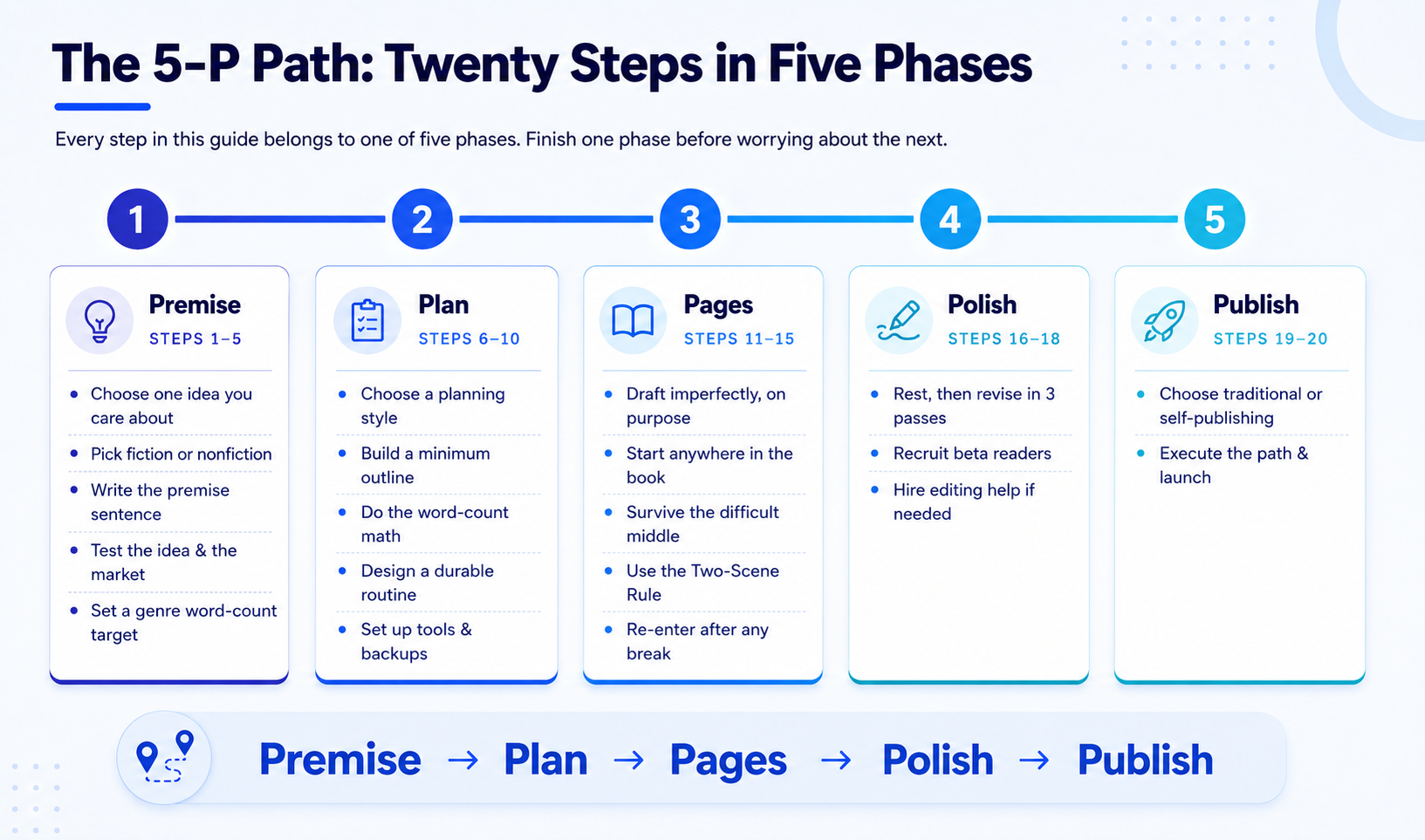
This guide is organized to prevent all seven. It follows the 5-P Path (Premise → Plan → Pages → Polish → Publish): twenty steps from vague idea to finished book, with separate guidance for fiction and nonfiction wherever the two genuinely differ.
How Book Writing Actually Works: the "Done Ladder"
A common beginner misconception is that experienced authors write clean, final-quality chapters from page one to the end. They don't. Most professionally published books pass through several planning, revision, editing, and production stages, and each stage has a different definition of done:
Stage | The question you're answering | What "done" means here |
|---|---|---|
Idea | Is this worth a book? | You can state the reader, promise, and angle in one or two sentences. |
Plan | What belongs, and in what order? | Every proposed chapter or major scene has one clear job. |
First draft | Does a complete version exist? | The manuscript runs beginning to end, even where it's rough. |
Revision | Does the book work? | Structural gaps, weak sections, and pacing problems are fixed. |
Editing | Is the writing clear and correct? | Sentences, facts, style, and continuity are checked. |
Production | Is it ready for readers? | Layout, cover, metadata, and final proof are approved. |
Internalize this ladder and you avoid two common problems: polishing chapter one forever (applying editing-stage standards to drafting-stage work) and publishing a first draft because it technically has an ending.
Phase 1: PREMISE - Decide What Your Book Is (Steps 1–5)
Step 1: Choose one idea you actually care about
The important instruction isn't "pick an idea." It's pick one, and pick it for the right reason. A first book takes months of unpaid, unwitnessed effort, and only genuine interest funds that. Books written to impress imaginary gatekeepers tend to die in the middle; books written from real curiosity have a fuel reserve.
Do this now: list every book idea you have, then circle the one you'd still want to write if you knew nobody would ever pay you for it. That's your book. Save the list; the other ideas will wait for book two.
Two common worries, answered. "My idea feels too ambitious for a beginner." You can't accurately judge scope as a new writer, ideas are never used up by a rough first attempt, and ambition is fuel. "Is my idea original enough?" Concept-level originality is nearly irrelevant; publishers buy books partly on the strength of "comp titles" (comparable existing books) as evidence a new one will sell. Originality lives in execution: your voice, your specifics, your angle.
Step 2: Pick your lane (fiction or nonfiction) and commit
Many stalled first books are stalled because the writer never decided what they were writing: a memoir keeps drifting into self-help; a novel keeps drifting into plotless autobiography. Decide now, because outline style, research method, and publishing path all fork here.
Fiction (novel, novella) | Nonfiction (guide, self-help, memoir) | |
|---|---|---|
Core promise | An emotional experience: a story | A transformation: a result or understanding |
Basic unit | A scene in which something changes | A chapter that answers one reader question |
Research is | Seasoning: enough for believability | The backbone: facts, sources, examples |
Sold by | Finishing the whole polished manuscript first | Often a proposal + sample chapters (traditional route) |
Biggest trap | Worldbuilding forever, never drafting | Researching forever, never claiming an opinion |
Memoir note: memoir is nonfiction that behaves like fiction. It's structured in scenes and arcs but sold as nonfiction, and it is not an autobiography: it selects experiences that illuminate one central change or question.
Step 3: Define one reader and one promise (the premise sentence)
Beginners write for "everyone," which makes every decision harder. Sketch a short reader profile (who they are, what they already know, what they want to feel or achieve), then compress your book into a single sentence. This is the cheapest test in publishing, and a useful early test of whether the book has a clear direction.
Fiction: When [inciting event] happens to [specific character with a want], they must [concrete goal], but [main opposition] stands in the way, and failure means [stakes].
Nonfiction: This book helps [specific reader] achieve [specific outcome] without [major obstacle] by using [your distinct method or experience].
Memoir: Through [defined period or experience], this memoir explores how [narrator] moved from [starting state] to [changed state] while confronting [central question].
If you can't fill in the blanks yet, you have a topic or a situation, not yet a book. Keep asking "and then what?" (fiction) or "so the reader can do what?" (nonfiction) until the sentence works. The sentence is a compass, not a contract; it can evolve, but you should always be able to state the current version.
Step 4: Test whether the idea can carry a whole book
Run the idea through three questions before committing months:
Desire: Will you still care after the novelty fades?
Demand: Can you identify readers who already buy this kind of book?
Deliverability: Can you supply the story, evidence, expertise, or access it requires?
Test demand with a comparable-book study. Choose five to ten books published in the last five years for the same readers. Record each one's intended reader, core promise or story engine, length, structure, what reviewers praise, what they find missing, and how your book will be meaningfully different.
Nonfiction, add one hour of validation: find the five bestselling books closest to yours (a busy shelf with a visible gap is what you want; an empty shelf usually means no audience), name your gap in one sentence, check whether real people ask your book's questions on Reddit and Quora, and explain the premise to five people in your target audience. "Oh, I need that" is validation; "oh, nice" is not.
Fiction validation is lighter because novels are bought on execution, not concepts: confirm the genre actively sells and that your premise sentence makes a couple of genre readers say "I'd read that."
Step 5: Study your genre and set a target word count
Track your manuscript in words, not pages (page counts change with formatting). The ranges below are typical guidance, not rules: market conventions that vary by genre, age category, publisher, and agent. Always check the current submission requirements of the specific agents or publishers you plan to approach; resources like Writers & Artists publish current expectations.
Genre / category | Typical range (guidance only) |
|---|---|
Picture books | Usually below 1,000 words |
Middle grade | ~30,000–55,000 |
Young adult (YA) | ~55,000–80,000 |
Romance, mystery, thriller | ~70,000–90,000 |
Adult commercial / literary fiction | ~80,000–100,000 |
Science fiction / fantasy | ~90,000–120,000 (debuts near the low end) |
Memoir / narrative nonfiction | ~60,000–90,000 |
Business / self-help / practical nonfiction | ~40,000–70,000 |
On the low end: some industry and award classifications, including the Nebula Awards, class works of 40,000 words or more as novels, but that is a category boundary, not a universal publishing definition. At 50,000 words, a manuscript may be short for some adult genres but normal for others; genre, audience, and execution matter more than the number alone. On the high end, very long debuts are harder to place traditionally because they cost more to edit, print, and distribute.
Phase 2: PLAN - Design the Book and the Habit (Steps 6–10)
Step 6: Choose your planning style honestly
"Do I have to outline, or can I just start writing?" Both methods produce published books, but they fail differently:
Plotters outline in detail first. Failure mode: outlining becomes procrastination, and over-planning can kill the discovery that makes drafting fun.
Pantsers discover the story as they draft. Failure mode: the story runs out of road mid-manuscript with no map back.
Plantsers outline the skeleton (premise, a handful of turning points, the ending) and discover everything between. For a first book, this hybrid carries less risk than either extreme, and it's close to what many successful "pantsers" actually do.
Method is personal. Pick one, finish something with it, and adjust. Outline until you can write; return to the outline when you lose direction.
Step 7: Build a minimum viable outline
You don't need a 40-page blueprint; you need enough structure that the middle of your draft can't ambush you. An outline is a cheap place to find problems that would be expensive to fix after 80,000 words.
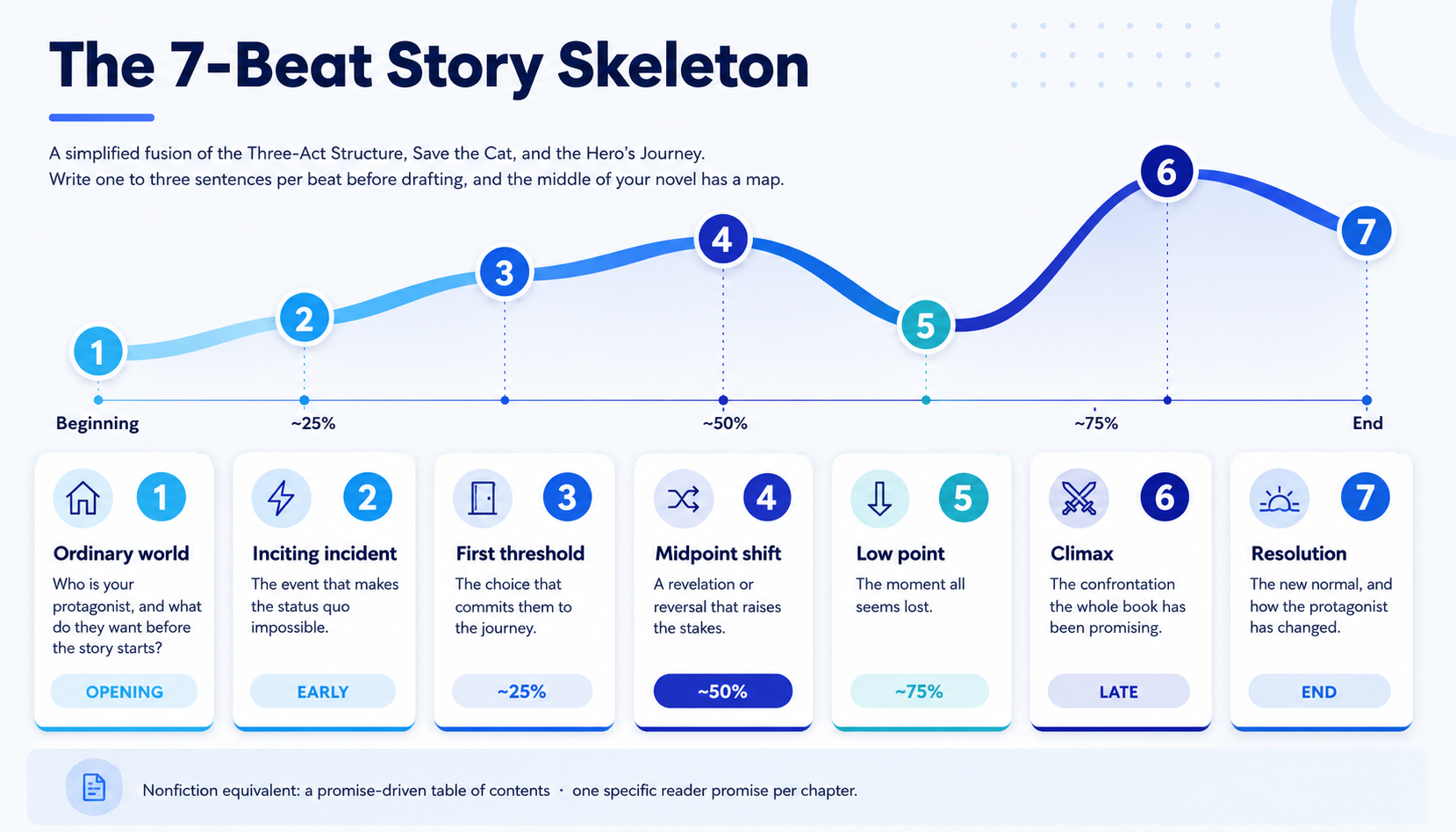
Fiction: the 7-beat skeleton. One to three sentences each:
Ordinary world: who is your protagonist, and what do they want before the story starts?
Inciting incident: what event makes the status quo impossible?
First threshold (~25%): the choice that commits them to the journey.
Midpoint shift (~50%): a revelation or reversal that raises the stakes.
Low point (~75%): the moment all seems lost.
Climax: the confrontation the whole book has been promising.
Resolution: the new normal; how the protagonist has changed.
This is a simplified fusion of the Three-Act Structure, Save the Cat, and the Hero's Journey; you don't need to pick between frameworks, just secure seven load-bearing beats. For deeper planning, the Snowflake Method is a natural next level. Then test every drafted scene against a simple engine: viewpoint, goal, opposition, turn, consequence. If a scene changes nothing, merge it, add resistance, or cut it.
Nonfiction: the promise-driven table of contents. For each of 8–14 chapters, write one line: Chapter [N]: [Working title]. After this chapter, the reader will be able to [specific thing]. If two chapters make the same promise, merge them; if a promise doesn't serve the premise sentence, cut it; then order the promises as a journey from the reader's current state to the book's transformation. While drafting, each chapter should answer: what question is the reader asking, what's the short answer, why should they trust it, and what should they do with it?
How many chapters? There's no reliable universal norm, and successful books fall well outside any average. As one planning example: a 90,000-word thriller might use 45 two-thousand-word chapters while a literary novel the same length uses 15 long ones. Let each chapter cover one scene-sequence or one idea and end with a reason to keep reading.
Step 8: Do the word-count math
Vague goals ("write a book this year") fail; arithmetic goals turn an intimidating object into a number you can hit on an ordinary Tuesday:
Target word count ÷ available weeks ÷ sessions per week = words per session
Assuming five writing days per week:
Daily words | 60,000-word draft | 80,000-word draft | 100,000-word draft |
|---|---|---|---|
250/day (15–20 min) | ~11 months | ~15 months | ~18 months |
500/day (30–45 min) | ~5.5 months | ~7.5 months | ~9 months |
1,000/day (1–1.5 hrs) | ~3 months | ~4 months | ~5 months |
Notes:
250 words a day is a real strategy. It's roughly one page and it survives busy seasons. Daily targets vary enormously among working authors; your number is your number.
Sprints exist too. NaNoWriMo's former November challenge asked participants to draft 50,000 words in 30 days; reported completion rates varied by year, and the nonprofit closed in 2025, as reported by TechCrunch. The lesson that survives it: a fuller outline can make fast drafting easier for some writers.
Add a buffer of 15–20% for illness, hard chapters, and ordinary life.
Deadlines work better with a witness. A Dominican University study summary involving 267 recruited participants reported better goal attainment among participants who wrote down goals and sent weekly progress updates to a friend. It's one modest study, not proof, but the practice costs nothing: pick a finish date, write it down, and send one person your word count every Sunday.
Use three levels of session success so a hard day can't become a lost week: a minimum (10 minutes or 100 words) that keeps the habit alive, a normal target that moves the project, and an optional stretch.
Step 9: Design a routine that survives real life
"Write every day" is the most repeated and least examined advice in publishing. What holds up better:
Consistency beats intensity, and perfection isn't required. A University College London habit-formation study (Lally et al.) found new habits took an average of 66 days to become automatic, with enormous individual variation (18 to 254 days). It studied small health behaviors, not writers, so don't treat 66 days as a deadline; the two findings worth keeping are that automaticity takes weeks to months, and that missing a single day did not significantly derail habit formation. Missing multiple sessions does not mean the project has failed; resume at the next practical opportunity.
Anchor the session, not the mood. Attach writing to an existing daily anchor (after morning coffee, on the lunch break, once the kids are asleep) so the decision is already made. Common patterns for writers with full-time jobs: early-morning sessions before the household wakes (many writers prefer mornings because interruptions are limited); a lunch-break split plus one weekend block; or dictation on a commute or walk. Dictation can increase drafting speed for some writers, though it normally takes practice and extra cleanup, and it's a genuinely useful option for writers with chronic pain, RSI, or attention differences. Choose a repeatable time that fits your actual schedule; that matters more than which one.
End sessions mid-momentum. Stop in the middle of a sentence, or leave a one-line note for your future self ("Next: Mara confronts the archivist"). Tomorrow starts with zero blank-page friction.
Track it visibly, and keep an "idea parking lot": a separate file where new plot lines, titles, and ideas for other books go, so mid-draft temptations don't derail this one.
Step 10: Set up tools and backups without making it a project
Beginners lose weeks to software research. The best book-writing software is the one that disappears; bestsellers have been drafted in all of these. Start with Google Docs or the free browser version of Microsoft Word; the full desktop version of Word normally requires a purchase or Microsoft 365 subscription. Scrivener (approximately USD 60 as a one-time purchase, checked July 2026) helps organize long manuscripts; Atticus (approximately USD 147 as a one-time purchase, checked July 2026) adds print/ebook formatting; Reedsy Studio offers free core writing and formatting features with optional paid add-ons. Prices and plans change, so verify before buying. Add grammar tools only at revision time, because checkers during drafting feed the perfectionism loop.
Keep five files: manuscript, outline, research/source log, a "deleted scenes" file, and the parking lot. Back up on the 3-2-1 principle (three copies, two kinds of storage, one offsite or in a secure cloud). A book is months of your life; don't trust it to one laptop. Your writing space needs three properties: it's the same place most days, your phone is out of reach, and the people you live with know 30 minutes there means you're gone.
Phase 3: PAGES - Write the First Draft (Steps 11–15)
Step 11: Write a deliberately imperfect first draft
If you keep one sentence from this guide, keep this one:
You can't edit a blank page. Write it badly; you can fix it later.
The first draft has exactly one job: to exist. Professional writers have institutionalized this idea; Anne Lamott's Bird by Bird famously champions the deliberately rough first draft, and Terry Pratchett called the first draft "just you telling yourself the story." The books you love went through many revisions before you saw them (there's no correct number of drafts, but multiple passes are normal). Comparing your first attempt to their finished version is a category error. Your first draft does not need to be polished; it needs to be finished.
Anti-perfectionism rules (pick at least two and follow them mechanically):
No re-reading beyond the last paragraph when you sit down. Re-reading chapter one "to get back in the voice" is how chapter one gets rewritten eleven times while chapter nine never gets written.
Use placeholders instead of stopping. Can't find the word, the name, the fact? Type [TK] (publishing shorthand for "to come") and keep moving: She drove through [TK small town in Ohio] rehearsing the speech. Search for "TK" during revision. This removes one of the most common excuses for mid-scene stalls. Variants: [VERIFY], [SOURCE NEEDED], [NAME], [REWRITE LATER].
Turn off spell-check and grammar tools until the draft is done.
Track words, not quality. A date column and a word-count column can't tell you whether the writing was good, only whether it happened, which in draft one is the only metric that matters.
One clarification: "don't edit while drafting" doesn't mean "never fix anything." Correcting a distracting typo is fine. The danger is spending three weeks polishing ten pages while the rest of the book remains imaginary.
Step 12: Start anywhere, including not at the beginning
Books are often not written front-to-back. If the opening chapter is paralyzing you, you have full permission to start at chapter two and write the opening last; start at the scene you can already see and stitch later; or write a placeholder opener in 15 minutes, flag it [REWRITE LATER], and move on. When you craft the real opening in revision, you only need one of four common opening approaches: a surprising statement, a moment of change or trouble, a striking image, or a distinct voice. Study the first page of three books in your genre to see which move each uses. A brilliant first line atop an unfinished manuscript helps no one.
Step 13: Survive the difficult middle
Guides usually mention the "sagging middle" as a plot problem. The writers actually living it describe something more: mid-draft, the new-project excitement is gone, the ending is far away, and the draft "feels directionless and flawed." Many writers find this the hardest stretch of the whole project, so treat it on two fronts.
Structural fixes (when the story or argument itself sags):
Fiction: check your midpoint. If nothing fundamentally shifts around the middle (a revelation, betrayal, reversal, or raising of stakes), the second act is one long corridor; install a shift. Also reliable: introduce a complication, force two characters who avoid each other into proximity, make the protagonist's plan fail publicly, or skip the scene that bores you (if it bores you to write, it will bore readers).
Nonfiction: hunt repetition. The mid-book sag is usually later chapters re-proving what earlier chapters already established. Re-read your chapter promises from Step 7 and cut or merge duplicates. A shorter book that keeps its promise beats a padded one.
Both: reverse-outline what exists. List what actually happens in each scene or chapter, one line each. Gaps and repetition jump out immediately.
Psychological fixes (when you sag, which is at least as common):
Shrink the horizon. Your only project is the next scene or section. One sentence a day still counts.
Re-read your premise sentence and your "why" from Steps 1–3.
Get a witness. Writers stuck in the middle very often have nobody watching. A weekly word-count text to one friend, a critique group, or an online community converts private drudgery into visible progress.
Don't start the shiny new idea. Mid-draft, your brain will offer you a better book. It only looks better because you haven't reached its difficult middle yet. Give it a one-page memo in the parking lot and close the file.
Step 14: Escape research and worldbuilding rabbit holes with the Two-Scene Rule
Fantasy writers drown in worldbuilding; nonfiction and historical writers drown in research. The fix is a stopping rule:
You may only build or research what the next two scenes (or the current section) force you to decide. Everything else gets a placeholder.
Need to know whether the city has canals because your character flees through them next scene? Decide it. Curious about the tax system of the northern provinces? [TK]. The world accretes behind the story exactly where the story touched it, and you deepen deliberately in revision. A useful principle many working writers follow: imply the world beyond your story, and fill in the setting as the story needs it.
Nonfiction research discipline: research in batches, not mid-sentence. Draft the chapter from what you know, mark [TK: source] at every claim needing support, then run one dedicated research session per chapter. Keep a source log (author, title, URL, date accessed, claim supported) so fact-checking is painless later, and set a research stop date.
Step 15: The Re-Entry Ramp: how to restart after a break
Every long project hits this: you stopped. Vacation, illness, work crunch. Now it's been five weeks, the draft feels foreign, and every day of not-looking makes looking scarier. Don't jump back in at full speed, and don't re-read the whole manuscript (that triggers the revision reflex and the cringe reflex at once). Use four days, twenty minutes each:
Day 1: Touch it without writing. Read only the last two pages. Write one sentence on where things stand. Close it. You've broken the avoidance seal, which was the real obstacle.
Day 2: Write around the book. 200 words of anything peripheral: a character interview, a note about a future chapter, a memo on what excited you at the start.
Day 3: Write the smallest real thing. One paragraph of actual manuscript, placeholders welcome.
Day 4: Resume your normal session at half your previous goal for the first week.
If you know a break is coming, leave a re-entry note at the bottom of the manuscript ("Next: Maya confronts her sister at the funeral; she's holding the letter"). And a diagnostic habit for any kind of stuckness: name the problem before medicating it. No direction? List three possible turns and pick the strongest consequence. Flat scene? Give the viewpoint character a goal and real resistance. Rewriting the opening again? Move it to a separate file and draft the next chapter. Dreading every session for weeks? Reduce scope, change method, or honestly reevaluate the premise.
Finishing: with the end in sight, many writers slow down, because "what if it's bad?" becomes "what if it's finished and bad?" Declare a deadline for the final chapters, write the ending you planned even if you doubt it (a written ending is fixable; an unwritten one isn't), and type THE END. A first draft is done when it runs beginning to end, every major unit performs a recognizable job, the core promise or transformation is present, and uncertainties are marked rather than hidden. It does not need to be elegant. Celebrate, then put it in a drawer.
Phase 4: POLISH - Revise, Get Feedback, Edit (Steps 16–18)
Step 16: Let it rest, then revise in three passes
Rest first: 2–6 weeks. Revision requires reading your book as a reader, and you can't do that while the writing is still warm.
Then revise in three separate passes, in order. Trying to fix everything in one read (a plot hole, then a typo, then a clunky sentence) is why beginners hit the revision wall. Sequenced passes turn revision into a checklist instead of an abyss, and they map onto the professional vocabulary you'll need if you hire help: developmental editing, line editing, copyediting, proofreading.
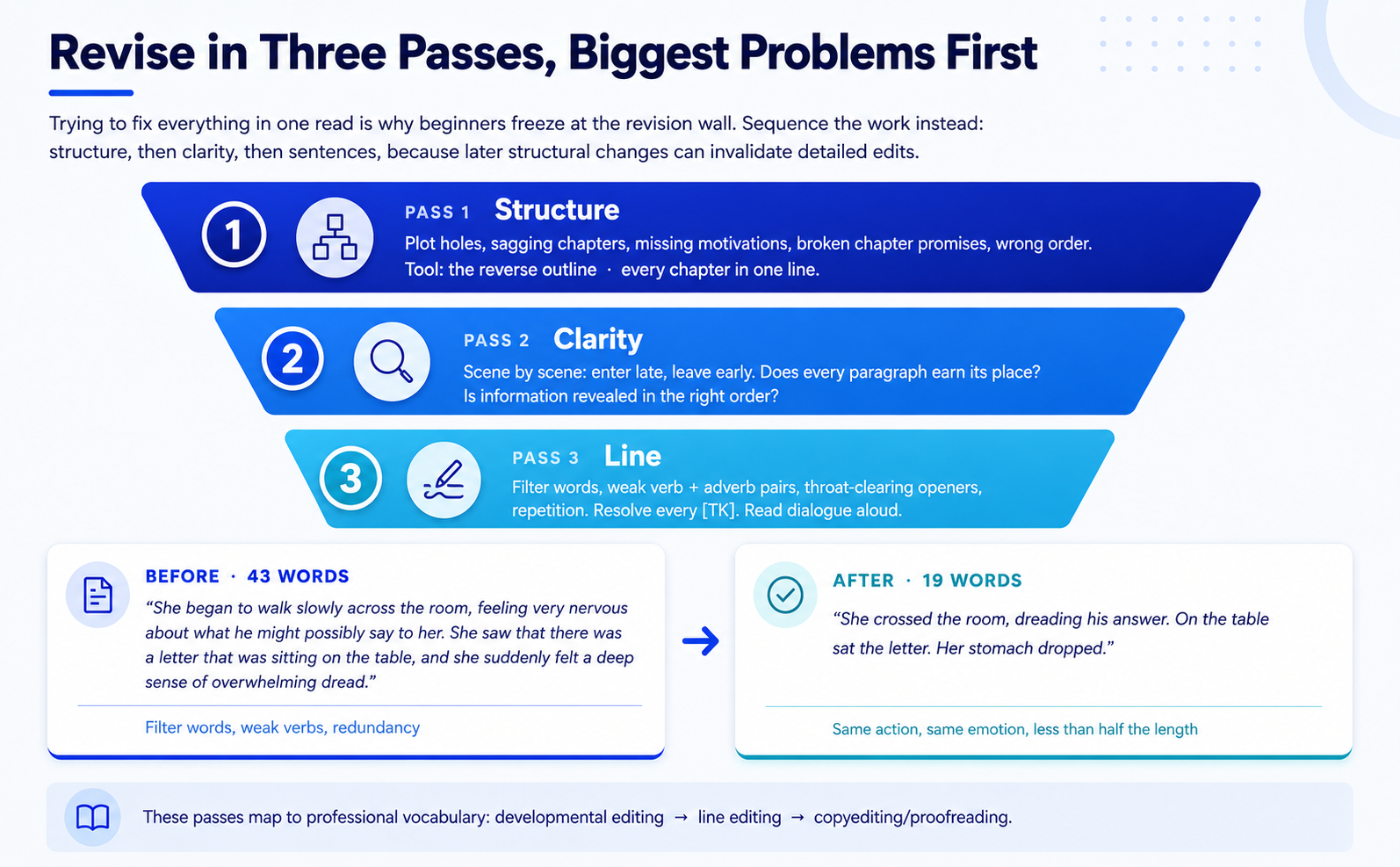
Pass 1: Structure. Read the whole draft fast, taking notes but changing nothing; then fix only large things: plot holes, sagging chapters, missing motivations, broken chapter promises, material in the wrong order. Address structure before sentence-level polish, because later structural changes can invalidate detailed edits. The essential tool is the reverse outline: every chapter or scene in one line with its purpose and word count. It instantly reveals slow stretches, repetition, and chapters that exist only because they were in the original plan.
Pass 2: Clarity. Chapter by chapter: does each scene enter late and leave early? Does every paragraph earn its place? Is information revealed in the right order? Handle show-versus-tell here: show the pivotal and emotional moments; telling is fine for connective tissue.
Pass 3: Line. Cut filter words (she saw, he felt, I noticed), weak verb-plus-adverb pairs (walked slowly → trudged), throat-clearing openers, and repetition. Resolve every [TK]. Read dialogue aloud; your ear catches what your eye forgives. Here's the kind of change this pass makes:
Before (43 words): She began to walk slowly across the room, feeling very nervous about what he might possibly say to her. She saw that there was a letter that was sitting on the table, and she suddenly felt a deep sense of overwhelming dread.
After (19 words): She crossed the room, dreading his answer. On the table sat the letter. Her stomach dropped.
The revision reduces the passage from 43 to 19 words while preserving its central action.
Step 17: Beta readers: break out of the vacuum
Many first-time writers have no one: no writer friends, family who don't ask, and a growing suspicion that their attachment to the book is bias. Feedback is the exit, and different readers do different jobs: critique partners during drafting (you learn as much editing theirs), subject experts for factual accuracy, authenticity readers when the book represents experiences beyond your own, and beta readers after your structure and clarity passes, not before.
Recruit three to five beta readers, ideally people who read your genre rather than people who love you. Sources: Critique Circle, Scribophile, genre communities, local library writing groups, or a manuscript swap with another writer.
Ask structured questions ("did you like it?" produces polite noise): Where were you bored or skimming? Where were you confused? What did you expect to happen or learn next? What do you remember a day later? What do you think the book is ultimately about?
Process feedback with a practical heuristic: investigate any issue that two or more independent readers identify, and weigh single opinions lightly. Listen to the problem, not the prescription; a reader's proposed fix is often wrong while the discomfort that produced it is real. Feedback can sting at first; give it a couple of days before acting on it. If you're too afraid to show anyone, share one chapter with one stranger in an online critique community first (strangers have no relationship stakes), then widen.
Step 18: Professional editing: what it costs and when it's worth it
Rates vary substantially by editor, genre, and manuscript condition, so treat these as orientation, not quotes (figures checked July 2026). Using the Editorial Freelancers Association's current rate chart, median rates for an 80,000-word fiction manuscript work out to approximately USD 2,400–2,800 for developmental editing, USD 2,160–2,800 for line editing, USD 1,600–2,160 for copyediting, and USD 960–1,600 for proofreading. Marketplaces such as Reedsy list vetted editors with genre track records; always compare multiple quotes.
Three honest notes:
Pursuing traditional publishing? You generally don't need to pay for a full professional edit. Agents expect a clean, well-revised manuscript; your revision passes plus beta feedback are the standard.
Self-publishing? Budget for at least a copyedit or line edit if you can; reviews mentioning typos and errors are among the most preventable sales killers.
Hire carefully. Ask whether the editor offers a sample edit, what it costs, and what it includes, and get the scope in writing, because "editing" means different things to different providers. On a tight budget, careful self-editing (read aloud, grammar checker, multiple passes) goes a long way; many indie authors start small and invest more as they earn.
Phase 5: PUBLISH - Choose Your Path (Steps 19–20)
This guide's focus is writing the book; publishing deserves its own deep dives. Here is the decision in brief. Platform terms, royalty rules, and fees in this section were checked July 2026 and change over time; always confirm current terms on the linked official pages.
Step 19: Traditional vs. self-publishing
Traditional publishing | Self-publishing | |
|---|---|---|
Upfront cost to you | A legitimate publisher does not charge you to publish; it may pay an advance and/or royalties, depending on the contract. Advances vary widely by project and publisher, from low four figures to six figures or more, with no reliable universal median | Authors purchasing professional editing, design, and formatting may spend several thousand dollars, although costs vary and DIY publication can cost much less |
Gatekeeping | Highly competitive; results vary by genre, manuscript, agent list, and query quality | None: you decide when it's ready; readers decide if it's good |
Timeline after finishing | Typically years (querying, deal, then production) | Days to months once the final files are ready |
Control | Cover, title, and timing are largely the publisher's | High, subject to retailer, distributor, and platform requirements; you must manage everything |
Best fit | Established distribution, professional production, and publisher investment; requires patience | Speed, control, prolific writers, niche audiences |
A third label exists, hybrid publishing, where the author pays a company for services; quality varies enormously, so apply the due-diligence questions below to any offer.
The money reality, with sources and scope. AAP's StatShot annual report estimated total U.S. publishing revenue at USD 32.5 billion for 2024, a figure that includes trade, educational, professional, and course-material publishing; trade (consumer) revenue accounted for USD 21.2 billion. Author income is far more modest: in the Authors Guild's 2023 income survey, respondents reported median book-related income of USD 2,000 for 2022 across all published authors (a respondent survey, not a census). Surveys of committed independent authors, such as the Alliance of Independent Authors' 2025 data, report higher medians (about USD 13,500), and Written Word Media's surveys find that high-earning indie authors overwhelmingly have large catalogs and reader email lists; all of these are self-selected samples. The message that survives every dataset: a first book often earns modestly, although outcomes vary widely. Treat it as the first asset in a catalog and the tuition for book two.
Step 20: Execute your path
Traditional: Fiction is pitched with a complete, polished manuscript. Nonfiction practices vary: most prescriptive nonfiction (how-to, business, self-help) can be queried with a proposal (concept, author platform, market and comp analysis, chapter outline, sample chapters), but memoir and narrative nonfiction may require a completed manuscript. Research agents who represent your genre (QueryTracker, agency websites, acknowledgments pages of comp titles), send one-page queries in small batches so you can revise the letter if responses are poor, and follow each agent's guidelines exactly. Expect months and rejections; rejection is the path, not a detour from it. And know this rule: legitimate agents never charge reading fees, per the Association of American Literary Agents' Canon of Ethics.
Self-publishing platform map, with current terms:
Amazon KDP (free to upload): ebook plus print-on-demand. Ebook royalties come in 35% and 70% options; eligibility, territory, list-price, and delivery-cost rules determine which applies. Paperback royalties are generally 50% or 60% of list price depending on price and marketplace, minus printing costs; Expanded Distribution generally pays 40% minus printing costs. KDP currently limits publishing to 10 titles per book format per week, with exceptions available, and requires disclosure of AI-generated content.
IngramSpark: makes eligible titles available to bookstores and libraries through its distribution network; availability makes a book orderable but does not guarantee stores will stock it.
Draft2Digital: distributes ebooks to Apple Books, Kobo, Barnes & Noble, and libraries. Note its current terms: a USD 20 one-time activation fee for new publishing accounts, a possible USD 12 annual maintenance fee for accounts earning under USD 100 per year, and a commission of approximately 10% of retail price on sales.
ISBNs: an ISBN identifies an edition; it is not copyright protection. Per KDP's ISBN guidance, KDP can provide a free ISBN for paperback and hardcover editions; it lists "Independently published" as the imprint and is usable only through KDP, and KDP ebooks don't require an ISBN. Buying your own (Bowker in the U.S.; free from ISBN Canada for eligible Canadian publishers) makes you the publisher of record across stores. Copyright itself is automatic in most countries under the Berne Convention; registration rules vary, so check WIPO or your national copyright office.
Launch basics: a professional, genre-appropriate cover; a compelling description; a modest launch price; and an author email list, which consistently correlates with higher indie earnings in author surveys. On early reviews, follow retailer rules carefully: offer advance copies to independent genre readers without requiring a positive review, or any review at all; do not compensate reviewers, influence their opinions, or solicit reviews from close friends and family, which review platforms prohibit.
Protect yourself from scams. The Authors Guild has warned repeatedly about scam messages impersonating agents, publishers, and film producers. Be suspicious of anyone who contacts you with praise, a guaranteed deal, or an urgent request for money. Before paying any publishing company, get written answers to: Who owns each right, and for how long? Can you terminate? Who controls the files, ISBN, retailer accounts, and sales data? Can you speak to several authors who used the service?
Using AI Responsibly
You're not unusual for asking. In a 2025 BookBub survey of more than 1,200 authors, 45% of respondents reported using generative AI somewhere in their work, most commonly for research, brainstorming, and marketing rather than prose. (That's one survey's respondent pool, not all authors.)
Where AI helps a first-time author: brainstorming and stress-testing premises, comparing outline structures, summarizing your own research notes, first-pass diagnostics ("where does this chapter drag?"), and grammar checking at revision time.
Where it hurts: generating your actual prose. Practically, platforms now regulate it; Amazon KDP requires disclosure of AI-generated content. Legally, the U.S. Copyright Office's guidance is that copyright can protect human-authored expression, selection, arrangement, or modification, but prompts alone generally do not provide sufficient human control over purely AI-generated output (U.S. guidance; laws vary by country). Creatively, a 2024 Science Advances experiment found that AI story ideas raised average ratings for some individual writers while making the group's stories measurably more similar to one another; assistance can smooth output while making it less distinct. And personally, the compounding value of a first book (the skill, the voice, the proof you can do it) comes from the reps.
The workable rule: AI as brainstorming partner and research assistant, never as the author. Verify factual leads against real sources, check data terms before uploading confidential material, and disclose what your platform requires.
A Worked Example: From Idea to Schedule in One Page
Here's the planning method applied end to end to a sample project:
Premise sentence: When a burned-out hospice nurse inherits her estranged mother's failing bookshop, she must save it from foreclosure in ninety days, but the ledger points to a debt her own family wants buried, and losing means losing her last connection to the family she never understood.
Seven beats: (1) Ordinary world: Nora, 41, competent and numb, avoids her hometown. (2) Inciting incident: her mother dies; the will leaves her the shop and its debts. (3) First threshold (~25%): she takes a 90-day leave to save it instead of selling. (4) Midpoint (~50%): the ledger reveals the debt traces to her uncle's "loan," and the family closes ranks. (5) Low point (~75%): the foreclosure notice arrives the same day her leave is revoked. (6) Climax: she confronts the uncle at the town meeting with the ledger. (7) Resolution: the shop survives in changed form; so does she.
Word-count math: 85,000-word target ÷ 34 weeks ÷ 5 sessions = 500 words per session, finish date written down, one friend receiving a word count every Sunday, plus a 20% buffer, so the real deadline is about 41 weeks out.
First placeholders left in the draft: [TK: how bookshop foreclosure timelines actually work], [TK: name of the estate lawyer]. Neither stopped a writing session.
Strip away the tables and frameworks, and writing your first book reduces to five sentences. Choose an idea you'd write even if no one paid you, and name the one reader it serves. Compress it to one sentence and sketch seven beats or a dozen chapter promises. Show up for a small scheduled session most days and write badly on purpose, with a witness receiving your word count. When the draft exists, rest, fix it in three passes, and let real readers see it. Then publish, by whichever path fits your goals, and start book two.
The people who finish books are rarely the ones who felt ready. They're the ones who wrote a few hundred imperfect words today. Open a document, name it after your premise sentence, and begin.
Frequently Asked Questions
Can anyone write a book?
Yes. No degree, license, or prior publication is required: only literacy, a premise you care about, and a sustained routine. A repeatable process (a small scheduled habit, a basic outline, a willingness to draft roughly and revise) can matter more than waiting to feel talented or ready.
How long does it take to write a book?
At 500 words a day, five days a week, an 80,000-word draft takes about eight months. A year from idea to a finished, revised manuscript is a practical planning estimate for many first-time authors, but actual timelines vary widely. Self-publishing adds a few months; traditional publishing typically adds years.
How many words should a book be?
Typical guidance: adult novels around 80,000–100,000 words, YA around 55,000–80,000, middle grade around 30,000–55,000, memoir around 60,000–90,000, practical nonfiction around 40,000–70,000. These are market conventions, not rules; check the current requirements of the agents or publishers you plan to approach.
Should I outline my book or just start writing?
Many beginners benefit from at least a skeleton outline: a premise sentence, five to seven major beats, and an ending. Full outliners and pure discovery writers both publish books; the hybrid approach reduces the risk of stalling mid-manuscript with no map.
Do I have to write in order, starting with chapter one?
No. Write scenes or chapters out of order and stitch later if that keeps you moving, and consider writing the opening last, once you know what the book actually is.
Is my first draft supposed to be bad?
Your first draft does not need to be polished, and roughness is how drafting works, not a talent problem. Most publishable manuscripts undergo meaningful revision. Finishing the rough version is the win; it's the only version you can improve.
How do I overcome writer's block?
Diagnose it first, because "block" is several different problems: no direction (list three possible turns and pick one), perfectionism (move the opening to another file and draft forward), research avoidance (insert a [TK] placeholder and continue), or burnout (shrink to a 10-minute minimum session). Blocks usually ease when you stop trying to write and edit at the same time.
Do I need a literary agent?
Only for traditional publishing: many major trade imprints generally consider submissions through literary agents, although policies and exceptions vary. You don't need one to self-publish or to approach many smaller presses. Legitimate agents never charge reading fees, per the AALA Canon of Ethics, and earn a commission on deals instead.
How much does it cost to publish a book?
A legitimate traditional publisher does not charge an author to publish the book, although authors may still choose to pay personal expenses such as travel, a website, or independent marketing. Self-publishing is free to upload on Amazon KDP; authors purchasing professional editing, design, and formatting may spend several thousand dollars, although costs vary and DIY publication can cost much less. See current EFA rates for editing specifically.
Is it cheating to use AI to help write my book?
Using AI for brainstorming, outlining, research summaries, and grammar checking is widely practiced. Having it generate your prose is where legal, platform-disclosure, and craft issues arise; see the AI section above. Treat it as an assistant, never a ghostwriter.
Is it too late to start writing a book?
No. Debut authors publish in every decade of life; Frank McCourt published his Pulitzer-winning memoir at 66, and Laura Ingalls Wilder debuted at 65. In memoir and nonfiction, accumulated experience is raw material; in fiction, age is invisible on the page.
References
ThriftBooks / OnePoll (2021). "Half of Americans Think They've Got a Good Idea for a Novel." ThriftBooks blog. Sponsored consumer poll of 2,000 U.S. adults. Available at: https://www.thriftbooks.com/blog/nanowrimo-time-lets-go/ (accessed July 2026).
Lally, P., van Jaarsveld, C. H. M., Potts, H. W. W., and Wardle, J. (2010). "How are habits formed: Modelling habit formation in the real world." European Journal of Social Psychology, 40(6), 998–1009. Available at: https://onlinelibrary.wiley.com/doi/10.1002/ejsp.674 (accessed July 2026).
Matthews, G. (n.d.). "Goals Research Summary." Dominican University of California. Available at: https://www.dominican.edu/sites/default/files/2020-02/gailmatthews-harvard-goals-researchsummary.pdf (accessed July 2026).
Doshi, A. R., and Hauser, O. P. (2024). "Generative AI enhances individual creativity but reduces the collective diversity of novel content." Science Advances, 10(28). Available at: https://www.science.org/doi/10.1126/sciadv.adn5290 (accessed July 2026).
Editorial Freelancers Association (2026). "Editorial Rates." Available at: https://www.the-efa.org/rates/ (accessed July 2026).
Association of American Publishers (2025). "AAP StatShot Annual Report: Publishing Revenues Totaled 32.5 Billion Dollars for Calendar Year 2024." Available at: https://publishers.org/news/aap-statshot-annual-report-publishing-revenues-totaled-32-5-billion-for-calendar-year-2024/ (accessed July 2026).
The Authors Guild (2023). "Key Takeaways from the Authors Guild's 2023 Author Income Survey." Available at: https://authorsguild.org/news/key-takeaways-from-2023-author-income-survey/ (accessed July 2026).
BookBub Partners (2025). "How Authors Are Thinking About AI (Survey of 1,200+ Authors)." Available at: https://insights.bookbub.com/how-authors-are-thinking-about-ai-survey/ (accessed July 2026).
Amazon Kindle Direct Publishing (2026). "eBook Royalties." Available at: https://kdp.amazon.com/en_US/help/topic/G200644210; "Paperback Royalty." Available at: https://kdp.amazon.com/en_US/help/topic/G201834330; "What is an ISBN and Imprint?" Available at: https://kdp.amazon.com/en_US/help/topic/G201834170; "Content Guidelines." Available at: https://kdp.amazon.com/en_US/help/topic/G200672390 (all accessed July 2026).
Draft2Digital (2026). "Frequently Asked Questions." Available at: https://draft2digital.com/faq/ (accessed July 2026).
U.S. Copyright Office (2025). "Copyright and Artificial Intelligence." Includes the January 2025 report on copyrightability. Available at: https://www.copyright.gov/ai/ (accessed July 2026).
Science Fiction and Fantasy Writers Association (2026). "Complete Nebula Awards Rules." Available at: https://sfwa.org/complete-nebula-awards-rules/ (accessed July 2026).
Association of American Literary Agents (2026). "Canon of Ethics." Available at: https://aalitagents.org/canon-of-ethics/ (accessed July 2026).
World Intellectual Property Organization (2026). "Copyright." Available at: https://www.wipo.int/copyright/en/ (accessed July 2026).
Alliance of Independent Authors (2025). Author income research. Available at: https://www.allianceindependentauthors.org/ (accessed July 2026).
Written Word Media (2025). Author surveys. Available at: https://www.writtenwordmedia.com/ (accessed July 2026).
Writers & Artists (2026). Advice on manuscript length and submission standards. Available at: https://www.writersandartists.co.uk/ (accessed July 2026).
Wiggers, K. (2025). "NaNoWriMo shut down after AI, content moderation scandals." TechCrunch, April 1, 2025. Available at: https://techcrunch.com/2025/04/01/nanowrimo-shut-down-after-ai-content-moderation-scandals/ (accessed July 2026).
Ingermanson, R. (n.d.). "The Snowflake Method for Designing a Novel." Advanced Fiction Writing. Available at: https://www.advancedfictionwriting.com/articles/snowflake-method/ (accessed July 2026).
IngramSpark (2026). Print and distribution services. Available at: https://www.ingramspark.com/ (accessed July 2026).