How to Count Sentences in a Paragraph?
To count sentences in a paragraph, count the sentence-ending punctuation marks: every period, question mark, and exclamation mark that ends a complete statement…
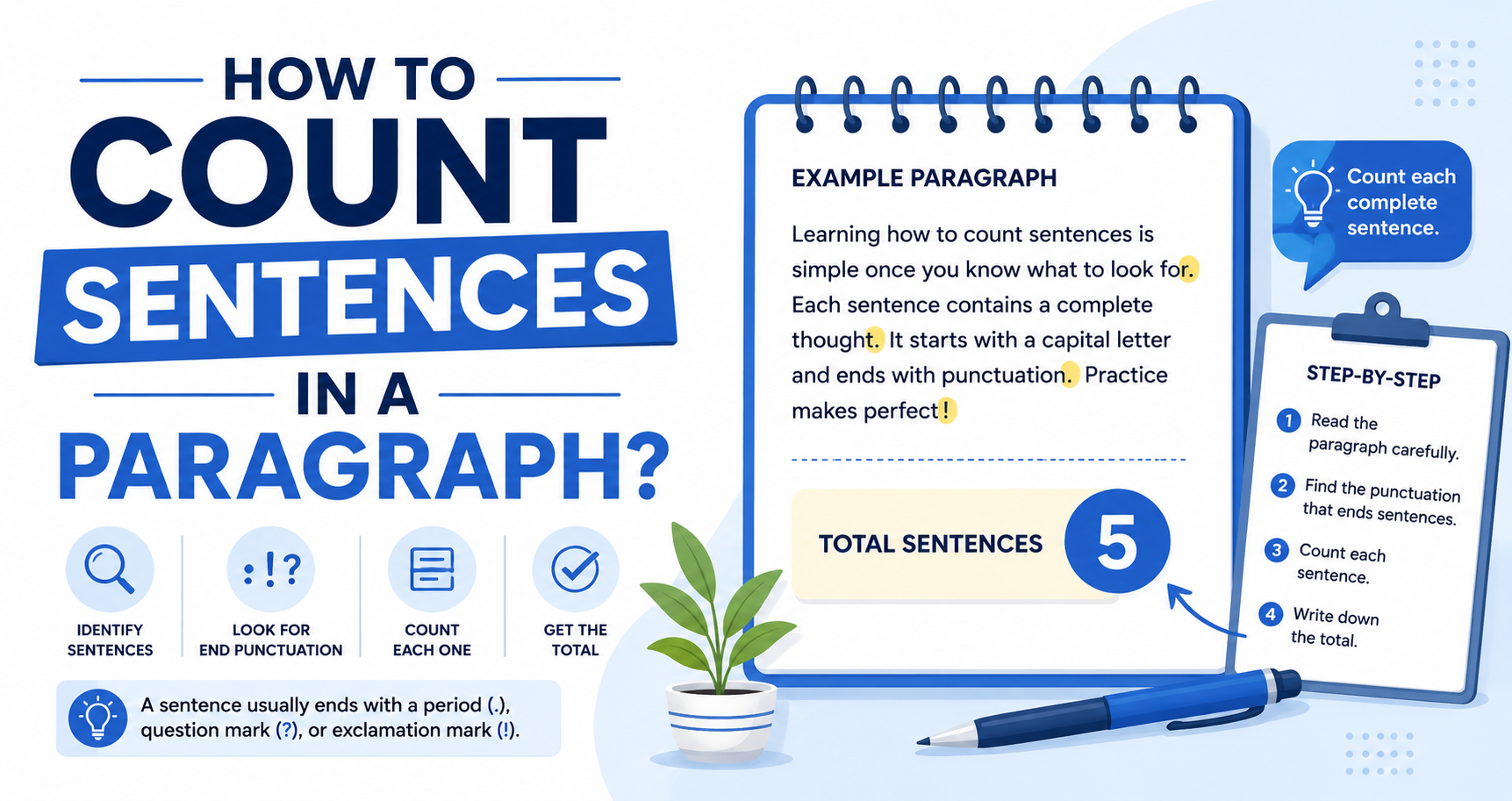
To count sentences in a paragraph, count the sentence-ending punctuation marks: every period, question mark, and exclamation mark that ends a complete statement equals one sentence. Scan the paragraph from start to finish and add one to your tally each time you reach one of those marks. The only thing to watch for is punctuation that looks like a sentence ending but is not, such as the period in an abbreviation or a decimal number, which you should skip.
The simple rule for counting sentences
A sentence is a complete statement that ends in one of three marks: a period, a question mark, or an exclamation mark. To count sentences by hand, read through the paragraph and tally each one of these marks as it closes a statement. For most ordinary writing that is all you need, because each full stop lines up with one sentence.
Ending mark | Counts as a sentence? | Example |
|---|---|---|
Period (.) | Yes | The meeting starts at noon. |
Question mark (?) | Yes | Are you coming? |
Exclamation mark (!) | Yes | Watch out! |
Ellipsis (...) | Usually yes, once | I am not sure... |
Comma, colon, semicolon | No | parts of a longer sentence |
Count sentences in three steps
Counting by hand is quick once you have a method. These three steps keep the tally accurate even in a long paragraph.
Step 1: Read to the first ending mark
Start at the beginning and read until you hit a period, question mark, or exclamation mark that closes a complete thought. That is sentence one.
Step 2: Tally and continue
Add one to your count and keep reading to the next ending mark. A running tally on paper or on your fingers works fine for a short paragraph. Keep going to the end of the block.
Step 3: Skip the false endings
Before you trust the total, check for periods that do not end a sentence, such as those inside abbreviations, decimals, or web addresses. Subtract any you counted by mistake. The next section covers exactly which ones to watch for.
The tricky cases that trip people up
Almost every disagreement about a sentence count comes down to a handful of edge cases where punctuation looks like a sentence ending but is not. This is also why two tools can report slightly different totals for the same text. The table below shows how to handle each one.
Tricky case | Example | How to count it |
|---|---|---|
Abbreviation | Dr. Smith arrived. | 1 sentence. The period in "Dr." does not count. |
Decimal number | The total was 3.14. | 1 sentence. The period inside 3.14 does not count. |
Ellipsis | Wait... what? | 2 sentences. The ellipsis ends one, the question mark another. |
Stacked marks | Really?! | 1 sentence. Collapse ?! into a single ending. |
URL or email | Visit example.com today. | 1 sentence. The dot in the URL does not count. |
Initials | J. R. R. Tolkien wrote it. | 1 sentence. The periods after initials do not count. |
The pattern is consistent: a period only ends a sentence when it closes a complete statement, not when it sits inside an abbreviation, a number, a set of initials, or a web address. Once you learn to skip those, manual counting is reliable.
The fastest way: use a sentence counter
Counting by hand is fine for a paragraph or two, but it gets slow and error-prone across a full essay. A sentence counter does it instantly and applies the same rules every time. Paste your text into our sentence counter and it tallies the sentences as you type, protecting decimals so a figure like 3.14 does not split a sentence. The same screen also runs as a word counter and a paragraph counter, so you see sentences, words, and paragraphs together. Because any automated tool reads punctuation, an unusual abbreviation can still nudge the count by one, so treat the figure as an accurate estimate and check tricky lines by eye when an exact number matters.
Why counting sentences is worth doing
Sentence count is more than a number. Dividing your word total by your sentence count gives your average sentence length, one of the clearest signals of how readable your writing is. Most clear prose averages 15 to 20 words per sentence, and when that climbs much higher, readers lose the thread. The word counter gives the words for that calculation, and the readability checker uses the same sentence-length input to score how easy your text is to read. Counting sentences in a paragraph is the first step toward spotting run-ons that need breaking up and choppy runs that need joining.
How many sentences should a paragraph have?
There is no fixed rule, but a useful guide is three to five sentences for academic writing and two to four for web and blog content, where shorter blocks read better on screens. The principle that matters more than any count is one main idea per paragraph. When a paragraph starts covering a second idea, that is the natural place to break it, whatever the sentence total happens to be.
Writing type | Sentences per paragraph |
|---|---|
Academic and formal | 3 to 5 |
Business and email | 2 to 4 |
Web and blog | 2 to 4 |
Frequently Asked Questions
How do you count sentences in a paragraph?
Count the sentence-ending punctuation. Each period, question mark, or exclamation mark that closes a complete statement equals one sentence, so read through and tally them. Skip periods that sit inside abbreviations, decimals, or web addresses, since those do not end a sentence.
Does an abbreviation like "Dr." count as a sentence?
No. The period in an abbreviation such as Dr., Mr., or e.g. does not end a sentence, so it should not add to your count. Only count a period when it closes a full statement. This is the most common reason manual counts come out too high.
How are decimals and numbers handled?
The period inside a number does not count. "The total was 3.14." is one sentence, not two, because the dot in 3.14 is a decimal point rather than a sentence ending. Good sentence counters protect decimals automatically.
Why do different tools give different sentence counts?
Because each tool handles edge cases like abbreviations, ellipses, and embedded quotes a little differently. Microsoft Word, Google Docs, and online counters can all disagree by a sentence or two on tricky text. For ordinary prose the counts match, so leave a small margin when an exact figure matters.
How many sentences should a paragraph be?
There is no fixed rule, but three to five sentences suits academic writing and two to four suits web and blog content. The more important guide is one main idea per paragraph: break the paragraph when it moves on to a new idea, whatever the sentence count.
Sources
The counting rules and edge cases in this guide reflect the standard conventions used by writing tools and word processors, where sentences are identified by terminal punctuation and periods inside abbreviations, decimals, initials, and web addresses are excluded from the count.