How Many Words Should a Blog Post Be? (Data-Backed Guide)
How many words should a blog post be? Most rank well at 1,500-2,500 words, but word count is not a ranking factor. See data, ranges by post type.
Ask ten marketers how long a blog post should be and you will get ten different numbers, anywhere from 350 to 5,000 words. The honest answer is that there is no single magic number, and chasing one is the wrong goal. What actually matters is covering your topic completely, matching what the searcher wants, and earning the reader's time.
That said, "it depends" is a frustrating place to stop. This guide gives you real, sourced numbers: what the studies show, the recommended word count for every common type of blog post, how the rise of AI search is changing the math, and a simple framework to decide the right length for your specific post. Whether you are a blogger, a content marketer, or a business owner, you will leave knowing exactly how long your next post should be.
How many words should a blog post be?
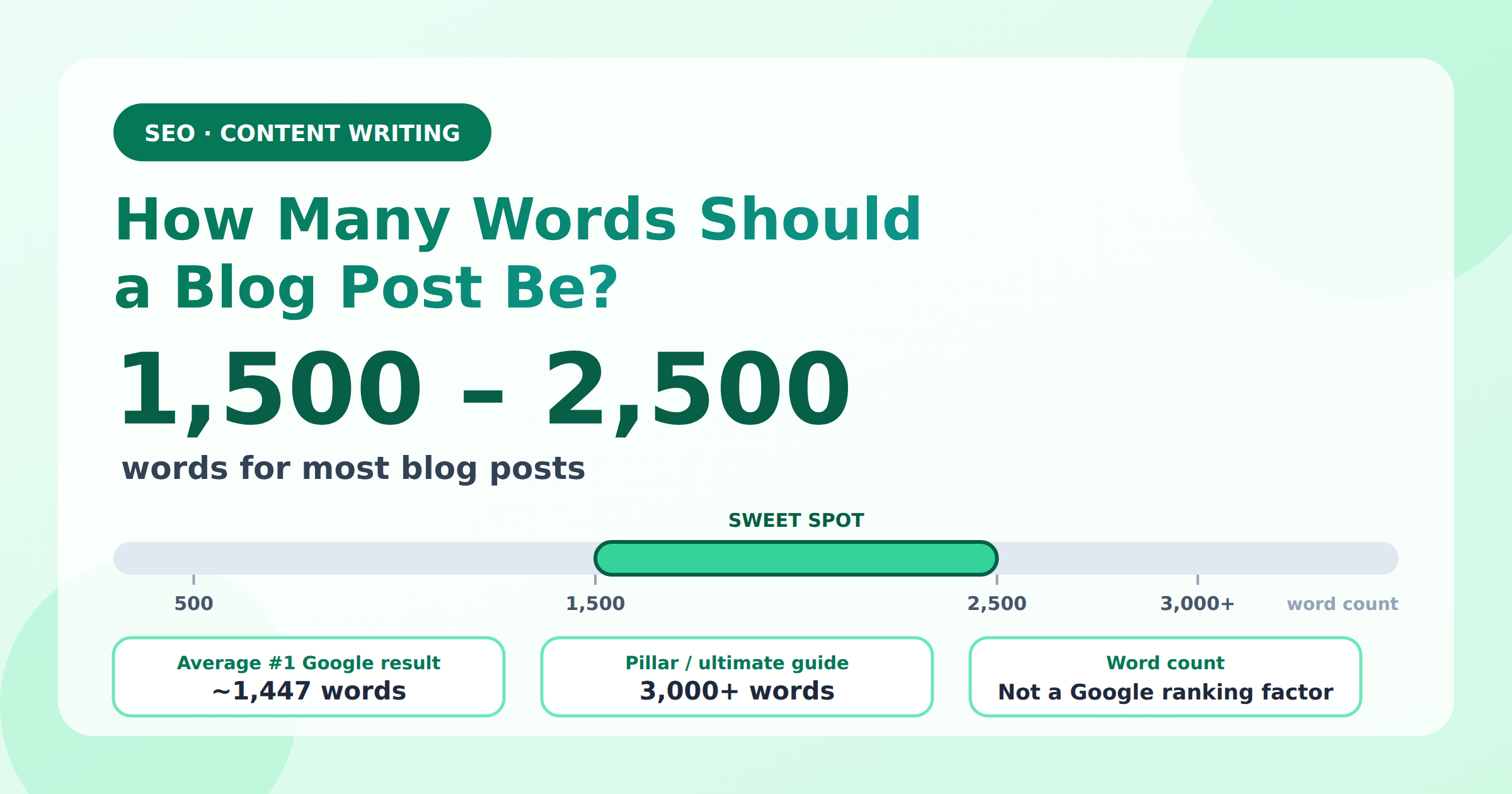
Most blog posts should be 1,500 to 2,500 words, and studies of first-page Google results consistently land around 1,400 to 2,400 words on average. But there is no ideal number: Google has confirmed that word count is not a ranking factor. The right length is however many words it takes to fully answer the search query and satisfy the reader, nothing more. A quick news update may need 500 words, while a pillar guide may need 3,000 or more.
Goal | Typical length |
|---|---|
General SEO blog post | 1,500 to 2,500 words |
Average first-page Google result | ~1,447 words (Backlinko) |
Pillar / ultimate guide | 3,000 to 5,000+ words |
Quick news or update | 300 to 600 words |
Minimum to be useful and indexable | ~300 words (Yoast) |
Key Takeaways
There is no single ideal blog post length, and Google has stated word count is not a direct ranking factor.
Most well-performing blog posts fall between 1,500 and 2,500 words, and studies of top results average roughly 1,400 to 2,400 words.
The right length is driven by search intent and topic depth, not a target number.
Longer is not automatically better. Newer data shows concise, high-value posts can outperform bloated ones.
Pillar and cornerstone content runs longer (3,000+ words); news and quick answers run shorter (300 to 800 words).
With AI Overviews and answer engines, clear structure and a strong, concise answer near the top matter more than raw length.
Decide your length by analyzing the current top-ranking pages for your keyword, then aim to be the most complete and useful result.
Length is an outcome, not a target (and not a ranking factor)
Here is the mindset shift that separates good bloggers from great ones. Word count is not something you decide before writing. It is the result of answering a question thoroughly and then cutting everything that does not serve the reader.
When you set out to hit "2,000 words," you pad. You add fluff, repeat points, and stretch a 900-word idea into a 2,000-word slog. Readers feel it, they bounce, and your rankings suffer. When you instead set out to completely answer the query, the right length appears on its own. A quick pass through a word counter after drafting tells you where you landed, not where to aim.
Google backs this up. Google's John Mueller has said directly that word count is not a quality or ranking factor, a point Google Search Central has repeated for years. Longer content does not rank because it is long; it ranks because length is often a byproduct of covering a topic well.
In other words, correlation is not causation. When Backlinko found that the average first-page result runs about 1,447 words, that was a description of pages that satisfy searchers, not an instruction to add words. If you can satisfy the query in 800 words, 800 words is the correct length. Padding it to 1,500 will hurt, not help. The same goes for stuffing keywords to fill space; a keyword density checker shows when repetition has crossed the line into spam.
Judge every paragraph by one test: does this help the reader get what they came for? If yes, keep it. If no, cut it, whatever it does to your word count.
What the data actually says about blog post length?
The studies do not all agree, partly because they were run in different years and measured different things. Here are the most-cited findings, with their sources and dates, so you can judge them yourself.
Finding | Source | Year |
|---|---|---|
The average first-page Google result is about 1,447 words | Backlinko (11.8M results) | 2020 |
The average blog post is about 1,400 words and takes nearly 4 hours to write | Orbit Media (annual blogger survey) | Updated yearly |
Around 2,100 words is a strong target for ranking content | 2021 | |
Top-10 results historically ran 2,032 to 2,416 words | SerpIQ (site now offline) | 2012 |
A 7-minute read (roughly 1,600 words) captures the most total reading time | 2013 | |
High-performing content averaged 1,152 words vs 668 words for low performers | Semrush (700K articles) | 2019 |
Content over 3,000 words earns about 77% more backlinks | Backlinko and BuzzSumo (912M posts) | 2019 |
AI Overview citations average about 1,282 words, and 53% of cited pages are under 1,000 words | Ahrefs (174K pages) | 2025 |
A practical minimum of about 300 words to be useful and indexable | Ongoing guidance |
Read together, these tell a consistent story. Content that ranks and earns links tends to be substantial, often in the 1,400 to 2,400 word range, because thorough content answers more questions and attracts more links. But the newest analyses (Semrush, Ahrefs) show that shorter, sharper content is winning more often than it used to, especially in AI-driven search. None of this means you should write 2,000 words by default. Be thorough, then stop.
Recommended blog post length by type
Different posts serve different jobs, and their ideal lengths differ accordingly. Use this as a starting range, then adjust based on the competition for your specific keyword. Reading times assume an average pace of about 240 words per minute; if you think in pages instead, see how many pages 500 words fills.
Blog post type | Recommended length | Reading time | Why |
|---|---|---|---|
News / quick update | 300 to 600 words | 1 to 3 min | Readers want the fact fast |
Product or category page | 600 to 1,000 words | 3 to 4 min | Enough to inform and convert |
Opinion / thought leadership | 1,000 to 1,500 words | 4 to 6 min | Ideas over exhaustiveness |
Case study | 1,000 to 1,500 words | 4 to 6 min | Problem, solution, results |
Standard SEO blog post | 1,500 to 2,500 words | 6 to 10 min | Room to cover intent fully |
How-to guide / tutorial | 1,500 to 2,500 words | 6 to 10 min | Every step, no gaps |
Listicle | 1,500 to 2,500 words | 6 to 10 min | About 150 to 300 words per item |
"What is" / definition post | 1,300 to 1,800 words | 5 to 7 min | Define, explain, give examples |
Pillar / ultimate guide | 3,000 to 5,000+ words | 12 to 20+ min | Covers a whole topic in depth |
Research / white paper | 4,000+ words | 16+ min | Original data and analysis |
How AI search changed the length question?
For years the advice trended toward "longer is better." AI search has complicated that, and it is the freshest reason not to chase big word counts.
Answer engines like Google's AI Overviews, ChatGPT, and Perplexity pull concise, well-structured answers out of pages and present them directly. Ahrefs found that pages cited in AI Overviews average about 1,282 words, and more than half of cited pages are under 1,000 words. Length is not what gets your content quoted. A clear, direct answer placed near the top, clean headings, and scannable structure are.
The practical move is to write for both audiences at once. Put a crisp, quotable answer high on the page (a quick-answer box works well), then provide the depth a human researcher wants below it. Pair it with a tight title tag and meta description so the page earns the click when it is cited. That structure serves traditional SEO, featured snippets, and AI answer engines together, regardless of the final word count.
How to decide the right length for your post?
Skip the guesswork. This five-step method gives you a defensible target for any keyword.
Search your keyword and read the top 5 results. Google has already decided what satisfies this query. Study the pages that rank.
Note their rough length and what they cover. Are they 800-word quick answers or 2,500-word guides? What subtopics do they all include?
Identify the gaps. What questions do they leave unanswered? What is outdated, thin, or missing?
Match the format, then beat it on value. Aim to be at least as complete as the best result, and more useful, without padding.
Write to cover the topic, then trim. Draft everything the reader needs, then cut anything that does not earn its place.
If the top results are all around 1,200 words, a 4,000-word post is probably overkill and a 400-word post is probably too thin. Let the SERP set the range, and let quality set you apart.
Length, search intent, and reading time
Three factors decide how long a post feels right, and they usually point to the same answer.
Search intent is the biggest driver. Someone searching "what time is the Super Bowl" wants one line, not an essay. Someone searching "how to file taxes as a freelancer" wants a thorough guide. Match the depth to the intent behind the query.
Topic complexity sets the floor. A genuinely complex topic cannot be covered well in 500 words, and trying makes you look thin. A simple one cannot be stretched to 3,000 without padding.
Reading time is the reader's experience of length. Most readers happily give a useful post 6 to 10 minutes (roughly 1,500 to 2,400 words), and a reading time calculator converts any word count for you. Beyond that, completion rates drop, so long pieces need strong structure, a table of contents, and skimmable formatting to hold attention.
Quality over quantity: why thin and bloated both lose
Two failure modes cost rankings and readers.
Thin content tries to rank a 300-word post for a topic that needs real depth. It answers the headline but none of the follow-up questions, so readers bounce back to Google and your rankings slide.
Bloated content pads a simple answer to hit a word target. It buries the point under filler, wears out the reader, and convinces no one of your authority. Before publishing, run your draft through a readability checker to catch bloat before your readers do.
The winners sit in the middle: comprehensive without padding. Every section earns its place, the main answer is easy to find, and nothing wastes the reader's time. That is what "quality over quantity" actually means in practice.
Blog post length and pillar-cluster strategy
Length also depends on where a post sits in your site architecture.
A pillar page (or cornerstone content) covers a broad topic comprehensively and runs long, often 3,000 words or more, because it links out to and summarizes many subtopics. A cluster post dives deep on one of those subtopics and can be shorter, 1,200 to 2,000 words, because the pillar handles the breadth. Together they form a topic cluster that signals expertise to search engines and keeps readers on your site.
So before deciding a length, decide the role: is this the broad hub, or a focused spoke? Hubs run long; spokes run tighter.
Two myths that refuse to die
"Short posts cannot rank." They can and do. Concise posts win when the query calls for a quick answer, and Ahrefs found that more than half of pages cited in AI Overviews are under 1,000 words.
"More words means more authority." Authority comes from accuracy, first-hand experience, and links from other sites. A 4,000-word post with nothing new is less authoritative than an 800-word post that says something only you can say.
When a shorter blog post is the right call?
Longer is not the default. Write short and tight when:
The search intent is a quick answer (definitions, facts, yes/no questions).
You are covering breaking news where speed beats depth.
The topic is genuinely simple and padding would insult the reader.
You are writing for AI Overviews and snippets, where a clean, direct answer wins.
Your audience is time-poor and wants the point immediately.
Blog post length checklist
Before you publish, run through this:
Does the post fully answer the search query and its obvious follow-ups?
Is the main answer easy to find near the top?
Is it at least as complete as the top-ranking results, and more useful?
Have I cut every sentence that does not help the reader?
Is it broken up with headings, short paragraphs, and lists?
Does the reading time match the reader's likely patience?
Is there a concise, quotable answer for snippets and AI Overviews?
Did I choose the length to serve the reader, not to hit a number?
The real answer to "how many words should a blog post be" is: as many as it takes to fully answer the question, and not one word more. The data points to a comfortable range of about 1,500 to 2,500 words for most posts, with pillar guides running longer and quick answers running shorter, but those are starting points, not rules.
For what it is worth, this post runs about 2,700 words. Not because that was the target, but because that is what it took to show you the data, break lengths down by post type, and give you a method.
Stop writing to a number. Study what already ranks, cover the topic better than anyone else, put a clear answer up top for readers and AI alike, and cut the filler. Do that, and the right word count will take care of itself.
Frequently Asked Questions
How many words should a blog post be for SEO?
Most SEO-focused posts perform well at 1,500 to 2,500 words, and studies of first-page results average around 1,400 to 2,400 words. But word count is not a ranking factor. Write enough to fully answer the query, then stop.
Is a 500-word blog post too short?
Not always. A 500-word post is fine for a news update, a simple definition, or a quick answer. It is too short only when the topic clearly needs more depth to be useful.
Do longer blog posts rank higher on Google?
Not because they are longer. Longer posts often rank because they cover topics more completely, but Google has confirmed it does not use word count as a ranking factor. Padding a post to make it longer does not help.
What is the ideal blog post length in 2026?
There is no single ideal length. For most posts, aim for 1,500 to 2,500 words, use pillar guides of 3,000+ for broad topics, and keep quick answers short. With AI search now driving a large share of discovery, a clear, concise answer near the top matters more than total length.
How long should a pillar or cornerstone page be?
Pillar pages usually run 3,000 words or more because they cover a broad topic and link to many related cluster posts. Depth and clear structure matter more than hitting a specific number.
How many words is a 5-minute blog post?
About 1,200 words, based on an average reading speed of roughly 240 words per minute. A 7-minute read is close to 1,600 words, and a 10-minute read is around 2,400 words.
Does word count matter for AI Overviews and ChatGPT?
Length is not the deciding factor. Answer engines favor pages with a clear, direct answer near the top and clean, scannable structure. Ahrefs found the majority of AI-cited pages are actually under 1,000 words.
What is the minimum length for a blog post?
There is no hard rule, but around 300 words is a practical floor for a post to be useful and easily indexed. Below that, it is hard to cover anything meaningfully.
How do I decide how long my blog post should be?
Search your target keyword, read the top five results, note their length and coverage, find the gaps, and write something at least as complete and more useful. Let the top results set the range and let quality set you apart.