How Canadian Teachers Can Use Wordle in the Classroom?
Learn how Canadian teachers can use Wordle for phonics, vocabulary, spelling and mathematics with lesson plans, curriculum links and inclusive classroom ideas.
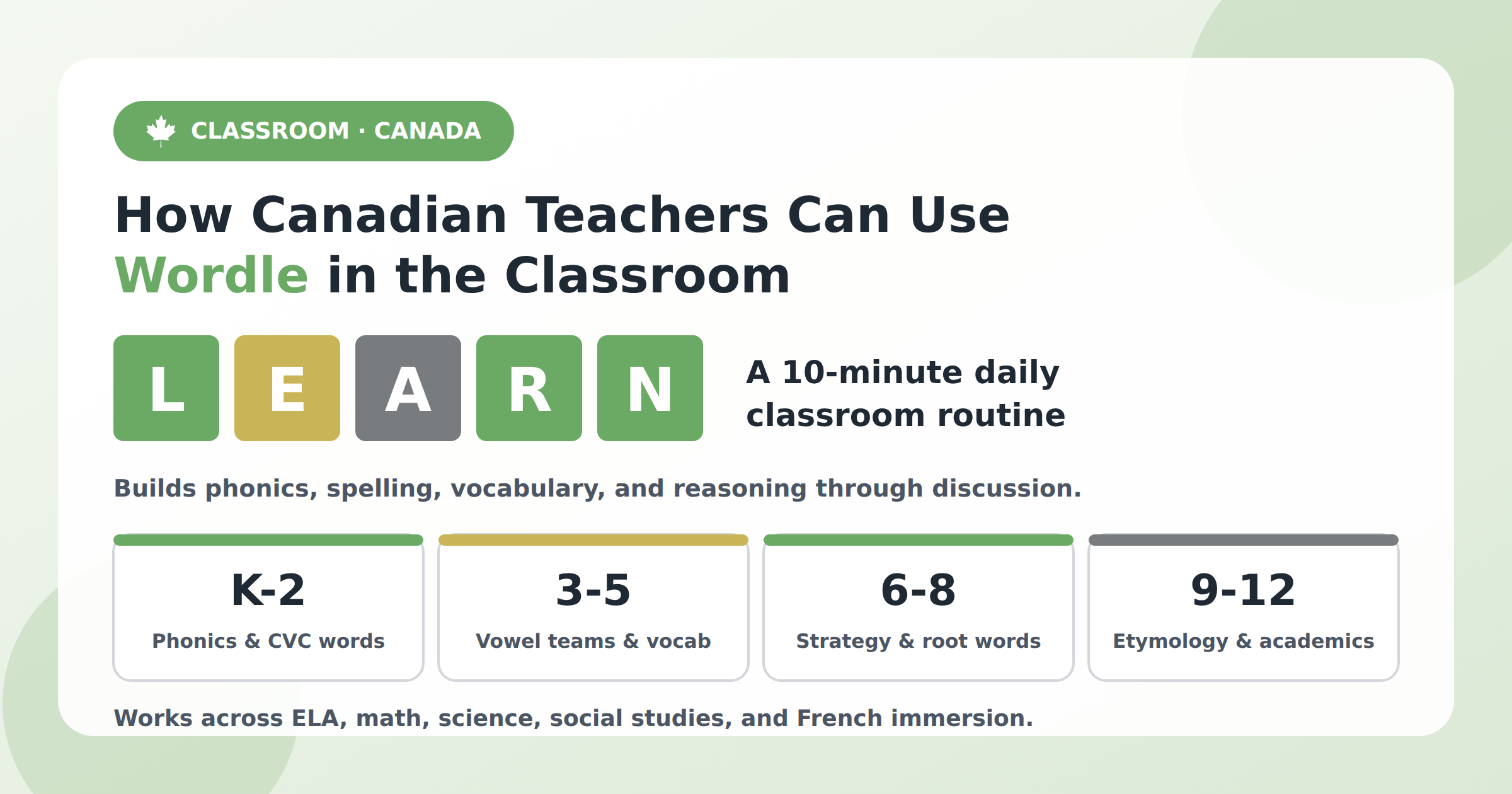
Wordle can become more than a five-minute guessing game. Used deliberately, it can help Canadian students examine spelling patterns, retrieve vocabulary, explain reasoning, compare letter frequency, and apply subject knowledge.
The key is what happens around the puzzle. Simply finding the hidden word does not prove that a student understands its meaning or can use it. A stronger classroom routine asks students to predict, justify, learn, and apply.
That distinction matters across Canada. The latest international results found that 18% of Canadian 15-year-olds did not reach the baseline reading level, while 14% performed at the highest levels, according to the Council of Ministers of Education, Canada. This range reinforces the need for activities that can be scaffolded for developing readers and extended for advanced learners.
Quick answer
Canadian teachers can use Wordle as a short, curriculum-connected activity for phonics and spelling-pattern practice, vocabulary retrieval and application, oral reasoning and collaborative discussion, French and English language learning, probability and data analysis, subject-area terminology in science, mathematics and social studies, formative assessment, and screen-free word study.
For the best results, choose a word connected to the lesson, let students justify each guess, teach the word after it is solved, and finish with a short application task. A complete classroom routine should take about 8 to 12 minutes (roughly a 10-minute core), not the entire period.
First, which Wordle are we talking about?
Two different educational tools have been called Wordle.
The current Wordle word game
This is the puzzle in which players have six attempts to identify a hidden word. Feedback shows whether each letter is correct and in the right position, present but in the wrong position, or absent from the answer. This article focuses on that game and on teacher-created activities that use the same reasoning system.
The older Wordle word-cloud generator
Before the current game became popular, Wordle was also the name of a tool that turned text into visual word clouds, with frequently repeated words appearing larger. Several older classroom resources still refer to this version: a 2013 myPITA resource discusses using Wordle to create word clouds for book reports, predictions, and unit summaries, and an older Edutopia guide also refers to word clouds rather than the guessing game. Word clouds can still support discussion, but they are a separate activity. Teachers searching for "Wordle in the classroom" should check which tool a resource is describing before following its instructions.
What does Wordle actually teach?
Wordle does not automatically teach vocabulary, phonics, or reading comprehension. It provides a structure in which those skills can be practised.
Classroom skill | How Wordle can support it |
|---|---|
Phonemic awareness | Students identify and manipulate sounds in possible words |
Phonics | Students connect sounds with letter patterns |
Spelling | Students test orthographic patterns and letter positions |
Vocabulary | Students retrieve, define, and apply known words |
Morphology | Students examine roots, prefixes, and suffixes |
Oral communication | Groups propose and defend possible guesses |
Logical reasoning | Students eliminate impossible words using evidence |
Metacognition | Students explain why a strategy succeeded or failed |
Statistics | Students examine frequency, averages, and distributions |
Collaboration | Students listen, disagree respectfully, and reach a decision |
The educational value comes from the conversation and the follow-up task, not from the coloured grid alone. Research on digital game-based vocabulary learning generally reports benefits for motivation, interaction, and vocabulary retention, but outcomes depend on the game design, the learner's age, and the quality of instruction around the game, as an ERIC review of digital game-based vocabulary learning notes. This is why Wordle should supplement explicit instruction rather than replace it. Current literacy guidance from the Institute of Education Sciences recommends teaching word meanings through context, morphology, examples, and structured practice.
How Wordle connects to Canadian curricula?
Education is governed provincially and territorially, so there is no single Canadian Wordle expectation. The same activity can nevertheless support common language and mathematics outcomes.
Jurisdiction | Possible curriculum connection |
|---|---|
Ontario | Phonemic awareness, phonics, word-level reading, spelling, morphology, vocabulary, and oral communication |
British Columbia | Vocabulary development, word structure, Canadian spelling, communication, and metacognitive strategies |
Alberta | Phonics, vocabulary development, spelling, oral language, and transferring new vocabulary to different contexts |
Quebec and French-language programs | Vocabulary, oral interaction, spelling patterns, accents, and comparison between French and English |
Other provinces and territories | Word study, communication, problem-solving, digital literacy, and subject-specific vocabulary |
Ontario's 2023 Language Curriculum places explicit attention on word-level reading, spelling, phonological knowledge, morphology, and vocabulary, and expects students in Grades 4 to 8 to apply orthographic, morphological, and vocabulary knowledge with increasing independence. British Columbia's updated foundational learning progressions distinguish everyday Tier 1 vocabulary, high-utility Tier 2 vocabulary, and subject-specific Tier 3 vocabulary, and note that some learners, including English language learners, may need more explicit instruction. Alberta's curriculum similarly expects students to identify new word meanings, develop vocabulary through varied literacy experiences, and transfer new vocabulary into different situations. Wordle fits these outcomes only when students move beyond guessing and demonstrate their understanding.
The puzzle-to-learning cycle
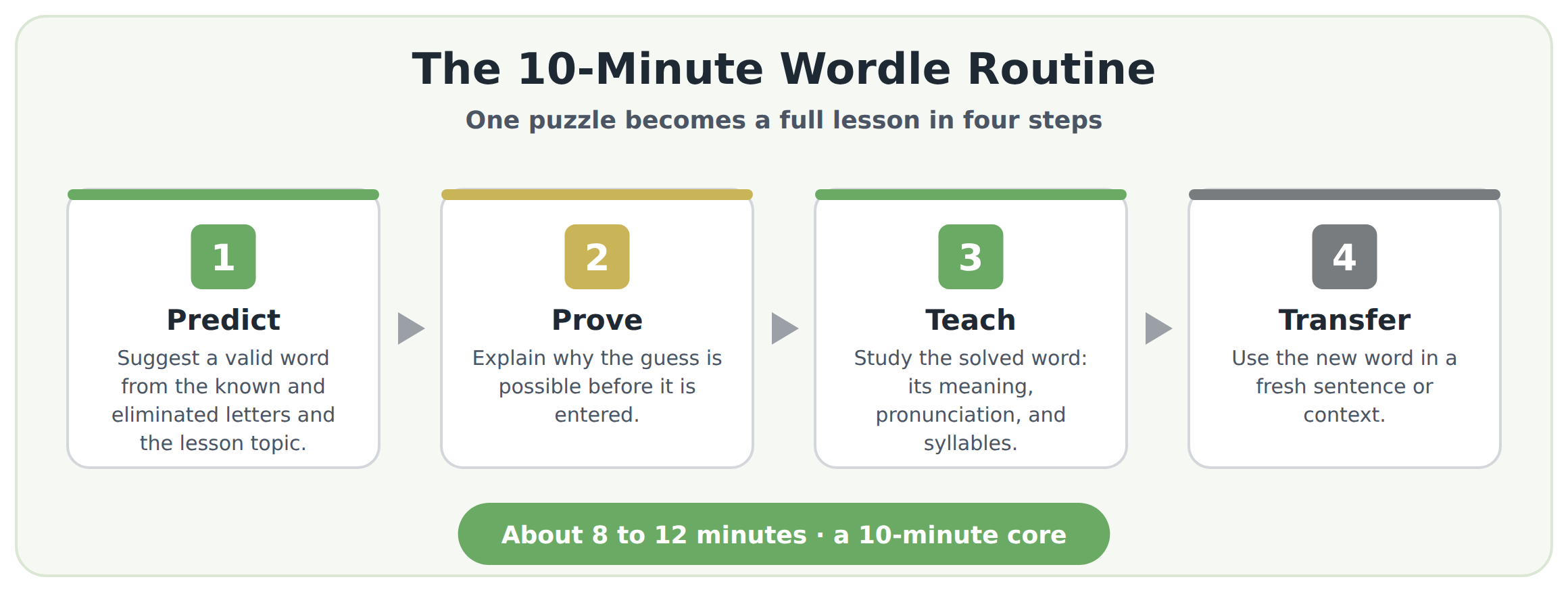
A reliable classroom routine can be built around four stages: Predict, Prove, Teach, and Transfer.
1. Predict
Students propose a valid word based on known letters, eliminated letters, vowel patterns, consonant blends, word families, the lesson topic, and any definition or contextual clue.
2. Prove
Before a guess is entered, students explain why it is possible. A useful sentence frame is: "We propose _____ because it uses _____ in the confirmed position, moves _____ to a new position, and avoids the eliminated letters _____." This turns a guess into evidence-based reasoning.
3. Teach
Once the word is solved, examine it directly: What does it mean? How is it pronounced? How many syllables does it have? Does it contain a prefix, root, or suffix? Is the spelling regular or irregular? Does it have multiple meanings? Is there a French or English cognate? Where does it appear in the current unit? Students can check the word's structure with a syllable counter and then confirm the pronunciation together.
4. Transfer
Students use the word in a new context. Transfer tasks include writing an original sentence, giving an example and a non-example, explaining the word to a younger student, connecting it to another unit term, drawing and labelling the concept, using it in a short oral explanation, finding it in a text and explaining its role, or creating a new problem using the term. Without this final stage, students may solve the spelling pattern without learning the concept.
A 10-minute Wordle lesson plan
Learning objective: Students will use spelling evidence and contextual knowledge to identify and apply a unit word. Example target word: orbit.
Time | Teacher action | Student action |
|---|---|---|
1 min | Introduce the learning target and rules | Review possible evidence |
2 min | Provide a clue or sentence | Discuss likely word features |
4 min | Invite and evaluate guesses | Propose and justify guesses |
1 min | Reveal and pronounce the word | Read and segment the word |
2 min | Ask for meaning and application | Define, connect, and use the word |
Sample teacher script: "Today's answer is a five-letter word from our space unit. Before we enter a guess, your group must show how the word follows all previous clues. Solving the puzzle is only the first step. Afterward, you will explain the word and use it in a scientific sentence."
After solving orbit, students might define it in their own words, identify it as both a noun and a verb, explain the difference between an orbit and a rotation, and use it in a sentence about Earth or the Moon. The puzzle creates attention; the follow-up creates learning.
How to play Wordle with a class of 30 students?
Managing a large class is the concern teachers raise most often: how do you run Wordle with 30 students without it descending into shouting? The answer is to give every student a defined thinking role instead of letting the fastest few control the board.
Use six teams of five
Role | Responsibility |
|---|---|
Word finder | Suggests possible words |
Evidence checker | Checks confirmed and eliminated letters |
Pattern analyst | Looks for spelling and sound patterns |
Recorder | Writes the team's reasoning |
Speaker | Presents the final proposal |
Rotate roles regularly so that confident spellers do not always become the speakers.
Use a think, team, vote routine
Give every student 20 to 30 seconds of silent thinking time, let teams compare ideas, and ask each team to submit one proposal. Display two or three valid choices, have the class vote only after hearing the evidence, then enter the selected word and repeat with the new information. This approach prevents calling-out and gives quieter students time to think.
Do not reward speed alone
If the first student to shout a word always wins, developing readers may stop participating. Reward strong evidence, a useful spelling observation, a thoughtful correction, respectful disagreement, a good connection to the unit, and a clear explanation of why a word cannot work. The instructional goal is reasoning, not finishing first.
Choosing the right word
A classroom Wordle answer should satisfy four conditions.
1. It serves a clear learning purpose
Choose a word students need to read, understand, or use. Do not select a word simply because it has five letters.
2. It is reasonably accessible
The answer may be challenging, but students should have enough knowledge to make progress. Avoid extremely obscure words, unexplained proper nouns, slang unfamiliar to most students, words that rely on a single cultural reference, and specialist vocabulary that has not been introduced.
3. It works with the game format
Traditional Wordle uses five-letter words, but that restriction is not educationally necessary. In 2025, The New York Times introduced an official custom-puzzle feature supporting answers from four to seven letters with optional clues. Creating a puzzle requires an eligible subscription, but people receiving the link can play without one. Teachers should still confirm that the service is approved by their school or board. For longer terms, use a teacher-controlled grid, slides, or a paper template rather than changing a word simply to fit five boxes.
4. It respects Canadian spelling
Check whether a puzzle uses Canadian, American, or British spelling.
Canadian form | Common American form |
|---|---|
colour | color |
centre | center |
fibre | fiber |
metre | meter |
labour | labor |
travelled | traveled |
Do not accidentally mark a locally accepted Canadian spelling as wrong. A custom six-letter puzzle can use colour, while the standard five-letter game may accept only color. When more than one spelling is accepted, explain the difference rather than presenting one form as universally correct.
Finding useful words in a class text
Teachers do not need to build every puzzle from memory. For a teacher-written passage, lesson summary, or set of class notes, paste the text into a word frequency counter, identify repeated subject terms, remove common function words such as "the," "and," and "of," and choose a word connected to the lesson objective. Then check that students have enough background knowledge and create a contextual clue or sentence. A unique word counter can also help reveal less common vocabulary in a passage, though the teacher should still decide whether each word is important enough to teach. Frequency does not equal importance: a central concept may appear only once, while an unimportant word may appear several times.
Wordle ideas by grade level
Kindergarten to Grade 2
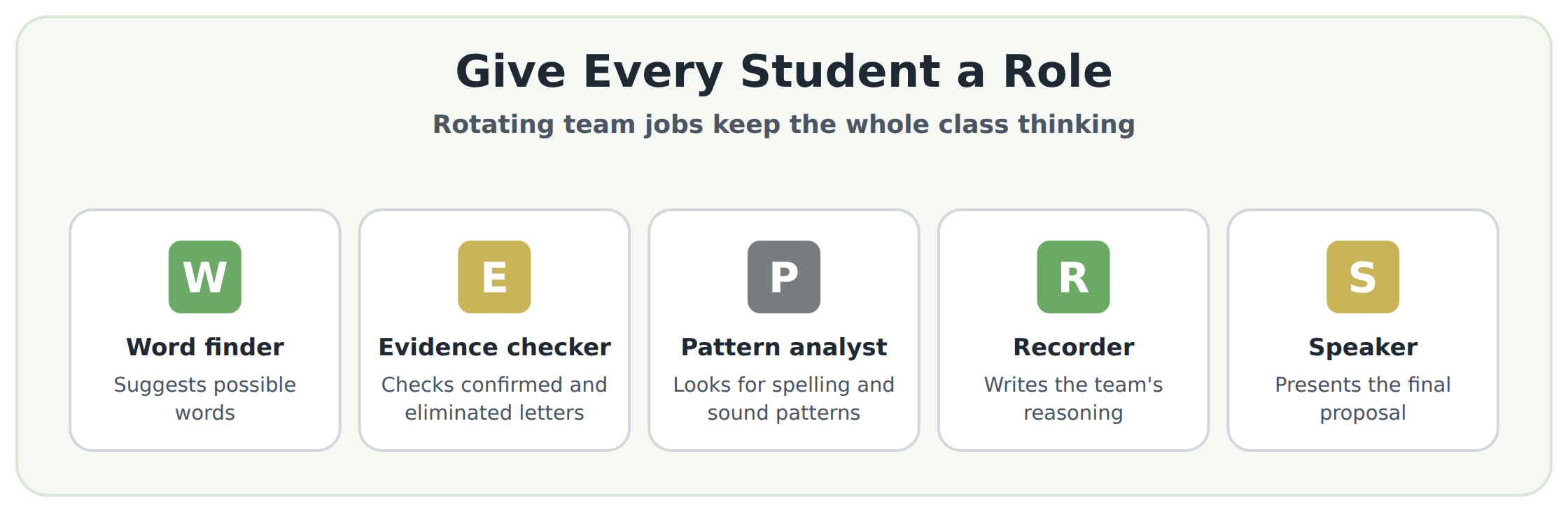
Use an adapted three- or four-letter grid rather than the official daily puzzle, and focus on consonant-vowel-consonant words, initial and final sounds, short and long vowels, simple digraphs, oral blending, and letter tiles or sound boxes. Good answers are words already taught through explicit phonics instruction. At this level, Wordle should reinforce a known pattern, not ask students to guess unfamiliar spellings from context alone.
Grades 3 to 5
Use four- to six-letter words connected to vowel teams, digraphs and blends, common prefixes and suffixes, high-utility vocabulary, science and social studies units, character traits, and word families. After solving, ask students to identify the spelling pattern and use the word in a new sentence.
Grades 6 to 8
Shift the emphasis from finding letters to explaining strategy. Students can compare efficient and inefficient guesses, analyze roots and affixes, defend a character-trait word with textual evidence, retrieve vocabulary from previous lessons, calculate class averages, compare French and English letter patterns, and evaluate whether a clue was fair.
Grades 9 to 12
Use Wordle as an entry point for deeper disciplinary thinking: probability and information gain, algorithm design, linguistic variation, etymology and morphology, statistical bias in shared scores, Canadian versus American spelling, academic vocabulary retrieval, and evaluation of game design and accessibility. Older students should spend less time on the puzzle and more time analyzing the decisions behind it.
Subject-specific Wordle activities
English language arts
Character evidence. Use an adjective connected to a character, such as brave. After solving, students provide one quotation or event that supports the trait, one possible counterexample, a more precise synonym, and a sentence explaining their judgement. Spelling-pattern investigation. Select a word containing the pattern being studied, then ask students to list other words with the same pattern. Revision vocabulary. Choose a vivid verb students can apply in their writing, then have them revise one weak sentence using the target word or a related verb.
Mathematics
Wordle can support mathematical reasoning even when the answer is a word. In a letter-frequency investigation, students count the frequency of letters in a class text, compare vowels and consonants, recommend an opening word, explain how sample choice changes the result, and create a bar graph or histogram. Edutopia suggests using Wordle results to explore averages, modes, ranges, percentages, histograms, and sampling bias. For strategy comparison, ask which guess removed the most possibilities, whether a repeated letter was useful, how much information each guess produced, and whether a lucky result proves the strategy was good. This helps students distinguish process quality from outcome quality.
Science
Use terms such as orbit, force, solid, scale, virus, or biome, and make the post-puzzle task require scientific understanding. For solid, students could compare solids, liquids, and gases; for force, they could identify a force acting in a classroom example.
Social studies
Possible terms include civic, trade, treaty, rights, urban, and rural. Avoid reducing culturally or historically significant concepts to isolated vocabulary. After solving treaty, for example, students should study its meaning in the relevant historical and contemporary context. When working with Indigenous languages or community-specific knowledge, consult appropriate local educators and approved resources, and do not treat sacred, restricted, or culturally specific terms as casual puzzle content.
Core French and French immersion
French Wordle activities can help students notice accents, gender and agreement, cognates, false cognates, common letter combinations, verb forms, and differences in letter frequency. Useful follow-ups include giving the article and gender, using the word in a complete French sentence, naming a related word, comparing it with an English cognate, and explaining how an accent changes pronunciation or meaning. Do not remove accents merely to make a word fit a tool designed for English; use a paper grid or an approved multilingual tool that supports the required orthography.
Computer science
Students can examine how guesses are validated, how feedback is calculated, how repeated letters should be handled, how an answer list differs from an allowed-guess list, how accessibility could be improved, and how to write pseudocode for the feedback system. The focus should be computational thinking, not copying a commercial product's branding or code.
Supporting multilingual learners
Wordle can become frustrating when success depends on vocabulary a student has never encountered. Provide support through a unit word bank, a definition or contextual sentence, a picture, a first-language translation when appropriate, a cognate, the number of syllables, a known prefix or root, partner discussion, additional processing time, and a reduced set of possible answers.
Use sentence frames for reasoning: "I think _____ is possible because _____." "The letter _____ cannot go in position _____ because _____." "This word is connected to our lesson about _____." "In my first language, a related word is _____." Multilingual knowledge should be treated as an asset, and students can compare spelling systems, sounds, cognates, and word structures across languages.
Making Wordle accessible
A classroom game should not depend on speed, colour vision, handwriting, or a large English vocabulary.
Do not communicate through colour alone. Add symbols or labels to the tile feedback: C for correct position, M for misplaced letter, and X for absent letter. Patterns, borders, or written labels can also accompany colours.
Offer more than one way to participate. Students may speak a suggestion, type it, arrange letter tiles, write on a mini whiteboard, point to a word from a bank, ask a partner to record the idea, or read information aloud. Say each proposed word and spell it aloud when appropriate, which supports students who cannot clearly see the projected board.
Reduce unnecessary competition. Do not publicly rank students by speed, streak, or number of guesses, because a student may understand the target concept but process spelling information more slowly.
Pre-teach unusual rules. Repeated letters often cause confusion, so explain that a word can contain the same letter more than once and that feedback applies to each position.
Provide a screen-free version. A laminated grid, magnetic letters, paper tiles, or a whiteboard can deliver the same reasoning practice without individual devices.
Student privacy and digital safety
A free online tool is not automatically approved for classroom use. In 2025, Canada's federal, provincial, and territorial privacy authorities called for stronger safeguards in educational technology, including privacy-protective defaults, data minimization, generic logins or anonymous profiles, clear retention rules, and meaningful alternatives to EdTech use.
Before using a digital Wordle tool, check your board or district's approved-tool policy, project from a teacher-controlled device when possible, avoid requiring student accounts, and do not ask students to provide personal email addresses. Do not place student names or personal information in custom puzzles, do not publish identifiable results or streaks, review what data the website collects, provide a paper or oral alternative, and recheck links before class because third-party tools can change. Ontario's Information and Privacy Commissioner notes that school boards remain accountable for online educational services used in classrooms, even when a tool is free or easy to access.
How to handle daily-word spoilers?
The official daily puzzle can create a practical problem: some students may already know the answer. Create a custom curriculum word, prepare a teacher-controlled paper puzzle, use yesterday's answer after it is no longer active, ask students who know the answer to become evidence checkers, keep an alternate puzzle ready, use different words in different class periods, and avoid posting the daily answer where other classes can see it. Do not punish students for having played earlier; give them a role that preserves the activity for others.
Can Wordle be used for assessment?
Wordle works best as formative assessment, not as a graded spelling or reading test. A wrong guess may result from limited vocabulary, an unfamiliar cultural reference, a risky strategy, a repeated-letter misunderstanding, difficulty seeing the board, or a guess chosen by the group rather than the individual. Instead of grading whether students solve the word, assess the reasoning they demonstrate.
Criterion | 0 | 1 | 2 |
|---|---|---|---|
Uses puzzle evidence | Does not use feedback | Uses some feedback | Uses all relevant feedback accurately |
Explains reasoning | Gives no explanation | Gives a partial explanation | Gives a clear evidence-based explanation |
Understands the word | Cannot explain meaning | Gives a basic meaning | Explains meaning precisely in context |
Transfers learning | Does not apply the word | Applies it with support | Applies it independently and accurately |
The maximum score is eight, but teachers can also use the rubric only for observation. For a stronger exit ticket, ask students to write 25 to 40 words answering: "What was the most useful clue today, and how did it change your group's next guess?" Students can check the response with a word counter if a short limit is part of the task.
Common classroom mistakes
Using a random word with no lesson connection. Engagement alone does not create curriculum value.
Stopping when the answer appears. The reveal is the beginning of the vocabulary lesson, not the end.
Letting one strong student dominate. Use roles, silent thinking time, and team submissions.
Treating Wordle as explicit phonics instruction. It can reinforce taught patterns but does not provide a systematic phonics sequence.
Assuming every student knows the same words. Provide clues, context, and word banks where needed.
Relying only on green, yellow, and grey. Add text, symbols, or patterns so feedback is accessible without colour.
Using unapproved websites. Check district policies, privacy terms, and classroom suitability first.
Marking Canadian spelling as incorrect. Decide which convention applies and explain regional differences.
Turning every lesson into a Wordle. Novelty fades; use the puzzle when its feedback system serves the learning goal.
A one-week classroom plan
Day | Focus | Target activity |
|---|---|---|
Monday | Introduce the routine | Whole-class puzzle with teacher modelling |
Tuesday | Spelling evidence | Students justify each possible guess |
Wednesday | Unit vocabulary | Solve, define, and use a subject term |
Thursday | Student creation | Teams design a fair puzzle and clue |
Friday | Reflection and transfer | Compare strategies and complete an exit ticket |
After the first week, use Wordle once or twice weekly rather than automatically playing every day.
Teacher planning template
Before using a classroom Wordle, complete this plan: target word; grade and subject; curriculum skill; why this word matters; what students already know; clue or context sentence; possible accessibility supports; post-puzzle teaching point; transfer task; and the evidence of learning you will observe. If the curriculum skill or transfer task is blank, the activity may be entertainment rather than instruction.
Wordle works best when it is treated as a reasoning structure rather than a daily reward. For an effective Canadian classroom routine: select a curriculum-connected word, respect Canadian spelling conventions, give every student a participation role, require evidence before entering a guess, teach the word after it is solved, finish with a transfer task, provide multilingual, visual, and screen-free supports, protect student privacy, use Wordle for formative evidence rather than high-stakes grading, and stop using it when the puzzle no longer serves the learning goal.
A successful classroom Wordle does not end with five green tiles. It ends when students can explain the word, connect it to their learning, and use it independently.
Frequently Asked Questions
How can teachers use Wordle in the classroom?
As a warm-up, vocabulary review, phonics activity, reasoning task, mathematics investigation, or exit-ticket prompt. The strongest routine requires students to justify guesses and apply the final word after solving it.
What skills does Wordle develop?
Spelling, phonics, vocabulary retrieval, logical elimination, oral communication, collaboration, and metacognition, plus statistics and probability. It does not teach these skills automatically.
Is Wordle good for teaching vocabulary?
It can reinforce vocabulary already introduced. To teach a new word properly, add a definition, context, morphology, examples, and an application task. Guessing the spelling alone does not demonstrate vocabulary knowledge.
Can Wordle support the science of reading?
It can reinforce phoneme-grapheme relationships and taught spelling patterns, but it should not replace explicit, systematic instruction in phonemic awareness, phonics, decoding, or morphology.
What age is Wordle appropriate for?
The standard five-letter version is most accessible from upper elementary onward, though readiness varies. Younger students can use three- or four-letter adaptations with known phonics patterns, while older students can examine probability, morphology, and strategy.
Which Wordle version is safest for younger grades?
A screen-free three- or four-letter grid using already-taught phonics patterns, rather than the official five-letter daily puzzle, which can assume vocabulary young students may not yet have.
How do you play Wordle with a whole class?
Divide the class into teams, assign reasoning roles, provide silent thinking time, and require evidence before accepting a guess. The teacher controls the main board while every team records its own reasoning.
Should students play individually or collaboratively?
Collaborative play is usually more inclusive, because students discuss evidence and learn from different strategies. Individual play can support formative observation but should not become a public speed competition.
Can Wordle be used in mathematics?
Yes. Students can explore letter frequency, probability, averages, modes, ranges, histograms, sampling bias, and efficient decision-making.
Can Wordle be used in French class?
Yes, provided the grid or digital tool supports French spelling and accents. Students can study pronunciation, gender, cognates, verb forms, and letter-frequency differences.
Is Wordle accessible for colour-blind students?
Colour should never be the only feedback. Add letters, symbols, borders, or patterns that show whether a tile is correct, misplaced, or absent.
Does Wordle require student accounts?
A teacher can run a screen-free or projected whole-class version without student accounts. Requirements for online versions can change, so check the current service and your board's approved-tool policy.
Is the official daily Wordle free?
Access conditions can change. The daily puzzle is generally available on the New York Times website, while some creation, archive, or account features may have additional requirements. Confirm access before planning the lesson.
Can students create their own Wordle puzzles?
Yes. Student-created puzzles develop vocabulary selection, clue writing, and audience awareness. Require approved words, no personal information, and an explanation of why the chosen word matters.
Should Wordle be graded?
The final answer should not usually be graded. Assess the student's use of evidence, explanation, vocabulary understanding, and ability to apply the word.